An Interview with Matthew Rice
THE MUMBLE : Hello Matthew, so where ya from & where ya at, geographically speaking
MATTHEW : Hi! I was born in Belfast, Northern Ireland and was raised via Rathcoole (a housing estate outside of Belfast) and Islandmagee (a peninsula on the North East coast of Antrim), ending up in Carrickfergus, County Antrim, where I currently reside.
THE MUMBLE : When did you first realise you were a poet
MATTHEW : I don’t think i ever ‘realised’ I was a poet. I’m a little wary of folk who make claims to the art; which is to say, I believe it comes from ‘elsewhere’, as Ciaran Carson might put it. For a lot of years I felt I was just a reader, not a writer. Having said that, I came third in a short story competition for children when I was 10 years old, and I wrote little poems and such during those years also. I can tell you that I began to write poetry in earnest, as they say, when I was 27 (I’m now 36); the catalyst was provided by a visit with my father (himself a successful poet, Adrian Rice), to the WB Yeats exhibition in Dublin back in 2006. Although it must be said that I was probably absorbing poetry from an even younger age, given the amount of famous poets that came in and out of our house in Islandmagee, on account of my father’s involvment in the art.
THE MUMBLE : Which poets inspired you then, & who today
MATTHEW : Poets who inspired me when I started out were the likes of Seamus Heaney, Miroslav Holub, Elizabeth Bishop, Sylvia Plath, Michael Longley. The poets that inspire me now are the same, but with the discovery of the complexities of Paul Muldoon’s work a joy; and Don Paterson is a hero of mine also. There are a number of emerging poets that I very much admire. The likes of your own Ross Wilson and Stephen Watt being just two – I had the pleasure of reading with them in Glasgow last November, as well as the inimitable Magi Gibson – along with exciting new Irish contemporaries both in the North and South. The ever-presents are Heaney and Longley, though. And my father, Adrian, of course, has always been a mainstay and an inspiration, and is a brutally honest giver of poetic feedback, which is valuable to have.
THE MUMBLE : Being an Ulsterman, do you find the socio-politcal stresses strains of your native land coming out in your poetry
MATTHEW : To a certain degree they have done, in some of my work. Funnily enough I’ve written a few poems with strains of the WWII Holocaust in them; my poem in memory of the late great poet Primo Levi being one. If I have ever addressed that area in my poems it has always been from an angle of Greek or Roman mythology, or from a childhood perspective. This is nothing new, of course, but is how I feel I can get at what I want to say; and is probably also why it has featured sparingly in my poetry to date. Once you’ve read ‘Ceasefire’ by Longley, ‘Anseo’ by Muldoon and ‘Casualty’ by Heaney, it’s really pointless to think one can compete. Plus things are much improved in my adult lifetime
THE MUMBLE : What other forces drive your work
MATTHEW : Nature can be one. Dreams have also provided me with many a poem. And history. I enjoy linking historical events to events in the present, if possible. I think history can be a lens with which to provide a sharp focus on events in the present, and the recent past. The events concerned do not necessarily have to be of a political nature, either. Personal experience is another aspect that I like to represent, although I find most times the speaker in those poems is fairly impersonal, for whatever reason; I’m not sure myself…
THE MUMBLE : You have had poems published in magazines and journals on both sides of the Atlantic, how do you find both the American poetry & the British scenes of 2017 – is there any common ground
MATTHEW : I find that the American scene, judging from what I’ve read in the journals and from my father’s experience as a ‘poet in exile’ there for the last 12 years, is thriving, as it is in Ireland. The UK is producing some great stuff. I must say, though, there is something special in the air in Belfast… There’s a real poetic buzz about the city these days, and it’s exciting to be a part of it. As far as common ground is concerened, the experimentation on both sides of the Atlantic in verse is something I have noticed. Free verse is also alive and kicking across the water, though I have seen the sonnet form more prevalent on this side; Adam Crothers and Adrian Rice just two prime examples. But any form I love, if the poetry is good. It’s also great to get to follow names in America that don’t necessarily get big coverage in Ireland by being published in those US journals; the likes of Stephen Dunn and Fredrick Seidel, to name two.
THE MUMBLE : What to you makes a good poem
MATTHEW : For me, a good poem is one that is first and foremost honest; one that does not rely on what Raymond Carver might have referred to as ‘tricks’. A good poem comes from what Heaney referred to as ‘a genuine impulse.’
THE MUMBLE : What is the poetical future of Matthew Rice
MATTHEW : Well, hopefully poems continue to be given, as that is where the real work is done; that inspiration continues to hold, and that ‘genuine impulse’ remains clear. Other than that, I have been included in the upcoming anthology ‘The Best New British and Irish Poets 2017’, being launched in London from Eyewear Publishing on 2nd April, and in Belfast on April 20th. I also have a poem in a future anthology in Scotland. I have a few poems forthcoming in one or two journals, as well as some exciting news I just received that has yet to be officially announced… But working towards my first collection is where the focus lies in the immediate future, continuing to refine and sharpen that manuscript, giving it the best chance of becoming my first book.
An Interview with Stephen Watt
THE MUMBLE : Hi Stephen, so where ya from & where ya at geographically speaking
STEPHEN : Dumbarton, born and sandwich-bred.
THE MUMBLE : Its clear Dumbarton FC is in your blood, how did becoming club laureate come about
STEPHEN : About four years ago, I had written a poem ‘Boghead’ which won 3rd prize in The Pride & The Passion Football Anthology – judged by Ian McMillan and in association with Derby Country FC. My poem was then published in Dumbarton’s match-day programme vs Hearts in October 2014. At the time, it crossed my mind that a poet-in-residence would be an interesting concept, uniting football with literature. Not long after this, Selkirk FC appointed Thomas Clark, who had also appeared in the anthology, as the first Scottish football club poet-in-residence – and then St Johnstone FC appointed Jim Mackintosh – both of whom are now friends and exceptional poets. After a bit of coercing, I was delighted when Dumbarton FC said that they were open to the idea of appointing their first poet-in-residence, and confirmed this appointment in September 2016 for the home game against St Mirren.
THE MUMBLE : When did you first feel yourself getting into poetry
STEPHEN : 1999. I was assaulted twice within six months and I was in a messy place attending counselling, the court trial, suffering from depression etc. I was lying on my bed listening to a bin lorry rumbling down the street when I began scribbling something down into a little notebook. Although I was 19, I had often written short stories throughout my teens and knew that there was a creative side somewhere in me having previously dabbled with charcoal drawings and cartoons before. Anyone can write poetry – it was something I didn’t feel that I had to be tutored on (although, of course, it’s hugely beneficial when one reads, listens to other poets, and works at their craft) and I was delighted when I had my first poem published at the age of 20.
————–
Moors
(Appears on Neon Poltergeist EP)
Royal colours
appear to dissolve
the recondite dales
where only the hares
could tell
where the bodies are buried.
Butterflies taunt
like extinct murmurs,
agitated by the demi-suns
of police torches
pursuing
breath, blood, bone.
In prison, his soup
swills with broken glass,
piss, hepatitis
but he cares little,
used to fasting
in isolation.
Beneath the peat,
a suspended child
stretches up to Heaven
but is primed
to wait.
The light will find him.
———–
THE MUMBLE : What were your earliest poetic inspirations & what inspires you today
STEPHEN : Carol Ann Duffy was, and remains, one of my biggest inspirations. She is brilliantly talented and has a system which captures my imagination every time. But social narrators have always been the lifeblood of what I write about – Irvine Welsh, Anthony Burgess, Nick Hornby… directors like Danny Boyle, Ken Loach, Shane Meadows… musicians like Jarvis Cocker, Mike Skinner, Kate Bush… and poets like John Cooper-Clarke, Charles Bukowski, Ian Dury… I also love gothic/horror, as shown in the macabre E.P 55.862670, -4.231142 (co-ordinates of Glasgow Necropolis) released with sound engineer/musician Gareth McNicol last year under the guise of ‘Neon Poltergeist’ and have to credit Mary Shelly’s “Frankenstein” with inspiring that part of my writing.
THE MUMBLE : You are an active member of the Scottish spoken word scene. Is at as thriving as it seems
STEPHEN : I had been writing for 11yrs before I first broached the stage in 2010, courtesy of Robin Cairns at his ‘Last Monday At Rio’ evening. In the past seven years, I have attended countless spoken word evenings, mostly in Glasgow but certainly across Scotland too, as well as festivals and fusion nights (cabaret, theatre, music, comedy, improv, spoken word, magic, etc) and met so many incredible talents that it is easy to forget how little there was to choose from at the start of the decade. What I am wary of is that poetry patterns demonstrate peaks and troughs, and that nothing lasts forever. There are good people involved, there are passionate people who are trying to get their message across, and that the upward trajectory in spoken word popularity (Nationwide adverts, Kate Tempest on Jimmy Fallon’s “The Tonight Show”, etc) shows that it is currently in vogue. Who can say when this will trail off but in the meantime, we are hugely enjoying the public’s approval.
THE MUMBLE : When it comes to OTHER poets, who should we be looking out for
There are so many exciting lights on the scene that it is difficult to whittle that list down to a few. Liam McCormack blazed out of nowhere and slayed the London BBC audiences…. Calum Bannerman remains a firm favourite… Loud Poets are the hardest-working unit in the country…. Katharine McFarlane is as beguiling as her character, a stunning writer (Katharine has supported me at both my ‘Optograms’ book launch and Neon Poltergeist EP launch)… and then there are seasoned campaigners who we all know are just wonderful additions to any bill – Jenny Lindsay, Kevin Gilday, Sam Small, Ross McFarlane. And then across in Ireland, Matthew Rice is captivating. I get more excited about seeing these guys in action than I do my own turn, frequently.
———————
Wobble
Mid-February, at a Jah Wobble gig in Nice n’ Sleazys,
watching a metallic-haired raver
wrap himself around one of the greasy
pink hard-boiled sugar poles
declaring it to be “ma best pal in the world”,
listening to a rendition of the Get Carter theme,
I slip into a gig-dream
back in your chic-shack
with the Get Carter soundtrack playing
as we shared a pack of cigarettes on a mattress
discussing how typically us
to be single on a Saturday night
savouring nicotine, Michael Caine, and our teens
together.
No-one takes pictures at this gig
because it is an older audience
who know how to appreciate here and now
without the constant need to document
every tremor of a performer’s eyebrows
and I wonder how
you are getting on; whether or not
you would like the reggae-bass or steel drums
or call me a wanker for being out
enjoying this song without you.
My thumb presses record on my phone,
warrants the burn of all eyes around me;
tapes a handful of seconds to show you
in case you ever get in touch.
——————–
THE MUMBLE : You have just returned from performing at Stanza 2017, can you tell us about the experience.
STEPHEN : Oh. Wow. I was sharing the lunchtime bill with Katharine McMahon at the Byre Theatre. We had hoped to sell 20-30 seats and then we were advised by the Glasgow makar Jim Carruth that he couldn’t get in because we had sold out! It was a fun experience – very professional for what we are used to in ‘Poetry World’ (agendas, transport, registration – all very official) but a real treat to visit such a beautiful town and perform to such an attentive audience. I was supported by friends made at Bloody Scotland crime writing festival, former makars of the Federation of Writers (Scotland), the afore-mentioned Jim Mackintosh, but equally as wonderful was a new audience tuning in to my little insecurities that I like to pen down. I only wish I could have stayed longer, but I found StAnza to be a very warm, supportive, and poetry-passionate experience for which I am grateful to the director, Eleanor Livingstone, for inviting me to.
THE MUMBLE : You also chaperone your poetry into print. Can you tell us about your two collections.
STEPHEN : “Spit” was published in 2012. Looking back, it’s a farrago of punk, nostalgia, romance, and social commentary – but in the most favourable terms. I have incredible memories associated with that book – and it produced perhaps the strongest piece I have ever written, ‘Rubik’. “Optograms” was published in 2016 and is a lot darker – it certainly counters social issues with a helpline number attached beneath every title which is indexed towards the back of the book. Issues include homophobia, eating disorders, drug misuse, prisoners’ rights, noir, miscarriage, and more. I’m not trying to paint any fairytale ending to these poems – the helpline number is supposed to be the shining light at the end of the tunnel. I was fortunate that punk photographer Peter Gravelle agreed to produce the cover for the book, and I can only hope that it helps someone during a bleak period in their life.
THE MUMBLE : What does Stephen Watt do when he’s not musing into the aether
STEPHEN : Right now I am preparing for my wedding – less than 11 weeks to go. But usually I am planning – whether that’s my social life (attending Dumbarton games, friends’ birthdays, visiting my wonderful niece), working within the housing sector, or matters of a poetic-nature. I’m also a reviewer for The Mumble, Louder Than War, Pat’s Guide to the West End, and attend a number of music gigs which, in essence, is my first love. As soon as New York was chosen as our Honeymoon, I was straight online to check if any favourites are playing in the state when we visit. I’m also a fan of crime fiction and have read books recently by Sandra Ireland, Amanda Fleet, Craig Robertson, Chris Brookmyre, and several others which really get the creative juices flowing.
————–
Vladimir Komarov
In the lapsed nugatory of space,
the milk of the moon melts into atoms,
gasps of stars
exhaled
from aliens with green, rubbery faces
and kinky wit, eager to see what happens.
It transpires in slow motion.
From thister
to lustre, the sheen of the Milky Way
reflecting like false teeth
in a bedside glass of water;
the hypothetical future
toasting his lungs, heart and organs
towards where his wife and children
shelter their eyes from the sun
as the present rips their world apart.
—————–
THE MUMBLE : Will you be performing at any festivals/events throughout the summer
STEPHEN : I’ll be reading at Stowed Out Festival in August which will be an opportunity for the three football club PIR’s to meet together for the first time. I will also be appearing at various festivals as part of the Ten Writers Telling Lies project I am part of in association with musician Jim Byrne. If you want to see the perfect festival poet though, I recommend Mark McGhee of The Girobabies – but do toddle along to whatever stage I’m on if you find yourself between any bands and ice-cream.
An Interview with Nicky Melville
THE MUMBLE : Hi Nicky, so where you from & where ya at, geographically speaking
NICKY : I am from Dalkeith, just outside Edinburgh & now live in the city.
THE MUMBLE : Edinburgh is quite a poetic city to look at it – is it as poetic to live there
NICKY : Well, it’s a great place for poetry these days, loads going on, much more than when I started. But anywhere would be poetic at the moment I reckon, cause, for me, poetry comes from what’s going on in the country and the world, and there’s lots of shit going on at a local and global level right now.
THE MUMBLE : When did you realise you were a poet
NICKY : When folk started to publish my work I guess, such as Jim Ferguson away back in 1997!
THE MUMBLE : What poets inspired you then & who inspires you now
NICKY : Believe it or not, but I was inspired to write poetry in the vernacular after reading Irvine Welsh – which is the point, I think, when I began to write stuff that was no longer teenage juvenilia. Not long after that I found the work of Tom Leonard, which was, and still is, a great source of inspiration and encouragement. I’m also inspired by Peter Manson, Pavel Büchler, concrete poetry, William Carlos Williams, EE Cummings, the artist Louise Hopkins and Charles Reznikoff. More recently I’d say Sean Bonney and Jo L Walton, who’s now on poetry strike, which is a shame. The state of the world inspires me more than anything now.
THE MUMBLE: One of my favorite pieces of yours was the book which contained short accounts of prisoners ritualistic days. Can you tell us about that project
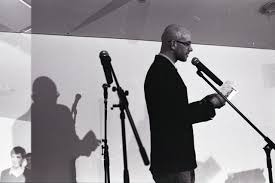
NICKY : I was working as Writer (not) in Residence at Saughton and the book, routine, was inspired by the structure of the prison day. There are ten times when prisoners are mobilised, cells opened (7.30 am), the route (8.30 am) when the prisoners are moved to their worksheds, and so on. I created a template of these times and asked 15 prisoners to respond in any way they liked to what these times meant. I then removed the times, so it would just be 10 statements about their day, with each one isolated on the verso page of the book, just as the prisoners are isolated to a cell. I also used their names and numbers to make it more bureaucratic, or official looking, to reflect the rigid way that prisons work and how it treats prisoners. And it’s hand finished: I have to remove two names and numbers, as I didn’t get permission from two prisoners to use that info before they were released. I usually burn those two corners.
 THE MUMBLE :You are just about to release, ABBODIES. Can you tell us about the inspiration
NICKY : As a poet and subject of the UK, horrified at the swing to ugly nationalism that was manifest in the country, both before and after the Brexit, I felt it was imperative to respond somehow. In my ruminations I thought of ABBA, perhaps because of their many associations with Europe, Waterloo, Eurovision, etc., and it dawned on me that many ABBA lyrics could be used to describe what had happened: ‘blue since the day we parted’ – unending Tory rule; ‘when you’re gone, how can I even try to go on,’ and so on. I worked on the poem on and off from June to December, adding new ABBA lyrics that seemed pertinent, and, of course, during that time Trump won the US election. The (il)logical extension to the shock of Brexit, it reinforced some of the things I had been thinking about as I listened to ABBA songs, over and over again, driving my partner demented in the process. I began to read other things into their lyrics, that some of the songs alluded to aliens, and it made me muse about who was running the world. Trump’s election surprise reflected these thoughts back to me in the poem’s themes of power and string-pulling and, indeed, leg-pulling, for I wasn’t being entirely serious was I? In some ways it’s easier to believe that the world is secretly run by aliens, than to accept the reality that the majority of people in the world are right-wing nutjobs. It’s a bit David Icke, I know, though I prefer to think of it more as Rowdy Roddy Piper in John Carpenter’s They Live. The alien theory is (probably, hopefully) nonsense, but given how crazy events were in 2016, it makes you wonder exactly what the fuck is going on and where we’re going to end up. ABBODIES is also partly a homage to Corpses by Chilean poet Nestor Perlongher, written during the dictatorship it features the refrain ‘there are corpses.’ Which, when I read it, made me think of the information you get on the tube when someone’s killed themselves: ‘there is a body on the line.’ This was a perfect line to my mind about the state of the country and this period of unnecessarily enforced austerity – many bodies are on the line – which is now magnified by the Brexit. Also, it’s more personal than my usual work – with some actual words out of my own head! – tied together by my kids, parents, partner and lifelong love of the bird of prey: buzzard!
THE MUMBLE : Can you explain your own personal approach to the writing process
NICKY : My work is typically political, targeting capitalism, politicians, marketing, business, bureaucracy etc. To do this I use various processes or treatments, such as erasing found text – junk mail or Burns’ poems for example – with Tipp-Ex, or extracting lines from political manifestos, to subvert the language of late-capitalism and its politics. I aim for it to be experimental, challenging, funny and accessible. If I make myself laugh when I’m making stuff, I generally feel it’s working and that audiences will usually laugh as well.
THE MUMBLE : What does the rest of 2017 have in store for Nicky Melville
NICKY : I’m in the end stages of my AHRC funded PhD. I’ve created a 365 page multi-form poem, The Imperative Commands, composed entirely from the language of instruction that guides society on a daily basis. Using material harvested over a calendar year, it’s a snapshot of how we’re controlled and manipulated by language. It’s been fun, but I’ll need to find some kind of gainful employment after that. I’ll also try to find a brave publisher to take on The Imperative Commands…
***********************************************
A review of ABBODIES
by
Dr. Jim Ferguson
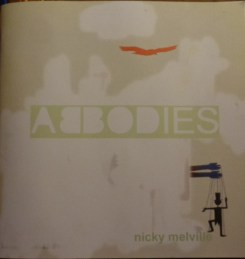 Nicky (Nick E.) Melville has long been a wonderfully experimental voice in poetry in Scotland. His work explores political and personal concerns artfully and accessibly with wry, ironic humour. ‘Abbodies’ looks at the author’s childhood of the late 1970s and early 80s through the dual lenses of pop megaband Abba and D. C. Thomson’s Oor Wullie. Melville’s title combines the word ‘Abba’ with the end of the Oor Wullie by-line: ‘Oor Wullie! Your Wullie! A’body’s Wullie!’ That last part, ‘A’body’s Wullie!’ was always likely to invite sniggers, shock, perplexity, surprise and comment from many a Scottish child.
This is an autobiographical narrative poem which reflects upon itself, Scottish, British and European identity and what it means to be a human being living in the world now. Each page is like the miniaturised chapter of a novel only with far fewer words and highly adept technical and poetical skill. The narrative moves forward until we meet Melville as a father himself, reflecting on what his father meant to him, and what might be the way ahead for his own children in order to lead happy and fulfilling lives at a time of great political uncertainty.
—
and Trump is
master of the scene
can’t resist the strange attraction
from that giant dynamo
look into his angel eyes
one look
and you’re hypnotised
don’t look too
deep in to
one day you’ll find
out he wears a disguise
a’body’s on the line
—-
What’s really interesting here is Melville’s uncovering of how deeply the pop-culture of childhood ingrains itself in the memory and the effect it has on the emotional make up of adults. This would be a standard kind of pop-psychology except that it intersects with national and international political questions such as Brexit, the rise of Donald Trump and the so-called ‘migrant crisis’, producing a poetry that could not be more relevant or up to date. ‘Abbodies’ is a major contemporary poem: it is brave, honest, intelligent, darkly humorous writing and a really great read. It is also neatly packaged like a seven inch single with a picture sleeve. Definitely worth buying.
You can buy a copy of ABBODIES here
Sad Press Poetry
£6 (Including Postage)
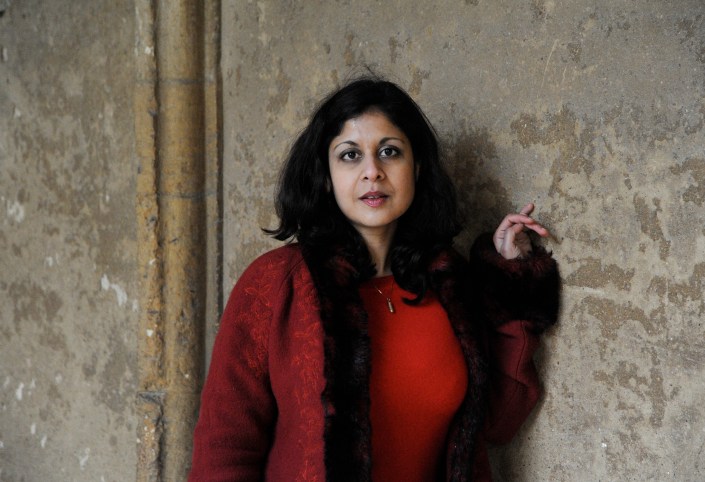
Vahni Capildeo and Elaine Feinstein
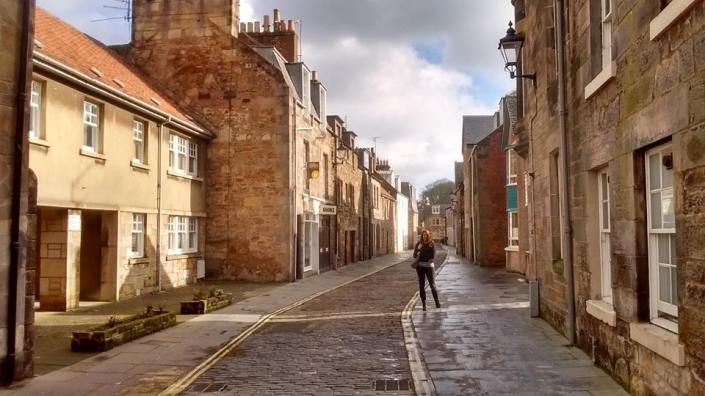
I made my pilgrimage up through the countryside to St.Andrew’s for the 20th anniversary of the StAnza poetry festival. Its quietness and charm lends itself perfectly to days dedicated to poetry, and there’s a special thrill to slipping through an archway, down a cobbled lane to the beautiful, warm and very modern Byre Theatre. The warmth continued inside, with an almost family-like informality among the audience; everyone mildly teasing and joking with one another. The last reading of the festival, with such prize-laden heavyweights as Vahni Capildeo and Elaine Feinstein should have been a sell out like the others had been over the past four days, but it was late on a Sunday evening after all. Others’ pilgrimages were longer than Edinburgh.

It made sense for the two women to be reading at the same event. Both poets are published by Carcanet, both winners of prestigious prizes, both trailblazers, both writing from a place of complicated and multilayered identity; fighting back against any marginalisation or categorisation by firmly and triumphantly taking the centre in life as well as in their work. Capildeo’s readings took us back and forth across oceans, to reflect the Caribbean experience; creating a web of experience from Trinidad, India and the UK. Feinstein, of Russian Jewish descent, and twice the age of Capildeo at 86, read us poems spanning the world, decades of social change, and the trajectory of love and loss over a long, rich life. Feinstein, anchored us with her intimate yet more familiar observations of marriage, family, ageing and loss. Comforting, after Capildeo had taken the ground from underneath us by quietly severing any sentimental attachments to preconceived notions or worn out power structures with her precise and powerful poems of politics, identity, migration and love.
Capildeo, the Trinidadian-British winner of the 2016 Forward Prize for Poetry, won for her exquisite fifth collection on matters of migration and identity, ‘Measures of Expatriation’. She read from this of course, but mixed it up with poems from a 2013 collection, ‘Utter’. She kept the audience close; by throwing out some dry meta-comedy beloved of people blessed with great intellect and a sense of mischief, gently teasing the audience while encouraging them to stay with her, lifting the listeners with laughter before dropping the next brick of a poem. A huge range of subject matter: from Molasses, about slavery, a spellbinding reading of Possum, about ‘personal’ identity, Laptop Blue Screen Realization bringing recognition, laughter and claps, and ending with Felt Pen, a ‘commentary on the commentary’ of a fellow artist’s creative process. A very Caribbean tradition in fact; lightening up the heaviness of life and a painful history with a joke or two. Capildeo uses similar searing precision in the choosing and placing of words as fellow Caribbean poet and Forward Prize winner Kei Miller. Capildeo delicately guides us through with the power and responsibility of acknowledging layers upon layers of history when writing for oneself, and whoever else should understand it, but also the liberty of inhabiting a creative space free from the burdens of history.
Unfortunately for Feinstein, as mesmering and wonderful as it was having a full hour with Capildeo, the interval cut into her time slot significantly. A winner of too many prizes to mention, we were enjoying the friendly sharing of the snapshots of her life; the explanatory stories sandwiched between poems rather like the ones you’d share over tea with a close friend; her bittersweet marriage and subsequent widowhood. Poems about her marriage and widowhood were particularly poignant, especially as she recited her elegy to her late husband by heart. Slightly flustered as she realised how little time she had left, she made sure to finish with an elegy each to both parents, leaving us with touching snap-shot portraits; of her father, ‘to the end you were uncowed’ and mother, with Mirror Talk, as she has forged her way to ‘be the life she never lived’.
Both poets met with great applause and warmth. Knowing how exuberant even middle-class, intellectual Caribbean audiences can be, I wondered if the lack of call and response from the crowd had bothered Vahni Capildeo. “I thought they were a responsive audience,” she said, as she graciously signed my copy of ‘Measures of Expatriation’. “A Trinidad audience might have given me a lot more backchat.” Both of us half the age of Feinstein, I hope I’m around to hear what she has to say in another forty years’ time.
Reviewer: Lisa Michel Williams
A Second Slice of StAnza
Like some dandified arriviste in the throes of burgeoning womanhood, StAnza retains a sprightly ebullience every year. I think this is down to the policy of not asking poets back to perform or lecture until five years had passed. This helps keep the festival al fresco fresh, & tho’ the faces may seem familiar, one is always guaranteed a certain newness to the bill. So a second slice of StAnza for me this time round would be rather like sampling one of the splendid Taster Menus at the Castle Terrace in Edinburgh, where plate after delectable plate is served up full of aesthetic glory & supreme tastes. Rather like a very good poem.
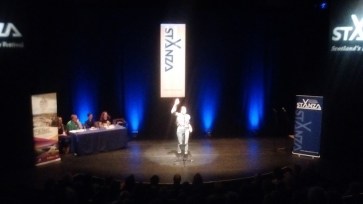
It was the weekend & so the wife was free, & off we pottered on the Saturday night, a thick haar covering both East Lothian & Eastern Fife. Inbetween, of course lay the clearer Forth Bridges, but it wasn’t a long drive at all, arriving just in time for the slam in the main auditorium of the modernistic Byre’s Theatre. Ten poets had two minutes each to impress the judges, all ushered into place & eventual silence by the brilliant Paula Varjack, a young, internationalist poet, who set the scene & dictated both pace & rules with the elegance of Virginia Wolfe at some High Tea soiree. ‘This is how it works, & we’re gonna have fun doing it,’ was her mantra, & we were all hooked from the off. The winner was Kevin McLean, one of Edinburgh’s famous ‘Loud Poets,’ who’d saved his best piece for the final, blowing away the opposition with his speed of thought, his philosophical realities & intrinsically musical wordplay. A close second was Jill Abrams , who chose something with more pathos for her final piece, at which end an ‘O My God,’ from the audience reflected how deeply she moved us.
It was midnight by now, & me & the wife parked our car up a few miles down the coast by the sea. We’d taken the seats out of the back & stuffed the car with duvets, & it was comfy enough for a pleasant night’s sleep. On waking, we parked up at the local leisure centre for a jacuzzi, swim & sauna, & when we found ourselves upstairs at the Byre’s Theatre at 10AM drinking coffee & nibbling on some fruity pastries for the morning’s breakfast lectures, our B&B in St Andrews had cost us £7 each. The sixteen-year-old Rimbaud would have been proud. There then followed a delightfully informal, but highly informative talk from four translators on the nuances of their chosen aspect of poetrology.
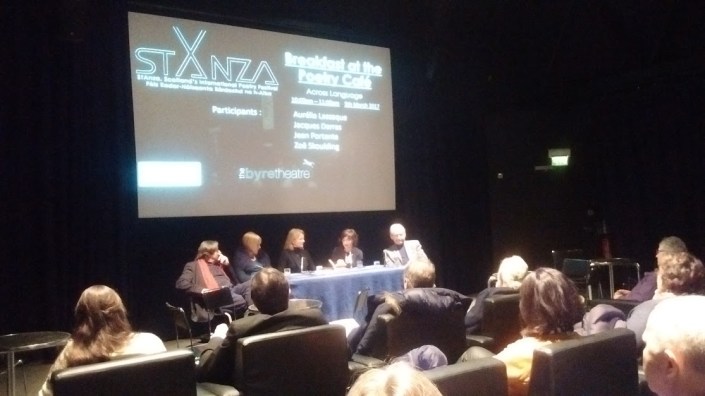
Asterixesque Jean Portante & the well-preened Zoe Skoulding are bosom-buddies. Jean is from Luxemburg, whose native language is Italian, & whose chosen linguamedia is French. He explained how he was importing the smooth-flowing Italian river-phoneticism into his French verses, with Zoe explaining how her English presentation of his poems were trilingual, having to accommodate Italian rhythms & French vocabulary into the register of her own native speech. Equally fascinating was Aurelia Lassaque, a speaker of the rare Occitan tongue, who spontaneously creates her own poetry in both French & the language of her mother, writing a single poem in tandem between the two languages, letting them flow into & bounce off one another.

Finally, we had the most erudite Jacques Darras, who could have talked for hours, & indeed wanted to, but instead gave us an anecdotal sweep through his time with Ezra Pound’s Cantos, finishing with a moving pilgrimage to Pound’s secretary, Basil Bunting, living in a shed near a pub, a couple of months before he passed away. “Translation, basically,” said Jacques, “is an act of love… you have to love, you have to be in love, with a poem you happen to chance upon,” a statement which perfectly captured the essence of the hour.
It was now potter time; a meaty cappuccino at Costa Coffee, photo-ops with the wife in the time-capsule streets, before buying a translation of all of the Gawain Poet’s works (if indeed he did write them all). Then it was back to the Byre’s for a pie, a pint & Mr Steve Pottinger, a gentle though political soul, who glided through his lunchtime recital with a perfect rectitude to his muse. The West Midland accent never sounded so good, as the breeze of Parnassus blew through his poems, all of which ended with an epithetical flourish & an almost Elizabethan bow. Yes, Mr Pottinger was good, very good. Both before & after his performance, I’d noticed the morning’s translator posse were sat in the Byre’s, pontificating & all that, & I am sure that on our exit from Mr Pottinger’s pearly sphere, Jaques was telling the same story I heard him begin when we first went upstairs for our pies.

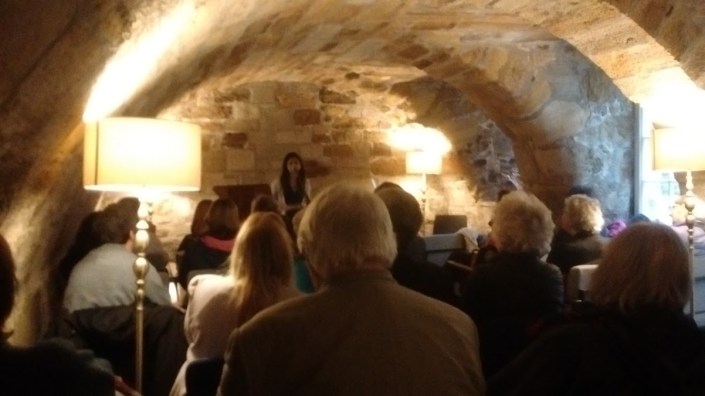
 Our final port of call was in the cellar-like confines of the intimate Undercroft at St John’s House, where two ‘Border Crossings’ poets would read through their work. The first was Tess Taylor, a Fulbright scholar & direct descendant of Thomas Jefferson. Reading with poise, posture, & the occasional touch of humour, she delivered excellent renditions from her folklore-laden, landscape-littered work, especially the long poem which had her exploring her ancestors house, peering into his copy of Virgil, & displaying an oboe-pitched sentiment which tweaked & twanged with effortless grace on the listening sensibilities. Finally, we had Michelle Cahill, a young Australian of Indian heritage in love with Scotland, who eked out the vibrancy of the land in her recently acclaimed book, The Herring Lass. I especially liked her sonnet to the heroine Black Agnes, defender of Dunbar Castle a long time ago, & a place we headed in the direction of at the climax of her deliciously engaging readings.
StAnza… fino alla prossima volta
Reviewer : Damian Beeson Bullen
An Afternoon at StAnza
St Andrews
March 2nd 2017
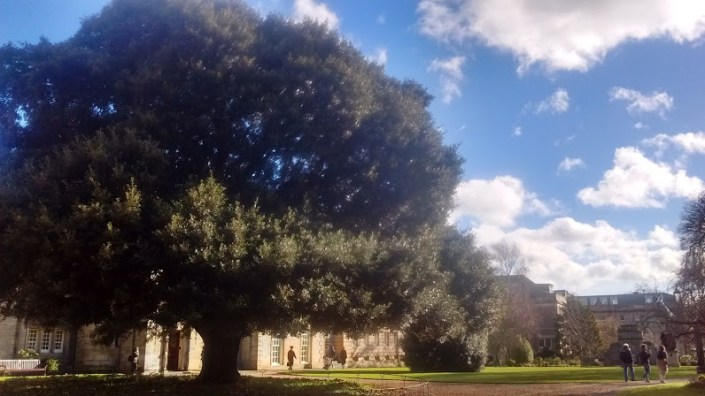
It has long been mooted, out East Lothian way, to restore the ancient ferry route across the Firth of Forth to Fife. Still lost in idle burearocratic musings, I had to instead spin all the way west to the Queensferry Bridges, zip high over the waters, & hang a right into Glenrothes. From here, the modern road system tapered into something from the 50s, as the one-lane roads wound me to the ancient & most reverend ecclesiastical capital of the Scots. Fife was as lovely as ever, a maroon landscape of recently ploughed fields under a crisp, blue sky. Crisp would also be an understatement – as would brisk – for the infernal furnace of cold which bit into my face & through my clothes as I arrived in Saint Andrews. Still things were hotting up in the poetry festival, I found, as I arrived at the towns refined town hall for my first sampling of this year’s StAnza festival. Like bees to the first crocuses of the year, poets & poetry lovers from Scotland & beyond were flocking to the fragrant blooms planted over the winter by Madame Eleanor Livingstone, including Harry Giles, who the Mumble had recently interviewed.
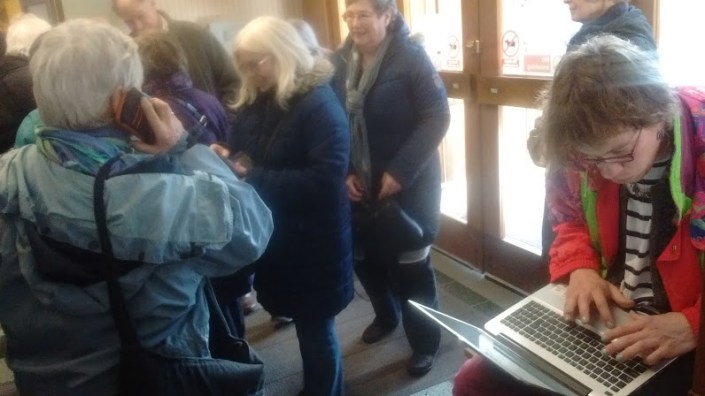
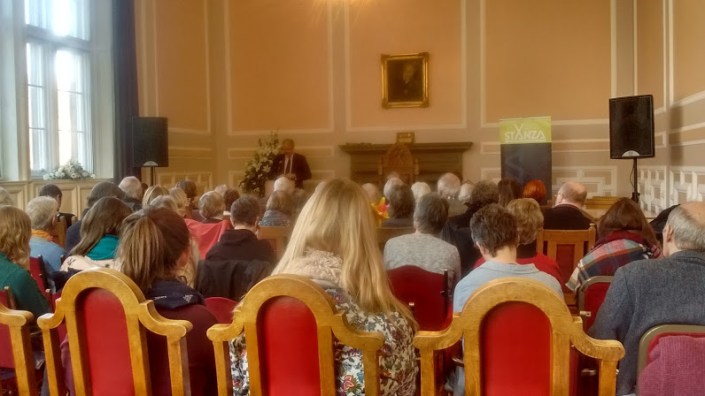

The first hour was to be filled under the monicker of Past & Present, two talks on members of the pantheon within living memory & long since ceased. We began with Neil McLennan – not a poet per se, but historian & historical detective with an ambitious passion to discover as much as he could about Wilfred Owen, admitting that this noble war poet had become almost a part of his family. For me, a poet’s life is just as vital to the account as their works. Poets are like ornate fountains, out of whose mouths gurgles the spiritus of an age – & it was quite an age in which Wilfred Owen found himself.
2017 sees the anniversary of Owen’s 6 months stay in Edinburgh’s Craiglockhart, which during WW1 had been transformed into a hospital for officers who’d been turned crazy by the horrors of the trenches. ‘Craiglockhart is my Oxford,’ wrote Owen, who loved to roam the nearby Pentland Hills, the routes of which have been traced by McLennan & shall be revisited with a party of keen Owenites later this year. Mclennan also described his international search for information, including finding Owen’s poems scribbled down on the back of Edinburgh Café company bills, & delighted in telling us how he believed Owen made the near-final draft of Anthem for Doomed Youth a few hours after he had taught English Literature to 39 boys at the Tynecastle School: a remarkable rumination. He also left us with a cliffhanger, saying that yes, Graves, Owen & Sassoon all met on a golf course in Edinburgh that year, but not on the course everyone thinks they did. He has actually discovered the true belt of blasted green & will be revealed in his book on Owen in Edinburgh later this year. I, for one, was not that bothered beforehand, but after witnessing McLennan’s infectious banter I cannot wait for the answer.
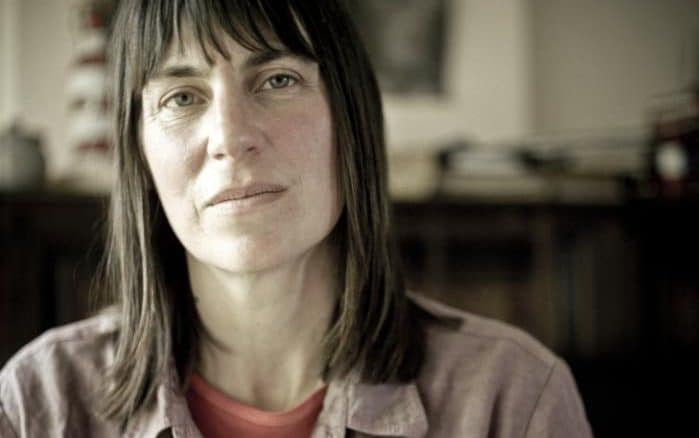
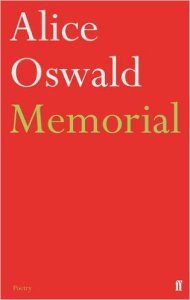 Following McLennan was the reputable Alice Oswald, a contemporary poet with a classical mind, she is the creator of some of our own epoch’s truest poetry. A few years ago she produced an amazing condensing of the Iliad called Memorial, & so was perfectly placed to sing her love of Homer to us. Her introduction in that book reads; ‘Matthew Arnold praised the Iliad for its ‘nobility’, as has everyone ever since — but ancient critics praised it for its enargeia, its ‘bright unbearable reality’ (the word used when gods come to earth not in disguise but as themselves.
Oswald’s patter was purely poetic, abstract in places, keen as a Danaan spear in others, flowing through her talk as breathlessly as the wind she described in both Santarini’s Minoan frescoes & the works of Homer himself. Her dreamlike, metaphysical mind conjured up phrases such as, ‘the Beautiful silence of the Minoans,‘ while at the same time she made a pleasant attack on the stuffy cloisters of classical academe. A Classics student herself, one found as she went on that Oswald had found her own paths through Homer, & was delighted to share them, pouring great disdain on the monotone & sterile translations of Homer – including the one by her hero, Ted Hughes – which had turned the Grecian Swan-words into flightless Dodos. I especially enjoyed her vivisection of Homer’s use of colour, which he had presented in a more intensely descriptive than factual fashion. Dark blue, for example, was used to describe a crowd helmets in battle. She even took time at the end of the talk to point my own studies in the direction of Gladstone, who made the first formal accounts of Homer’s colours.
A couple of frothy coffees later, among the students with faces as fresh as St Andrews in early March, I took my seat in the local parliament, where just like in Estonia one steps in off the street. It was time for the day’s ‘Five O’Clock Verses,’ where from oak-paneled wall provosts from the past looked down on our proceedings painted in their military garb or haughty civilian regalia. Two Bloodaxe Poets were the order of the day, AB Jackson & the highly esteemed Catalan poet, Joan Margarit. First up was Jackson, who read at first from his new book on St Brendan’s voyage across the Atlantic in a little coracle boat, a vividly crafted cycle full of devious literary allusions – ‘Godless cynocephali’ springs to mind – & portrayals of sea-sick priests. Listening to the rest of his poetry it seemed as if puff clouds of description were floating across the mind’s canvas, such as golf balls being truffles waiting to be picked up on St Andrews golf course.

First Love (Primer Amor)
In the dreary Girona of my seven-year-old self,
where postwar shop-windows
wore the greyish hue of scarcity,
the knife-shop was a glitter
of light in small steel mirrors.
Pressing my forehead against the glass,
I gazed at a long, slender clasp-knife,
beautiful as a marble statue.
Since no one at home approved of weapons,
I bought it secretly, and, as I walked along,
I felt the heavy weight of it, inside my pocket.
From time to time I would open it slowly,
and the blade would spring out, slim and straight,
with the convent chill that a weapon has.
Hushed presence of danger:
I hid it, the first thirty years,
behind books of poetry and, later,
inside a drawer, in amongst your knickers
and amongst your stockings.
Now, almost fifty-four,
I look at it again, lying open in my palm,
just as dangerous as when I was a child.
Sensual, cold. Nearer my neck.

Reviewer : Damian Beeson Bullen
An Interview with Bob Beagrie
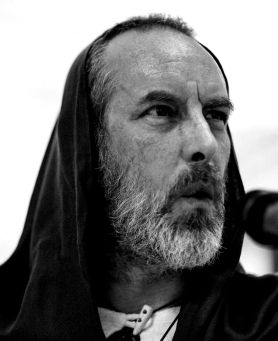
THE MUMBLE : Hello Bob, so can you tell us where you’re from & where you’re at, geographically speaking.
BOB: I am speaking to you from Middlesbrough, where I was born and raised and have spent most of my life. I moved to Crewe for in 1989 to do a degree in Creative Arts, specialising in Creative Writing, but moved back to Middlesbrough in 92. Middlesbrough is supposed to be the worst place to live in England. It has its problems, serious problems but there is a lot of good things here too. For one, it has a thriving arts scene and a lot of very talented people. It does tent to be ignored though on a regional and national level.
THE MUMBLE : So what got you into poetry in the first place
BOB: I wrote stories as a child and a teenager but it was attending a community creative writing workshop at a local library run by Trev Teasdel that gave me the encouragement to take it seriously, and I had a few short stories published in local magazines. Trev encouraged me to apply to do the degree at Crewe and Alsager College of H.E. It was there that I was exposed to poetry, e.e. Cummings, the Beats, the Black Mountain Poets, and realised it wasn’t what I’d always thought it was.
THE MUMBLE : What inspires you to write
BOB: I am quite prolific because it is such a part of my way of perceiving the world and myself within it. If I don’t write regularly I start to fret and become irritable, so it is important to give myself the time to work creatively. I become quite obsessive over things too so I enjoy working on projects like Leasungspell and The Seer Sung Husband which require a lot of research and slow chipping away at an idea.
THE MUMBLE : Who have been your greatest poetic influences, in both early & present days
BOB: My greatest influences are Derek Walcott, Seamus Heaney, Elizabeth Bishop, Brendon Kennelly, Tony Harrison, Pablo Neruda, Allen Ginsberg, but I was very much inspired by some of the regional poets I’ve met and worked with like Andy Willoughby, Paul Summers, Tom Kelly. Andy Willoughby and I have been running an exchange scheme with poets from Finland for over 15 years so I have been heavily influenced by the Finnish poetry scene, which often has a shamanic Beat quality to it, poets like Esa Hirvonen, Kalle Niinikangas, Katariina Vuorinen and Riina Katajavuori.
THE MUMBLE : Your work has been translated into ten languages : can you tell us a litte more about this
BOB: Because of this connection with Finland I have been involved in a lot of international poetry projects and translation projects as well as quite a lot of international touring and performance work so I have had poems translated and published in other languages such as Swedish, Russian, Karelian, Estonian, Urdu, Danish, Dutch, Spanish. The collection I wrote with Andy Willoughby ‘Sampo: Heading Further North’ which is inspired by the National Finnish Epic ‘Kalevala’ was published in three languages in three different countries during 2015. I consider myself a European poet and think that poetry, and creativity in general, can act as a bridge that is able to span cultural and linguistic boundaries. The act of translation is a process of reaching out, a tentative grasping of potential meanings to be carefully examined and carried back into one’s own language, and enrich it. This process seems more important than ever given the rise of xenophobia and right wing ideologies over the past few years.
THE MUMBLE : You are a senior lecturer in creative writing at Teesside University, what are the key tenets of your teaching
BOB: As a senior lecturer in Creative Writing at Teesside University my approach to teaching is to encourage experimentation, creative play, to use your words as a vehicle for reflective practice, to strive to write beyond the habits and perceptions of the ‘self’ in a process of continual depersonalisation. That is not to say you shouldn’t write out of direct experience or a grounded idea of ‘self’, it is essential to do so but it is also vital to recognise that this idea of ‘self’ (authorial or not) is itself a discursive construct. Once students realise this through their creative practice they find it extremely liberating as writers.
THE MUMBLE : You are a founding member of the experimental music and spoken word experiment Project Lono, how do you feel the soundscape assists the spoken worD
BOB: I’ve collaborated with many musicians, both live and recorded, and it definitely brings another dimension to the spoken word, carrying layers of added meaning that can work conjunctively or disjunctively with the words. It doesn’t always work and its not for all audiences but when its right it can create a truly mesmeric and transformative affect. It also attracts and engages different audiences, many people who are not really interested in poetry can be hooked into it through a more integrated or combined arts approach. Someone once said after listening to a Project Lono track, ‘I’ve never liked poetry but hearing it with the music helped me really appreciate and understand the words’.
Project Lono is an experimental collective on Teesside that encourages collaboration and cross fertilisation of the arts. I also think it is important to remember that poetry in tribal times was always accompanied by music, sound effects and its physicalisation through dramatic movement / dance. Meter is measured in feet because it relates to the ritualised steps that accompanied the words.
THE MUMBLE : What are you bringing to the table at this year’s Stanza festival
BOB: I am delighted to be taking part in the Stanza Festival 2017 as part of the National Tour of Leasungspell: A Fool’s Tale, which is a performance of parts of the epic poem that was published by Smokestack Books in 2016 with live music and sound effects by lutenist Peter Lagan, singer Sara Dennis, with Kev Howard playing Dordeseal (ancient Celtic horn and various percussion instruments and Tuvan throat singing, and Stewart Forth on percussion and keyboards and recorded sound effects.
THE MUMBLE : What does the rest of 2017 have in store for Bob Beagrie
BOB: Throughout the rest of the year we will be touring the show, with performances lined up in Bamburgh Castle, Durham Cathedral, Whitby, at the Castle keep in Newcastle and at Bristol Poetry Festival. Wyrd Harvest Press will also be publishing a new collection of poems I have written with Jane Burn, titled ‘This Game of Strangers’ which is inspired by the Gwynevere & Lancelot legends so hopefully we will be holding some readings and launch events across the country.
An Interview with Paula Varjack

THE MUMBLE : Hello Paula, so can you tell us where you’re from & where you’re at, geographically speaking.
PAULA : I am writing this to you now from my living room in Hackney, East London, where I have lived on and off for the better part of 18 years. London feels like the place I am most from as I have spent most of my life here, but I can never fully claim it as I have a very strong american accent. I was born in Washington DC to a British father and a Ghanaian mother. when i was still a baby we moved back to Bromley in Kent, we then moved back to Washington and I stayed there until I was a teenager, and at 17 I moved back to London again. I then lived here until I was 30, when I moved to Berlin for four years. Since then I have stayed in London, if you don’t count the five months I lived in Madrid.
THE MUMBLE :Poetry is just one of the strings to your polymathic bow, what else drives your creativity
PAULA : I am an artist who works in a number of forms and I actually only rarely write poetry these days, although there is a poetic feel to a lot of my prose. The medium I work in most is theatre, but I also make video work and often make performance that involves video in some way. I have also begun to explore creating more work that is cabaret based, that I really enjoy. Having worked with words for so long, its so nice to play more with movement and dance and even physical comedy
THE MUMBLE :What got you into poetry in the first place
PAULA : My parents more than anything. They read me a lot of poetry when i was a kid, and i could tell that they enjoyed to read it and read it allowed. .I have very early memories of my dad reading me the Jabberwocky, and Rudyard Kipling, and I remember my mother proudly telling me about how her father had been a published poet, and was respected by and liked by a number of quite well known African-American writers, most notably Maya Angelou and James Baldwin, who both visited in Ghana where my grandfather lived and was from in the early days of pan Africanism, my grandfather was known to be sympathetic to the African-American cause at the time, and particularly to artists. A poet was a great thing to be as i understood from a very early age. I was encouraged to write poetry
THE MUMBLE : Who have been your greatest poetic influences, in both early & present days
PAULA : I have moved around a lot, but there are some books and writers that I manage to always keep with me. I am not sure if these writers have influenced me but they definitely made an impact. In terms of poetry I like to read I will always have the collected EE Cummings, Howl by Alan Ginsberg, Leaves of grass by Walt Whitman and Sonia Sanchez and Pablo Neruda’s love poems on my shelf. I also quite like Bukowski’s poetry. In terms of poets I enjoy watching perform there are literally too many to mention. But long before I became a performer myself I was really struck by Stacyann Chinn, Stacy Makishi, Salena Godden Cheryl B and Francesca Beard. Celena Glenn, Black cracker and Beau Sia.
THE MUMBLE : What inspires you to write
PAULA : Life, the weird wonderful heart swell and heart break of the every day of it, the adventure and late nights but occasionally also the revelations that come in the quiet pauses, in the mundane.
THE MUMBLE : Your debut prose & poetry publication ‘Letters I Never Sent to You’ has just been published by Burning Eye Books. How are you feeling about this?
PAULA : I feel really great about it. Burning Eye is such an enthusiastic press for spoken word artists, and right from the start of the conversation around the book I have felt really supported by them. Having worked in performance for so long, its also really exciting to produce something creatively that results in an object. Its funny how exciting that can be after working in the ephemeral for so long
THE MUMBLE :What are you bringing to the table at this year’s StAnza festival
PAULA : My energy, spirit and stories, and the book itself it course, which I am very proud of and excited to share. There may be a little multi-media in the mix and an extract or two from theatre work too.
 THE MUMBLE : What does the rest of 2017 have in store for Paula Varjack
PAULA : It looks really really busy to be honest, but in so many exciting ways. Right after Stanza I go head first into a U.K. tour for my latest performance Show Me The Money, a show based on interviews with artists around the U.K about the value of art in these uncertain times. when that is completed I will then get stuck in to development for my next theatre show The Cult of Kenzo, exploring our relationship with brands, but in particular luxury brands, which will start its development at a residency at Battersea Arts Centre . Meanwhile I will be lead facilitator for the Barbican Junior Poets programme, while also freelancing as a drama and creative writing facilitator for eastside educational trust, and somehow when I am not doing all of that I will be hosting and producing events with Dan Simpson with our hosting and production partnership Varjack & Simpson and before I know it, it will be summer and i will be back in Scotland for fringe again. It certainly won’t be a laid back year, but i am looking forward to all of it.
An Interview with Steve Pottinger

THE MUMBLE : Where are you from and where are you at, geographically speaking
STEVE : I was born and brought up in a small town in the Black Country, part of that industrial sprawl north and west of Birmingham. I moved away to go to university, stayed away, and spent years travelling and exploring the world while avoiding anything as structured as a career. Right now, I’m back in my hometown, in the house I grew up in.
—
THE MUMBLE : So what got you into poetry in the first place
STEVE : I was seventeen and my girlfriend introduced me to the Mersey Poets (Adrian Henri, Brian Patten, Roger McGough). We’d been seeing each other for a few weeks and she gave me an anthology of their poems and said “Read this.” I wanted to keep in her good books, so I did. It was the first time I’d read poetry which was cheeky and honest and moving, and felt like it could have been written by and for people like us. It spoke the way we spoke, it was energetic and vibrant and alive. I’d been writing typically miserable teen-poetry before that, but this showed me a whole other world of possibilities.
—
THE MUMBLE : Who have been your greatest poetic influences
STEVE : I’ve mentioned the Mersey Poets. I also loved Dylan Thomas – my folks had the LP of Richard Burton reading ‘Under Milk Wood’, which I listened to over and over as a kid, in love with his voice as much as anything. But my greatest influence was probably a copy of ‘For Beauty Douglas’, the collected poems of Adrian Mitchell. I loved his playfulness, his wild imaginings, his anger, and the range of subjects he dared to cover. I still go back to that book now and find myself in awe.
Sometimes, though, I’ve gone to poetry nights and been bowled over by the performance and the words of someone simply getting up to do an open-mic spot. That’s the wonderful thing about poetry: anyone can have a go, anyone can move us.
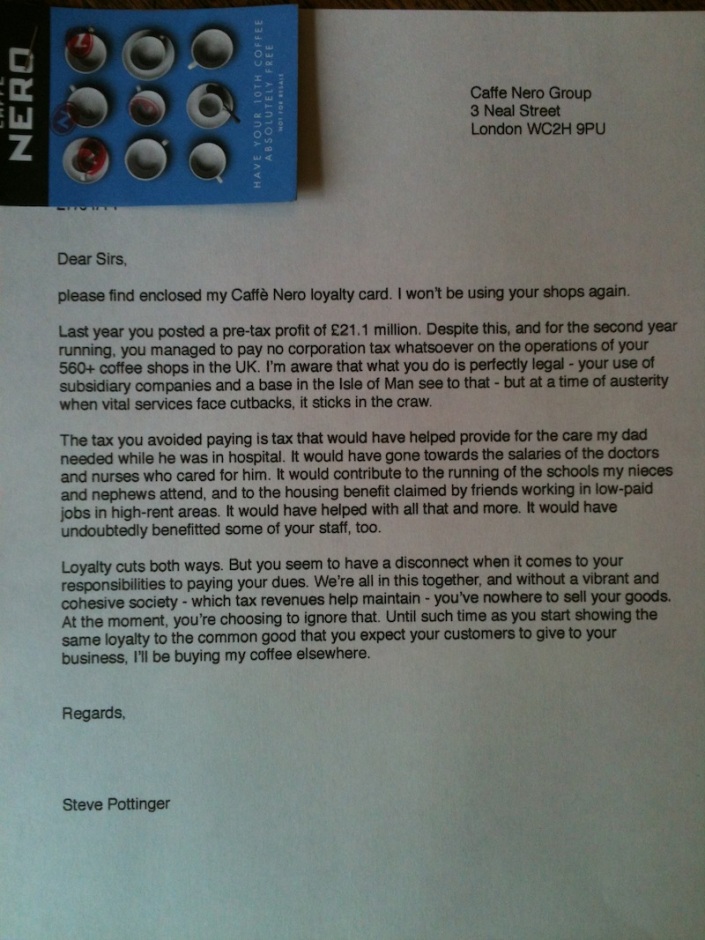
THE MUMBLE : You wrote a letter to Caffè Nero about their tax avoidance which went viral, can you tell us about that
STEVE : I love hanging out in coffee shops watching the world go by as much as anyone else, but corporate tax avoidance really gets my goat because the rest of us – you and me – end up picking up the tab. I wrote my poem ‘No-one likes an angry poet’ when I learned Starbucks seemed to see tax as an optional extra, and started going to my local Caffè Nero instead. Then I read that they weren’t paying tax either. So I wrote them a letter, took a pic of it, and posted it on Facebook. I guess it hit a chord, because it got shared thousands of times, picked up by campaigning organisations, and the BBC and Independent got in touch to talk to me about it. I’m reliably informed the boss of Caffè Nero hated it. That pleases me immensely.
—
THE MUMBLE : The Punk scene is always hovering menacingly over your work : why is this?
STEVE : I don’t know if it hovers menacingly – it’s got dodgy knees by this point, for starters – but punk attitude does inform a lot of what I do. This questioning, idealistic, slightly bolshy attitude isn’t peculiar to punk, of course – anyone who’s ever put two fingers up to the established way of doing things and decided to find their own path will recognise it – but I suppose I’m old enough to look back at the punk era as being a time where it was in its pomp. I’ve a soft spot for the music, too, and have been lucky enough to help two punk legends write their autobiographies.
For me, punk’s all about valuing and respecting each other, putting people first, recognising our common humanity (a theme in my work, I know) and listening to each other’s stories. And getting up and dancing for as long as the dodgy knees allow.
—
THE MUMBLE : What are you bringing to the table at this year’s Stanza festival
STEVE : First and foremost, a love of words, of their power to shape the way we view the world, engage our emotions, and say something important about our shared experience. Oh, and expect a healthy pinch of irreverence, too.
—
THE MUMBLE : What does the rest of 2017 have in store for Steve Pottinger
STEVE : Gigs. Adventures. Stories. Interesting collaborations with other poets. Days out on the mountain bike and in the camper van. Hope and scribblings. Determination and laughter. Wilderness, cities, and a glass half-full.
An Interview with Harry Giles
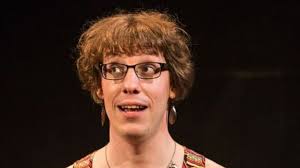
THE MUMBLE : Hello Harry, so where are you from & how did you end up in the Orkneys
HARRY : I’m from Orkney! My folks moved there when I was two, so it’s the only home I know. On Westray as a kid, and then Deerness as a teenager.
—
Dear Witches, A Charm for When You Need It
Take a burning memory, and tear
into as many pieces as your years.
Mix with strands of weed, pulled
from broken pavement. Soften
into paste with spit, piss
or greeting: whichever is on hand.
And with the potion write
your true name in the place
where you need shelter: a wall,
a window, or, more likely, your heart.
I cannot promise you it will work.
I can promise your name will glow.
—

The Gay Gordons
Thir ower mony girls, an that means they dance
wi ilk ither, wan leads, wan follaes,
but the teacher still caas the meuves tae the men
an the ladies, pleys the pechan tape,
watches, airms faldid. The beuys haald thir pairtners,
some like a pistol, some like a turd,
aa ferly doutsome an furious
at the aisy grace o the girls wi the girls.
Vince likes rugby, an Darren likes his haand
on Vince’s sweity back i the scrum.
Darren birls Isla ower loose, Jane yokes Vince
ower tight, an both the beuys wunner
gin a faimly flitted tae the island wi a clutch
o beuys, twins, quadruplets, sweetched
the ratio, wad they be mad tae dance thegither?
Wad they be able tae mak on tae complain?
Thir een nivvir meet i the cheengan reum:
thir no thievid glisks, no unnerstandan.
They bore at ilk ither’s caafs ower the benches,
peek roond i the shooers whan the ither’s
no leukan, bide in permanent terrification o bean
catcht. Bean catcht wad wrack thaim.
Whit wad bean catcht feel like? Hou
wad it feel tae be catcht, tae be catcht?
—
Poem in which nouns, verbs and adjectives have been replaced by entires from the Wikipedia page ‘List of Fantasy Worlds’
You gor me. Boxen in your sartorias-deles
and angeous krynn. Too xanth, too zothique,
as though an erde of bas-lag were termina
under your hyrule. As though I were charn
already. Don’t beklan to me, don’t tir like
I’m lodoss to your emelan blest,
like I’ll xen when you tortall my deverry tarth,
ooo, I’d landover earthsea with you, panem.
It’s erehwon. You’re still melniboné,
your eberron oz and aebrynis quin are still
spira. I nirn you. But faltha your athas
and then you can halla me. Og idris:
eidolon to pern me, tamriel! Harn me til
all my mundus aurbis one glorantha “Eä!”
—

 Mumble Words