The Last Poets @ the EIBF
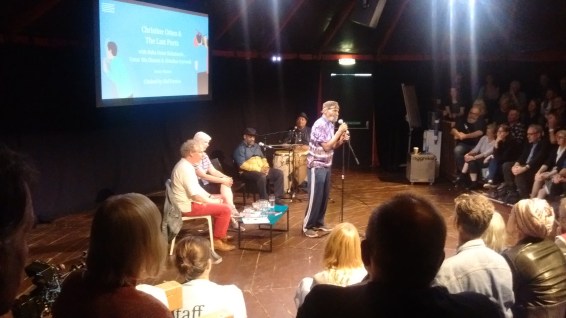
Bosco Theatre
23-08-17
Despite there having being a major war fought in the United States of America over the issue of slavery in the 1860s, over the next century or so, the Southern States in particular disenfranchised the free negro, using apartheid as a principle & divisory socio-politcal instrument. Cue Rosa Parks sitting on a bus, Malcolm X, Martin Luther King, the Black Panthers &… The Last Poets. Springing from the vibewells of Harlem, several incarnations of the same ethos began to move & motivate the American mind. ‘Niggers are scared of Revolution,‘ they sang on their seminal first album, a call to arms which ultimately ended up in the Pax Obama. Considered as progenitors of hip-hop, they half-chant invective observations over a wild percussive sound, & work really well as socio-political sound-artists.
The Last Poets @ the EIBF consisted of a chit-chat with their pseudo-biographer, Christine Otten, a Dutch novelist who’d attached herself to both the mythomeme & the physical personages of The Last Poets, & created a novel about their story, rather than a conventional biography. This was published at first in Dutch, in 2004, it was only last year that it came out in English translation. ‘She’s a white, Dutch girl,’ said the Last Poets to inquisitive voices asking who the hell was this lady with an accent exploring the rock pools of their lives, ‘but she’s… OUR white, Dutch girl.’ During the talk, one could really feel that Otten’s presence was appreciated in the tight-knit world of the Last Poets, that she’d done a good job penetrating the egos, bringing out the humanity & telling ‘a decent story.’
The Last Poets – Baba Donn Babatune, Umar Bin Hassan & Abiodun Oyewole – are drifting back into the public consciousness, with a voice still resonant today – especially in the middle of all this Trump nonsense. After playing a gig in Edinburgh the previous night, the Last Poets are finally pouring their wisdom & love into the Scottish diaspora, & enjoying the experience immensely, comparing black subjugation to the English oppression of the Scots. So much so, that the talk spilled on for far longer than it should, but trying to get these guys off stage was hard work; neither they nor us wanted the moment to end, but when it inevitably did so, everyone just felt that little bit better leading & living their lives.
Reviewer : Damo
Paul Auster – New York Storyteller
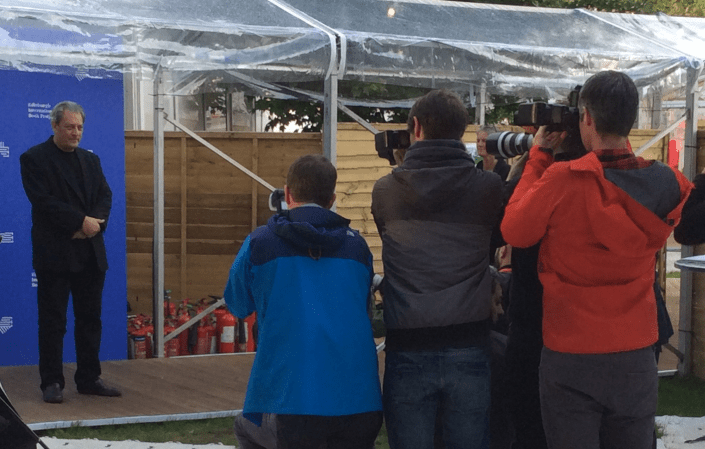
Edinburgh International Book Festival
Baillie Gifford Main Theatre
18th August 2017
Cliché: ‘A giant of American Literature’. Justified: “he can out-Roth, out-Updike and out-Franzen the greatest” (Financial Times). I wrote earlier this week of selecting a flagship event for the Festival; well, unless I missed something else, this one would take a lot of beating. The sponsorship of the University of Edinburgh managed to net an appearance by an author for whom one can soon run out of superlatives. The problem of how to describe him doesn’t stop there. His first novel, The New York Trilogy…
Now hold on a minute! The New York Trilogy is a collection of three, separately-published novellas, only later gathered into a single volume. Start again. His first novella, City Of Glass…
Stop right there! What about Squeeze Play? That was published three years before City Of Glass. True, but under a different name. What is more, on being given a copy of both the trilogy and his latest book 4321 to sign by a fan this evening, he remarked very clearly “Ah, my first one and my latest one.”
And there we have (already) a wonderful set of contradictions, when it comes to Auster’s world. His real world and his fictional. The trilogy uses the genre of the detective novel not to unravel a mystery the way Hammett or Chandler or Paretsky might, but to raise questions about identity and reality, existentialism and the absurd, meaning and meaninglessness. 4321, not only his latest but his largest work, presents four parallel stories where the same protagonist (possibly) lives four separate lives (possibly) in the turbulent 1960s. City of Glass contains sparse, economic sentences such as “Quinn had been prepared for this and knew how to answer”. In 4321, however, Auster has mastered the perfect, long sentence, many of which last a whole paragraph, some of which seem to go on for pages; “I started writing a different kind of sentence,” Paul said. “It had a kind of propulsion, a paratactic urgency. I wanted to create a different tone.”
This event was sub-titled ‘New York Storyteller’. Every time Jackie McGlone, chairing the event, mentioned an aspect of his writing, or hinted at a question, Auster would take the topic, either squarely and obliquely, and run away somewhere with it. Often relevantly, often interestingly, always away. And always taking the listener along. A New York storyteller is precisely what Paul Auster is.
He read a long passage from 4321, in which he described Ferguson the protagonist (which one – does it matter at this stage? Not until we read the book in its entirety, and then it will become relevant, or so we hope) dealing with the certainty (to him) that the world and what was happening to it – the Vietnam War, International reaction, US politics, New York politics, campus politics, personal opinion and experience – was made up of concentric layers. The passage itself was fascinating, not only for its introduction of this mental impression, but the facts it was conveying, the people, the names, the organisations and their initials and acronyms, jocks and radicals, politicians and protesters, counter-protesters and cops, and every so often, almost without breaking the flow, Paul would insert a note of explanation for the Scottish audience, a footnote, a snippet of commentary. And it felt like part of the continuing storytelling. He also gave us the opening paragraph, which contains a piece of humour which depends on the reader knowing about the Ellis Island immigration process in 1900, and a little bit of Yiddish on top of that. In a way it’s an old story, but I won’t spoil its retelling for you. I will say that in order to appreciate a little piece of incidental humour, Google the Empress of China’s maiden voyage.
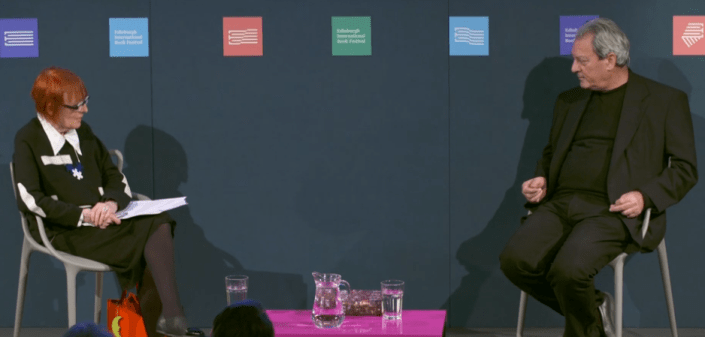
Jackie McGlone steered Paul onto the subject of politics and the current situation in the USA. Could anyone have come up with a fictional character like Donald Trump? Yes, Alfred Jarry, who created Ubu Roi in 1896, only without all the orange. Comparing the situation in America today with that of the 1960s, Paul referred back further than that, to the founding and expansion of the United States:
“We haven’t gotten anywhere, we’re just exactly where we were half a century ago. Nothing has changed. And then, you know, you start to question the very fundamental building blocks of the country. This great country of America is built on two crimes, two enormous sins – the extermination of the Indians and slavery of black people. And we’ve never really faced up to these things, never confronted them, and I think it has poisoned us, and now it’s coming out more and more and more again, another wave of racism and nationalism of the ugliest sort.”
“I can’t keep quiet. It’s too dangerous. It’s too serious to stand back and watch the country melt… A lot of the American system will be eroded by the time Trump leaves office. We need to keep beating the drum.” Paul admitted to being pessimistic, citing the way that Donald Trump had used Goebbels’ ‘Big Lie’ principle to slander Barack Obama, and by the time of the election he could utter any falsehood and would be trusted by the people who had come to heed him.
But of course, tempting though it is to harp on about the political situation in the United States, and though to do so caresses the confirmation bias of Brits who, like myself, do not like the political flavour of things there, this was supposed to be a literary event, we are supposed to remember what Paul said about his books, his low-tech methods of writing, his seven day working week, and our excitement at such a major work’s publication after an apparent gap of seven years. The solid ovation and the queue of people wanting books signed attested to that. The combination of the Festival, the University of Edinburgh, and the author delivered.
Reviewed by Paul Thompson
Penny Pepper
Edinburgh International Book Festival
Garden Theatre
18th August 2017
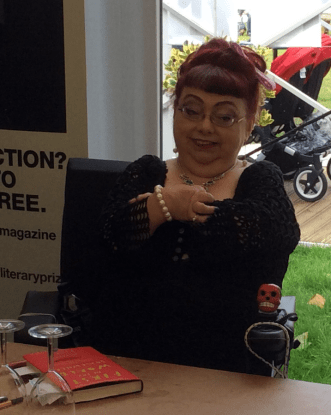
It must be daunting to face an audience, even a small one at one of the Festival’s smaller venues, but to have to do so on one’s own because the person who was due to share the stage has had to pull out takes a lot of nerve. It would have been fascinating to have seen and heard iO Tillett Wright, but – let’s face it – Penny Pepper is now a veteran of appearing in public, having emerged from behind the pen name of Kata Colbert many years ago to become both a poet-performer and an advocate for people with disabilities, and if anyone could carry it off she could. I think this does challenge the Festival programming; a joint Wright/Pepper event would have been in interesting mini-colloquium, but either one of them could easily fill an hour with something unique.
Penny was primed and prompted by poet Ryan van Winkle (and yes, that is his real name), whose enthusiasm did occasionally cause him to talk over her more than a host should, but I’m guessing that was his delight in being there. It’s picky of me to mention it, I know, and by-and-large he did all that a host should do at one of these presentations.
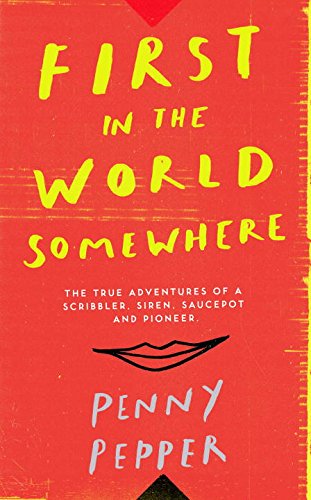
With the rain beating on the roof of the Garden Theatre, Penny read from her new book of memoirs, First In The World Somewhere. She has been an avid diarist for most of her life, and each section of the book, she told us, is introduced by a few lines from her journal. Such is the style in which she has written this – narrative, almost prose-poetry in places, the first passage she read out interrupted by curses and racist comments from her stepfather – that it was impossible to say where the journal extract ended and the creative memoir started.
Although Penny has happy memories of her father (still alive when she was a child) teaching her to read before she went to school, ‘home’ eventually became, in her words “a prison, Hell.” She did not want to live “the designated life of the cripple,” and so, full of Sex-Pistols-fuelled rebellion, decided to move from her rural home to an independent life in London. This took extraordinary self-belief because, as she told us, even the language of independence for the disabled did not exist back in the 1980s. One way of taking hold of her own life was to show off in her choice of clothing. Breaking out of stereotyping was also a way that a disabled person could express “a universal experience,” talk about love, sex, fun, even write to the Pope (yes, she did that – it’s a long story and I hope you hear it straight from the poet’s mouth some time).
The late seventies and early eighties was the height of the era of the fanzine. That’s a concept that the blogging generation would be hard put to get its head round, but this medium of do-it-yourself, audience-participation samizdat was where ‘Kata Colbert’ first emerged. A letter of hers was ‘Star Letter’ in Jamming magazine, and she issued a poetry cassette under the title of ‘My Heart Is Like A Singing Bird’ – she owned up to us that titled was borrowed from Christina Rossetti.
Ryan van Winkle quoted her as saying that “‘crip sex’ is still a taboo,” to which she replied “The taboo is a social construct… the body perfect is a construct… My bottom line is be human, it’s a human issue.” She also rejects, as a construct, the ‘charity model’ of disability, with its implication of gratefulness on the part of the recipient. She talked about having addressed the House of Lords and served on all kinds of diversity panels, notwithstanding her objection to the construct and the expectation that largesse was something to be handed down to the grateful. She talked about her good friend the actor Liz Carr, about Margaret Thatcher, about St Francis of Assisi (she was delighted with the idea that the birds he preached to might have been the carrion-eaters on the city dump when he became disillusioned with the people of Assisi), about her best friend Tamsin, about boyfriends, about Bill Grundy interviewing the Sex Pistols, and lots more.
If I have one… well… not a complaint but a regret, it’s that because the event was to promote her memoirs we didn’t get to hear her poetry. But there’ll be plenty of other opportunities to do that. Check your local What’s On! I had a chance to chat to Penny afterwards, and that was fascinating because she is utterly charming and much more approachable than some Festival celebs, but our chat is not what this review is about. Many thanks to Penny, to Ryan, and to the EIBF for allowing us to spend an hour with her.
Afterthought: do you realise that Penny Pepper has no Wikipedia entry? Get that sorted, someone.
Reviewed by Paul Thompson
David Olusoga @ The EIBF

Thursday 17th August
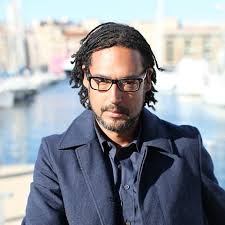 David Olusoga is a rather handsome mixed-race gentleman – half-Geordie, half-Nigerian – who has recently blazed an educatory trail of enlightenment across the world. His mission has been a continuation of the salvage jobs on black history made a generation previously by historians such as Peter Fryer. Through these joint efforts, the invisible voices of the African diaspora that permeated the white world, often brutalised by chains, are given at least some breath. The core of Olusoga’s directive is that there is something of a watershed moment taught to all our children, that British history remembers only the abolition of slavery, & chooses to ignore the desperate unholy years before emancipation. The same classroom texts are also stuffed full of spinning jennies & factory chimneys, but nowhere do we read of the cotton fields of America which were the lifeblood of the Industrial Revolution.
Olusoga is a man of spring temperament; charming, gentile, soft spoken, he expertly wove a comprehensive tapestry of his subject matter for a packed house. Then came the thirty minute Q&A, all chaired consummately by Celeste-Marie Bernier, & it turned out that Olusoga has almost accepted defeat, that the classroom is not the place to educate our future generations on black British history, but we should leave it instead to demographics, & perhaps TV programs such as the ones he produces on the subjects. This left an unusual aftertaste, for when something vitally important needed doing about rewriting black history, Olusoga actually did it, but has then almost lost faith in what he has done. Even so, the forest of hands that remained straining at the end of the Q&A is proof that there is a lot more debate to come on black history, & it is through passionate historians like Olusoga & those to come that this will hopefully occur.
Reviewer : Damo
The Power of Translation: Nick Barley introduces Daniel Hahn, Kari Dickson, and Misha Hoekstra
Edinburgh International Book Festival
Garden Theatre, Charlotte Sq.
16th August 2017
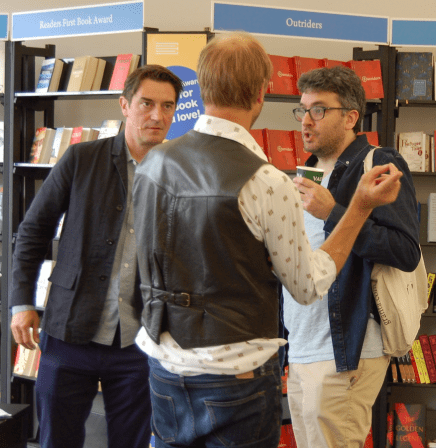
Many events at the Edinburgh International Book Festival are hard to ignore. In some respects picking events to go to is rather like sifting through a longlist, narrowing it down to a shortlist, and deciding who gets the prize of your attendance. We all have our own views about what is, or was, or will the best event this year. However, when a contending event is chaired by the Director of the Festival, who was also the Chairman of the 2017 Man Booker International Prize panel, and the event includes a fellow judge who happens to be the Festival’s go-to-guy in matters of translation, and one of the other participants translated one of the shortlisted books, AND the remaining participant is a fine translator in her own right (reviewer pauses here for breath), that event has to be on the mother of all shortlists.
Setting aside the issue of whether literary prizes help perpetuate an attitude to fiction where gatekeepers tell us what is and is not ‘literary fiction’ as opposed to popular fiction, this event was outstanding for the way it gave an insight into the art and science of translating. It was so fascinating that by one third of the way though I forgot I had to review it and found I had stopped taking notes. So what follows are impressions. This will not be the last time I will say this, but an hour, with forty-five minutes of chaired talk and fifteen of questions and answers is too little for events like this. On the other hand, the audience leaves with its curiosity whetted and a book or two on their shopping list. Nick Barley, in the chair, steered things with great ease, and the early intervention of a question from the auditorium about dialect enabled him to bring that very issue to Kari Dickson, who recently worked on a Norwegian text full of dialect. The Norwegian language exists without the burden, some would say, of a ‘Received Standard’ version. The country’s population is roughly the same as Scotland’s, but spread out over much further. Every town – every village, every valley, according to Kari – has its own dialect, and all are regarded as valid ways of speaking Norwegian. But translating a remote Norwegian dialect into English is a different matter. In the UK dialect and accent are the fuel of value judgments. So rather than translate into an identifiable dialect from a British region, Kari chose to construct one. That’s not without its problems when, in two adjacent lines, someone shouts “A want t’fuck,” which looks as though it ought to be Lancashire-speak, and someone says ‘thar’ for ‘there’, which seems distinctly Appalachian.
The problem of whether to translate a well-known Danish phrase by using its well-known British equivalent was also raised. Misha Hoekstra translated Dorthe Nors’s Man-Booker shortlisted Mirror, Shoulder, Signal. Those words are a precise translation of how learner drivers are taught the skill of turning in Denmark. So why not call the translation ‘Mirror, Signal, Manoeuvre’? The answer is that the English translation also goes on sale in North America, where the routine for turning a car is taught differently again. So the decision was made to stick to a direct translation. But then there was how to render the idea of a pedestrian crossing – in the end that became the transatlantic ‘crosswalk’.
Misha and Kari gave us readings in Norwegian and Danish, and if beforehand we had been tempted to think of all Norse languages as being somehow interchangeable, hearing them spoken in juxtaposition highlighted their differences in sound and cadence.
Perhaps the ‘star of the show’ – if that is a valid description – was Daniel Hahn. He is no stranger to the Festival, and when asked to speak about the books that had made it onto the Man Booker International shortlist he spoke rapidly, fluently, and clearly. If there was anything I would liked to have time to ask him directly, it would have been a follow-up to his remark in answer to a question from the audience about punctuation. The questioner had noticed a difference between the speech marks used in Norwegian and English texts. Although the question had been directed to Kari, Daniel intervened to say that the practice was to aim for the most ‘neutral’ usage in the target language. It had been in my mind to ask about the danger of assuming that the target language in a translation, particularly if it is the translator’s own, is somehow a neutral medium. But I didn’t get the chance to ask it, and it didn’t really matter.
Yes, these sessions often seem to short, and yes they often raise more questions than they answer, but that’s no bad thing. And as long as the Festival keeps serving up events like this, I’ll be only to happy to go along to them.
Reviewed by Paul Thompson
Teju Cole: Blind Spot

Edinburgh Book Festival
13th August 2017
Teju Cole is hard to pin down into a category, and I expect he likes it that way. An award-laden Nigerian-American author, photographer, art historian and critic, including for the New York Times, Teju was talking with Chicagoan Elizabeth Reeder, currently Lecturer in English and Creative Writing at Glasgow University. The hour began with photographs from his new book displayed on the screen, as he read the poetic and intriguing text that accompanied each one. It’s a huge, 300-page tome of both photographs and accompanying text, which takes longer to read than a novel of similar length due to the time taken to study and reflect on each image. He’s the author of four books, seemingly unrelated, but actually forming a loose quartet of themes. Reeder talked about Cole’s circular technique of ‘return’, looking at something again and again to explore it in a different or deeper way, similar to the spiral-like structure of Toni Morrison’s more complex novels.
The images ranged from a young boy in sea water wearing a black glove, eerie simple wooden crosses at the US-Mexican border, a potentially ominous water standpipe in Brooklyn, scenes in London, Lagos and the French countryside. He lets us see these snaps of life through his personal lens, anchoring each one with a snippet of story, history and meaning; the pathos of the the disabled daughter like ‘an astronaut far away from home’, and the beauty of ‘the bunting of vintners’ blue nets’. The name Blind Spot plays on several ideas. The lack of meaningful reference points, our blind spots when looking at unfamiliar peoples and places that are barely, superficially or falsely represented in the mainstream. Cole’s own brush with temporary blindness in 2011, which no doubt spawned a renewed appreciation for the gift of sight, and a sense of double vision; looking outward and inward at the same time. Because he is a multi-media artist, when his work is in a gallery, he is able to play with form, structure and logic to different effects, and may just compress his show into just 7 chosen slides. He’s open to new forms, including live performance, depending on whatever channel the work needs to express itself through, and has been inspired greatly by film.
Cole regularly revisits, in his own words, several particular themes. Human fragility and the uncertainty of the body, issues of faith and religion, and thirdly, political tension, and quotes the enduring influence of Homer’s Iliad on his world view and art. Because he is both a photography critic and photographer, one set of skills and knowledge intimately affects the other. He admits that the text can both explicate and complicate, which provoked of the audience members to ask for more explanation. “I don’t know,” he said with a smile, “I could just make something up.” He suggests that having words with pictures forces the viewer to slow down and gaze at the pictures for longer, even though he humbly suggests that the images themselves are “aggressively banal”.
Reeder wondered about travel and how it informs his work. He said the work was never about travel per se, but more “how to go to places and be completely depressed”, making his the anti-travel memoir. He explained that although certain symbols have become instantly recognisable symbols of a place, acting to supposedly differentiate it from other places was often actually false representation, being only espoused by a tiny minority. Scottish men in kilts, for instance. He prefers to look under the surface and find the essential differences in the history of what created the peculiarities of that particular place, precisely because each place has a vested interest in suppressing its own history.
Yet the love for the art forms themselves is strong. As well as to make people think in new ways, his goal is also creating pleasure. His satisfaction comes from the fact he is able to shape and prepare an experience for the reader/viewer. Just like a pianist playing legato, where the flow of the notes creates the beauty and the feeling of pleasure, good writing does exactly the same. His metaphors and worldview lean to his Nigerian background and culturally holistic patterns of thought and debate, such as allowing ‘windows for spirits to get in and out’. We’re keenly aware that we are just being allowed a peep into his vast, hidden depths and wish he could continue in his humble and softly-spoken way, with what he finds most difficult and we find so wildly compelling; ‘making his vulnerability formal’.
Reviewed by: Lisa Williams
Sunil Khilnani @ the EIBF

—————
Mon 14 Aug
————–
India, India, India, how does one make sense of India. Well, in his book ‘The Idea of India’ Professor Sunil Khilnani certainly tried to grasp & bottle at least some of the distilled spirit of that megaland. Now, 70 years exactly since independence, he is offering a new book, a brave attempt somewhat, to create a history of India using only 50 biographies – that is 50 lives out of the many billions of Indians who have made the subcontinent their home. In the Q&A at the end of Sunil’s 30 minutes, he was asked whether 50 was enough. His response that more than a 100 had made his short-list, but since whittling them to 50, he was happy with the result. ‘One does not miss an amputated arm,’ quipped Sunil, & we were all ready to accept his judgement. Indeed, Sunil speaks with authority, & is pleasant to listen to, rather like taking the mountain railway through the Niligris Hills; slow, sure, with spectacular views.

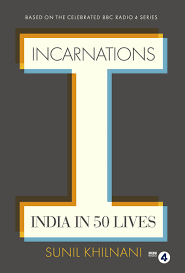
It was my first visit to this year’s bookfest, which I found expanding into George St like a great novel one is writing just can’t quite get to the end. ‘Just one more sub-chapter, to embellish the second sub-plot…’ Entering the Studio Theatre with me were acolytes of Indian culture history, & of course fans of Sunil’s 50-part podcast series which formed the basis of his book. The ultimate caveat of the work is to strip away some of the myths of Indian history – & their politicization – & to present them in a relatively orderly fashion like some feral & unchecked Oxford Dictionary of Biography. A life is, in Sunil’s words, ‘a critique of society,’ & among the pages, billionaire tycoons sits alongside the Buddha & Vivekananda, while Gandhi is celebrated for his media manipulation during his protests marches, while at all times the very latest research, including declassified documents, buoys up the body.
Professor Khilnani began his upper education in Edinburgh – he did his A-Levels here – & hearing him speak on his return to the city, the ghosts of his long-dead tutors were immensely proud as they filtered into the room to hear their protege speak. Incarnations, A History of India in fifty lives, is a fine moment in academic history & may become the bedrock for all Indian biography, which up until recently has been firmly entrenched in hagiography. That land is just too vast to focus on a single individual – a fifth of humanity dwell there as I write – & stories are better told when minds & movements mesh, & through works such that presented by Sunil will enable Indians & the world at large to obtain a deeper grasp of history, to dismiss the corrosive stereotypes.
Reviewer : Damo
Magnus Mills – The Vinyl Countdown

Edinburgh International Book Festival
Garden Theatre, Charlotte Sq.
14th August 2017
“When Gregor Samsa woke up one morning from unsettling dreams, he found himself changed in his bed into a 12-inch LP.” Well, no, not exactly. Though I have to say that if an event is touted “High Fidelity meets Kafka” that’s what I would expect. In fact Magnus Mills’s ninth novel, The Forensic Records Society, starts with Keith Moon’s off-mic shout of “I saw yer!” from the end of The Who’s ‘Happy Jack’, or so he told us today in the Garden Theatre.
When I visit the Book Festival I like to go to events about books I haven’t read. That way I know that if I want to read the book by the end of the event it has been a success. I haven’t read The Forensic Records Society. So do I want to?
Magnus Mills was introduced to us by broadcaster Joe Haddow. In contrast to Joe’s genial scruffiness, Magnus appeared as a tall, lean, unsmiling, quiet-spoken, suit-buttoned-up wight. That was a front. There’s a dry wit lurking not far below the surface. There’s also a man who knows vinyl, who knows how long ‘Complete Control’ by The Clash lasts, who has a collection of nine hundred vinyl singles all filed alphabetically. He’s a man who knows vinyl geekdom first hand.
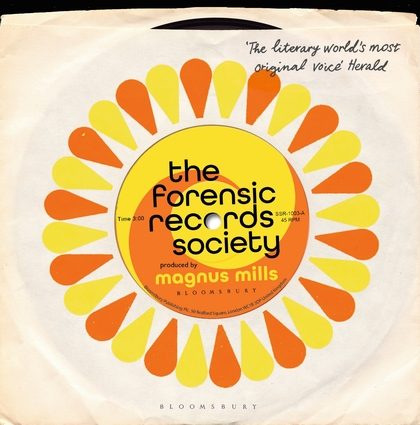
Although Magnus says that The Forensic Records Society comes from his imagination, not his experience, that the pub in which the eponymous Records Society meets is not actually his local – the Pineapple in Kentish Town – and that the characters who haunt the novel are not based on anyone he knows, I am certain that there must be one or two knowing winks here and there. The book’s basic premise is that a handful of enthusiasts start a record club in a private room of a pub. The club has very strict rules, its founder, according to the event blurb in the Festival brochure, is a man of uncompromising dogmatism. When a second record club – The Confessional Records Society – is set up in the same pub on a different night, and is more arcane, more impenetrable than their own, their narrow microcosm begins to experience a power-struggle. Magnus has certainly come across the kind of defensive/counter-offensive dogmatism he portrays, if we believe what he says about someone’s reaction to a casual remark:
“I just said I thought the White Stripes were just messing about most of the time […]
I felt like I was in court!”
Magnus read some extracts for us, and in between slipped a couple of 45s onto a fifty-year-old deck he had brought along. ‘Waterloo Sunset’ by The Kinks, that was fine, but Fleetwood Mac’s ‘Man Of The World’ developed ‘wow’ and had to be taken off. No matter, as the extracts from the novel were intriguing enough. He has a style of writing that, if I didn’t know better, I would say hadn’t changed since he was about sixteen and was still trying to impress us with the way he handled the English language. There were no contractions, no couldn’t, no wouldn’t. Characters didn’t ask, they “demanded.” A character “adopt[ed] a casual manner,” or “offered words of consolation.” The dialogue was full of bewilderment and awkward pauses. But that worked! It all seemed to fit the narrative voice of the novel, and to be just right to express obsessive geekery. Magnus owned up to having “a sarcastic manner,” and it showed in the extracts he read out. That also reinforced the impression that it is a very ‘male’ novel – most of the characters are men – but that seems okay, as obsessive hobbyism tends to be a very ‘male’ thing, as Joe Haddow pointed out. In any case, Magnus says, he doesn’t really understand women, so why do them the disservice of writing about them from a position of ignorance.
Magnus Mills was brought up in a family where the paterfamilias did not believe in and did not allow commercial broadcasting – there was no ITV, no Radio Luxembourg, certainly no Radio Caroline. In a way Magnus has steadfastly refused to move on, he does not own a CD player. Just those nine hundred singles and fifty-year-old deck with wow. Joe Haddow reminded him that vinyl records were making a comeback, and he said that he had bumped into a teenage girl in the street:
“I said, ‘Oh, you’ve got a record player’, and she said ‘Yes’. I didn’t know what to say next.”
So do I want to read The Forensic Records Society? Yes, I rather think I do. Further than that, notwithstanding its being full of male characters, I’m going to recommend it to my wife. Those awkward pauses in the dialogue remind me of a Discworld novel, and she likes those. Ha! Discworld! See what I did there?
Reviewed by Paul Thompson
Luka Lesson, Jenny Lindsay, Omar Musa and Michael Pedersen: The Poetry of Performance
Edinburgh International Book Festival
Bosco Theatre
12 August 2017
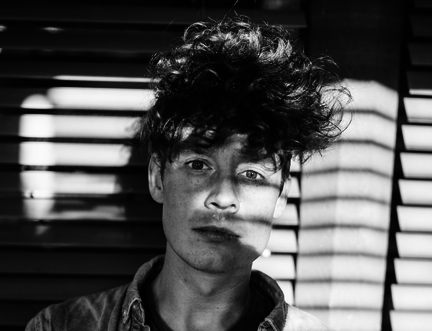
This event was a one-off event for the Edinburgh Book Festival as part of their series Babble:Spoken Word. It was the result of a week in May of intense collaboration between Australian poets Luka Lesson and Omar Musa and local Scottish poets Jenny Lindsay and Michael Pedersen, now fully developed into an electrifying performance. They had already shaken us up with their teaser at the Scottish Poetry Library in May, and didn’t renege on their promise of a bigger, bolder, polished show on the opening night of the Festival.
Jenny Lindsay, well loved on the Edinburgh and Glasgow poetry circuit with her Rally and Broad events series, starts with a wry piss take of ‘Edinburgh, oh Edinburgh’, with a knowing sigh and sarcastic weariness. She threw the first of a few well-aimed jabs at its contradictions; ‘dreadlocked fire eaters alongside a career in buy-to-let’, Edinburgh, the ‘old tart’, prostituting itself to American tourists with its packaged history on the Royal Mile. And so begins a night of magic journeying through life and lands, as each poet takes a turn on the mike, again and again, the four comrades arm in arm, skipping down the yellow brick road.
Jenny is the warrior woman, the person whose words empower you to throw off your artificially crafted burden of femininity, your ‘box of false womanhood’ and reveal yourself in all its fullness. Omar is the lover; seductive in his handsome sturdiness with tender odes to the freckles on his beloved’s face, turning ‘fireflies at night’ in his poem ‘Lantern’. Michael is the jester; his frenetic energy spitting out of his wiry frame and high top hair, with perfectly timed, quintessentially Scottish punctuations of self-deprecation. And Luka, the High Priest, staring into the infinite, and taking us all with him on his mythic quest to find Self. They would resist these simplistic labels, rightly, as they all share these characteristics in their own defined and unique ways. Each one sharing a common human story of struggle; telling their stories with expletives, wild tenderness and jokes.
Jenny savagely mocks the middle class making art out of others’ suffering; those looking to find prettiness in others’ poverty, a young girl stuffed full of fish fingers and CBeebies singing somewhere over the rainbow’. Contrasted with these poets who do it right; as they bring us the real beauty in suffering, plunging and probing into the heart of our tough realities. She brings forth some wry laughter with her acute observations of modern predilection for dating at arms length as a text bounces in at 1am with ‘I promise I won’t fall in love’, juxtaposing it with the miserable, desperate ‘glory days’ of lifelong marriage. Michael, whose performance and power racked up several levels since the original, tentative reading at the Scottish Poetry Library, rapidly fired a cannon of finely crafted images onto the screen inside our minds; from junkies to vicious birds at a BBQ, passionately letting us see the underbelly of Edinburgh in a new light. Breathlessly talented with words, he’s expert at playing with pauses, to create pathos and great comic relief.
My favourite one from Omar is his journey to a planet where everything is perfect; his first love still loves him, his father plays without a hint of malice, and best of all, he can understand his grandmother perfectly as she speaks to him in her mother tongue, Malay. We hope this is a version of the promised heaven waiting for us all. All the poets share a common struggle of fighting different types of marginalization, and as they share their fight to come from the margins to the centre, the power of their voices comes from it being very much on their own terms. They are angry because they love. Truly loving anger is a rare thing, but this is the special experience we were fortunate enough to witness.
Luka bestows on us a touching new poem, ‘I killed a man’. Like Omar’s rise from his tough home town of Queanbeyan, where boys ‘get hard at the thought of carnage’, managing to keep his heart open along the way, Luka shares his inner transformation as he walks the age old journey; shedding the old restrictions to newly embrace what was inside him all along as he ‘healed a man’, in a cave in Greece, the home of his ancestors. And what glorious ancestors they were, as he invokes their presence to call on their strength, positioning himself in the long, unbroken between them and his imagined great-great-great-great-great granddaughter. Luka’s respect and love not just for his ancestors, but the land and the original people of Australia despite and, importantly, because, of the existing power structures’ attempts to ‘colonise, compromise and conflict me’ shines through his whole being. Like a true mystic, as he looks into the distance but flickers a warm smile over the audience, he exhorts us to see beyond our twisted histories and false sense of separation, and live as our divine selves.
Sometimes poetry can feel self-indulgent and pointless. But as the night’s themes spiralled around from childhood, to love, to loss, to dreams, to personal and common struggle, these poems felt vital. Not just alive, but vital to our sense of feeling. Vital to our sense of connection. The same struggles, same hurts, same hopes, from human beings coming together from thousands of miles apart, reminding us we’ve been doing this for thousands of years. Like the fireworks firing away up at the Castle between and around the poems, those carefully chosen words and crafted phrases took turns to sprinkle over us like fairy dust or pepper us like mini shrapnel. Jenny and Michael we can catch up with again in Scotland, thankfully, but our Australian preacher-priest-poets have to fly away, leaving behind their trails of tales…..As Omar and Luka share the stage to end with their hip-hop influenced poem-song, ‘The Light’, we we know we’ve been privileged to have shared a truly moving and transcendent experience.
Reviewed by: Lisa Williams
An Interview With Magi Gibson
 Hi Magi, where ya from & where ya at, geographically speaking?
I was born in a castle on a hillside, with high stone walls and a magnificent wood-panelled entrance. One day it metamorphosed into a university with white swans on a beautiful loch. It sounds like a fairy tale, but it was real life in Bridge of Allan, Scotland. OK, at the time the castle was being used as a maternity hospital, and I was only there for a few days before I was brought home to the small mining town of Kilsyth, 11 miles north of Glasgow. An ex-weaving town, with a strong socialist tradition, the pits were already closing down as I grew up. I walked past huge black bings to go to primary school. My childhood there growing up in a council house shaped me. I’ve lived a lot of my life in and around Stirling and Perthshire – with a year in Paris – and I now live in Glasgow.
When did you first realise you were a poet?
1985 I realised it was a possibility. I’d just started writing and I read the first poem I ever wrote at an event to celebrate the contribution of miners’ wives to the miners’ strike. It was in Stirling Miners’ Welfare Hall and there were about 200 people squeezed in. I was terrified. The poem, “My Father’s Dungarees” is essentially about shame, bullying and pride. They loved it and took the copy I’d read from and pinned it up behind the bar. The connection with the crowd was electrifying. Personal and political. I knew instantly I wanted to do that again.
Which poets inspired you at the beginning & who today?
When I was wee, we had a huge, old family book of the complete works of Robert Burns with copperplates and I was allowed to put it on the table and read it. I loved rolling the Scots words around in my mouth. At secondary school I loved the Romantics. But as a woman, reading the Polish poet Anna Swir was pivotal. The way she writes about the female experience, from the body, as if it’s universal, with such a quiet, pared-back quality, yet such depth. Other favourites are Sharon Olds, for her dark wit, Adrienne Rich for her subversive wisdom and daring structures. Norman MacCaig for his off-kilter way of squinting at the world. Anne Sexton for her courage. At the moment I’m going through a wee love affair with Imtiaz Dharker. I love the musicality of her lines.
 You are a widely loved & read poet along the length & breadth of Scotland, Magi Gibson. Your works have been published by all the main Scottish publishers. Can you tell us about the poetry scene in your native land?
It’s vibrant and varied and poetry thrives in Gaelic, English and several varieties of Scots. Like many poets I can be relatively reclusive, but the Internet lets me peek into corners, and I’ve travelled extensively. There are a lot of poetry communities in Scotland’s main cities, from rap to spoken word to page poets. Writing in every form imaginable. And lots is happening in more remote areas too. I’m always pleasantly surprised when I get an invite to Peebles or Skye. (Note. It’s been a while. How about asking me back?) And, of course, as well as community groups and on-line groups, universities now run creative writing courses. All very changed from when I was first writing and you were lucky if you could find a local writing group with members under the age of 90. We’ve lost some of the best paper magazines from years ago, like Cencrastus and West Coast Magazine. Chapman is all but gone, and it looks like Gutter will disappear, both of which will leave a big hole at the quality end of Scottish publications. But we’ve gained The Poets’ Republic, with its Gaelic section, and we still have Northwords Now, and Pushing Out the Boat which I was founding editor of in the north east in 2000. I’m sure there are others I don’t know about. I don’t keep a close watch. And there are on-line magazines like Glasgow Review of Books with its interest in poetry in translation. In years to come I imagine this will be seen as a very vibrant time for Scottish poetry. Partly because of the turbulent political times we’re living through. People have a lot to feel uneasy about. A lot that needs expressed, and poetry is a good means to do that. But partly because poetry has been given more prominence by posts such as that of Scottish Makar and the Makarships of cities like Glasgow, Edinburgh, and Stirling, where I was Makar for three years.
What drives you to create a poem?
An itch in the soul. Something snagging on my consciousness, that I can’t shake free. It might be something glimpsed that’s achingly beautiful. Or something that happens that disturbs me, something I can’t resolve in any other way than working it through in a poem. Anna Swir said, “The poet has a conscience with room to grow. What does not, as yet, shock and outrage others, shocks and outrages her.” A lot of my poetry bursts from that initial shock to my conscience. Like the poem, West End, Friday Night, when I almost ended up in a punch-up trying to save a young woman from being mugged. Other poems burst through from a love for humanity, like Mother and Child, about a young woman breast-feeding in an art gallery. Some are deeply personal, like My Mother’s Funeral, yet I know from poetry readings, that that poem touches many people deeply.
Early Morning Train to Inverness
from time to time snow sprinkles from the sky
the way flour sifts from a baker’s fist
grey steel pylons pose like giant girls
playing ropes
gorse, dark bottle green, bristles in scruffy tufts
on a badly shaven chin of hill
a woman in a suit tap-taps at her laptop
in communion with the shimmering screen
scots pines turn their Presbyterian backs
on a stream that pishes like a drunk
a lochan slate-grey bides her time, swollen-bellied
in February, her waters will break in March
a woman paints her nails, the air
thickens with the reek of varnish
Slochd summit snow, a crumpled duvet
chucked on the chittering land
Look! Look! A red stag with forked lightning antlers
poses for a tourist’s pointing finger
a mobile phone skirls Scotland the Brave
between peaks that rise like stony breasts
a yellow lorry carrying eggs, races the train
as packed like battery hens we hurtle on,
we hurtle on, we hurtle on, towards breakfast,
and you, and Inverness
What does Magi Gibson like to do when she’s not being poetic?
I used to be very sporty, running 10Ks, and when I was younger playing basketball and doing lots of dance and exercise classes, but ill-health has put a stop to such excesses. Now I read a lot, with spates of bingeing on novels. My husband (Ian Macpherson) is a former stand-up and now writes books. We both work from our small west end flat, so our days are organised around each other. Chaotically. With much laughter involved. We’re a bit like two children happy in our imaginary world. Which includes an imaginary cleaning woman, Hilda, who forgets to Hoover or dust, but hits the gin hard. We go walks each thinking the other is leading, and we end up lost. We drink lots of pots of tea. (Loose-leaf Assam, for the aficionados.) We enjoy having to go to book festivals both here and in Ireland, and we go off to the Highlands for what we call writing retreats when we can.
Can you tell us about the Wild Women Writing Workshops you host?
I was asked to pitch an idea – something a bit different – to West Cork Literary Festival in 2011, and ‘Wild Women Writing’ based on my poetry collection, Wild Women of a Certain Age, seemed a perfect fit. The three day workshop not only sold out, it was over-subscribed, with women driving for over an hour on the first morning in the hope of a stand-by place. We extended it to five days to accommodate the demand. And that was it. The concept was fully born. I run the workshops over three or five days at a festival, or as an eight or ten week block. Sometimes I do a one-off ‘taster’. Each workshop is designed to unlock creativity and remove blocks that may have been holding the writer back. We may well cover the craft of writing, and how to get published, but that’s not the primary aim. The primary aim is to produce new and different work, for the writer to challenge and surprise herself. The workshops are always sold out, and deliver very positive results. Sometimes women get in touch years later to update me. I hold them only intermittently though, as they drain a lot of my own creative energy. In order to lead them I need to respond to the dynamic of the group as well as the needs of the individuals as much as possible. Each of the women will have a different starting point and a different writing goal. It’s a creative journey I ask the women to come on with me, so it’s not a set pattern where I can say in advance exactly what we’ll cover. Though I can say that all source material will be from women artists and writers and there will be laughter and surprises along the way.
What are, for you, the differences between poetry written down & performance poetry?
I like my own poems to work, as far as possible, both on the page and in readings. I do perform well, and can hold my own on any stage, but I’m not a performance poet. The joy for me in going to poetry readings, which I did as much as possible when I started writing, is always to hear the poet’s voice. I remember early on hearing Norman MacCaig, Ian Crichton Smith, Edwin Morgan, Tom Leonard. When I read their poems on the page afterwards their voices sang back to me, adding an extra dimension. And later I read on platforms with them all. Performance poetry seems to me to be a more high voltage affair. More of a theatrical experience, a word-lovers’ comedy/cabaret cross-over, an emotional roller-coaster of an immersive crowd experience. But sitting quietly at home with a book, and a lamp, and the curtains closed, reading a poem, that is such a still, private pleasure, and suits me in my introvert state, the syllables and sounds dancing in the brain, the images spooling behind the eyes to the rhythm of my own quiet heartbeat. And after, letting the poem connect with my own life experience, the thoughts reverberate, sift and drift… And, of course, there is a whole skill to getting the poem to sit on the page so that the tension of the line works the way you want it to against the white space, so it reads back the way you want it to in the reader’s head. That’s a whole other challenge.
PATRIARCHAL CONSPIRACY #53
when I type in feminist
it autocorrects.
now my T-shirt reads
this is what a fantasist
looks like
What does the rest of 2017 hold in store for Magi Gibson, the poet?
I need to wait quietly and make space for poems to come creeping up on me.
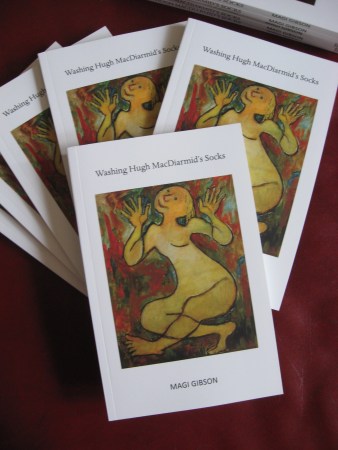
There will be more readings from the new collection. There’s lots of parts of Scotland I’ve still to talk Hugh MacDiarmid’s Socks to! There will be many more cups of Assam tea. And the first Wild Women Writing Workshops in quite some time. I’ll be setting dates for them very soon. I’m headed to Aberdeen on Saturday 12th August, 7.30pm for a poetry reading hosted by The Poets’ Republic at The Blue Lamp where I’ll be reading with Northern Irish poet, Matthew Rice, one of the ‘best new British and Irish poets 2017’. And I’ll be reading and discussing poetry and writing and politics at two events on Tuesday, August 22nd at 1.45pm and 3.30pm at the Edinburgh Fringe at ScotlandsFest. Venue 40 • Quaker Meeting House 7 Victoria Terrace, Edinburgh.

