Border Crossings: Laura Accerboni & Kathrine Sowerby
StAnza International Poetry Festival
The Undercroft, St John’s House, St Andrews
9th March 2019
The Undercroft is an intimate, arched, windowed cellar room belonging to the School of History at the University of St Andrews. It is almost too intimate for a mic’dpresentation, but being long and narrow it is not intimate enough to do without. Thereon hangs a problem: microphone technique is not something that everyone has, and a simple operational slip can cause something unwanted to obtrude.
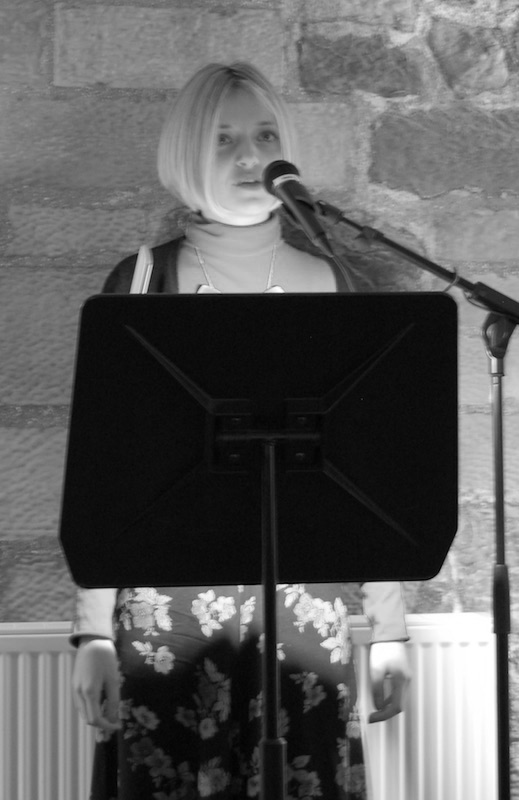
So I’m sorry to start on a negative note – please bear with me. As Laura Accerboni recited her work purely in Italian, she was partnered by a man who alternated with translations into English of each poem. He sat while she recited, and vice versa; the lack of space meant that they had to shuffle round each other to get to the lectern, and whilst Laura recited from memory, her English reader referred to a script, spoke with his head down, approached the microphone too closely, and treated us to a series of plosive, overdriven consonants. Added to that, his script was organised in such a way that on several occasions he had to turn over his corner-stapled A4 sheets in the middle of a poem. Interruption of speech. Rustle, rustle. All this could have been avoided with a tiny bit more planning. He and Laura could have both stood, either side of the lectern, approaching and retreating as necessary; he could have had a better-organised, less unwieldy script. That would have added the little bit of polish that had worn off Laura’s half of the event.
Did it matter much? Well, to be honest, not when one considers the poetry. Laura’s wont is to stand immobile, arms by her side, and almost declaim her work, the listener, to whom it is xenoglossy, being made aware of the aural qualities of the Italian language. Each line of poetry seemed to take a single breath, and there was a rise-and-fall there, regardless of enjambment. As I listened, I recalled how Swiss French has this kind of rise-and-fall, and wondered if what I heard was some characteristic of the spoken Italian in the same country. As my own knowledge of Italian is very sketchy, I found myself listening as though to Baroque music – Scarlatti or Pergolesi – and reflecting how much Basil Bunting would have approved of that! The lack of movement of limb or feature in Laura’s presentation meant that every syllable was crystalline, and that aspect of her half of the event was utterly captivating.
One thing the English translations certainly did do was reveal the sometimes startling imagery behind the musicality. Otherwise who would have guessed, for instance, that “Yesterday all the tallest boys / made their enemies starve / and quickly gathered up their toys. / They showed their mothers / the order / and discipline of the dead.”

The matter of translation is something both poets at this event shared. Katherine Sowerby – we learned from the chairman’s introduction – had recently taken part in poetry translation projects in Pakistan and Latvia. Katherine, right at the beginning of her half, signaled her intention to read twelve poems. It was that structured. There was to be no looking across at the chairman to check how long there was to go, no fitting in a couple of short ones at the end. Twelve were scheduled and twelve is what we got. The result was that this session of ‘Border Crossings’ had a ‘short-and-sharp’ feel to it, the whole event lasting little more than half an hour. Although her delivery was not as straight-ahead as Laura Accerboni’s, although there was animation in her face and voice, there was a non-nonsense feel to the presentation. Title, poem. Title, poem. Title, poem…
House However, her most recent collection, from which she selected part of her presentation, consists of sixty-two prose poems. If, as another contemporary Scottish poet said, poetry is whatever prose wouldn’t dare say, where does that leave ‘prose poetry’? in Katherine’s case it leaves it in a place where (yes!) short-and-sharp images can be strung together, teasing us with their apparent lack of relevance to each other but, true to the concept of gestalt, making up a whole that is other than the sum of their parts. Sometimes, despite this, there is deliberate repetition (“You want to reach us. You want to reach us. You want to reach us. You want us. You want us. You want.”), often there isn’t (“The creak of a chair. Our lit-up faces,” or “Mountains cut in half. I wear a shirt from that day. You told me the cost. You asked me questions about my microwave.”). The answer is, therefore, is that prose poetry can indeed fulfill the same function as any other kind of poetry, move us out of our comfort zone in which we expect step and step, cause and effect, day and night.
All of which leaves me wanting to read Katherine’s three-novellas-in-one-cover, The Spit, the Sound and the Nest, to find out what in her poetics feeds into her fiction. Poets can make the most startling storytellers, and a story would add yet another dimension to what I was able to experience today.
Paul Thompson
An Interview with Megha Sood

Megha Sood’s talent began blossoming in the Himalayan foothills, these days it is flourishing in the streets of New Jersey…
Hello Megha, so where are you from & where are you at at, geographically speaking?
I was born in a quaint little hilly city called Nangal, Himachal Pradesh, India. I have spent most of life in India and traveled a lot around the Northern states as my father was transferred often. After getting married in 2008 I shifted my base from India to the east coast of the United States. Now I live in Jersey City, New Jersey. My home is next to the beautiful Hudson River.
When did you realise you were a poet?
Writing poems has always given me that cathartic feeling and to pen down your deep thoughts have always given me solace. Writing in any form lets you connect to your deeper self. This change in perspective made me realize that I have a grown appreciation of these moments around me.That slowly seeping feeling was the affirmation of me being a poet and along with a growling list of publications.
Which poets inspired you, both old skool & of today?
I have been influenced by modern poets, such as Kaveh Akbar, Peycho Kanev, Rupi Kaur, Nikita Gill, Shel Silverstein, Lang Leav, Ocean Vuong, Tiana Clark, Danez Smith, Elizabeth Horan, Courtney Poppell, to name a few. Classic poets have also inspired me. I love to read the amazing and soul-stirring poetry of Maya Angelou, Ruskin Bond, the confessional poetry of Sylvia Plath, the dark and surreal poetry of Edgar Allan Poe, and the mesmerizing sonnets of Rumi. Also, being a member of literary collectives, I’m extremely blessed to work with and read the amazing writings of the talented poets of the WordPress, such as Christine Ray, Kindra Austin, Georgia Parks, Kristiana Reed, Devika Mathur, Aakriti Kuntal, Nicholas Gagnier, and Stephen Fuller.
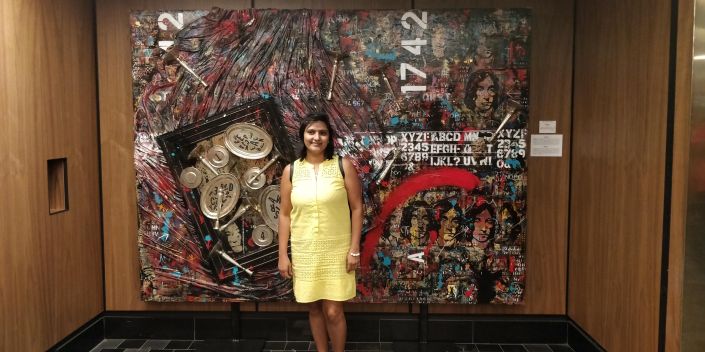
What does Megha Sood like to do when she’s not being, well, poetic?
I’m the mother of a smart and energetic 8-year-old boy. When I’m not writing I’m taking care of his activities along with the regular chores.I have also worked in the IT field for almost 12 years as a Project Manager in Business Intelligence and Data Mining. In the last one year, there has been a boost in my writing process and I’ve been blessed to be part of six literary collectives.I’m a collaborative member and associate editor in many of them. So in addition to writing and submitting for my dream publication(s), I also get the chance to review the submission for these Literary collectives and prepare for the next Issue.Being a contributing author on many of these requires me to submit poems occasionally. I also moderate regular features such as ” Pay it Forward Thursdays” on GoDogGO cafe. Also, I volunteer as class president in my son’s school along with a few neighborhood activities.
You have your fingers in quite a number of poetical pies, such as GoDogGO Cafe & Whisper and the Roar – can you tell us about this?
GoDogGO Cafe is a virtual Cafe on WordPress which serve as a place where all writers are welcome, collaboration is encouraged. It was founded by a fellow poet Stephen Fuller and now have raised to the string collective of 16 members. They are brimming with daily features( Writing prompts, Pay it forward, Promote yourself etc) and are inclusive of the writers of the WordPress community. To me, it is a warm and cozy virtual cafe where all writers are invited. It was one of the first few literary collectives which not only published my first poem but also invited me to join their amazing team of writers. Whisper and the Roar is a feminist literary collective founded initially by Georgia Parks and now a strong team of 15 collective members. All the members are well-established authors and seasoned writers with a long list of books and publications under their belt. In addition to the above, I’m also a collaborative member for the Poet’s Corner ( UK Based Poetry website), Candles Online ( India based writing portal) and recently have joined the Ariel Chart ( a signatory of pw.org) as an associate editor.
How on earth do you keep have the time or energy to do anything else?
I was always decent with time management and I guess that skill of mine has helped in juggling all these tasks effectively. There are days where I’m drowned with writing deadlines and there are days where I can simply read, create and revel in the writing of my favorite writers.
When do you know you have just composed a decent poem, & how does it make you feel?
They say if a poem doesn’t stir your soul, it has lost its purpose. As I always say, the writing has been a cathartic experience to me and and I feel if a poem moves me from inside or fills me with the joy of accomplishing something, I know I have written something significant.
You recently won the 1st prize in NAMI NJ Dara Axelrod Mental Health Poetry contest, can we see the poem?
Yes, my poem bagged the 1st place. The prompt was “What’s your song?”
My Victory Song
My heart parts its lips
utter something
pure and divine
like the moon in its reverie
you ask “What’s my song”
I laugh and smile
with beauty imbued with
the fluttering of the
butterfly wings
so sublime;
My heart though brimming
with pain and anxiety
but ready for its encore every time.
My love is boundless
like a star-spangled sky
covering every iota of my soul;
gives me the sustenance
clears out the wool and webbing
from my disordered thinking
and makes me feel alive
once more.
I adorn the scars
as victory marks and
leaves the bloody trails
as maps, who follow;
Pushed and shoved aside
for reasons unknown
I thrash like a juggernaut
crashing and crumbling
the voices which pull me down
I simply ignore.
Waving my victory flag
so fervently
and singing my song
under my bated breath;
Here I come to
conquer the
uncharted waters of
my life
with a roar.
Where can we find your published work?
Last Year I was accepted in the Poets and Writers( pw.org) Directory of Poets and Writers. Founded in 1970, Poets & Writers is the nation’s largest nonprofit organization serving creative writers. Their mission is to foster the professional development of poets and writers, to promote communication throughout the literary community, and to help create an environment in which literature can be appreciated by the widest possible public. The following link gives a comprehensive view of few of the places where my writing has been published. My 290+ poems have been published in the almost 70 literary collectives around the world. To know more about my published works you can visit here. In addition to this my works have been published or upcoming in the following anthology by US, UK , Canada, Australia, Philippines,based publishing presses.
Anthology ( Past and upcoming)
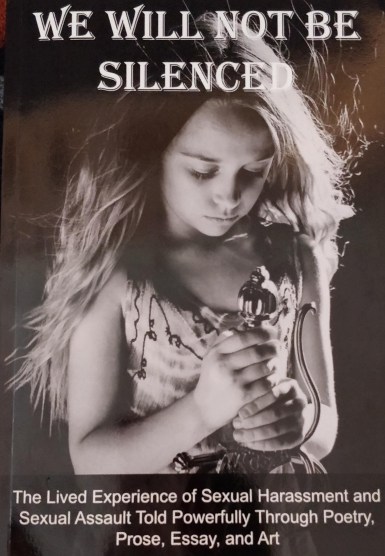
“We will not be silenced”, Indie Blu(e) Publishing, Fall 2018, USA
“All the lonely people”, Blank Paper Press, Feb 2019, Canada
“Voices Carry”, Sudden Denouement Publishing, Feb 2019, USA
Madness Muse Press, Fall 2019, USA
The Stray Branch, Fall 2019, USA
Poetica Vol 2, By Me Poetry Press, Australia, 2019
RECLAIM Anthology, Philippines, 2019
Flight Magazine, Nightingale and Sparrow, March 2019, USA
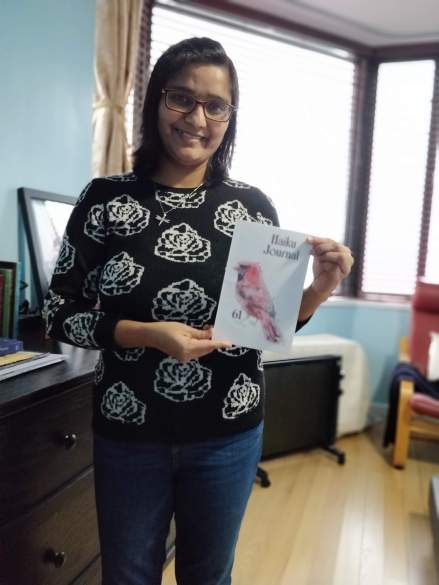
HAIKU Journal, Prolific Press, Feb 2019, USA
Poetry Quarterly Winter Issue, Prolific Press, March 2019
What will you be doing for the rest of 2019?
After getting published online and in a various print publication I am gearing myself to work for on my full poetry collection.In addition to that, I am planning to attend the poetry-related events in and around Jersey City and Manhattan.
www.meghasworldsite.com
Border Crossings: Nadine Aisha Jassat and Mary Jean Chan.
StAnza International Poetry Festival
The Supper Room, The Town Hall, St Andrews
8thMarch 2019
I am ashamed to say that it totally passed me by that Friday was International Women’s Day until I was on the train home. There, I’ve got that confession out of the way, so there is no danger of my falling for the temptation of claiming I came to see these two poets as some kind of celebration or act of solidarity. Nope, I just had poetry on my mind. I had just come from a free lunch at the ‘Poetry Café’, and hearing Nadine Aisha Jassat start off by remarking that she had her “Fisher and Donaldson stash” offstage right made me hope that this wasn’t going to be the “pudding session” of the day. Don’t worry – it wasn’t.

However, wherever I go at StAnza synchronicity seems to keep step with me, and today was no exception. Nadine’s first poem was about her grandmother, who has Alzheimer’s, and whom she refers to as a “time traveller” because of the shifts in time and place that seem to go on in her mind, according to the narrative of her one-sided conversation. Of course I too am a time traveller as I write this review, having just written a review of an event from Saturday the 9th, in which the topic of dementia also came to the fore. Review-writing can be approached phenomenologically, let me tell you… oh… Let Me Tell Youis the title of Nadine’s debut collection, damn this synchronicity thing! As for her grandmother, Nadine says that her time travelling is by turns moving and hilarious, because you can never be quite sure what you are going to get.
I can see the “moving” part of it without any problem; to watch an elder’s memory loosen like a piece of fine, paterned cloth having threads tugged from it must be especially poignant for someone with as many threads to her heritage as Nadine has. Her voice is Yorkshire, her family story is full of other people’s journeys to where she is. Her own journey includes, expressed in a poem – “Hopscotch” – all the words that men have said to her on the street. There is only one up-side of the latter circumstance, and that is the poem itself, its anger presented so gently in a simple reading, used as a reason to create. If you want to hear it in full menace mode, then I suggest the following short film by Roxana Vilk, which is based on the poem.
Mary Jean Chan is a poet and an academic living in London, though originally from Hong Kong. I love the way she delivers her poetry, which is with composure and utter clarity. It’s not surprising to note that when she was a young adult she was a fencer, nor is it surprising to find out, in the context of border crossings, that her discipline was European – she handled an épée – rather than Chinese. Given the subtlety and directness of her poetry, the simplicity of the choice between a straight and pistol grip seems entirely in keeping…
Here I stop and stand apart for a moment. There is a challenge to ‘Border Crossings’, and it is this: how much attention do we give to the ethnicity, or the actual mix of heritages, that the poets bring with them? There are those of us, I suppose, who try to keep this uppermost in their minds, and others whose priority is to try to let the words, the actual poetry, take them. What, on that sliding scale, is appropriate? Each poet – every poet fulfilling a ‘Border Crossing’ role at StAnza – has crossed, or even ‘transgressed’, some of the fault lines that we, humanity, have opened up for ourselves. They have made a conscious journey, taken a step across a metaphorical meridian, made a choice to say this-and-that in such-and-such a way not necessarily their own, or perhaps have brought something very much their own and set it down in the context of a Scottish poetry festival. Take Mary Jean Chan, for example, whose latest collection is called ‘Flèche’. She has already crossed from Cantonese to English; now that French word, a homophone for ‘flesh’, crosses yet another border, punning as it goes. The blurb for her book puts it like this: “This cross-linguistic pun presents the queer, non-white body as both vulnerable and weaponised, and evokes the difficulties of reconciling one’s need for safety alongside the desire to shed one’s protective armour in order to fully embrace the world.” In French, ‘flèche’ means ‘arrow’, and it is also a method of attack in the discipline of épée.
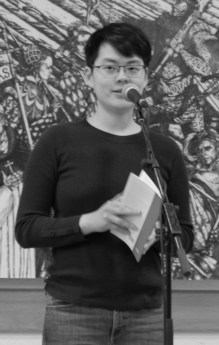
Over her vulnerable flesh, “my skin is yellow,” she says in one poem, and in doing so she takes on directly one of our fault lines – the biological fiction of race and skin colour, of which we have made so big a deal, so great a burden for ourselves. And then in the next she cites fencing: “As a teenager […] the closest thing I knew to desire.” It is a sudden and surprising launch of an image, direct, as I said before, to find a fighting sport, a combat between two people, made cognate with sex and with sexuality, the homosociality of the young women’s group suddenly given a tension that wasn’t there before as they change between one uniform and another.
This is brilliant stuff, and no mistake. At the end I wanted to shake both poets’ hands, I wanted to cross that border between listener and… something else. In the end I only managed a brief passing comment about Yorkshire to Nadine, but I did shake Mary Jean’s. I took hold of a hand that had both held an épée and penned poetry, and I left the Town Hall buzzing, and ready for a cup of normal tea… that sounds like normality… and which, in my case, means Earl Grey.
Paul Thompson
Stanza 2019
StAnza International Poetry Festival
‘Poetry Café’, featuring Harry Baker (8th March)
‘Poetry Café’, featuring Ben Norris (9th March)
Studio Theatre, The Byre Theatre, St Andrews
I’ve decided to roll two reviews into one, because in many ways the ‘Poetry Café’ experience at StAnza is of-a-piece. For example, your ticket entitles you to a drink, and a pie by Stuarts of Buckhaven – you get a choice between macaroni, scotch, steak-and-ale, and chicken curry, and believe me, they deliver more pie for your peso! The chicken curry pies are insanely delicious and, without fail, I’m in danger of regarding the poetry as an afterthought. You get a comfy armchair too.
However, the good folk at Stanza have a knack of picking poets for the Café that they know will deliver on a par with the pies. On the two occasions I was there this year, for example, they put up two Slam Champions for us. First up, on the Friday was Harry Baker, at one time the youngest ever World Poetry Slam Champion. The other amazing fact about him is that he is a mathematician, though really I don’t know why that should be amazing – the juxtaposition of poet and mathematician – because a love of numbers and patterns can manifest itself in both disciplines. In Harry’s case, it can result in poems that are actually about prime numbers. Equally it can result in alliterative displays about proper pop-up purple paper people.
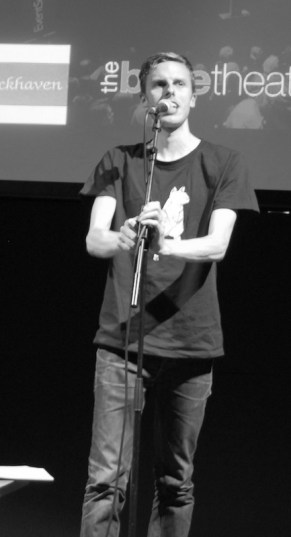
Harry Baker delivers, somehow, with the air of a boy in Year 10, but a very clever boy. If he were wearing a blazer you would want to hate him, but you wouldn’t be able to, because not only would he be too clever he would also be too damn funny. You would let him hang out with you and the rest of the kids who think that school in uncool, he would take a sip of Relentless and say “Bloody hell, that’s strong,” and proceed to tell you the percentages of the ingredients, and then multiply the calories by the number of minutes in a week. He, and only he, could compose a poem about the number of birthdays there are every day, or how many hours he has been alive, or could say that ten thousand days equals 27.39726 years, unless you’re talking binary, and then it’s sixteen.
A panel of five random French people crowned him champion, true, but there is one thing that worries me rather than delights me in his delivery. He has a tendency to let his voice die away at the end of lines or phrases, to the extent that sometimes, regardless of the mic, one can lose an important word and thus fail to succumb to the force of the slam. High point, though, was the poem in which he taught us a brand new word in German: Falafellöffel. As I said to him afterwards, “Das war ausgezeichnet!”
Two slammers means more of the same, right? Wrong. For a start, have you ever had this nagging feeling that you recognise someone’s voice? That’s how it was with Ben Norris. “Who the heck is this bloke?” I kept asking myself. It turns out he plays Ben Archer in BBC Radio4’s The Archers. StAnza sure know how to pick someone for a middle-class, middle-aged audience!
Ben Norris is not as outright funny as Harry Baker, but then he doesn’t need to be and doesn’t try to be. Twenty minutes of his performance was dedicated not to a poem, but to a short story written from the point of view of a young man visiting his gran, who is hospitalised and in the grip of senile dementia. It is written in a style, and was delivered in a style, that demanded and held attention. For most of it the story had a solidity and a flow; towards the end it became more fragmented, but for the listener that was the part which reminded us that Ben is a poet, its fragments signaled ideas, breaths, images.
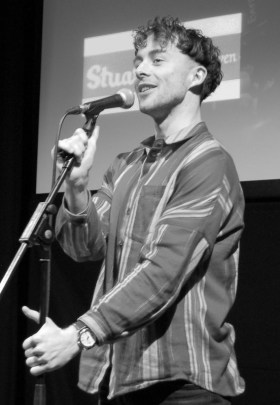
A Poetry Café performance, you see, does not need to be funny. As Ben launched into a series of poems about the time when his parents split up, and he learned that his mother had been having an affair that lasted six years, he told us there was no need to applaud. And indeed, they were moving, intense, and personal, so we didn’t. Not that they were full of angst or resentment – though he did refer to them as the poems he wouldn’t recite to his family – indeed the poem dedicated to his father’s subsequent partner, Sue, was a work of dedication and appreciation. Strangely enough, this was probably the point in the performance where the majority of the laughs came, if only because Ben forgot the opening words of the poem – ‘The Only Ethnic Minority Dentist in Boston, Lincs’ – and decided to do the millennial thing of reading it all off his phone. And why not. Hand-held devices are now part of the performance poet’s natural toolkit.
It’s marginal which of these two poetry lunches I liked best. I liked them both, I loved the poetry, I warmed to the poets. Ben, by a whisker, though. People slightly ahead of numbers. But do appreciate these two guys, and if either comes to your town, give him a look-see and a listen-hear.
Paul Thompson
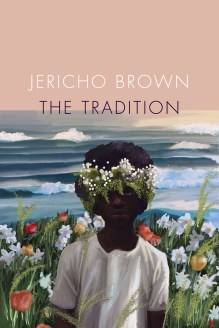
Jericho Brown: The Tradition
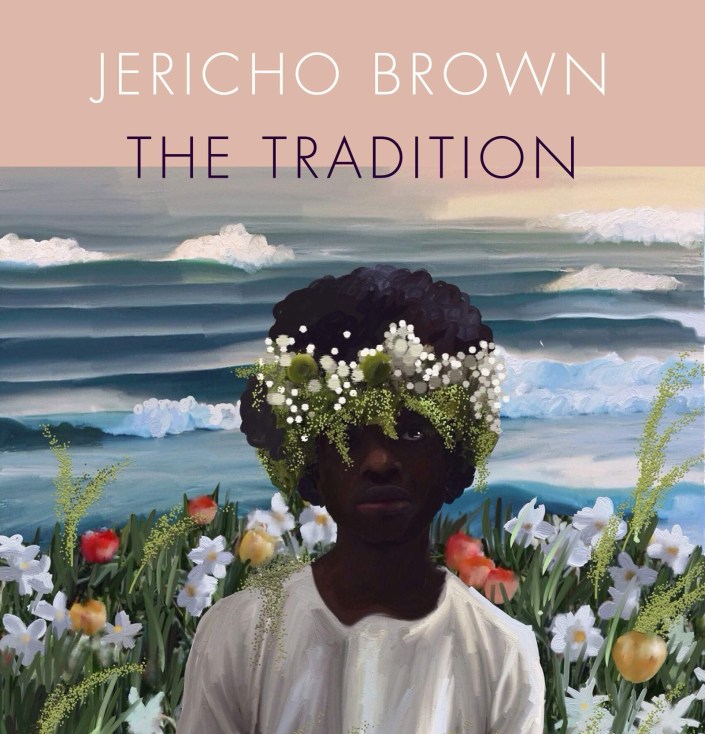
The poetry of Jericho Brown is like a magnet. It always pulls you in. His third collection is firmly upholding the tradition.
I love Copper Canyon’s books; soft & gentle pages carress’d by a lip-gloss cover lending a certain bubble-bath quality to the reading of one of their poets. But ultimately it is what is on the page that counts. First things first, Jericho Brown is a poet, a real, poet, he has the elixir in his veins. He also possesses a curious voice, like a multi-sharded cylinder standing steadfast in a storm. That storm is America, its culture & its questionable past.
His first two volumes were received with high praise & deep respect across the English-speaking world, the second of which, New Testament (2014) won the Anisfield-Wolf Book Award. The Tradition is eagerly awaited, then, & does not disappoint. In places it even exceeds expectations; the lyrical jaundice of Flower, the killer jibes of truth within Bullet Points & numerous moments of the highest pathos & beauty, as in the closing couplet of The Microscopes;
A region I imagine you imagine when you see
A white women walking with a speck like me
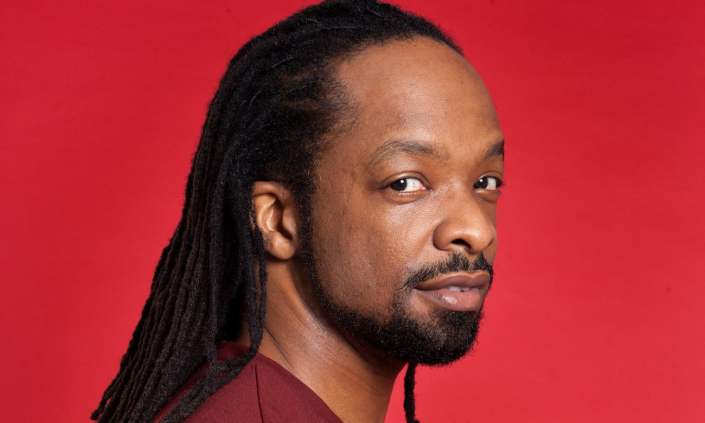
The chief pillars of Jericho’s creative temple are his colour, his family & his sexuality. His mother, grandmother, brother & kids all have cameos & something important to contribute to both the poet’s life & our understanding of the world. These very personal takes are full of raw remembrance temper’d by a supreme sense of post-Millennium reality.
……………………………They remind
Me of black people who see the movie
About slaves and exit saying how they would
Have fought to whip Legree with his own whip
And walked away from the plantation,
Their eyes raised to the sun, without going blind.
On a number of occasions I was very much reminded of a poem by Gwendolyn Brooks, Negro Hero; the pitch & balance of the wordplay are almost identical – is he her spiritual inheritor, perhaps? Jericho’s art presents the Apollonian & the Dionysical extremes of poetic composition; from technical stanza formation full of controll’d & order’d musings, to solid blocks of Wolfean streams of consciousness. The latter sort are often triggered by the smallest things, such as the two copulating rabbits on his lawn, providing the catalyst for an introspective journey into the failings of his own love life. Then, with his title poem, Jericho proves he can turn not just a good sonnet, but an absolutely bangin’ one.
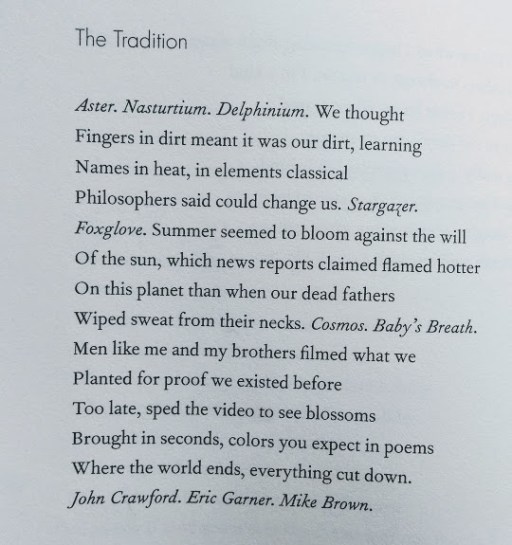
Also a sonnet of sorts are his five Duplex poems, seven couplets where the second line is the same as the first line in the following couplet. From innovation comes mastery, and Jericho is growing into his role as both a teacher in his tactile environment, & a clear-cadenced, beautiful poet-teacher for the planet. Indeed, his academic background – studying at Harvard, teaching at Emery – seems to be a fertile field for inspiring such embedded nuances as his use of Homeric simile in the opening to As a Human Being;
There is the happiness you have
And the happiness you deserve.
They sit apart from each other
The way you and your mother
Sat on opposite ends of the sofa
After an ambulance came to take
Your father away.
Jericho Brown is a philosopher-poet, stood on a crag overlooking the humanity of America, striking the rocks, drawing lightning into his penstaff & tossing electrical ejecta onto his page. The Tradition delights on first reading & invites further study. Each poem contains a different beam of inspiration wassailing from Jericho’s kaleidoscopic soul, altho’ the colors aren’t garish, its too moody a piece for that. This is an extremely intelligent collection, filled with both unpretentious flair & flashes of Faustian confidence. Roll on Brown’s 4th book.
Buy the Book
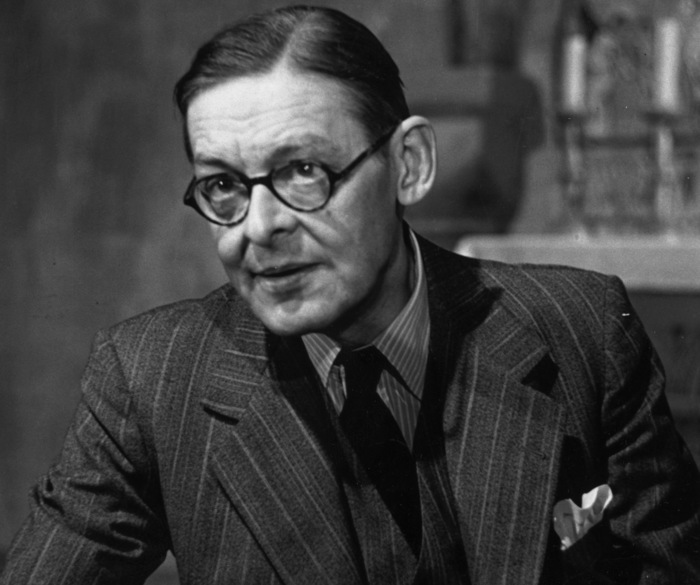
Classic Essays: TS Elliot’s Tradition & The Individual Talent
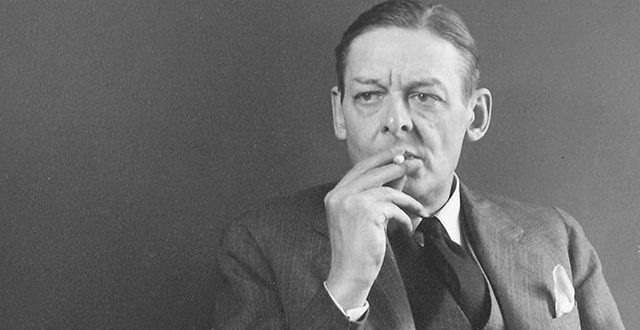
Continuing a series of classic essays on literature. This month sees the sagely intuition of TS Elliot in quintessential action (1919)
In English writing we seldom speak of tradition, though we occasionally apply its name in deploring its absence. We cannot refer to “the tradition” or to “a tradition”; at most, we employ the adjective in saying that the poetry of So-and-so is “traditional” or even “too traditional.” Seldom, perhaps, does the word appear except in a phrase of censure. If otherwise, it is vaguely approbative, with the implication, as to the work approved, of some pleasing archaeological reconstruction. You can hardly make the word agreeable to English ears without this comfortable reference to the reassuring science of archaeology.
Certainly the word is not likely to appear in our appreciations of living or dead writers. Every nation, every race, has not only its own creative, but its own critical turn of mind; and is even more oblivious of the shortcomings and limitations of its critical habits than of those of its creative genius. We know, or think we know, from the enormous mass of critical writing that has appeared in the French language the critical method or habit of the French; we only conclude (we are such unconscious people) that the French are “more critical” than we, and sometimes even plume ourselves a little with the fact, as if the French were the less spontaneous. Perhaps they are; but we might remind ourselves that criticism is as inevitable as breathing, and that we should be none the worse for articulating what passes in our minds when we read a book and feel an emotion about it, for criticizing our own minds in their work of criticism. One of the facts that might come to light in this process is our tendency to insist, when we praise a poet, upon those aspects of his work in which he least resembles any one else. In these aspects or parts of his work we pretend to find what is individual, what is the peculiar essence of the man. We dwell with satisfaction upon the poet’s difference from his predecessors, especially his immediate predecessors; we endeavour to find something that can be isolated in order to be enjoyed. Whereas if we approach a poet without this prejudice we shall often find that not only the best, but the most individual parts of his work may be those in which the dead poets, his ancestors, assert their immortality most vigorously. And I do not mean the impressionable period of adolescence, but the period of full maturity.
Yet if the only form of tradition, of handing down, consisted in following the ways of the immediate generation before us in a blind or timid adherence to its successes, “tradition” should positively be discouraged. We have seen many such simple currents soon lost in the sand; and novelty is better than repetition. Tradition is a matter of much wider significance. It cannot be inherited, and if you want it you must obtain it by great labour. It involves, in the first place, the historical sense, which we may call nearly indispensable to any one who would continue to be a poet beyond his twenty-fifth year; and the historical sense involves a perception, not only of the pastness of the past, but of its presence; the historical sense compels a man to write not merely with his own generation in his bones, but with a feeling that the whole of the literature of Europe from Homer and within it the whole of the literature of his own country has a simultaneous existence and composes a simultaneous order. This historical sense, which is a sense of the timeless as well as of the temporal and of the timeless and of the temporal together, is what makes a writer traditional. And it is at the same time what makes a writer most acutely conscious of his place in time, of his own contemporaneity.
No poet, no artist of any art, has his complete meaning alone. His significance, his appreciation is the appreciation of his relation to the dead poets and artists. You cannot value him alone; you must set him, for contrast and comparison, among the dead. I mean this as a principle of aesthetic, not merely historical, criticism. The necessity that he shall conform, that he shall cohere, is not onesided; what happens when a new work of art is created is something that happens simultaneously to all the works of art which preceded it. The existing monuments form an ideal order among themselves, which is modified by the introduction of the new (the really new) work of art among them. The existing order is complete before the new work arrives; for order to persist after the supervention of novelty, the whole existing order must be, if ever so slightly, altered; and so the relations, proportions, values of each work of art toward the whole are readjusted; and this is conformity between the old and the new. Whoever has approved this idea of order, of the form of European, of English literature will not find it preposterous that the past should be altered by the present as much as the present is directed by the past. And the poet who is aware of this will be aware of great difficulties and responsibilities.
In a peculiar sense he will be aware also that he must inevitably be judged by the standards of the past. I say judged, not amputated, by them; not judged to be as good as, or worse or better than, the dead; and certainly not judged by the canons of dead critics. It is a judgment, a comparison, in which two things are measured by each other. To conform merely would be for the new work not really to conform at all; it would not be new, and would therefore not be a work of art. And we do not quite say that the new is more valuable because it fits in; but its fitting in is a test of its value—a test, it is true, which can only be slowly and cautiously applied, for we are none of us infallible judges of conformity. We say: it appears to conform, and is perhaps individual, or it appears individual, and many conform; but we are hardly likely to find that it is one and not the other.
To proceed to a more intelligible exposition of the relation of the poet to the past: he can neither take the past as a lump, an indiscriminate bolus, nor can he form himself wholly on one or two private admirations, nor can he form himself wholly upon one preferred period. The first course is inadmissible, the second is an important experience of youth, and the third is a pleasant and highly desirable supplement. The poet must be very conscious of the main current, which does not at all flow invariably through the most distinguished reputations. He must be quite aware of the obvious fact that art never improves, but that the material of art is never quite the same. He must be aware that the mind of Europe—the mind of his own country—a mind which he learns in time to be much more important than his own private mind—is a mind which changes, and that this change is a development which abandons nothing en route, which does not superannuate either Shakespeare, or Homer, or the rock drawing of the Magdalenian draughtsmen. That this development, refinement perhaps, complication certainly, is not, from the point of view of the artist, any improvement. Perhaps not even an improvement from the point of view of the psychologist or not to the extent which we imagine; perhaps only in the end based upon a complication in economics and machinery. But the difference between the present and the past is that the conscious present is an awareness of the past in a way and to an extent which the past’s awareness of itself cannot show.
Some one said: “The dead writers are remote from us because we know so much more than they did.” Precisely, and they are that which we know.
I am alive to a usual objection to what is clearly part of my programme for the métier of poetry. The objection is that the doctrine requires a ridiculous amount of erudition (pedantry), a claim which can be rejected by appeal to the lives of poets in any pantheon. It will even be affirmed that much learning deadens or perverts poetic sensibility. While, however, we persist in believing that a poet ought to know as much as will not encroach upon his necessary receptivity and necessary laziness, it is not desirable to confine knowledge to whatever can be put into a useful shape for examinations, drawing-rooms, or the still more pretentious modes of publicity. Some can absorb knowledge, the more tardy must sweat for it. Shakespeare acquired more essential history from Plutarch than most men could from the whole British Museum. What is to be insisted upon is that the poet must develop or procure the consciousness of the past and that he should continue to develop this consciousness throughout his career.
What happens is a continual surrender of himself as he is at the moment to something which is more valuable. The progress of an artist is a continual self-sacrifice, a continual extinction of personality. There remains to define this process of depersonalization and its relation to the sense of tradition. It is in this depersonalization that art may be said to approach the condition of science. I, therefore, invite you to consider, as a suggestive analogy, the action which takes place when a bit of finely filiated platinum is introduced into a chamber containing oxygen and sulphur dioxide.
This is only the first part of the essay. There are two more parts.
If you enjoyed this article
Please make a donation
***

An Interview with Damian Beeson Bullen

Damian Beeson Bullen’s definitive 2019 collection has been described as ‘The Sgt. Pepper’s of Poetry.’
 Hello Damo, so when did you realise you were a poet?
My first poetical moment came when I was like 7 or 8 – there was a poetry competition at Lowerhouse Junior school in Burnley. I won I think, & the opening couplet I still remember; ‘The river flowing by is often wide & high.’ Roll on a few years & I won a Christmas story competition at Gawthorpe high school – it was the story of a leaping being who turned out to be a snowflake. There was no technical poetics, but it was a visionary metaphorical piece. A few years later I was studying music in Barnsley Music College, & it was there one night while reading through William Butler Years that I realised I was actually a poet. I quit college soon after & set off for the English South Coast with a guitar & a yellow suitcase full of poetry books.

What are your thoughts on the poetic art itself?
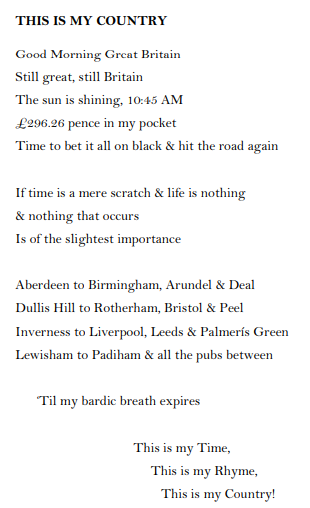
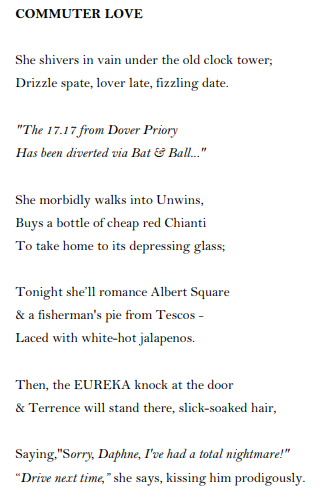
There’s a passage in Plato’s Euthyphro which always piqued my interest, I really feel it defines what the poetic art is all about. ‘He (Daedalus) only made his own products mobile, while I apparently make other people’s mobile as well as my own.’ This ‘mobility’ is what makes the magical energy of the best poetry fly on the wings of inspiration into the poems of others. To my mind, poetry works on two levels, basically the local ‘zeitgeist’ & then the eternal tradition. If you look back to the 18th century, English poetry was essentially rhyming couplets in iambic pentameter. In the same way, some modern poetry editors wont even look at rhyming poetry – according to them we dwell very much the age of free verse. But like the fashion for the Georgian couplet became a busted flush during the Romantic period, free verse is also only a fashion & will inevtibaly be superceded at some point by something else. To be honest, this proliferation of Free Verse masks the fact that there are a lot of poets out there claim to be poets, but don’t really know anything about the craft. I find technique extremely important. I’m always trying to be a complete poet & I’ve realised I have to be serious about studying & experimenting with form – including free verse, of course, which I think is just a small piece in a big jigsaw.
What do you think is the poet’s role & do you identify with it?
Good question. Well, the poet has always been a teacher, but also an entertainer. I like the blend myself, keeps things interesting. A poet should also be connecting with their readers/listeners on two levels; inviting them to think is the intellectual, & inviting them to feel intuitively is the spiritual. The latter is the seer element to poetry, what the Romans called the Vates. Some say poets are merely the human receptacles of divine inspiration, & there’s probably some truth in that. As Horace says in his Ars Poetica, ‘It is not enough for poetry to be beautiful; it must also be pleasing & lead the hear’s mind where it will.’ I also love Phillip Sydney’s, ‘this purifying of wit, this enritching of memory, enabling of judgementy, & enlarging of conceyt, which commonly we call learning, under what name soever it com forth, or to what immediat end soever it be directed, the final end is to lead & draw us to as high a perfection as our degenerate soules, made worse by theyr clayeye lodgings, can be capable of.’
What is it about composing poetry you love the most?
Its difficult to explain. Its part validation, part duty, part pleasure – there’s nothing like exercising the mind. I also do most of my formal composition, lets say, out in the fields, up in the hills, walking with notebook, paper & my thoughts. There is also nothing like the feeling of knowing you’ve just written a poem which contains the pure juice of Parnassus – you can just tell when it happens. As an artist, I am fascinated with the prosodic elements of poetry – the Welsh call it cynghanned, & its not called composition for nothing. You’ve got to create a symphony in the mind. I do love my music & poetry is, to me, an instrument as important as my bass guitar.
Can you tell us about Completely Novel?
Completely Novel is a brilliant way to circumvent the cliquey world of publishing. They are a fabulous self-publishing service who facilitate print-on demand copies being sent anywhere in the world at a few clicks of a button. I pay a wee hosting fee every much – its not much at all – & get to publish ten books, all with shiny ISBN numbers. Its brilliant. They’re really nice folk to work with too. There’s nothing to stop me ordering as many books as I want, as well, to sell independently or through bookstores.
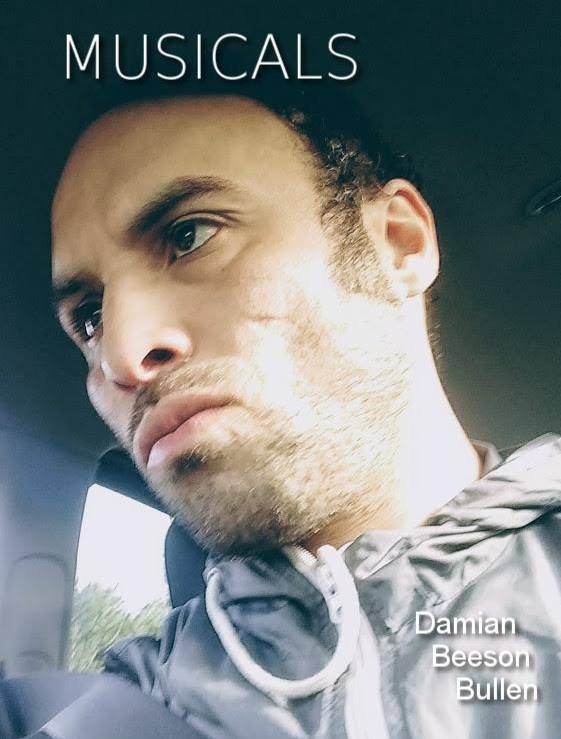
 You have just released a collection of poetry through Completely Novel called MUSICALS. How did you choose the poems to be included?
I selected the poems from 20 years of composition. Some, especially the sonnets, are just as they were composed originally. Others can be quite edited-down versions of longer epyllia. The poem about Pendle Hill, for example, is about 5 percent of the full piece – it contains the quintessence of my inspirations ,if you will. Over the years I’ve always had moments of editorial, when I’d look at my all work in the bank, & see where my new compositions fitted in to the overall scheme. Its a bit like a crawling snake – the ancient symbol for wisdom by the way – after every pulse forward it pauses & half recedes, & from the retrogressive movement collects the force which again carries it forward. With Musicals I think I’ve finally reached my destination, or at least a place to hang out for a while, promote the book, do some readings & stuff, maybe even some slams. It’s been over a decade since I performed my poetry in public.
Are there any unifying themes?
There sure are. Poetry is about bringing all of its constituent parts into harmony. With Musicals the same principles apply, & the book is flush with harmonizing forms & themes. At its core the text is an autobiographical journey across the world. I’ve also got a nice sub-plot with a romantic interest called ‘Rosie’ – its a Stone Roses thing, big fan. She’s actually an amalgamation of a number of ‘love poems’ I have created over the years. The lady I’m with now, however, provided most of these – she’s my proper soul-mate, like, my muse. As for the title, of course we have the ‘muse’ embedded in the name, but I also feel like each of the chapters is a bit like a musical – a combination of narrative, drama & lyricisim.
 You have put Musicals online for anyone to read – what’s all that about?
Well, Lord Byron said a true gentleman shouldn’t make any money from writing. He did make a fortune the sale of Newstead Abbey, though, enough to fund an army in the Greek War of Independence, so he would say that. The idea is essentially they same, tho, anyone can read my work online – but, if I sell copies that’s a bonus. I am not alone in appreciating the true beauty of proper books is their tactility – so I’m catering for both worlds here, the modern internet-haunter & the traditional lover of the page. You’ve also gotta go with the times, & my online versions will eventually all have youtube videos of me reading the poetry. Another bonus to doing it online is that I can make corrections & improvements at any point. My plan is to release fresh editions of the book by uploading a new file & replacing the old one – its quite a simple process really. So in 2020 there will most probably by a second edition of Musicals.
Musicals has been described as ‘the Sgt. Pepper’s of poetry,’ why is that?
Well, I think it’s the mixture of form & content. With Pepper’s you have English country garden vibes, Indian mysticism, proper rock & Roll, all complemented by a wide variety of instruments & musicianship. In a similar war Musicals expresses political terza rima, transcreations of Tamil love paeans, reworkings of English folk songs, free verse sonnets, French sonnets composed in Italian – I could go on. There’s loads of influences in there, its packed.

 What other titles have you released?
Musicals is the ninth book in what I call the Pendragon Collection. A few years ago I kinda realised I had actually embark’d on something like the classical bardic training as described by Julius Ceasar. This passage I basically took to heart & soul & it became my mantra; ‘In their schools they are said to learn by heart an extraordinary number of lines, and in sometimes to remain under instruction for as many as twenty years.’ I started to take the poetic vocation seriously in in 1997/98 – I was 21 years old at the time – so as my own twenty years of training began to climax, I thought it prudent to draw a line in the sand of my studies. The final collection has 9 titles, of course; alongside Musicals there are another five collections of poetry, including my main epic, Axis & Allies, which I pretty much worked on during the full twenty years.
The vast majority of poems in the Musicals collection are taken from these five volumes, excepting Axis & Allies – essentially, this epic is for posterity, but Musicals for the now. The Pendragon Collection also includes essays on poetry, personal epistles telling the stories of my adventures, & the final volume of the nine, which I’ll be re-releasing later this year, an assemblage of historical studies called The Chisper Effect.
 So what have people to expect from Musicals?
Well for a start its the very best of my very best work, & that means colour. I try & put a lot of colour in my poetry – so much modern stuff is like a twilight sky of opalescent grey! There’s also the travelling element – people get to go to Italy, Greece, India, America & even beautiful Burnley. I enjoy poems of place, Byron’s Childe Harold & Wordsworth’s Tours of Europe for example, so it was natural that I’d create something similar. Along the way its a composite blend of all the ‘Ms’ – there’s a mixture of music, moods, moulds (ie forms) & measures Just as a poem’s form can be divided into MEASURE & MOULD, so a poet’s voice is divided into two composite halves; the MOOD & the MUSIC. The Mood can be defined as a trance which envelops the poet as they compose their piece. The Music is the pure artifice of linguistic creation as the poets translate their Mood into words. Understanding such a pretext, the order of poetical creation is as this; Mood (then) Music (then) Measure (then) Mould.
Can you tell us about the Global Laureacy.
I will, & thanks. The Global Laureate has no choice but to dedicate themselves unto the Liberation, the Unification & the Education of Humanity. I have only been in the role officially for a few months now, so it is still early days, but to adhere to the three job specs, so to speak, I am creating three texts. These are The New Truth (Liberation) a universal language (Unification) & a purification my Humanology piece (Education), which is itself based on the Kural of Thiruvalluvar. I am also in the middle of transcreating the 24 poems from 24 international poets published by Gingko as A New Divan. The idea is to translate these transcultural pieces into my new language as its first ever text – a neat choice, I think, reflecting an international sangam of poets
Can you tell us about Stars & Stripes?
Sure – I’m very proud of it – I think it’s my best work. You can read it in full here. The catalyst was meeting my good lady, who is from Seattle. Her ancestor was Colonel Daniel Gillespie, who was at Valley Forge. Thus, Stars & Stripes is what you get when the bloodline of an American patriot meets an English epic poet. My partner & her spirit gave me the connection to the American fibre, while being from Burnley shouldn’t really matter as America is the ultimate immigrant nation.
“The United States,” wrote American scholar, Ed Simon, “seems rare among nations in not having an identifiable and obvious candidate for national epic.” What made you think you were qualified?
Well, for an epic poem you need an epic poet, & they don’t really pop up all that often. There’s also something about the organic matter that is a language, that it should spring naturally from the soil & bedrock of a land. Thus, the English language in America is an immigrant language & by proxy America cannot really produce a true epic poet unless they were writing in the languages of the native Indian races. With Stars & Stripes, however, I have just made an attempt, to show that something close to epic poetry can be written. America offers wonderful subject matter. “The United States themselves are essentially the greatest poem,” opined Walt Whitman, & there’s some truth in that. The creation of that particular nation at that particular time in the universe is an absolute fascinating jumble of conflicting forces.
Can you tell us about your music?
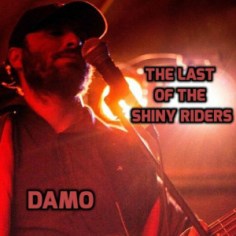
Well, after being in bands on & off since a teenager, I’ve recently gone solo as DAMO. In the past twelve months or so I’ve been assembling my back catalogue of recorded music into two albums, last year’s ‘THE LAST OF THE SHINY RIDERS’ & this year’s ‘GEMINI FIRE DRAGON.’ I now have a platform to work on an as yet untitled third album, which I’ve decided to play all the parts on – drums, bass, guitar, vocals, etc. I’m looking forwards very much to the process – it should be ready by next summer.
READ THE BOOK HERE
BUY ‘MUSICALS’ NOW
Only £5.99 via Completely Novel

Or £8.99 with Amazon

An Interview with Ben Norris

A rising star in the world of words, 2019 sees Ben Norris make his debut appearance at StAnza Poetry Festival…
Hello Ben, so where are you from & where are you at at, geographically speaking?
I’m from Nottingham. I currently live in London but I’m back in Notts more and more these days, as I’ve just started working more closely with the Playhouse there, and with Nottinghamshire Libraries as their poet-in-residence, which is lovely.
When did you realise you were a poet?
I started to dabble in sixth form (in secret of course – the shame!), but it was when I got to university that I really knew I had the bug. I went to university in Birmingham, which has an incredibly vital poetry and spoken-word scene both on campus and in the city as a whole, so it was really fecund ground to develop as a writer and performer. It’s impossible to overstate what an impact that place, and those people, had on me.
You’ve won the national poetry slam TWICE. How did you pull that off & did you have to write a whole new set for the second event?
Poetry slams in this country are a bit like boxing titles, in that there can be several champions at once, because there are quite a few different events! My two national titles came from two different slams (the UK All-Stars in 2013 and the BBC Slam in 2017), and because they were 4 years apart, thankfully I had written some new poems in that time, yes!
NIGHTSWIMMING
after R.E.M.I ran to the bay
hard and long-spined
like someone was watching
a keen blade
through the beetroot streets
of a new place
hit the rails at the end of the fishing pier
did my best Titanic
eyes shut arms wide the figurehead
at the prow of the cityremembered my granddad
the non-swimmer
his sleepwalk down
to the sea one night
in Morecambe/Swansea/
somewhereHow he loosened a boat from the bayside
eased like the too-tight knot of a tie
from its moorings
rowed out into
a patient dawn his craft a finger
lightly pressed on the creaseless shirt
of the waterI imagined him coming to oddly calm
his hydrophobia a distant second to his reason
smiling the smile my mum sometimes says I have
noticing his raincoat buttoned perfectly
over his long johns and night vest
realising how little choice he had
to resurface thereI sucked back the Severn salt
drug for an inland man
tipped a wide-brimmed windswept smile downstream
gazed out towards Weston-super-Mare
ten miles to the south east
Latin America just a little beyond it
if I’d my father’s wrist for skimming stones
if I’d my mother’s hope
I thought and felt
my anchor fall
What does Ben Norris like to do when he’s not being, well, poetic?
I was a very keen long-distance runner when I was in my teens, and over the last year or so I’ve found myself getting back into that, which has been great. It’s not just a fitness thing for me, but a mindfulness practice too. So an ideal Sunday would probably involve at least 14 miles of gallivanting through some muddy fields!

Can you tell us about The Hitchhiker’s Guide to the Family?
It was my debut show, a one-man performance about me and my dad. I hitchhiked to everywhere he ever lived when he was growing up (he was born in Brixton and every time he moved house he moved north, and roughly in line with the M1, so that provided a convenient geographical structure!). I started in Nottingham and hitchhiked south, going backwards through his life. I wanted to learn more about his past in the hope I would get to know him better in the present. I hoped to discover some cataclysmic event that explained away our differences (me the millennial who, I thought, was good at opening up, and he the typically taciturn male baby-boomer), but I quickly realised the irony of my going on this hugely convoluted journey rather than just ringing him up and asking him about his childhood(!), so the show became a lot more about me and my own reservations, and masculinity in general, and all the hang-ups that remain. It went to the Edinburgh Fringe in 2015 where it won the IdeasTap Underbelly Award before touring the UK and then Australia.
How did you find yourself a part of the international institution that is The Archers, & how is it all going?
I was invited to audition, I believe, on the recommendation of my radio teacher at my old drama school, and was lucky enough to be offered the job. Relatively normal process really! It’s going well; everyone there is so lovely, they’ve made me feel very welcome, and it’s a real honour to be part of such an institution.
As a writer yourself, do you get to tweak the script?
Not really, and I wouldn’t really want to either, because I know how annoying it is when other people mess with your work! Occasionally if we need to lose a bit of time on an episode we might suggest small cuts but the director leads on that. Those who know their characters better than me might feel a bit more qualified to tweak things (if they’ve been playing them for several decades!) but I’m still getting to know Ben Archer…
Which poets inspired you, both old skool & of today?
There are so many, far too numerous to list. But these people have all been hugely influential to me, some of whom are friends, some of whom are long dead. Some aren’t even really ‘poets’ by popular consensus, but I think their writing could easily be classified as such.
Bohdan Piasecki, Liz Berry, Caroline Bird, Claudia Rankine,
Richard Scott, Sean Colletti, Sharon Olds, Andrew McMillan,
Dizraeli, Loyle Carner, Joni Mitchell, Anthony Anaxagorou,
Melissa Lozada-Oliva, Jo Bell, Helen Mort, Maria Ferguson,
Geoff Hattersley, Sylvia Plath … I mean, I could go on, but I shouldn’t…
When do you know you have just composed a decent poem?
When you finish it and feel a sense of relief, having purged something, or captured something that you feared might elude you. If you’ve done justice to the idea that inspired you to start writing. Even if it’s shifted as you wrote it. The hypothetical poem in your head will always be better before it exists than once it’s written, but a good poem is one that is closest to the hypothetical ‘perfect’ poem that inspired the actual poem into life. If you finish it and still feel an itch that hasn’t been scratched, or if you immediately want to start hacking it up, then it probably isn’t great.
This year you have a pamphlet of poems forthcoming from Verve Poetry Press, can we see a couple?
Yes.
It’s difficult for children to pinpoint the exact moment they realise that
nothing lasts forever, but rather it slides into view, like the silver wink
of the sea as the family Astra rounds the bend of a Lincolnshire hillOf course I wasn’t to know
as Jason Leathen and I
pretended at playing snooker
on a full size table
as dad shuffled Clare and me
round the go-kart track
if only to get our money’s worth
as grey day turned to grey night
and the adults all drank
and nobody thought to lament
the fact that the mums and dads
of Netherfield Colts FC (under 15s)
couldn’t afford to go abroad
as our static caravan
terrestrial tele
chicken nugget weekend
trundled on like
a 70s fairground ride
that no one found exciting even then
as Butlins spluttered into Mondayof course I wasn’t to know
that you were setting yourself on fire
letting yourself love him
for the first timeYou probably had brunch
probably held hands
linked kissed
with February lips
like a torn calendarI wasn’t to know
that one day this would find itself
in a happy poem
 What is it about performing your poetry you love the most?
The relationship with the audience. The fact you’re all in a room together, you’ve all agreed that that’s a nice way to spend your time. The mutual vulnerability and investment involved is genuinely beautiful. As much as I love performing on radio or to camera, nothing compares to the experience of live performance.
You are about to perform at this year’s StAnza. What are your former experiences of the Festival?
It’s my first time there!
What have you got in store for us?
Because I have a pamphlet coming out, and I had a pretty seismic 2018 personally speaking, there are a lot of new poems I’m looking to give a first read to at StAnza.
What will you be doing for the rest of 2019?
Writing more, both poetry and theatre. I’m looking to further develop a new show about long-distance running, inspired by my teenage obsession with it. I’d also like to go on holiday. Maybe. Probably not.
STANZA
Breakfast at the Poetry Café: Off the Page / Sat 9th March
Start your weekend with poetry and pastries!
The Byre Theatre, Abbey Street, Studio Theatre
Poetry Café: Ben Norris / Sat 9th March
Enjoy an entertaining lunch with a BBC slam champion
The Byre Theatre, Abbey Street, Studio Theatre
The StAnza Slam / Sat 9th March
With MC Ben Norris
The Byre Theatre, Abbey Street, Auditorium
www.bennorris.net
Birth of a Poet 4: Invoking the Muse
Continuing Damian Beeson Bullen’s retrospective adventure through the journey that made him a poet…
THURSDAY 16TH APRIL 1998
OK! My willpower didn’t last long (see later), but today was quite the day! We were woken by an Italian policeman at 9.30 AM, & we began to wander weary-bleary-eyed thro’ a sea of tourists to one of the many identical bars to get some, might I say, very fine cappuccino.
After this we found a very nice spot by a mad bridge to chill & eat a fine breakfast. I then turned the Englishman gentleman & gave Eva a pair of my dry socks as hers were soaked through. She was happy & proceeded to lay out loads of gypsy beads & necklaces in an effort to make some money – none sold unfortunately, but we did have a few reefers & got nicely stoned. It was a splendid feeling, actually, for marijuana is an excellent can-opener for the creativity tinned up in one’s soul.
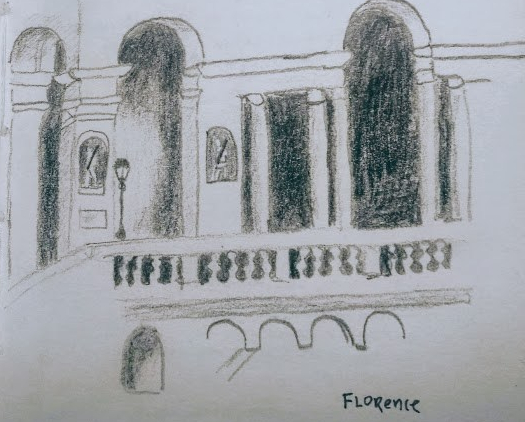
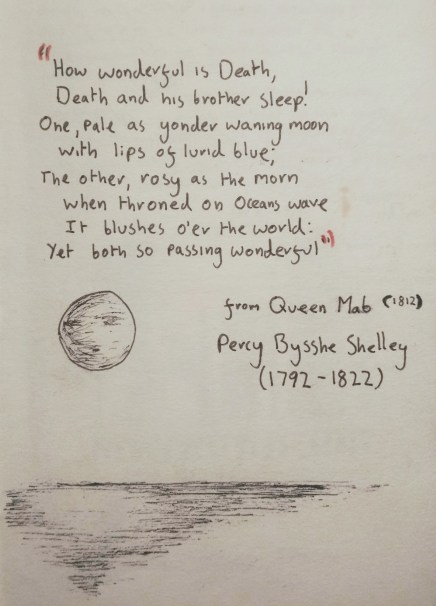
Being in such a stony haze led me to realize that I was meant to be writing a poem, a moment which broke our spell & compelled us all towards the stazione. My train was due to leave at any moment, so the farewells were swift & away I went, with a certain sadness of soul so beautiful was our time together.
The train journey to Pisa was uneventful, except for the fact that I got caught again! I was far too slack, & my punishment was 1750 lira! But I had arrived at my ultimate destination extremely cheaply, lets be honest.
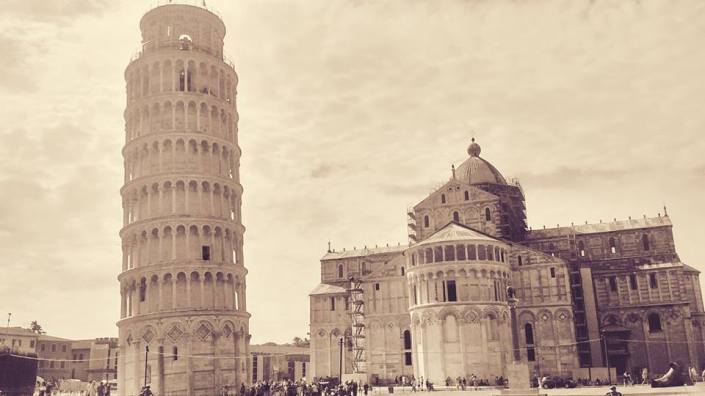
Once in Pisa I realised the first thing I had to do was to check out the tower – as did the two dizzy Americans at the stazione asking, ‘hey, is this the place where the tower is?‘ I thus turn’d into the cheezy tourist & began to walk through the old city; not as pretty as Venice or Florence, but extremely Italian, & rather noble. On the way I passed a troupe of rough looking buskers, then finally reached the tower.

How romantic it is to be abroad,
Free from the chains of a workin mans day,’
Think I whilst walkin the main Pisan road
Passin a troupe of buskers on the way
& with guitar, pens & notebook my load
I’ve arrived & all my dreams seem OK
Then see the leanin tower – am I drunk?
On further inspection one side has sunk.
It was fenced off & looked very unstable. When I first saw it, I thought I was quite drunk! I fished out my fish & sausage & reclined on some level grass, composed a little poetry, & dined within sight of that most iconic of buildings.
It was time to go, & I was heading for Livorno – where Shelley’s feet last touched soil – when my crazy life took a typically random turn. Stopping to chill with the buskers a moment, they offer’d me wine, & I pull’d out my weed. Before you know it I was too fuck’d to move from the streets of Pisa, & decided to spend the night in the environs.
Lucky for me I was with the right crew. My new buddies were excellent. There was a Somalian acoustic guitarist called Licenzo, who had a cool guitar & amp. He just went on jamming all day while his two ‘hatboys’ collected money from passers-by. Kapitano was a half-Chilean 46-year old who’d been on the road for 20 years, & basically went up to everyone asking for money & cigarettes – they smoke about a hundred fags a day between them – & usually getting it. He was very well-manner’d & quite elegant, with his baseball cap & long, Indian hair. The other guy was so funny, I just couldn’t stop laughing at him – a completely crazy dread-lock’d Brazilian call’d Jesse!
Later we moved to a new busking spot – I was now a part of the gang! We were soon joined by a guy call’d Aeriel – a smooth Italian sax-player. His music was so gutsy, very avant-garde street jazz, & I even join’d in by playing some psychedelic patterns on bass.
As the night drew to a close, & I accepted the fact that Pisa is really cool. The people are sound – I’ve begun studying them from the side of the road, & the place is full of students. With the busking over, we hit a couple of bars, ate & drank well off the day’s proceeds. We even strumm’d a little more in one of the café bars, which led to me finally breaking one of my guitar tuning pegs- ouch!
Returnin’ from the tower I do meet
The buskers troupe in musical mid-flow
There is an old black bluesman with bare feet,
A dark Chilean named Kapitano
And cool saxman who sultrifies the street.
They offer me wine, I add mine oestro,
You’ve never heard a more raunchier noise –
And just like that! I am one of the boys.
A football match was playing in the background, & after a while I realised it was Chelsea v Vicenza. It was the European Cup Winners Cup semi-final, second leg, & at one point Chelsea were 2-0 down on aggregate, including an away goal. Eventually, after a Mark Hughes wonder goal, Chelsea won 3-1 & the Italians around me weren’t happy at all. I kept my mouth shut just to be safe. They were pissed off & I was proper pissed off all the wine.
Leaving the bar, we traips’d about a bit in the rain, then found a shelter’d spot & settl’d down to sleep. Life on the streets, eh? My holiday has definitively shifted from hostels to pavements, but its good for the soul & you do get used it – its fun!
FRIDAY 17TH APRIL 1998
Last night I was so drunk, I’d forgotten I’d given my bag to Jesse to carry, & he’d completely dissapear’d. Bu lo & behold. he found us in the morning & woke us up – apparently he’d gone off dancing.
Going to chill out in a nearby park, I was fuck’d within 5 minutes, off the beer Jesse gave me & the spliff given us by a couple of passing Italian smack-heads. I was then taken to the equivalent of a seamen’s mission call’d a Mensa. Now, I’m not unfamiliar with free church food – I used to avail of the service in Portsmouth during my poetical studies – but OMG, here was pasta, fruit, veg & meat, an extremely clean place to eat it in & on the whole a far better class of beggar.
We all ate together, even drinking wine, & I found that Byron was correct when he noticed how the Italian language flowed like a river. I also realised that how struck dumb I’d become travelling in a foreign land. I’m quite a smart cookie, really, but none of these guys knew it. Perhaps one day I’ll invent an international language for moments such as these.
We spent the afternoon just bumbling about, getting wasted & making money. Jesse was the best, he could actually sing a few songs, some of which were love songs which he’d sing to passing girls, right in their faces.
There was more of the same in the evening, until it was time to go the ‘makinera.’ All day Jesse had been saying, ‘makinera,’ ‘drink,’ ‘smoke’ – the latter two words about all his English stretch’d to, expecting of course, ‘hey man, & ‘no speakee de Inglees!’
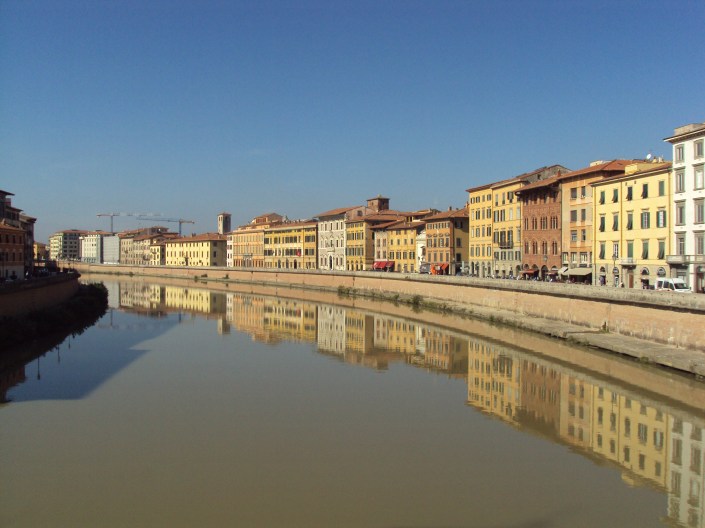
Inbetween the two ‘concerts’ was a free feed outside the stazione; including pasta from a food van, from which I slipp’d a load of apples for later. After this me & Kapitano had a nice wine drinking session by the river, which wasn’t as nice a spot, actually, loads of smack needles!
So off to the party we went; me, Jesse & a cool guy call’d Megadeth (according to his jacket). We had no money, but set off anyway, arriving twenty minutes later at a big, old building with an inner-city garden & caravans. Like a London squat, & the party vibe was very similar. It was wall’d off, & we couldn’t afford the 5000 lira, nor did my Enlish charm work.
However, eventually they stopp’d manning the gate & moved to the building, allowing us to stroll into the garden, where we sat with some punks & got pretty stoned. There was no conversation on my part, but it was just so cool to be there, so different, so street.
The sounds of a not that good a band stream’d out into the clear Italian night, most pleasant & mild. I was just about to make a bed for the night (I can sleep anywhere now, I reckon), when Jesse comes back with a couple of beers & said he’d blagg’d us in. The place wasn’t too pack’d, but you could see it had potential; quite dark, daub’d with psychedelic decor, florescent wall art, old chairs, beer cans on the floor & a rather well used toilet. In total contrast, the women were well hot.
The band grew on me in the end. Thirty-something rockers from Sardinia, whose songs were – I was told – sung in the Sardinian dialect. Jesse never stops begging for a second & kept turning up with beers, God bless him, & we were soon boogieing away to some impressively funky tunes.
Eventually the party stopp’d – at 4AM, like every night – & the place emptied & we were kick’d out. So we made our beds on a slab in the garden, play’d a bit of guitar & drifted off to a happy sleep. En route to slumberland, all I could hear was Jesse mumbling to himself – very funny, & not scary at all.
SATURDAY 18TH APRIL 1998

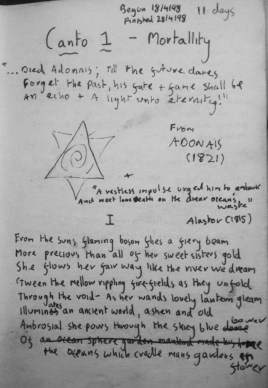
 Woke up a bit rough & walk’d to the Mensa again for another delicious lunch. The rest of the day was spent kinda meandering, drinking & eating & not really making any money. Jesse play’d all day, however, & found the most amazing instrument… a fuckin’ tyre inflator! It was so cool hearing him play it like a wah-wah & squeaking to the beat.
Two incidents of note happen’d during the day. The smackheads from a couple of mornings ago stole the purse of the newspaper stand lady near where we were – I got accused by the way! There was also the not so minor fact that I started to compose The Death of Shelley at last. I got two stanzas, which both roll’d so fluidly I almost had to weep. The line ‘Tween the mellow, rippling fire-fields as they unfold,‘ is one of the best I’ve ever written, etch’d in literary stone forever by the River Arno.
I’m amazed, really, to have found time during the day’s crazy, lazy madness to get the energy together to write. Even so, it was a very special moment when, after traversing half the continent, I invoked. the muse in an ornate piazza neath a glorious sun.
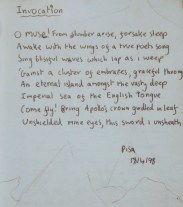
O muse! arise from slumber, forsake sleep,
Awake on the winds with the wings of song,
Sing blissful waves which lap as they weep
‘Gainst a cluster of embraces, graceful throng,
An eternal island amongst the vasty deep
Imperial sea of the English tongue –
Come fly! bring Apollo’s crown girdled in leaf,
Unshielded mine eyes, this sword I unsheath!
Whether the muse exists or not is open to discussion, but I believe that if the poet feels heady enough to acknowledge her existence & summon her to his psyche with the prayer-like incantations of an invocation, then she exists at least in the imagination, & as poetry springs from this recess of the mind, the surely she must be real.
Whether the muse exists or not is open to discussion, but I believe that if the poet feels heady enough to acknowledge her existence & summon her to his psyche with the prayer-like incantations of an invocation, then she exists at least in the imagination, & as poetry springs from this recess of the mind, the surely she must be real.
Night came, & we began tapping tourists & locals of loads of money. Kapitano says its all for tomorrow so we don’t have to work, a beach-rest apparently. A sudden change came over us a& we used some busker magic to take over the street. My voice ran raw with cigarettes, wine & singing; a few from my set plus some mad jams with Megadeth on harmonica & Jesse on his inflator. It was really, really cool, & I got to know a mad Italian bird & a few of the locals.
Return’d to our sleeping place with a guy call’d Vincent, where someone had left an extra sleeping bag. Being from the northern climes I claim’d it & had a really good sleep!
I settle with this best of holidays;
Each one begins with pasta from a nun,
Then idle hours spent musin neath the rays
Of an English Summer-like Spring Time sun
Then in the warm evenin I do amaze
The Pisan public with song-craft sweet spun,
& blitzed on six bottles of Tuscan red
Outside a church we make our cardboard bed.

SUNDAY 19TH APRIL 1998
Today was a day off! We ate at Mensa, where religious folk seem to walk about in a trance, then set off for the beach. All of a sudden Megadeth appears in a classy Italian car. It was quite a surprise & i’m not sure where he get it from – hey, even the bums are stylish in Italy, right!
We drove to the beach – Terraza del Tirrenia – pass’d an American army base. Now I understand the source of all the ‘Yankees Go Home’ graffiti scrawl’d about Pisa. It wasn’t too far to the beach, where I got my first taste of the long sought after – Mediterranean. It was windy as fuck! I thought Italy was meant to be a sunny paradise – its been pretty poor so far, but I suppose its only April. So we stroll about for a bit, taking it in turns to blast away on Megadeth’s cool bongo. Unfortunately a legion of metal poles had emerged from the sands, spraying water everywhere.
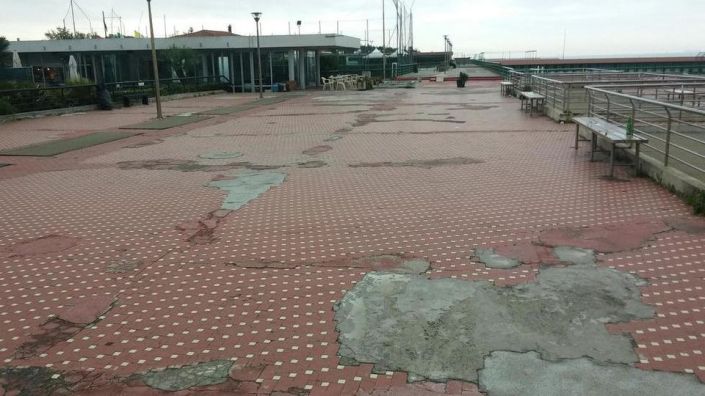
Megadeth also gave me a cool lesson in Italian, which is improving at the rate of about one word a day. I’ve never had a large capacity for anything other than English, unfortunately. But I am enjoying the vibe of learning & speaking street Italian.
We eventually stumbl’d on an abandon’d holiday complex of beach huts & heavy rowing boats. Its not far until Summer at all, but the place is in a state of quasi-disrepair. Id its ready for June I’ll be very much surprised. I began to explore anyway, & soon found a cool spot & loads of paraphenilia to make a shelter – proper Robinson Crueso fun. I must find solitude, I feel, to cleanse my spirit & compose. This abandoned stretch of coast definitely has potential.
We then headed back to a spot near the car, which slowly fill’d with tourists. We kick’d a ball around, ate & play’d a little music. Well, not all of us, Jesse was asleep all the time in a sleeping bag. We definitely had a beachy time, but it was cold & the wind kept blowing the water from the sprayers hard into our faces.
Composed another stanza today – very happy with it! I think the Muse is coming with a vengeance. There is an arcane power deep in the underlying belly of versemaking, & I hope to be able to tap it to the fullest.
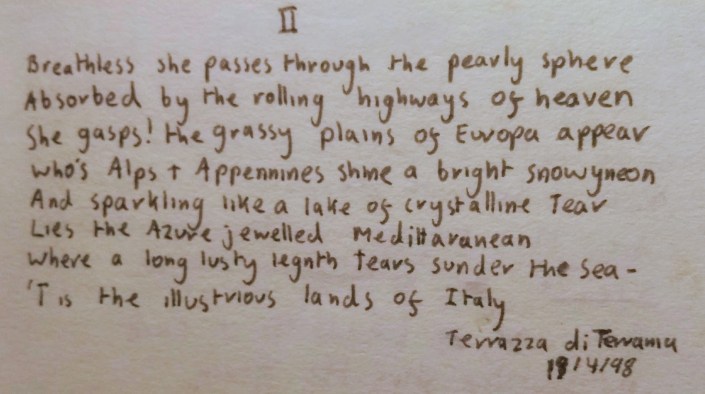
We set off back at about 6, by which time I was feeling ill. Perhaps its all the food I’m eating (I’m actually putting on weight on the road) or lack of cleanliness (I’m getting grubbier), or maybe it was just Megadeth’s driving! Whatever it was, as soon as the wine came out I began to feel a lot better – I do hope I’m not becoming an alcoholic!
Our evening meal came via the religious folks outside the stazione. Afterwards I had reefers & a reasonable conversation in English with one of the helpers, telling me the names of the outlying places about Pisa I can use in my poem. This was a rare moment of naturality for me, & I think the lack of English stimuli will actually help my poem – when only Shelley’s poems &Y my own internal dialogue being the source of words & & phrases & thoughts.
Return’d to our ‘home sweet home’ & stay’d up writing for a while, then hit this glorious, wonderful snoozeland… zzzzzzzzzzzz
THE BIRTH OF A POET
************************
Classic Essays: Sri Aurobindo’s ‘The Veda’
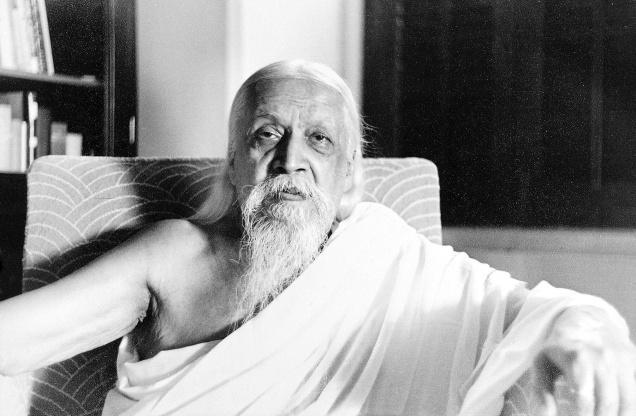
Beginning a series of classic essays on literature. This month sees the brilliant 20th century Indian ascetic poet Sri Aurobindo discussing Sanskrit literature (1920)
The greatness of a literature lies first in the greatness and worth of its substance, the value of its thought and the beauty of its forms, but also in the degree to which, satisfying the highest conditions of the art of speech, it avails to bring out and raise the soul and life or the living and the ideal mind of a people, an age, a culture, through the genius of some of its greatest or most sensitive representative spirits. And if we ask what in both these respects is the achievement of the Indian mind as it has come down to us in the Sanskrit and other literatures, we might surely say that here at least there is little room for any just depreciation and denial even by a mind the most disposed to quarrel with the effect on life and the character of the culture.
The ancient and classical creations of the Sanskrit tongue both in quality and in body and abundance of excellence, in their potent originality and force and beauty, in their substance and art and structure, in grandeur and justice and charm of speech and in the height and width of the reach of their spirit stand very evidently in the front rank among the world’s great literatures. The language itself, as has been universally recognised by those competent to form a judgment, is one of the most magnificent, the most perfect and wonderfully sufficient literary instruments developed by the human mind, at once majestic and sweet and flexible, strong and clearly-formed and full and vibrant and subtle, and its quality and character would be of itself a sufficient evidence of the character and quality of the race whose mind it expressed and the culture of which it was the reflecting medium.
The great and noble use made of it by poet and thinker did not fall below the splendour of its capacities. Nor is it in the Sanskrit tongue alone that the Indian mind has done high and beautiful and perfect things, though it couched in that language the larger part of its most prominent and formative and grandest creations. It would be necessary for a complete estimate to take into account as well the Buddhistic literature in Pali and the poetic literatures, here opulent, there more scanty in production, of about a dozen Sanskritic and Dravidian tongues. The whole has almost a continental effect and does not fall so far short in the quantity of its really lasting things and equals in its things of best excellence the work of ancient and mediaeval and modern Europe.
The people and the civilisation that count among their great works and their great names the Veda and the Upanishads, the mighty structures of the Mahabharata and the Ramayana, Kalidasa and Bhavabhuti and Bhartrihari and Jayadeva and the other rich creations of classical Indian drama and poetry and romance, the Dhammapada and the Jatakas, the Panchatantra, Tulsidas, Vidyapati and Chandidas and Ramprasad, Ramdas and Tukaram, Tiruvalluvar and Kamban and the songs of Nanak and Kabir and Mirabai and the southern Shaiva saints and the Alwars, – to name only the best-known writers and most characteristic productions, though there is a very large body of other work in the different tongues of both the first and the second excellence, – must surely be counted among the greatest civilisations and the world’s most developed and creative peoples. A mental activity so great and of so fine a quality commencing more than three thousand years ago and still not exhausted is unique and the best and most undeniable witness to something extraordinarily sound and vital in the culture.
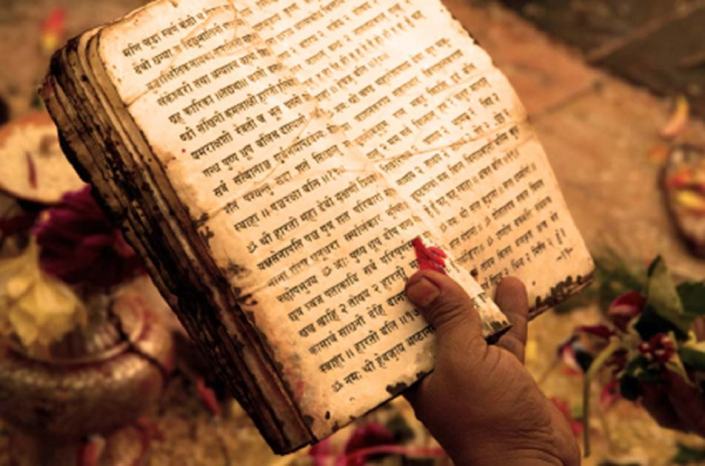
The early mind of India in the magnificent youth of the nation, when a fathomless spiritual insight was at work, a subtle intuitive vision and a deep, clear and greatly outlined intellectual and ethical thinking and heroic action and creation which founded and traced the plan and made the permanent structure of her unique culture and civilisation, is represented by four of the supreme productions of her genius, the Veda, the Upanishads and the two vast epics, and each of them is of a kind, a form and an intention not easily paralleled in any other literature. The two first are the visible foundation of her spiritual and religious being, the others a large creative interpretation of her greatest period of life, of the ideas that informed and the ideals that governed it and the figures in which she saw man and Nature and God and the powers of the universe. The Veda gave us the first types and figures of these things as seen and formed by an imaged spiritual intuition and psychological and religious experience; the Upanishads constantly breaking through and beyond form and symbol and image without entirely abandoning them, since always they come in as accompaniment or undertone, reveal in a unique kind of poetry the ultimate and unsurpassable truths of self and God and man and the world and its principles and powers in their most essential, their profoundest and most intimate and their most ample realities, – highest mysteries and clarities vividly seen in an irresistible, an unwalled perception that has got through the intuitive and psychological to the sheer spiritual vision.
And after that we have powerful and beautiful developments of the intellect and the life and of ideal, ethical, aesthetic, psychic, emotional and sensuous and physical knowledge and idea and vision and experience of which the epics are the early record and the rest of the literature the continuation; but the foundation remains the same throughout, and whatever new and often larger types and significant figures replace the old or intervene to add and modify and alter the whole ensemble, are in their essential build and character transmutations and extensions of the original vision and first spiritual experience and never an unconnected departure. There is a persistence, a continuity of the Indian mind in its literary creation in spite of great changes as consistent as that which we find in painting and sculpture.
The Veda is the creation of an early intuitive and symbolical mentality to which the later mind of man, strongly intellectualised and governed on the one side by reasoning idea and abstract conception, on the other hand by the facts of life and matter accepted as they present themselves to the senses and positive intelligence without seeking in them for any divine or mystic significance, indulging the imagination as a play of the aesthetic fancy rather than as an opener of the doors of truth and only trusting to its suggestions when they are confirmed by the logical reason or by physical experience, aware only of carefully intellectualised intuitions and recalcitrant for the most part to any others, has grown a total stranger. It is not surprising therefore that the Veda should have become unintelligible to our minds except in its most outward shell of language, and that even very imperfectly known owing to the obstacle of an antique and ill-understood diction, and that the most inadequate interpretations should be made which reduce this great creation of the young and splendid mind of humanity to a botched and defaced scrawl, an incoherent hotch-potch of the absurdities of a primitive imagination perplexing what would be otherwise the quite plain, flat and common record of a naturalistic religion which mirrored only and could only minister to the crude and materialistic desires of a barbaric life mind. The Veda became to the later scholastic and ritualistic idea of Indian priests and pundits nothing better than a book of mythology and sacrificial ceremonies; European scholars seeking in it for what was alone to them of any rational interest, the history, myths and popular religious notions of a primitive people, have done yet worse wrong to the Veda and by insisting on a wholly external rendering still farther stripped it of its spiritual interest and its poetic greatness and beauty.
The real character of the Veda can best be understood by taking it anywhere and rendering it straightforwardly according to its own phrases and images. A famous German scholar rating from his high pedestal of superior intelligence the silly persons who find sublimity in the Veda, tells us that it is full of childish, silly, even monstrous conceptions, that it is tedious, low, commonplace, that it represents human nature on a low level of selfishness and worldliness and that only here and there are a few rare sentiments that come from the depths of the soul. It may be made so if we put our own mental conceptions into the words of the Rishis, but if we read them as they are without any such false translation into what we think early barbarians ought to have said and thought, we shall find instead a sacred poetry sublime and powerful in its words and images, though with another kind of language and imagination than we now prefer and appreciate, deep and subtle in its psychological experience and stirred by a moved soul of vision and utterance. Hear rather the word itself of the Veda.

