An Interview with Damian Beeson Bullen

Damian Beeson Bullen’s definitive 2019 collection has been described as ‘The Sgt. Pepper’s of Poetry.’
 Hello Damo, so when did you realise you were a poet?
My first poetical moment came when I was like 7 or 8 – there was a poetry competition at Lowerhouse Junior school in Burnley. I won I think, & the opening couplet I still remember; ‘The river flowing by is often wide & high.’ Roll on a few years & I won a Christmas story competition at Gawthorpe high school – it was the story of a leaping being who turned out to be a snowflake. There was no technical poetics, but it was a visionary metaphorical piece. A few years later I was studying music in Barnsley Music College, & it was there one night while reading through William Butler Years that I realised I was actually a poet. I quit college soon after & set off for the English South Coast with a guitar & a yellow suitcase full of poetry books.

What are your thoughts on the poetic art itself?
There’s a passage in Plato’s Euthyphro which always piqued my interest, I really feel it defines what the poetic art is all about. ‘He (Daedalus) only made his own products mobile, while I apparently make other people’s mobile as well as my own.’ This ‘mobility’ is what makes the magical energy of the best poetry fly on the wings of inspiration into the poems of others. To my mind, poetry works on two levels, basically the local ‘zeitgeist’ & then the eternal tradition. If you look back to the 18th century, English poetry was essentially rhyming couplets in iambic pentameter. In the same way, some modern poetry editors wont even look at rhyming poetry – according to them we dwell very much the age of free verse. But like the fashion for the Georgian couplet became a busted flush during the Romantic period, free verse is also only a fashion & will inevtibaly be superceded at some point by something else. To be honest, this proliferation of Free Verse masks the fact that there are a lot of poets out there claim to be poets, but don’t really know anything about the craft. I find technique extremely important. I’m always trying to be a complete poet & I’ve realised I have to be serious about studying & experimenting with form – including free verse, of course, which I think is just a small piece in a big jigsaw.
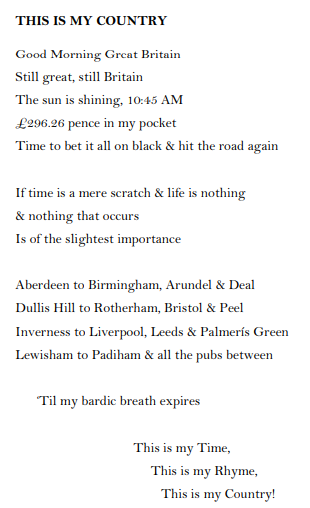
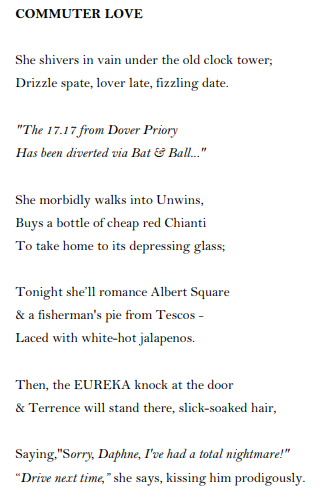
What do you think is the poet’s role & do you identify with it?
Good question. Well, the poet has always been a teacher, but also an entertainer. I like the blend myself, keeps things interesting. A poet should also be connecting with their readers/listeners on two levels; inviting them to think is the intellectual, & inviting them to feel intuitively is the spiritual. The latter is the seer element to poetry, what the Romans called the Vates. Some say poets are merely the human receptacles of divine inspiration, & there’s probably some truth in that. As Horace says in his Ars Poetica, ‘It is not enough for poetry to be beautiful; it must also be pleasing & lead the hear’s mind where it will.’ I also love Phillip Sydney’s, ‘this purifying of wit, this enritching of memory, enabling of judgementy, & enlarging of conceyt, which commonly we call learning, under what name soever it com forth, or to what immediat end soever it be directed, the final end is to lead & draw us to as high a perfection as our degenerate soules, made worse by theyr clayeye lodgings, can be capable of.’
What is it about composing poetry you love the most?
Its difficult to explain. Its part validation, part duty, part pleasure – there’s nothing like exercising the mind. I also do most of my formal composition, lets say, out in the fields, up in the hills, walking with notebook, paper & my thoughts. There is also nothing like the feeling of knowing you’ve just written a poem which contains the pure juice of Parnassus – you can just tell when it happens. As an artist, I am fascinated with the prosodic elements of poetry – the Welsh call it cynghanned, & its not called composition for nothing. You’ve got to create a symphony in the mind. I do love my music & poetry is, to me, an instrument as important as my bass guitar.
Can you tell us about Completely Novel?
Completely Novel is a brilliant way to circumvent the cliquey world of publishing. They are a fabulous self-publishing service who facilitate print-on demand copies being sent anywhere in the world at a few clicks of a button. I pay a wee hosting fee every much – its not much at all – & get to publish ten books, all with shiny ISBN numbers. Its brilliant. They’re really nice folk to work with too. There’s nothing to stop me ordering as many books as I want, as well, to sell independently or through bookstores.
 You have just released a collection of poetry through Completely Novel called MUSICALS. How did you choose the poems to be included?
I selected the poems from 20 years of composition. Some, especially the sonnets, are just as they were composed originally. Others can be quite edited-down versions of longer epyllia. The poem about Pendle Hill, for example, is about 5 percent of the full piece – it contains the quintessence of my inspirations ,if you will. Over the years I’ve always had moments of editorial, when I’d look at my all work in the bank, & see where my new compositions fitted in to the overall scheme. Its a bit like a crawling snake – the ancient symbol for wisdom by the way – after every pulse forward it pauses & half recedes, & from the retrogressive movement collects the force which again carries it forward. With Musicals I think I’ve finally reached my destination, or at least a place to hang out for a while, promote the book, do some readings & stuff, maybe even some slams. It’s been over a decade since I performed my poetry in public.
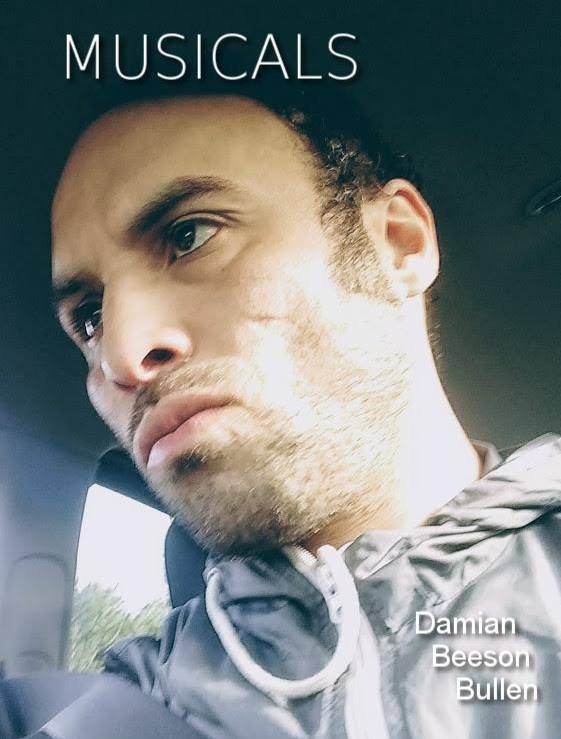
Are there any unifying themes?
There sure are. Poetry is about bringing all of its constituent parts into harmony. With Musicals the same principles apply, & the book is flush with harmonizing forms & themes. At its core the text is an autobiographical journey across the world. I’ve also got a nice sub-plot with a romantic interest called ‘Rosie’ – its a Stone Roses thing, big fan. She’s actually an amalgamation of a number of ‘love poems’ I have created over the years. The lady I’m with now, however, provided most of these – she’s my proper soul-mate, like, my muse. As for the title, of course we have the ‘muse’ embedded in the name, but I also feel like each of the chapters is a bit like a musical – a combination of narrative, drama & lyricisim.
 You have put Musicals online for anyone to read – what’s all that about?
Well, Lord Byron said a true gentleman shouldn’t make any money from writing. He did make a fortune the sale of Newstead Abbey, though, enough to fund an army in the Greek War of Independence, so he would say that. The idea is essentially they same, tho, anyone can read my work online – but, if I sell copies that’s a bonus. I am not alone in appreciating the true beauty of proper books is their tactility – so I’m catering for both worlds here, the modern internet-haunter & the traditional lover of the page. You’ve also gotta go with the times, & my online versions will eventually all have youtube videos of me reading the poetry. Another bonus to doing it online is that I can make corrections & improvements at any point. My plan is to release fresh editions of the book by uploading a new file & replacing the old one – its quite a simple process really. So in 2020 there will most probably by a second edition of Musicals.
Musicals has been described as ‘the Sgt. Pepper’s of poetry,’ why is that?
Well, I think it’s the mixture of form & content. With Pepper’s you have English country garden vibes, Indian mysticism, proper rock & Roll, all complemented by a wide variety of instruments & musicianship. In a similar war Musicals expresses political terza rima, transcreations of Tamil love paeans, reworkings of English folk songs, free verse sonnets, French sonnets composed in Italian – I could go on. There’s loads of influences in there, its packed.
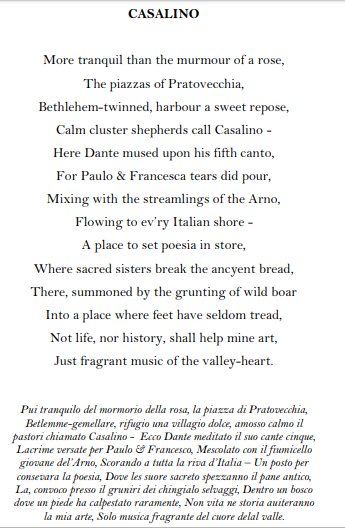

 What other titles have you released?
Musicals is the ninth book in what I call the Pendragon Collection. A few years ago I kinda realised I had actually embark’d on something like the classical bardic training as described by Julius Ceasar. This passage I basically took to heart & soul & it became my mantra; ‘In their schools they are said to learn by heart an extraordinary number of lines, and in sometimes to remain under instruction for as many as twenty years.’ I started to take the poetic vocation seriously in in 1997/98 – I was 21 years old at the time – so as my own twenty years of training began to climax, I thought it prudent to draw a line in the sand of my studies. The final collection has 9 titles, of course; alongside Musicals there are another five collections of poetry, including my main epic, Axis & Allies, which I pretty much worked on during the full twenty years.
The vast majority of poems in the Musicals collection are taken from these five volumes, excepting Axis & Allies – essentially, this epic is for posterity, but Musicals for the now. The Pendragon Collection also includes essays on poetry, personal epistles telling the stories of my adventures, & the final volume of the nine, which I’ll be re-releasing later this year, an assemblage of historical studies called The Chisper Effect.
 So what have people to expect from Musicals?
Well for a start its the very best of my very best work, & that means colour. I try & put a lot of colour in my poetry – so much modern stuff is like a twilight sky of opalescent grey! There’s also the travelling element – people get to go to Italy, Greece, India, America & even beautiful Burnley. I enjoy poems of place, Byron’s Childe Harold & Wordsworth’s Tours of Europe for example, so it was natural that I’d create something similar. Along the way its a composite blend of all the ‘Ms’ – there’s a mixture of music, moods, moulds (ie forms) & measures Just as a poem’s form can be divided into MEASURE & MOULD, so a poet’s voice is divided into two composite halves; the MOOD & the MUSIC. The Mood can be defined as a trance which envelops the poet as they compose their piece. The Music is the pure artifice of linguistic creation as the poets translate their Mood into words. Understanding such a pretext, the order of poetical creation is as this; Mood (then) Music (then) Measure (then) Mould.
Can you tell us about the Global Laureacy.
I will, & thanks. The Global Laureate has no choice but to dedicate themselves unto the Liberation, the Unification & the Education of Humanity. I have only been in the role officially for a few months now, so it is still early days, but to adhere to the three job specs, so to speak, I am creating three texts. These are The New Truth (Liberation) a universal language (Unification) & a purification my Humanology piece (Education), which is itself based on the Kural of Thiruvalluvar. I am also in the middle of transcreating the 24 poems from 24 international poets published by Gingko as A New Divan. The idea is to translate these transcultural pieces into my new language as its first ever text – a neat choice, I think, reflecting an international sangam of poets
Can you tell us about Stars & Stripes?
Sure – I’m very proud of it – I think it’s my best work. You can read it in full here. The catalyst was meeting my good lady, who is from Seattle. Her ancestor was Colonel Daniel Gillespie, who was at Valley Forge. Thus, Stars & Stripes is what you get when the bloodline of an American patriot meets an English epic poet. My partner & her spirit gave me the connection to the American fibre, while being from Burnley shouldn’t really matter as America is the ultimate immigrant nation.
“The United States,” wrote American scholar, Ed Simon, “seems rare among nations in not having an identifiable and obvious candidate for national epic.” What made you think you were qualified?
Well, for an epic poem you need an epic poet, & they don’t really pop up all that often. There’s also something about the organic matter that is a language, that it should spring naturally from the soil & bedrock of a land. Thus, the English language in America is an immigrant language & by proxy America cannot really produce a true epic poet unless they were writing in the languages of the native Indian races. With Stars & Stripes, however, I have just made an attempt, to show that something close to epic poetry can be written. America offers wonderful subject matter. “The United States themselves are essentially the greatest poem,” opined Walt Whitman, & there’s some truth in that. The creation of that particular nation at that particular time in the universe is an absolute fascinating jumble of conflicting forces.
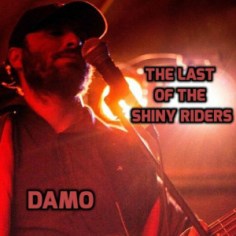
Can you tell us about your music?
Well, after being in bands on & off since a teenager, I’ve recently gone solo as DAMO. In the past twelve months or so I’ve been assembling my back catalogue of recorded music into two albums, last year’s ‘THE LAST OF THE SHINY RIDERS’ & this year’s ‘GEMINI FIRE DRAGON.’ I now have a platform to work on an as yet untitled third album, which I’ve decided to play all the parts on – drums, bass, guitar, vocals, etc. I’m looking forwards very much to the process – it should be ready by next summer.
READ THE BOOK HERE
BUY ‘MUSICALS’ NOW
Only £5.99 via Completely Novel

Or £8.99 with Amazon

An Interview with Ben Norris

A rising star in the world of words, 2019 sees Ben Norris make his debut appearance at StAnza Poetry Festival…
Hello Ben, so where are you from & where are you at at, geographically speaking?
I’m from Nottingham. I currently live in London but I’m back in Notts more and more these days, as I’ve just started working more closely with the Playhouse there, and with Nottinghamshire Libraries as their poet-in-residence, which is lovely.
When did you realise you were a poet?
I started to dabble in sixth form (in secret of course – the shame!), but it was when I got to university that I really knew I had the bug. I went to university in Birmingham, which has an incredibly vital poetry and spoken-word scene both on campus and in the city as a whole, so it was really fecund ground to develop as a writer and performer. It’s impossible to overstate what an impact that place, and those people, had on me.
You’ve won the national poetry slam TWICE. How did you pull that off & did you have to write a whole new set for the second event?
Poetry slams in this country are a bit like boxing titles, in that there can be several champions at once, because there are quite a few different events! My two national titles came from two different slams (the UK All-Stars in 2013 and the BBC Slam in 2017), and because they were 4 years apart, thankfully I had written some new poems in that time, yes!
NIGHTSWIMMING
after R.E.M.I ran to the bay
hard and long-spined
like someone was watching
a keen blade
through the beetroot streets
of a new place
hit the rails at the end of the fishing pier
did my best Titanic
eyes shut arms wide the figurehead
at the prow of the cityremembered my granddad
the non-swimmer
his sleepwalk down
to the sea one night
in Morecambe/Swansea/
somewhereHow he loosened a boat from the bayside
eased like the too-tight knot of a tie
from its moorings
rowed out into
a patient dawn his craft a finger
lightly pressed on the creaseless shirt
of the waterI imagined him coming to oddly calm
his hydrophobia a distant second to his reason
smiling the smile my mum sometimes says I have
noticing his raincoat buttoned perfectly
over his long johns and night vest
realising how little choice he had
to resurface thereI sucked back the Severn salt
drug for an inland man
tipped a wide-brimmed windswept smile downstream
gazed out towards Weston-super-Mare
ten miles to the south east
Latin America just a little beyond it
if I’d my father’s wrist for skimming stones
if I’d my mother’s hope
I thought and felt
my anchor fall
What does Ben Norris like to do when he’s not being, well, poetic?
I was a very keen long-distance runner when I was in my teens, and over the last year or so I’ve found myself getting back into that, which has been great. It’s not just a fitness thing for me, but a mindfulness practice too. So an ideal Sunday would probably involve at least 14 miles of gallivanting through some muddy fields!

Can you tell us about The Hitchhiker’s Guide to the Family?
It was my debut show, a one-man performance about me and my dad. I hitchhiked to everywhere he ever lived when he was growing up (he was born in Brixton and every time he moved house he moved north, and roughly in line with the M1, so that provided a convenient geographical structure!). I started in Nottingham and hitchhiked south, going backwards through his life. I wanted to learn more about his past in the hope I would get to know him better in the present. I hoped to discover some cataclysmic event that explained away our differences (me the millennial who, I thought, was good at opening up, and he the typically taciturn male baby-boomer), but I quickly realised the irony of my going on this hugely convoluted journey rather than just ringing him up and asking him about his childhood(!), so the show became a lot more about me and my own reservations, and masculinity in general, and all the hang-ups that remain. It went to the Edinburgh Fringe in 2015 where it won the IdeasTap Underbelly Award before touring the UK and then Australia.
How did you find yourself a part of the international institution that is The Archers, & how is it all going?
I was invited to audition, I believe, on the recommendation of my radio teacher at my old drama school, and was lucky enough to be offered the job. Relatively normal process really! It’s going well; everyone there is so lovely, they’ve made me feel very welcome, and it’s a real honour to be part of such an institution.
As a writer yourself, do you get to tweak the script?
Not really, and I wouldn’t really want to either, because I know how annoying it is when other people mess with your work! Occasionally if we need to lose a bit of time on an episode we might suggest small cuts but the director leads on that. Those who know their characters better than me might feel a bit more qualified to tweak things (if they’ve been playing them for several decades!) but I’m still getting to know Ben Archer…
Which poets inspired you, both old skool & of today?
There are so many, far too numerous to list. But these people have all been hugely influential to me, some of whom are friends, some of whom are long dead. Some aren’t even really ‘poets’ by popular consensus, but I think their writing could easily be classified as such.
Bohdan Piasecki, Liz Berry, Caroline Bird, Claudia Rankine,
Richard Scott, Sean Colletti, Sharon Olds, Andrew McMillan,
Dizraeli, Loyle Carner, Joni Mitchell, Anthony Anaxagorou,
Melissa Lozada-Oliva, Jo Bell, Helen Mort, Maria Ferguson,
Geoff Hattersley, Sylvia Plath … I mean, I could go on, but I shouldn’t…
When do you know you have just composed a decent poem?
When you finish it and feel a sense of relief, having purged something, or captured something that you feared might elude you. If you’ve done justice to the idea that inspired you to start writing. Even if it’s shifted as you wrote it. The hypothetical poem in your head will always be better before it exists than once it’s written, but a good poem is one that is closest to the hypothetical ‘perfect’ poem that inspired the actual poem into life. If you finish it and still feel an itch that hasn’t been scratched, or if you immediately want to start hacking it up, then it probably isn’t great.
This year you have a pamphlet of poems forthcoming from Verve Poetry Press, can we see a couple?
Yes.
It’s difficult for children to pinpoint the exact moment they realise that
nothing lasts forever, but rather it slides into view, like the silver wink
of the sea as the family Astra rounds the bend of a Lincolnshire hillOf course I wasn’t to know
as Jason Leathen and I
pretended at playing snooker
on a full size table
as dad shuffled Clare and me
round the go-kart track
if only to get our money’s worth
as grey day turned to grey night
and the adults all drank
and nobody thought to lament
the fact that the mums and dads
of Netherfield Colts FC (under 15s)
couldn’t afford to go abroad
as our static caravan
terrestrial tele
chicken nugget weekend
trundled on like
a 70s fairground ride
that no one found exciting even then
as Butlins spluttered into Mondayof course I wasn’t to know
that you were setting yourself on fire
letting yourself love him
for the first timeYou probably had brunch
probably held hands
linked kissed
with February lips
like a torn calendarI wasn’t to know
that one day this would find itself
in a happy poem
 What is it about performing your poetry you love the most?
The relationship with the audience. The fact you’re all in a room together, you’ve all agreed that that’s a nice way to spend your time. The mutual vulnerability and investment involved is genuinely beautiful. As much as I love performing on radio or to camera, nothing compares to the experience of live performance.
You are about to perform at this year’s StAnza. What are your former experiences of the Festival?
It’s my first time there!
What have you got in store for us?
Because I have a pamphlet coming out, and I had a pretty seismic 2018 personally speaking, there are a lot of new poems I’m looking to give a first read to at StAnza.
What will you be doing for the rest of 2019?
Writing more, both poetry and theatre. I’m looking to further develop a new show about long-distance running, inspired by my teenage obsession with it. I’d also like to go on holiday. Maybe. Probably not.
STANZA
Breakfast at the Poetry Café: Off the Page / Sat 9th March
Start your weekend with poetry and pastries!
The Byre Theatre, Abbey Street, Studio Theatre
Poetry Café: Ben Norris / Sat 9th March
Enjoy an entertaining lunch with a BBC slam champion
The Byre Theatre, Abbey Street, Studio Theatre
The StAnza Slam / Sat 9th March
With MC Ben Norris
The Byre Theatre, Abbey Street, Auditorium
www.bennorris.net
Birth of a Poet 4: Invoking the Muse
Continuing Damian Beeson Bullen’s retrospective adventure through the journey that made him a poet…
THURSDAY 16TH APRIL 1998
OK! My willpower didn’t last long (see later), but today was quite the day! We were woken by an Italian policeman at 9.30 AM, & we began to wander weary-bleary-eyed thro’ a sea of tourists to one of the many identical bars to get some, might I say, very fine cappuccino.
After this we found a very nice spot by a mad bridge to chill & eat a fine breakfast. I then turned the Englishman gentleman & gave Eva a pair of my dry socks as hers were soaked through. She was happy & proceeded to lay out loads of gypsy beads & necklaces in an effort to make some money – none sold unfortunately, but we did have a few reefers & got nicely stoned. It was a splendid feeling, actually, for marijuana is an excellent can-opener for the creativity tinned up in one’s soul.
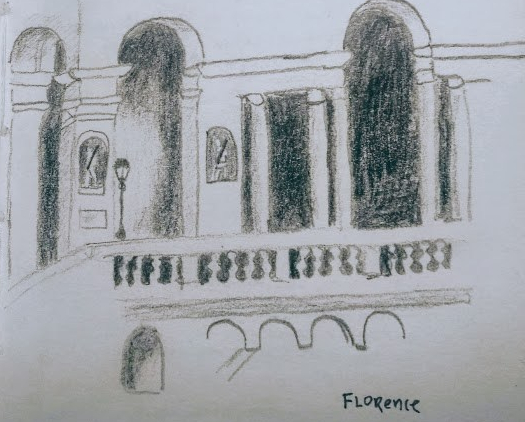
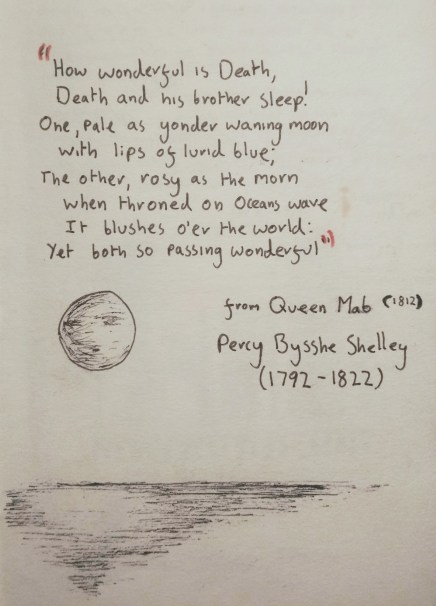
Being in such a stony haze led me to realize that I was meant to be writing a poem, a moment which broke our spell & compelled us all towards the stazione. My train was due to leave at any moment, so the farewells were swift & away I went, with a certain sadness of soul so beautiful was our time together.
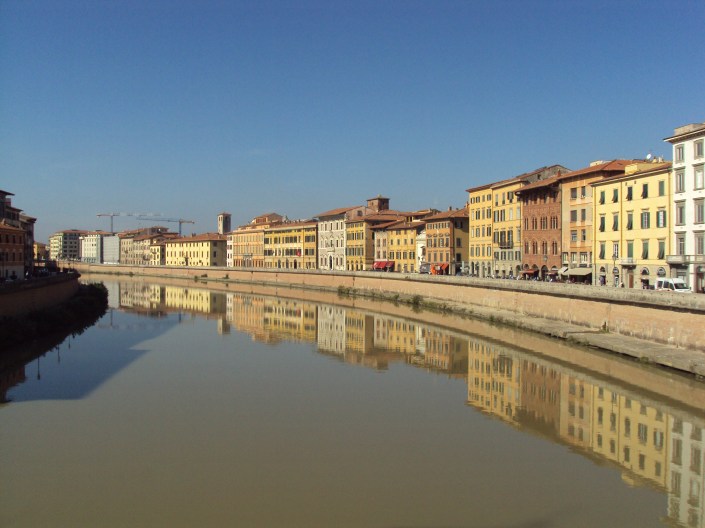
The train journey to Pisa was uneventful, except for the fact that I got caught again! I was far too slack, & my punishment was 1750 lira! But I had arrived at my ultimate destination extremely cheaply, lets be honest.
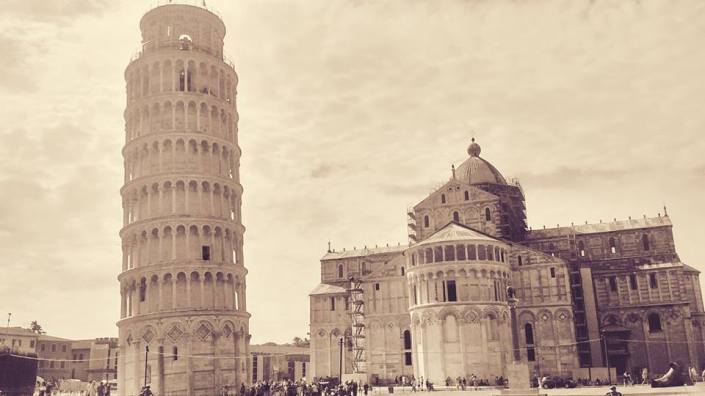
Once in Pisa I realised the first thing I had to do was to check out the tower – as did the two dizzy Americans at the stazione asking, ‘hey, is this the place where the tower is?‘ I thus turn’d into the cheezy tourist & began to walk through the old city; not as pretty as Venice or Florence, but extremely Italian, & rather noble. On the way I passed a troupe of rough looking buskers, then finally reached the tower.

How romantic it is to be abroad,
Free from the chains of a workin mans day,’
Think I whilst walkin the main Pisan road
Passin a troupe of buskers on the way
& with guitar, pens & notebook my load
I’ve arrived & all my dreams seem OK
Then see the leanin tower – am I drunk?
On further inspection one side has sunk.
It was fenced off & looked very unstable. When I first saw it, I thought I was quite drunk! I fished out my fish & sausage & reclined on some level grass, composed a little poetry, & dined within sight of that most iconic of buildings.
It was time to go, & I was heading for Livorno – where Shelley’s feet last touched soil – when my crazy life took a typically random turn. Stopping to chill with the buskers a moment, they offer’d me wine, & I pull’d out my weed. Before you know it I was too fuck’d to move from the streets of Pisa, & decided to spend the night in the environs.
Lucky for me I was with the right crew. My new buddies were excellent. There was a Somalian acoustic guitarist called Licenzo, who had a cool guitar & amp. He just went on jamming all day while his two ‘hatboys’ collected money from passers-by. Kapitano was a half-Chilean 46-year old who’d been on the road for 20 years, & basically went up to everyone asking for money & cigarettes – they smoke about a hundred fags a day between them – & usually getting it. He was very well-manner’d & quite elegant, with his baseball cap & long, Indian hair. The other guy was so funny, I just couldn’t stop laughing at him – a completely crazy dread-lock’d Brazilian call’d Jesse!
Later we moved to a new busking spot – I was now a part of the gang! We were soon joined by a guy call’d Aeriel – a smooth Italian sax-player. His music was so gutsy, very avant-garde street jazz, & I even join’d in by playing some psychedelic patterns on bass.
As the night drew to a close, & I accepted the fact that Pisa is really cool. The people are sound – I’ve begun studying them from the side of the road, & the place is full of students. With the busking over, we hit a couple of bars, ate & drank well off the day’s proceeds. We even strumm’d a little more in one of the café bars, which led to me finally breaking one of my guitar tuning pegs- ouch!
Returnin’ from the tower I do meet
The buskers troupe in musical mid-flow
There is an old black bluesman with bare feet,
A dark Chilean named Kapitano
And cool saxman who sultrifies the street.
They offer me wine, I add mine oestro,
You’ve never heard a more raunchier noise –
And just like that! I am one of the boys.
A football match was playing in the background, & after a while I realised it was Chelsea v Vicenza. It was the European Cup Winners Cup semi-final, second leg, & at one point Chelsea were 2-0 down on aggregate, including an away goal. Eventually, after a Mark Hughes wonder goal, Chelsea won 3-1 & the Italians around me weren’t happy at all. I kept my mouth shut just to be safe. They were pissed off & I was proper pissed off all the wine.
Leaving the bar, we traips’d about a bit in the rain, then found a shelter’d spot & settl’d down to sleep. Life on the streets, eh? My holiday has definitively shifted from hostels to pavements, but its good for the soul & you do get used it – its fun!
FRIDAY 17TH APRIL 1998
Last night I was so drunk, I’d forgotten I’d given my bag to Jesse to carry, & he’d completely dissapear’d. Bu lo & behold. he found us in the morning & woke us up – apparently he’d gone off dancing.
Going to chill out in a nearby park, I was fuck’d within 5 minutes, off the beer Jesse gave me & the spliff given us by a couple of passing Italian smack-heads. I was then taken to the equivalent of a seamen’s mission call’d a Mensa. Now, I’m not unfamiliar with free church food – I used to avail of the service in Portsmouth during my poetical studies – but OMG, here was pasta, fruit, veg & meat, an extremely clean place to eat it in & on the whole a far better class of beggar.
We all ate together, even drinking wine, & I found that Byron was correct when he noticed how the Italian language flowed like a river. I also realised that how struck dumb I’d become travelling in a foreign land. I’m quite a smart cookie, really, but none of these guys knew it. Perhaps one day I’ll invent an international language for moments such as these.
We spent the afternoon just bumbling about, getting wasted & making money. Jesse was the best, he could actually sing a few songs, some of which were love songs which he’d sing to passing girls, right in their faces.
There was more of the same in the evening, until it was time to go the ‘makinera.’ All day Jesse had been saying, ‘makinera,’ ‘drink,’ ‘smoke’ – the latter two words about all his English stretch’d to, expecting of course, ‘hey man, & ‘no speakee de Inglees!’
Inbetween the two ‘concerts’ was a free feed outside the stazione; including pasta from a food van, from which I slipp’d a load of apples for later. After this me & Kapitano had a nice wine drinking session by the river, which wasn’t as nice a spot, actually, loads of smack needles!
So off to the party we went; me, Jesse & a cool guy call’d Megadeth (according to his jacket). We had no money, but set off anyway, arriving twenty minutes later at a big, old building with an inner-city garden & caravans. Like a London squat, & the party vibe was very similar. It was wall’d off, & we couldn’t afford the 5000 lira, nor did my Enlish charm work.
However, eventually they stopp’d manning the gate & moved to the building, allowing us to stroll into the garden, where we sat with some punks & got pretty stoned. There was no conversation on my part, but it was just so cool to be there, so different, so street.
The sounds of a not that good a band stream’d out into the clear Italian night, most pleasant & mild. I was just about to make a bed for the night (I can sleep anywhere now, I reckon), when Jesse comes back with a couple of beers & said he’d blagg’d us in. The place wasn’t too pack’d, but you could see it had potential; quite dark, daub’d with psychedelic decor, florescent wall art, old chairs, beer cans on the floor & a rather well used toilet. In total contrast, the women were well hot.
The band grew on me in the end. Thirty-something rockers from Sardinia, whose songs were – I was told – sung in the Sardinian dialect. Jesse never stops begging for a second & kept turning up with beers, God bless him, & we were soon boogieing away to some impressively funky tunes.
Eventually the party stopp’d – at 4AM, like every night – & the place emptied & we were kick’d out. So we made our beds on a slab in the garden, play’d a bit of guitar & drifted off to a happy sleep. En route to slumberland, all I could hear was Jesse mumbling to himself – very funny, & not scary at all.
SATURDAY 18TH APRIL 1998

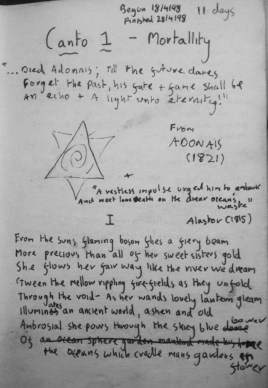
 Woke up a bit rough & walk’d to the Mensa again for another delicious lunch. The rest of the day was spent kinda meandering, drinking & eating & not really making any money. Jesse play’d all day, however, & found the most amazing instrument… a fuckin’ tyre inflator! It was so cool hearing him play it like a wah-wah & squeaking to the beat.
Two incidents of note happen’d during the day. The smackheads from a couple of mornings ago stole the purse of the newspaper stand lady near where we were – I got accused by the way! There was also the not so minor fact that I started to compose The Death of Shelley at last. I got two stanzas, which both roll’d so fluidly I almost had to weep. The line ‘Tween the mellow, rippling fire-fields as they unfold,‘ is one of the best I’ve ever written, etch’d in literary stone forever by the River Arno.
I’m amazed, really, to have found time during the day’s crazy, lazy madness to get the energy together to write. Even so, it was a very special moment when, after traversing half the continent, I invoked. the muse in an ornate piazza neath a glorious sun.
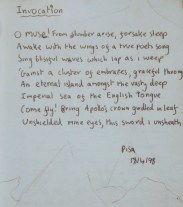
O muse! arise from slumber, forsake sleep,
Awake on the winds with the wings of song,
Sing blissful waves which lap as they weep
‘Gainst a cluster of embraces, graceful throng,
An eternal island amongst the vasty deep
Imperial sea of the English tongue –
Come fly! bring Apollo’s crown girdled in leaf,
Unshielded mine eyes, this sword I unsheath!
Whether the muse exists or not is open to discussion, but I believe that if the poet feels heady enough to acknowledge her existence & summon her to his psyche with the prayer-like incantations of an invocation, then she exists at least in the imagination, & as poetry springs from this recess of the mind, the surely she must be real.
Whether the muse exists or not is open to discussion, but I believe that if the poet feels heady enough to acknowledge her existence & summon her to his psyche with the prayer-like incantations of an invocation, then she exists at least in the imagination, & as poetry springs from this recess of the mind, the surely she must be real.
Night came, & we began tapping tourists & locals of loads of money. Kapitano says its all for tomorrow so we don’t have to work, a beach-rest apparently. A sudden change came over us a& we used some busker magic to take over the street. My voice ran raw with cigarettes, wine & singing; a few from my set plus some mad jams with Megadeth on harmonica & Jesse on his inflator. It was really, really cool, & I got to know a mad Italian bird & a few of the locals.
Return’d to our sleeping place with a guy call’d Vincent, where someone had left an extra sleeping bag. Being from the northern climes I claim’d it & had a really good sleep!
I settle with this best of holidays;
Each one begins with pasta from a nun,
Then idle hours spent musin neath the rays
Of an English Summer-like Spring Time sun
Then in the warm evenin I do amaze
The Pisan public with song-craft sweet spun,
& blitzed on six bottles of Tuscan red
Outside a church we make our cardboard bed.

SUNDAY 19TH APRIL 1998
Today was a day off! We ate at Mensa, where religious folk seem to walk about in a trance, then set off for the beach. All of a sudden Megadeth appears in a classy Italian car. It was quite a surprise & i’m not sure where he get it from – hey, even the bums are stylish in Italy, right!
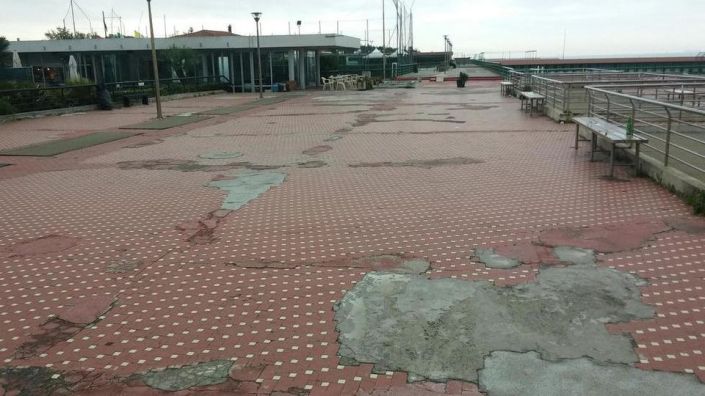
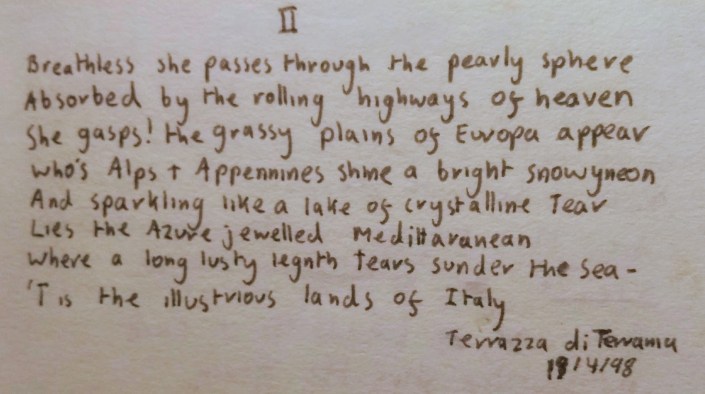
We drove to the beach – Terraza del Tirrenia – pass’d an American army base. Now I understand the source of all the ‘Yankees Go Home’ graffiti scrawl’d about Pisa. It wasn’t too far to the beach, where I got my first taste of the long sought after – Mediterranean. It was windy as fuck! I thought Italy was meant to be a sunny paradise – its been pretty poor so far, but I suppose its only April. So we stroll about for a bit, taking it in turns to blast away on Megadeth’s cool bongo. Unfortunately a legion of metal poles had emerged from the sands, spraying water everywhere.
Megadeth also gave me a cool lesson in Italian, which is improving at the rate of about one word a day. I’ve never had a large capacity for anything other than English, unfortunately. But I am enjoying the vibe of learning & speaking street Italian.
We eventually stumbl’d on an abandon’d holiday complex of beach huts & heavy rowing boats. Its not far until Summer at all, but the place is in a state of quasi-disrepair. Id its ready for June I’ll be very much surprised. I began to explore anyway, & soon found a cool spot & loads of paraphenilia to make a shelter – proper Robinson Crueso fun. I must find solitude, I feel, to cleanse my spirit & compose. This abandoned stretch of coast definitely has potential.
We then headed back to a spot near the car, which slowly fill’d with tourists. We kick’d a ball around, ate & play’d a little music. Well, not all of us, Jesse was asleep all the time in a sleeping bag. We definitely had a beachy time, but it was cold & the wind kept blowing the water from the sprayers hard into our faces.
Composed another stanza today – very happy with it! I think the Muse is coming with a vengeance. There is an arcane power deep in the underlying belly of versemaking, & I hope to be able to tap it to the fullest.
We set off back at about 6, by which time I was feeling ill. Perhaps its all the food I’m eating (I’m actually putting on weight on the road) or lack of cleanliness (I’m getting grubbier), or maybe it was just Megadeth’s driving! Whatever it was, as soon as the wine came out I began to feel a lot better – I do hope I’m not becoming an alcoholic!
Our evening meal came via the religious folks outside the stazione. Afterwards I had reefers & a reasonable conversation in English with one of the helpers, telling me the names of the outlying places about Pisa I can use in my poem. This was a rare moment of naturality for me, & I think the lack of English stimuli will actually help my poem – when only Shelley’s poems &Y my own internal dialogue being the source of words & & phrases & thoughts.
Return’d to our ‘home sweet home’ & stay’d up writing for a while, then hit this glorious, wonderful snoozeland… zzzzzzzzzzzz
THE BIRTH OF A POET
************************
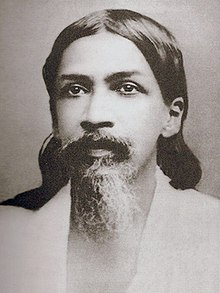
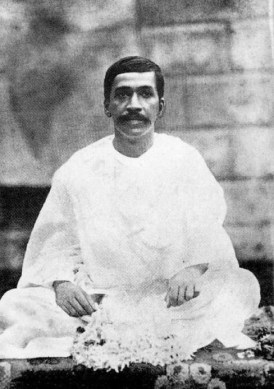
Classic Essays: Sri Aurobindo’s ‘The Veda’
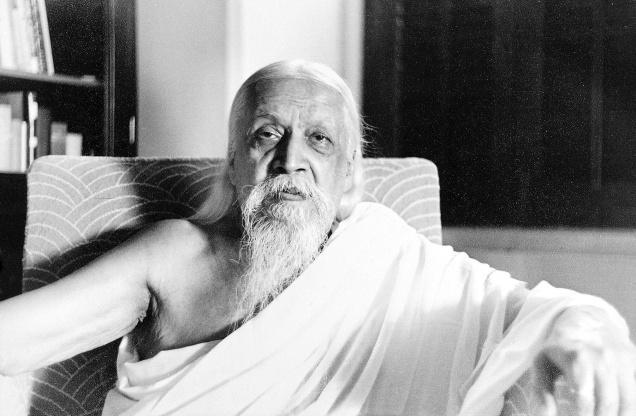
Beginning a series of classic essays on literature. This month sees the brilliant 20th century Indian ascetic poet Sri Aurobindo discussing Sanskrit literature (1920)
The greatness of a literature lies first in the greatness and worth of its substance, the value of its thought and the beauty of its forms, but also in the degree to which, satisfying the highest conditions of the art of speech, it avails to bring out and raise the soul and life or the living and the ideal mind of a people, an age, a culture, through the genius of some of its greatest or most sensitive representative spirits. And if we ask what in both these respects is the achievement of the Indian mind as it has come down to us in the Sanskrit and other literatures, we might surely say that here at least there is little room for any just depreciation and denial even by a mind the most disposed to quarrel with the effect on life and the character of the culture.
The ancient and classical creations of the Sanskrit tongue both in quality and in body and abundance of excellence, in their potent originality and force and beauty, in their substance and art and structure, in grandeur and justice and charm of speech and in the height and width of the reach of their spirit stand very evidently in the front rank among the world’s great literatures. The language itself, as has been universally recognised by those competent to form a judgment, is one of the most magnificent, the most perfect and wonderfully sufficient literary instruments developed by the human mind, at once majestic and sweet and flexible, strong and clearly-formed and full and vibrant and subtle, and its quality and character would be of itself a sufficient evidence of the character and quality of the race whose mind it expressed and the culture of which it was the reflecting medium.
The great and noble use made of it by poet and thinker did not fall below the splendour of its capacities. Nor is it in the Sanskrit tongue alone that the Indian mind has done high and beautiful and perfect things, though it couched in that language the larger part of its most prominent and formative and grandest creations. It would be necessary for a complete estimate to take into account as well the Buddhistic literature in Pali and the poetic literatures, here opulent, there more scanty in production, of about a dozen Sanskritic and Dravidian tongues. The whole has almost a continental effect and does not fall so far short in the quantity of its really lasting things and equals in its things of best excellence the work of ancient and mediaeval and modern Europe.
The people and the civilisation that count among their great works and their great names the Veda and the Upanishads, the mighty structures of the Mahabharata and the Ramayana, Kalidasa and Bhavabhuti and Bhartrihari and Jayadeva and the other rich creations of classical Indian drama and poetry and romance, the Dhammapada and the Jatakas, the Panchatantra, Tulsidas, Vidyapati and Chandidas and Ramprasad, Ramdas and Tukaram, Tiruvalluvar and Kamban and the songs of Nanak and Kabir and Mirabai and the southern Shaiva saints and the Alwars, – to name only the best-known writers and most characteristic productions, though there is a very large body of other work in the different tongues of both the first and the second excellence, – must surely be counted among the greatest civilisations and the world’s most developed and creative peoples. A mental activity so great and of so fine a quality commencing more than three thousand years ago and still not exhausted is unique and the best and most undeniable witness to something extraordinarily sound and vital in the culture.
The early mind of India in the magnificent youth of the nation, when a fathomless spiritual insight was at work, a subtle intuitive vision and a deep, clear and greatly outlined intellectual and ethical thinking and heroic action and creation which founded and traced the plan and made the permanent structure of her unique culture and civilisation, is represented by four of the supreme productions of her genius, the Veda, the Upanishads and the two vast epics, and each of them is of a kind, a form and an intention not easily paralleled in any other literature. The two first are the visible foundation of her spiritual and religious being, the others a large creative interpretation of her greatest period of life, of the ideas that informed and the ideals that governed it and the figures in which she saw man and Nature and God and the powers of the universe. The Veda gave us the first types and figures of these things as seen and formed by an imaged spiritual intuition and psychological and religious experience; the Upanishads constantly breaking through and beyond form and symbol and image without entirely abandoning them, since always they come in as accompaniment or undertone, reveal in a unique kind of poetry the ultimate and unsurpassable truths of self and God and man and the world and its principles and powers in their most essential, their profoundest and most intimate and their most ample realities, – highest mysteries and clarities vividly seen in an irresistible, an unwalled perception that has got through the intuitive and psychological to the sheer spiritual vision.
And after that we have powerful and beautiful developments of the intellect and the life and of ideal, ethical, aesthetic, psychic, emotional and sensuous and physical knowledge and idea and vision and experience of which the epics are the early record and the rest of the literature the continuation; but the foundation remains the same throughout, and whatever new and often larger types and significant figures replace the old or intervene to add and modify and alter the whole ensemble, are in their essential build and character transmutations and extensions of the original vision and first spiritual experience and never an unconnected departure. There is a persistence, a continuity of the Indian mind in its literary creation in spite of great changes as consistent as that which we find in painting and sculpture.
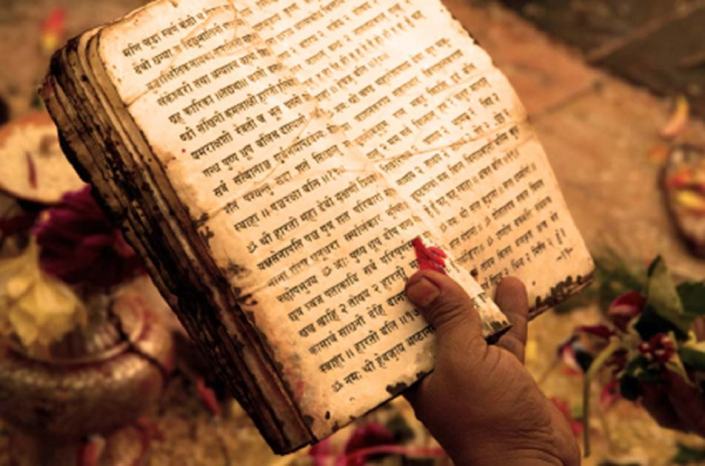
The Veda is the creation of an early intuitive and symbolical mentality to which the later mind of man, strongly intellectualised and governed on the one side by reasoning idea and abstract conception, on the other hand by the facts of life and matter accepted as they present themselves to the senses and positive intelligence without seeking in them for any divine or mystic significance, indulging the imagination as a play of the aesthetic fancy rather than as an opener of the doors of truth and only trusting to its suggestions when they are confirmed by the logical reason or by physical experience, aware only of carefully intellectualised intuitions and recalcitrant for the most part to any others, has grown a total stranger. It is not surprising therefore that the Veda should have become unintelligible to our minds except in its most outward shell of language, and that even very imperfectly known owing to the obstacle of an antique and ill-understood diction, and that the most inadequate interpretations should be made which reduce this great creation of the young and splendid mind of humanity to a botched and defaced scrawl, an incoherent hotch-potch of the absurdities of a primitive imagination perplexing what would be otherwise the quite plain, flat and common record of a naturalistic religion which mirrored only and could only minister to the crude and materialistic desires of a barbaric life mind. The Veda became to the later scholastic and ritualistic idea of Indian priests and pundits nothing better than a book of mythology and sacrificial ceremonies; European scholars seeking in it for what was alone to them of any rational interest, the history, myths and popular religious notions of a primitive people, have done yet worse wrong to the Veda and by insisting on a wholly external rendering still farther stripped it of its spiritual interest and its poetic greatness and beauty.
The real character of the Veda can best be understood by taking it anywhere and rendering it straightforwardly according to its own phrases and images. A famous German scholar rating from his high pedestal of superior intelligence the silly persons who find sublimity in the Veda, tells us that it is full of childish, silly, even monstrous conceptions, that it is tedious, low, commonplace, that it represents human nature on a low level of selfishness and worldliness and that only here and there are a few rare sentiments that come from the depths of the soul. It may be made so if we put our own mental conceptions into the words of the Rishis, but if we read them as they are without any such false translation into what we think early barbarians ought to have said and thought, we shall find instead a sacred poetry sublime and powerful in its words and images, though with another kind of language and imagination than we now prefer and appreciate, deep and subtle in its psychological experience and stirred by a moved soul of vision and utterance. Hear rather the word itself of the Veda.
Murder Ballads
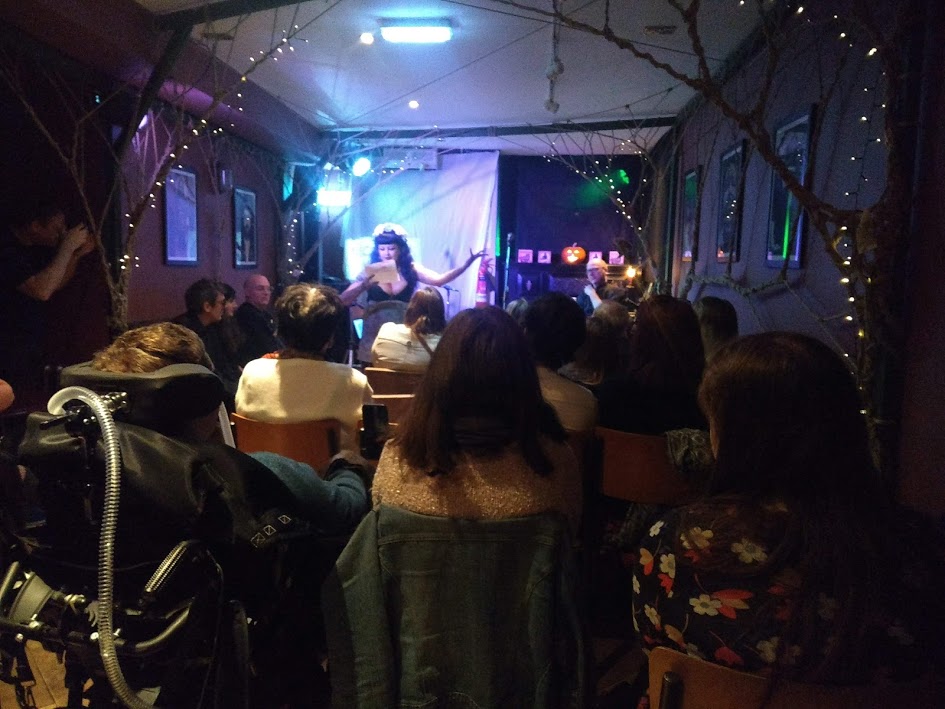
Woodland Creatures
Leith Walk, Edinburgh
30/10/18
Not only does Max Scratchmann possess the most deliciously suave of names, but he also loves to present the poetry-lovers of Edinburgh something different, something theatrical, something cool. His Halloween special, therefore, drew in poets from across Scotland to interject & connect with the continuous tartan thread that is Jennifer Ewan & her band.
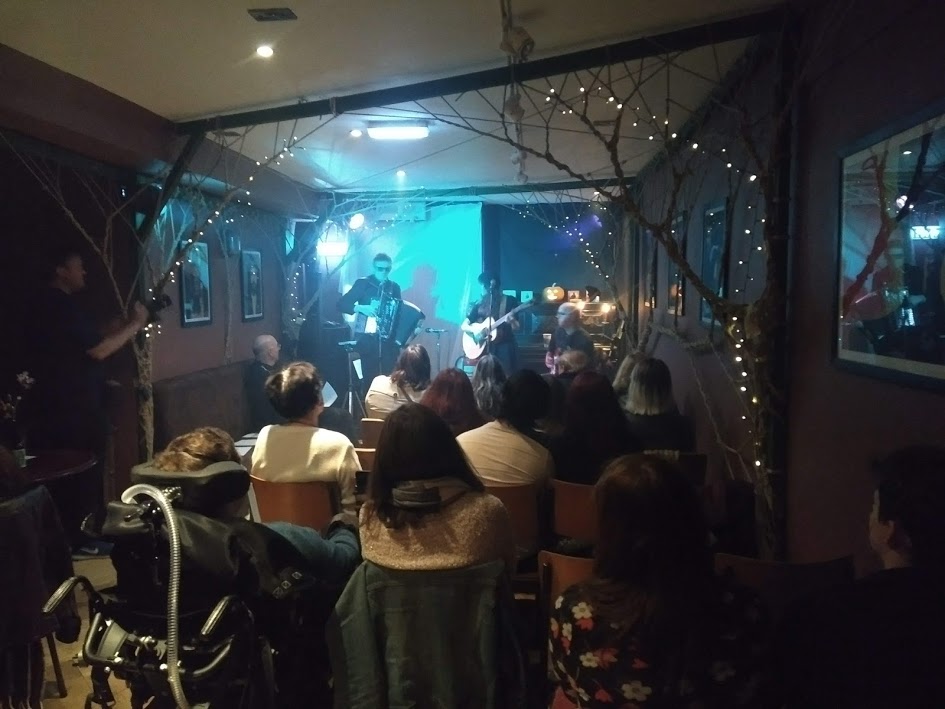
The prominent theme, of course, was the frighteners, but I found the evening less fearing & more full of fun, for the performers were all of the highest level. So, half of the time we were being regaled by the band – alongside Jennifer on guitar & vocals were Kim Tebble on accordion & Simon Fildes on bass; all were clad in black & their music swarmed into the ears of the healthy & ever-appreciative, sometimes-even-dancing audience, like bison reaching a prairie water-hole. We were given a steady stream of well-chosen numbers; of Jennifer’s own creations & also covers, when numbers such as Bessie Smith’s ‘Take me to the Electric Chair‘ sounded amazing with a Scottish burr.
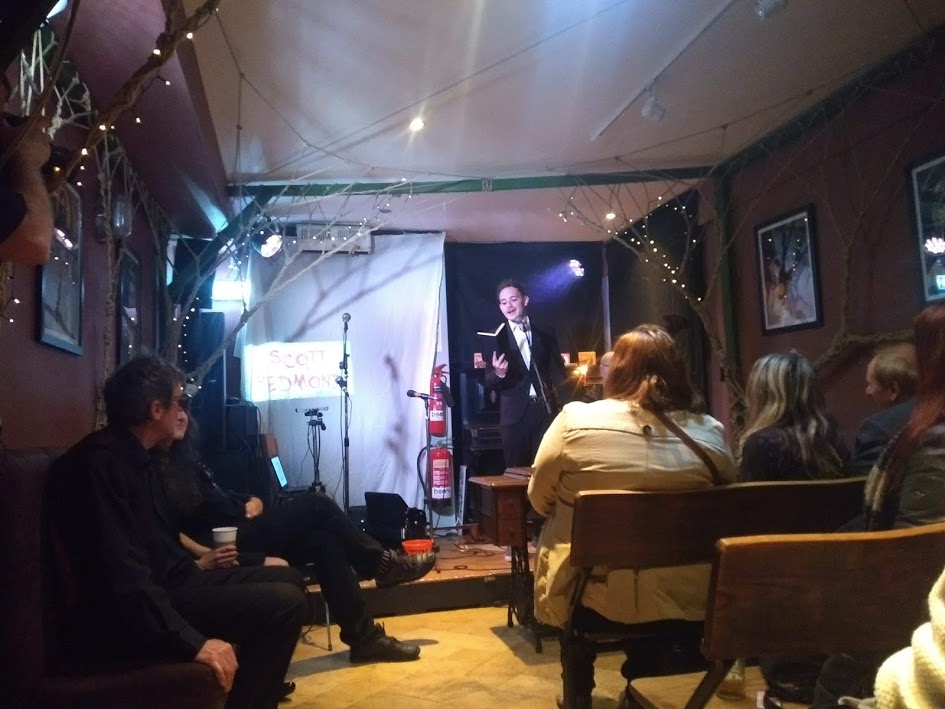
As for the poets, there were five of them, who did cheeky wee floor spots in between the ballads on both sides of the interval. Our host Max’s first poem defined Edinburgh as a ‘city of murder ballads‘ & we were off. A lot of the material was freshly written for the night – Molly McLachlan admitted to composing hers in Leith Weatherspoons earlier that day; not that you could tell – it flowed with elegant mastery. She, & the other poets – the shamanic Stella Birrell, the regal & dramatic Nicoletta Wylde, our beloved Max of course, & the rapid-tongued Scott TheRedman Redmond – presented some of the highest standard & absolute quintessence of performance poetry a la 2018 – when the post-modern polemical story-chaunt is all.
I’m not dying I’m transcending… & if I transcend you’ll transcend with me
Nicoletta Wylde
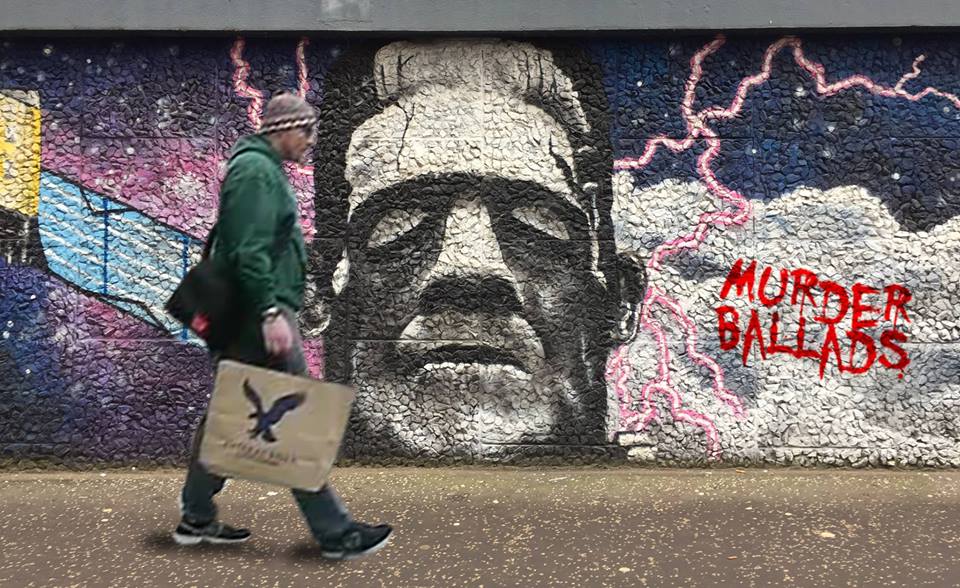
With half of the audience & all the performers making an effort aesthetically, & webbing & branches hanging off the walls of the venue, a genuine Tam O Shanter like vibe was gothically invoked. Thus setting & content were perfectly matched, upon which occasions good times are guaranteed, a tradition which Murder Ballads perpetuated with ease. A fluid, fascinating, & above all entertaining night’s entertainment.
Damo
Bukowski’s Irrepressible Brilliance

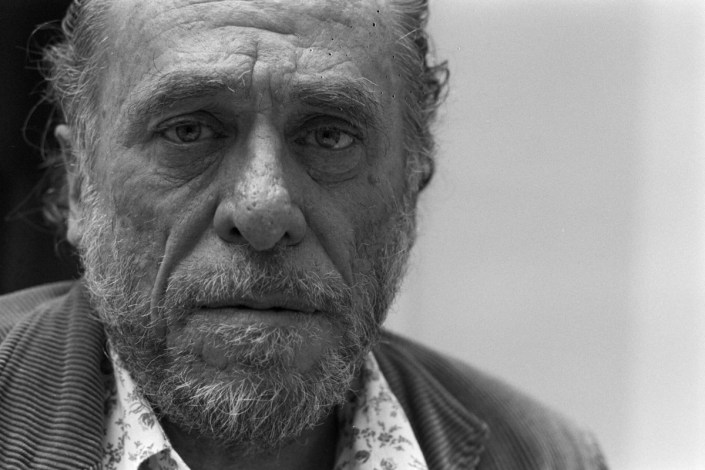
Ignored by the larger mainstream anthologists of America, Charles Bukowski is the ultimate proletarian anti-poet, an American hero their establishment would rather not possess on account of the fact he is by far their best, or rather truest poet. His style was refreshingly honest, a Tu Fu of the Beats, inspired by the twentieth century ‘Poetic Revolution‘ when poetry had, in Bukowski’s words, ‘turned from a diffuse and careful voice of formula and studied ineffectiveness to a voice of clarity and burnt toast and spilled loaves and me and you and the spider in the corner.’
Among Bukowski’s massive, almost industrial, output I have found a poem of his which is, in relation to the convetional poetic spheres, just so brilliantly curveball. It is found in a collection entitled ‘Love Is A Dog From Hell,’ a whirlwind of poems dated 1974-77. The book is midway between the publication of our poet’s first collection, ‘Flower, Fist & Bestial Wail’ (1960) & his death in 1994; & may be seen as the highwater-mark of his career. In this period Bukowski’s star was very much in the ascendency; success in Europe, breakthrough interviews with Rolling Stone Magazine & an acceptance into the American poetical elite as a notorious enfant terrible. On 25th November 1974, Bukowski read in Santa Cruz alongside Gary Snyder & Allen Ginsburg, an event memorialized by Ric Reynolds, who described Bukowski as; ‘a man of genius, the first poet to cut through light and consciousness for two thousand years & these bastards dont even appreciate it.’

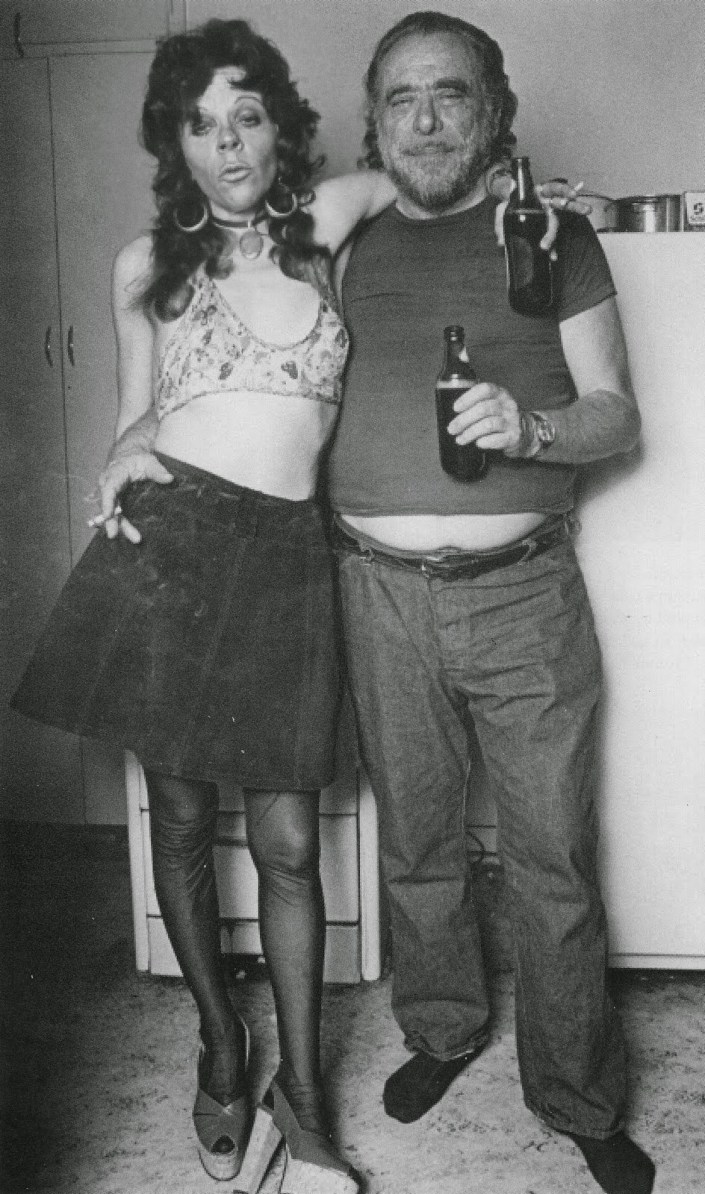
The mid-seventies also saw Bukowski engaged in a string of affairs with women; including Linda Lee Beighle, Pamela Miller – who becomes Nina in his short story, Workout – & Jane Manahattan – the Iris Hall of his Women. Of her time with Bukowski, Jane commented, ‘he was funny all day every day. A great love of life, & an enjoyment – always to be seeing the funny thing, & making a comment. he was a comedian.
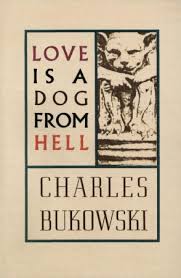 The poems within ‘Love Is A Dog From Hell’ are both sexually visceral & brutally protagonistic, with an incredibly poised ‘cogito, ergo sum.‘ Here we have the American sonnet sequence to Laura, but of course fashion’d via fabulously free ‘verse libre’ & the even freer love of the sex-addl’d seventies. In one of the poems, ‘how to be a great writer,’ he declares at its opening the creative & spiritual ordination of the entire collection;
you’ve got to fuck a great many women
beautiful women
and write a few decent love poems.
Ever since the publication of his first poem, ‘Aftermath of a Lengthy Rejection Slip,‘ in 1944 – at the age of 24 – the German-born Bukowski & his writing was dedicated to the holy trinity of Wein, Weib & Gesang – Wine, Women & Song. Thirty years later, his dedication to those core tenets was as strong as ever, only the delivery had changed to that of an ageing & cynical amourouse.
So to the poem I have chosen, artists: (Bukowski never respected the principle of capital letters), a classic laissez-faire love-affair with a groupie. Next to his omniscient genius – Bukowski almost breaks sweat telling us so – she is a minor writer, & not even that inspirational a lover. The scene is set for a droll masterpiece that could never find its way into an establishment canon, but for pure drama & in-the-moment magic it is unsurpass’d in all the poetry I have personally read. For the purposes of this essay I shall give the poem in full, adding a little critigloss in the interludes.
artists:
she wrote me for years.
“I’m drinking wine in the kitchen.
it’s raining outside. the children
are in school.”she was an average citizen
worried about her soul, her typewriter
and her
underground poetry reputationshe wrote fairly well and with honesty
but only long after others had
broken the road ahead
In eleven lines Bukowski brilliantly introduces his muse. We know so much about her already; a bor’d mother who writes to differentiate herself from the hum-drum. In a damning piece of critique on both her style & the state of modern poetry, Bukowski portrays her quite ruthlessly as lagging far behind the original poets who have ‘broken the road ahead.’
she’d phone me drunk at 2 a.m.
at 3 a.m.
while her husband slept“it’s good to hear your voice,” she’d say.
“it’s good to hear your voice too” I’d say.
what the hell, you
know.
In this next segment, Bukowski introduces himself into the poem – he is always the star -, converging on illicit daft-o’clock phonecalls with his faraway ‘mistress.’ There is no background to these calls, but the not-knowing encourages our minds to calculate why? She is a poet of an underground scene, did they meet that way? Did they sleep together then, or are these late night calls the first sordid steps towards her infidelity. We get all of that from just five short lines, which are followed by five superbly brusque words in which Bukowski’s soul & voice are eternised. He’s up for it, why not, wouldn’t you?
she finally came down. I think it had
something to do with
The Chapparal Poets Society of California.
they had to elect officers. she phoned me
from their hotel“I’m here,” she said, “we’re going to elect
officers.“o.k., fine” I said, “get some good ones.”
I hung up
the phone rang again
“hey, don’t you want to see me?”“sure,” I said, “what’s the address?”
With another piece of blasé indifference to his groupie – this time, given to his muse directly – Bukowski reaffirms all what he has been telling us about the situation. She is a poetess & she wants to see him, while he is completely indifferent to both her place in the poetry world & whether he gets to sleep with her or not. The Chaparral Society, by the way – Bukowski spelt it wrong – is the oldest and largest poetry organization in California, founded in the Los Angeles Area in 1939.
after she said goodby I jacked-off
changed my stockings
drank a half bottle of wine and
drove on outthey were all drunk and trying to
fuck each other.I drove her back to my place.
she had on pink panties with
ribbons.
Here, in its most poetically pungent, is the visceral sexuality I mentioned earlier. What stands out the most, & what for me first shone a light on this poem’s architectural majesty, is the brevity & poetry contained in, ‘I drove her back to my place / she had on pink panties with ribbons.‘ This is all we are allowed to hear about their sexual union, delicately tantalising & teasing us with what the poet secretly knows, but refuses to share, with just a hint of frilly lace to set our minds racing & our libidos rising.
we drank some beer and
smoked and talked about
Ezra Pound, then we
slept.its no longer clear to
me whether I drove her to
the airport or
not
In this post-coital aftermath, Bukowski sounds almost bored with the scene – going through the motions. He was in his mid-fifities at the time, & one imagines hundreds of notches on his bedpost from literary groupies. Many, many beers & many, many conversations about Ezra Pound. He then reinforces our instinctive inquiry by completely forgetting the episode’s denoument. There is no teary farewell at the airport, his muse simply dissapears into the aether.
she still writes letters
and I answer each one
viciously
hoping to make her stop
In this short stanza we get a suggestion of the interplay between Bukowski & his muse – they have a relationship, the student-teacher-lover type – & it is the only moment when Bukowski shows any real humanity in the poem. The fact that he takes the time to answer her letters proves she’s got under his skin, when other groupies were simply swatted away. There is something about this lady that was incorrigibly annoying to Bukowski, but whose spirit he could never truly shake off.
someday she may luck into
fame like Erica
Jong. (her face is not as good
but her body is better)
and I’ll think,
my God, what have I done?
I blew it.
or rather: I Didn’t blow
itmeanwhile I have her box number
and I’d better inform her
that my second novel will be out in September.
that ought to keep her nipples hard
while I consider the posibility of
Francine du Plessix Gray.
The last two stanzas of Bukowski’s remarkable poem differ from the mental theatre of the earlier stanzas, launching the poem into the more philosophical chambers of its creator’s mind. He is free now to pronounce judgment on both the affair & the poem, & does so with a flourish of bravura. Two leading literary lionesses of the seventies are dragg’d into the picture – one hardly expects Bukowski letting them know of his decision to do so – placed on pedestals beside his muse. Erica Jong ‘s 1973 novel Fear of Flying blew female sexuality wide open, while Francine du Plessix Gray was a Pulitzer-winning grand dame of the New Yorker magazine. To Bukowski, all three are simply sexual objects who just happen to write, & the most important happenstance here is actually his second novel – Factotum. This was published in 1975, giving us a terminus ad quem for the composition of artists:.
Personally, I find the ending a little abrasive – in the same way Millenials are being offended by some of the patter & subject matter of the Friends sitcom. But the honesty of artists: is what makes this poem transcend the confines of conscious dignity into the realms of cosmic genius. The afterburner proplusion of an already unchallengable classic. In a letter to Nancy Flynn (1975) our poet attempts some kind of explantion as to his psuedo-misogynistic style.
I’m no woman-hater. They’ve give me more highs and magics than anything else. but I’m also a writer, sometimes. and there are variances in all things

To conclude this essay, I would just like to show how Nancy Flynn could well be the muse of the poem. The drawing above shows a clear hint of sexual union, while in a letter dated April 7th 1975, Bukowski asks Nancy, ‘what’s this here shit about going to Turkey? It rains there too.’ This of course connects with the poem’s opening scene of a bored houswife writing about the rain. In another letter, dated April 21st, Bukowski mentions slipping ‘a couple of poems past the APR‘ – the American Poetry Review. The informal substance of this comment suggests Nancy is familiar with the poetic establishment. This fits easily into his muse’s connection to the poetic establishment and her links to the The Chaparral Society.

Finally, in the letter of the 21st our poet also tells Nancy; ‘finished the 2nd. novel, FACTOTUM, at last. It should be out in Sept,’ which is a clear match to the poems, ‘I‘d better inform her that my second novel will be out in September.‘ Nancy Poole is a poet, on whose website we may read, ‘I spent twenty years in Ithaca, New York, working and raising a son, before moving to western Oregon in 1998 with my husband and cats.’ She rather does look a lot like the literary photfit painted by Bukowski in his poem, & with that I rest my case.
Damian Beeson Bullen
If you enjoyed this article
Please make a donation
***

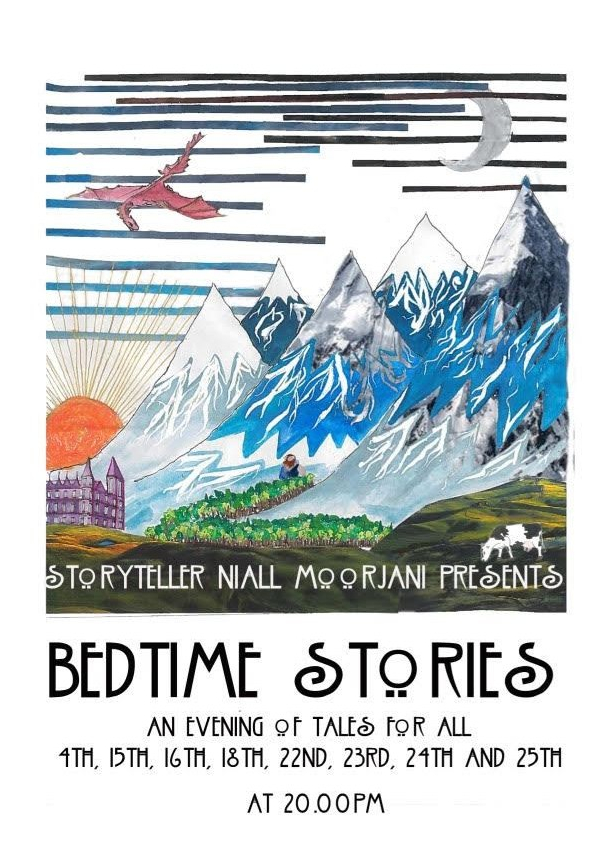
Bedtime Stories by Niall Moorjani
Edinburgh’s Lighthouse Radical Bookshop
Bedtime Stories, as befits the title of the show, took place in the relaxed atmosphere of a cosy nook of one of the most delightfully well-stocked bookshops you can find in these parts. It was hard not to get distracted by the many exciting book spines jostling for your attention. But pay attention we must, because real-live stories were being read to us, possibly for the first time in years. All we needed do was to stare, politely or perhaps gormlessly, or even close our eyes as we allowed ourselves to drift along to Niall Moorjani’s quirky, modern fairytales. Niall, originally from Dundee, has been a tour guide in Scotland for many years, and it showed in his confident and friendly delivery. The structure of the show took the form of a father telling bedtime stories to his son, a form of a classic storytelling device that allowed him to weave all of the stories together into a coherent whole. The entire experience was enhanced by the gentle, soporific sounds of the harp and the guitar, played by Ruth Brown and Anna Marta Sversberga respectively. Niall’s presence was engaging and his flow was flawless, as he guided us through some original fairy tale landscapes. He paused for just one natural intermission while we enjoyed a song from Anna, who accompanied her soothing voice with her guitar.
The stories are not particularly aimed at children, and there weren’t any families in the audience that evening, but none of the stories really verge into territory that’s inappropriate for wee ones. Niall regaled us with stories of lovers, witches and giants; the kind of characters and situations that we all know and love from childhood, but certainly with a modern twist. The Girl and the Dragon centres around our young heroine Elspeth, the only girl in a family of five brothers, on her way to an unexpected victory. With the story’s repeated exhortation to ‘never to apologise for tears’ we can begin to consider a more rounded idea of courage. The theme of a kind, conscious warrior came through in The Tale of the Man Who No one Could Remember, remembering the kindnesses which are rarely marked or celebrated in our society. The story of Bessie the cow was very funny, a tale which grew organically from his journeys up north as a tour guide. He’d become intrigued by a painting on a wall of a building of a cow with only 3 legs, and was determined to find out what on earth it was all about. One day he tracked down the local farmer to get him to spill the beans and give him the back story. The farmer in his thick rural accent did indeed spill the beans, and led us to the predictable but uncomfortable punchline that had everyone laughing.

The stories themselves are not particularly sophisticated or nuanced, but the traditional structure and rhythm of stories helps to make the experience soothing and comforting, as it reminds you of early childhood and having the time to indulge your imagination. This old-fashioned, simple entertainment gave some calm relief from the razzamatazz and the hustle of the festival that was still going on right outside the bookshop. With girl warriors, vegetarian dragons, and queer love stories, Niall is trying to create modern stories that can fire the imaginations of a wide range of people and the bookshop is an obvious venue for the kind of thoughtful, gentle people who would appreciate these kinds of stories. The crowd did seem particularly sweet natured, which you would hope and expect for a show of this nature. The audience is likely a homogenous and insular tribe in its own way, like a typical Brighton crowd of a couple of decades ago. However, all shows have their niche, Bedtime Stories has been consistently packed out, and Brighton was always ahead of its time. Let us welcome another necessary strand of the progressive frontier, and look forward to more stories from Niall in the future.
Lisa Williams
Anything But Dull: Jim Broadbent and Dix

Edinburgh International Book Festival
Baillie Gifford Main Theatre, Charlotte Sq. 23rd August 2018
After three events where the emphasis was on performance – I’ve seen four poets and two storytellers so far at the Book Festival – it almost felt strange to be in the Baillie Gifford for an hour’s chat. The main result of that strangeness, however, is that the event-goer is more aware that there is a book to promote. And what a book! I’m not a great fan of graphic novels. I own two, Alan Moore’s V for Vendetta because I like its anti-authoritarian, anti-nationalist stance, and Mark Russell’s The Flintstones because I appreciate its satire. I might soon own three. So let’s talk about the book first, and then the event itself.
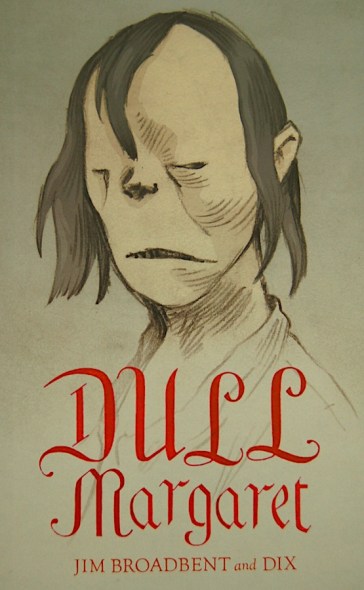
If any of you are familiar with Dix’s artwork – it’s difficult to call it cartooning – you’ll be used to seeing the human condition portrayed in all its venality, every vice expressed by a distortion of the features, but that distortion conveyed in lessening of features rather than complexity. A mouth becomes a slit, eyes become sullen and narrow, noses extend like Pinocchio’s after a hard day’s mendacity. Yet somehow he manages to convey three-dimensional depth, so if he needs to be complex, if, say, he needs to have someone wrapped in the coils of a dragon, he can startle the viewer by suddenly toggling complexity. Google him and you’ll miss by a mile, you’ll come up with German expressionist Otto Dix… but hang on a mo, it’s not as though there aren’t actually some similarities there, there is indeed something profoundly expressionistic about his work. Google “GRIMREALITY” to get an idea of his… er… normal fare. The cover of the book being promoted today, Dull Margaret, pares down his style. The lank-haired, Gollum-like protagonist stares sullenly at you, her face grey, her hair darker grey, the background a different grey. A peek inside at the flat, wet landscape she inhabits, and suddenly we’re out of Otto-Dix-Land and into somewhere more akin to the set of Kaneto Shindo’s Onibaba.
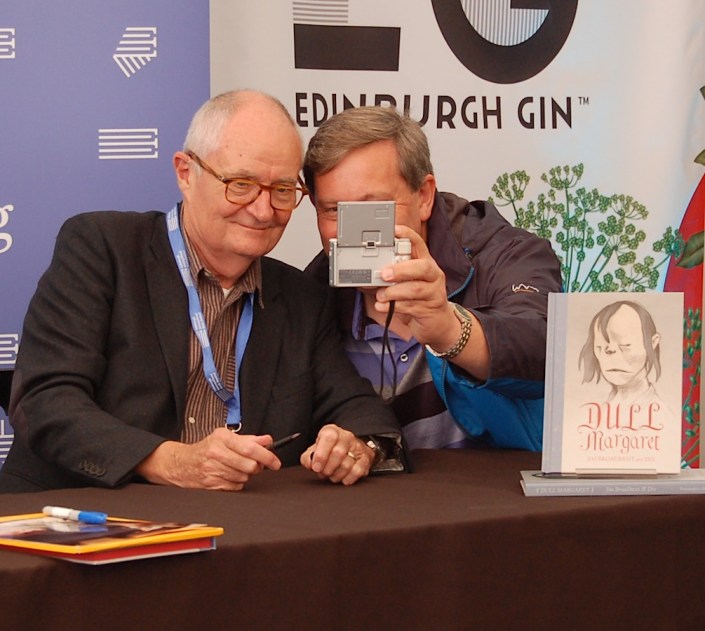
The filmic reference is appropriate. For frame after frame there is little in the way of dialogue, or even monologue, and no commentary or descriptive text. Everything is conveyed as atmosphere. The book was, after all, originally conceived by Jim Broadbent as a movie script. Listening to Jim reading out the opening paragraph of the script, describing the waterlogged landscape and the emergence of Dull Margaret herself, naked from under the ooze, dragging eels traps after her, it is easy to understand the word-barren, frame-after-frame presentation. A friend of Dix’s has created a forty-three second animated realisation of that opening sequence, and it is perfect. The whole thing must be realised; the clip got its own round of applause from the Baillie Gifford audience.
Jim Broadbent got the idea for the story whilst contemplating Bruegel’s painting Dulle Griet (‘Mad Meg’), and not having any “interesting acting” going on he set about writing a script. As the script progressed, the protagonist became less and less like the strange, strong woman striding sword-in-hand past the gates of Hell. She became a sorry wight, and her tale became a fairy story, it’s Grimm (in fact it’s bloody grimm!), it’s Andersenesque, or as Jim would have it “a cross between Victoria Wood and Hammer Horror.” It’s a moral tale, about the illusion of having one’s wishes granted, and about a diet of eels. It’s setting is a cross between a wasteland and Jim’s beloved Lincolnshire Marshes.
I’ve never heard Jim Broadbent referred to as a National Treasure, but he is one. He’s a deeply serious person, but as an actor has given us some achingly funny performances. Teamed with Miriam Margoles, she as a medieval Spanish Infanta and he as her interpreter in Blackadder, he managed to get laughs in total blackout; teamed with Miriam again in Blackadder’s Christmas Carol he was a hilarious Prince Albert to her Queen Victoria. He has been in the Harry Potter canon, he has been in Cloud Atlas, he has been half of the National Theatre of Brent, he has been in just about everything that required a character actor if his calibre. I first saw him on stage in Ken Campbell’s production of Neil Oram’s marathon play The Warp, at the Everyman Theatre in Liverpool in 1981. Outside the Fringe he has never seriously played a female role, so it is hardly surprising (well, is it?) that he wrote the title role of Dull Margaret for himself. Persuading a production company to take it on, however, didn’t happen – “Partly because I wanted to play the leading lady, and partly because it fitted no known genre!” – and by some arcane process Jim eventually found himself in contact with Dix and turning it all into a graphic novel.
And that’s where this Book Festival event really comes in. Daniel Hahn was in the chair, though what chair was the subject of a moment or two of faux bickering between him, Jim, and Dix. Daniel, himself a writer and translator, is a frequent presence at the Book Festival, and knows how to conduct a three-hand interview/discussion; but even he was unprepared for the sudden kettledrumming of the monsoon that struck the roof of the BG tent. A quick recovery – everyone on stage got a hand-mic. Well, actually Dix and Jim shared one, but what the hey! The book, said Daniel, is “extraordinary and beautiful and strange.” As I said, Jim is a deeply serious person, so this wasn’t an event full of guffaws. It was, however, full of gentle laughter – both Jim and Dix know what is actually funny in life, and what has been incongruously funny in the production of this extraordinary and beautiful and strange book. “I love her,” says Jim of his gauche, gaunt, venal creation. “Jim loves Margaret,” says Dix, “but I like the old man who says nothing, and adores her, and gets beaten regularly, and adores her even more after the beatings!” They discussed the eels, the starving dog that turns up later as a bloated corpse, the Faustian bargain that Dull Margaret strikes to escape the tedium and poverty and drenching of her life, the leeching of colour that allows a sudden gold or blood-red to leap out at the reader’s eye.
Working from the full script, Dix said, was a matter of saying to himself, of the various scenes, “That’ll work over two pages… that’ll work over four pages…” and so on. Thus the finished work grew. He had several attempts at the protagonist. “This was really exciting,” said Jim, “because Dix works in the early hours of the morning, so I’d get up and open my computer, and these images would have arrived overnight.” The first realisation was too plump-bodied for someone who existed solely on a diet of eels; the second was too neurotic, just not dull enough; the next was too fragile, she needed to be stronger to survive Margaret’s harsh lifestyle, and so on. “We didn’t want her to look like me,” said Jim, “even though when I was pushing the film script I said that part of her tragedy was that she looks like me.”
I often say that an hour is not enough for one of these events. Strangely, for all the fascination on offer, it was about right for Jim and Dix. Neither is verbose. As a result, there was time for a leisurely, quarter-hour Q and A session before we all trundled next door for the book signing, by which time we knew all we needed to know about how the book was conceived and realised. Pitched spot on, I’d say. And I think I’ll ask for Dull Margaret in my Christmas box. Enough said.
Paul Thompson
Paul Thompson
Strength in Difference: Jackie Kay
Edinburgh International Book Festival
Baillie Gifford Main Theatre. 3.15, Tues. 21st August 2018
I have encountered a major problem with the Book Festival – I have run out of superlatives. Seriously, I don’t think I’ve been to a bum event yet. This year I’ve seen the Poet Laureate AND the Makar, and poetry-wise it doesn’t get much better than that. So I’m at a loss as to how to make this review different. I could try to write it in Scots of course – I ken wir ain leid weel eneuch – or at least code-switch between Scots and review-ese the way Jackie does between Scots and a more standard English.*
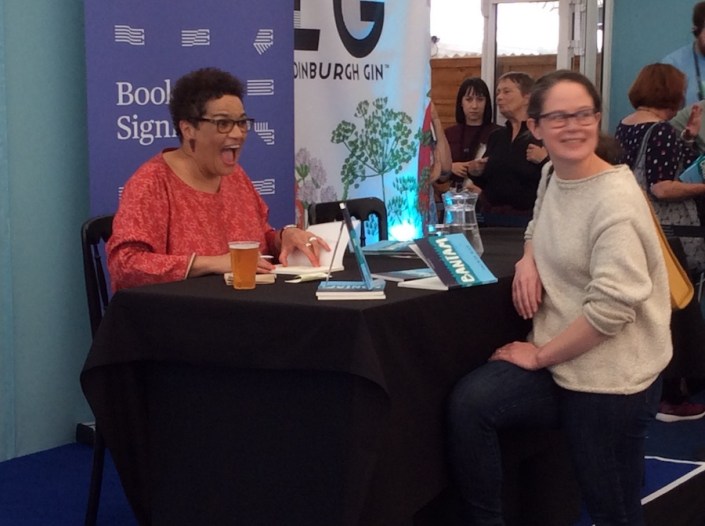
This event took place in the main theatre and it was packed, as you would expect for such a consistently popular figure at the Festival. The format was simple: after a few opening remarks from journalist and broadcaster Ruth Wishart, Jackie read poems from her new book Bantam, after which Ruth conducted a brief interview, moderated some questions from the body o’ the kirk, and the event finished with a couple more poems. All standard fare. “There’s a public health warning involved here,” quipped Ruth, “listening to Jackie read her own poetry can seriously damage your tear ducts.” Aye, well, maybe, but mainly from tears of laughter, and gentle ones at that, but nothing more. Jackie may have “one of the most infectious giggles in the business” (another of Ruth’s quips), but what really marks her poetry is its accessibility. That, let’s face it, is what the job of Makar is all about. The poetry is never facile, it can rhyme and it can rhythm with the best of them, but it never becomes a jingle of doggerel or a cut-up grocery list of prose. And it can make us chuckle, chuckle with recognition as a childhood memory or the pen-portrait of a parent or grandparent chimes or parallels one of our own, and does so without losing the signature of Jackie herself. I mean – who else could make us smile by re-telling the story of an eleven-year-old experiencing her first period whilst on a family holiday in Avielochan?
Jackie’s poetry is so direct, so clear, so personal, that she has to remind us that it’s dangerous to assume that every poem is autobiographical. As most poets do, Jackie constructs a ‘voice’ for each poem; many may be a version of her own, but some are not. I know I’m preaching to the choir here, I know we’re savvy to this truth of poetry-making, but if Jackie feels it worth reinforcing, then I’m with her. Her speaking voice, her delivery, is another matter; a major part of her directness, her ability to connect with an audience, has to do with its liquid, modulated treble, its inflections, its rise and fall. Sometimes she teases, almost like a stand-up comic, but without a comic’s abrasiveness, and it’s not us but herself she’s teasing: “… a packed tent… on a weekday afternoon… did you not have anywhere better to go?” And sometimes it is us: “… there’s a lot of old Scots words in this poem that some people might not understand… but that’s life.” The Scots words, the holiday locations of Ardtornish, Avielochan, and Rannoch Moor – no, we had no trouble with any of that.

Some of Jackie’s material today was on politically safe ground. A poem with an anti-Brexit flavour to it, poking fun at Nigel Farage, works well in overwhelmingly pro-Remain Écosse – yes, this dichotomy with Brexitshire is still hanging around up here – after all, she does not have to pander to anyone else in Britain, her manor is north of the Tweed-Solway line, even though she now actually lives south of it. Part of the discussion between Ruth and Jackie touched on a statement by Ali Smith (who was in the audience) to the effect that all art is political. “I think if you say something’s not political,” said Jackie, “it then becomes political… the act of doing something non-political is political,” freely admitting that this was a conundrum. There is a difference between ‘political’ and ‘polemical’, and it’s safe to say that Jackie’s material is not the latter. This is, of course, despite the lifelong communist radicalism of her Glaswegian adoptive mother and father – Ruth queried whether, to a child, the role of a ‘Party Organiser’ must have sounded like a grand job, a matter of blowing up balloons and putting sausages on little sticks. Jackie’s parents are now quite elderly, and she treated us to an impersonation of her father asking how long her term in office was and, when being told it was five years, saying briskly, “Oh well, we’ll just have tae see oot yer term in office, then!”
There was only one awkward moment in during the event, which came when a questioner referred to the audience, and to poetry’s usual comsumer-base, as ‘middle-class’. Several people reacted to that, and Jackie herself reminded the questioner that it was her task as Makar to contact and connect with all kinds of people within Scotland, irrespective of class. The questioner was made to feel a wee bittie abashed, and that left me sitting there contemplating the fact that I too had often (but silently) made the same observation about my fellow Book-Festival-goers. I think we are, by and large, of that particular social bracket, but for some reason we don’t like to be reminded of the word ‘class’.
Anyway, as regards hearing from Jackie, chuckling with her, and listening to some of those familiarly friendly poems from Bantam, the hour passed by in a blink, and I could have done with another hour. Like I said, I’ve put in an order for a fresh supply of superlatives.
Paul Thompson
*Don’t get me started on the status of Scots, or we’ll be here for the next month.
Afua Hirsch: Forged Identities

Afua Hirsch opened her talk by reading her new essay in the Freedom Papers, a series of 50 essays commissioned by the Book Festival on the theme of freedom and published as a supplement to the 18th issue of Gutter Magazine. Reading it to a background beat gave it a taste of spoken word dub poetry. Her personal story outlined in her Freedom Paper essay is a distillation of the ideas in her book Brit(ish), which gave us a useful overview of the issues to be debated. Journalist and author Chita Ramaswamy was a calm, measured and insightful chair and the conversation naturally flowed. Hirsch’s talk, quoting from author Toni Morrison that the ‘personal is the political’ invited us to see the connection in the struggle to understand and construct a clear identity as a mixed-race British woman with the need to debate and understand the ramifications of Britain’s history as an imperial power.
She began by deconstructing a common but well-meaning phrase from white friends and associates, the supposedly reassuring “We don’t see you as Black.” Attempting to pinpoint the source of discomfort embedded within such a comment highlights that Blackness itself is associated in our mainstream narrative with poverty, criminality and backwardness. As issues of identity are key to political movements such as Brexit, she underscored the link between the current rise in fascism and a sense of threat to constructed white identities that are based on falsehoods. The infamous Enoch Powell, famous for his incendiary ‘Rivers of Blood’ speech, could speak Urdu and longed for lost imperial grandeur, and she used this as a prime example of how imperial nostalgia can feed directly into racism. Powell’s musings that someone of West Indian or Asian heritage will always be viewed as ‘Other’ in a majority-white country is something that is sadly all too common today.
Both Ramaswamy and Hirsch agreed that the freedom to choose British identity is a fragile one; subject to the political whims of the ruling elite and the groundswell of feeling in the country as a whole. Although the extreme violence and hostility that previous generations of Black and Asian immigrants had to suffer has eased, institutional racism hasn’t gone away. Hirsch postulated that the new battleground is in the freedom to self-identify, particularly for those who can’t easily fit into a rigid category. Ramaswamy said that she greatly appreciated Brit(ish) for clearly articulating such common experiences for people of racialised and complex identities in Britain. Hirsch is pleased to see that space is finally opening up for discourse on these matters in Britain, but it’s certainly not an easy ride. She shared anecdotes of being invited to speak on The Pledge on Sky News, and attempting to avoid debating race when pitted against hostile white and right-wing commentators determined to invalidate her experiences of racism in Britain. She spoke of the exhaustion in continually fighting for one’s experience of racism to even be recognised as a legitimate reality. She shared the great effort involved in channelling the emotion that’s continually provoked by recalling disturbing experiences into the resources necessary to make points in a more cerebral way. Chita agreed that as a fellow journalist and middle-class British woman of colour, one is often accused of playing the victim and expected to remain silent when meeting a lack of empathy over the impact of continual racist slights.
Hirsch has been very courageous in exposing her personal story to potential attack by narrow minded members of the old white elite clinging to an outdated narrative. Some feathers are bound to be ruffled by exposing the hypocrisy of situations where British citizens, even those born here, are often made to feel like they don’t belong in a place they consider home. Although surprised but comforted by the overwhelmingly positive reception by readers, she’s observed two types of negative trends in the reactions to the book by pundits. Firstly, contempt, exemplified in a scathing review of her book by a Times journalist, strongly implying that she was attacking the country of her birth and upbringing. She wryly commented that at least a review of this nature removed the last shred of doubt that these archaic viewpoints are still very much in our midst. The other was gratitude, or more specifically, annoyance at the supposed lack of gratitude by British-born and bred second-generation immigrants to the county where they have been ‘allowed’ to live by a tolerant, benevolent majority. The outraged reaction to the Windrush scandal across the spectrum was bolstered by stories of “good immigrants”; because post-war Caribbean immigrants and their families had earned their right to stay with hard work and positive contributions, rather than the simple fact that people arriving in Britain at that time were not only invited here by the British government, but already legally classified as British citizens.
She spoke of her personal family history, which is outlined in depth in the book, and how grateful, in fact, her Ghanaian grandfather was to have the opportunity to go to Cambridge and raise the bar for the perception of African people at that time. There was no luxury of failure! She spoke of a strange coincidence when investigating local history; discovering that the windmill close to her childhood home in Wimbledon was where Baden-Powell wrote his Scouting Bible. The irony of this lies in the fact that he aided in the destruction of Kumasi in Ghana that turned some of her own family members into refugees. Even those handy survival tips he’s famous for he had learned directly from Ghanaian forest guides. A prime example that demonstrates that history framed as simply local in a country with such a huge imperial footprint will have often have complicated global connections.
This should be of interest to all, and be fully part of our education system. Yet Afua has been in the centre of the complex controversies developing around the issue of statues and what they represent. National heroes such as Nelson and Churchill are generally remembered in a one-dimensional way, as she developed in depth in her recent documentary ‘The Battle for Britain’s Heroes’. The mention of their more unsavoury attitudes and acts creates severe cognitive dissonance in those who cling to false binaries. She quoted a figure of 70% of British GDP coming from sugar grown on slave plantations in the Caribbean, but without the time to delve into the complexities of the effects of colonialism on our relative national economies, that statistic had nothing to ground it. At least that tidbit may have at least given some audience members some necessary food for thought. As Hirsch had mentioned, some conservative forces wish for History at school to be a celebratory subject. However, if we decided as a nation not to gloss over or omit the more difficult issues, we would do well to also celebrate those who fought for freedom from all forms of oppression.
Lisa Williams
 Mumble Words