The Aegean Edicts (1): The Tomb of Achilles – early clues

Literary essays from a pilgrimage to Troy
With the world some weird kind of pagan ritual lockdown, I thought it a better time than most to head off the beaten tracks & go searching for the fabled burial mound of Achilles & his best pal, Patrocolus. Since Schliemann digging Troy out of Hisalrik Hill in the 19th Century, the idea that Achilles fought & died in the Troad moves from phantasy to possibilty – the next two stages are plausable & probable, but we’re not there yet.
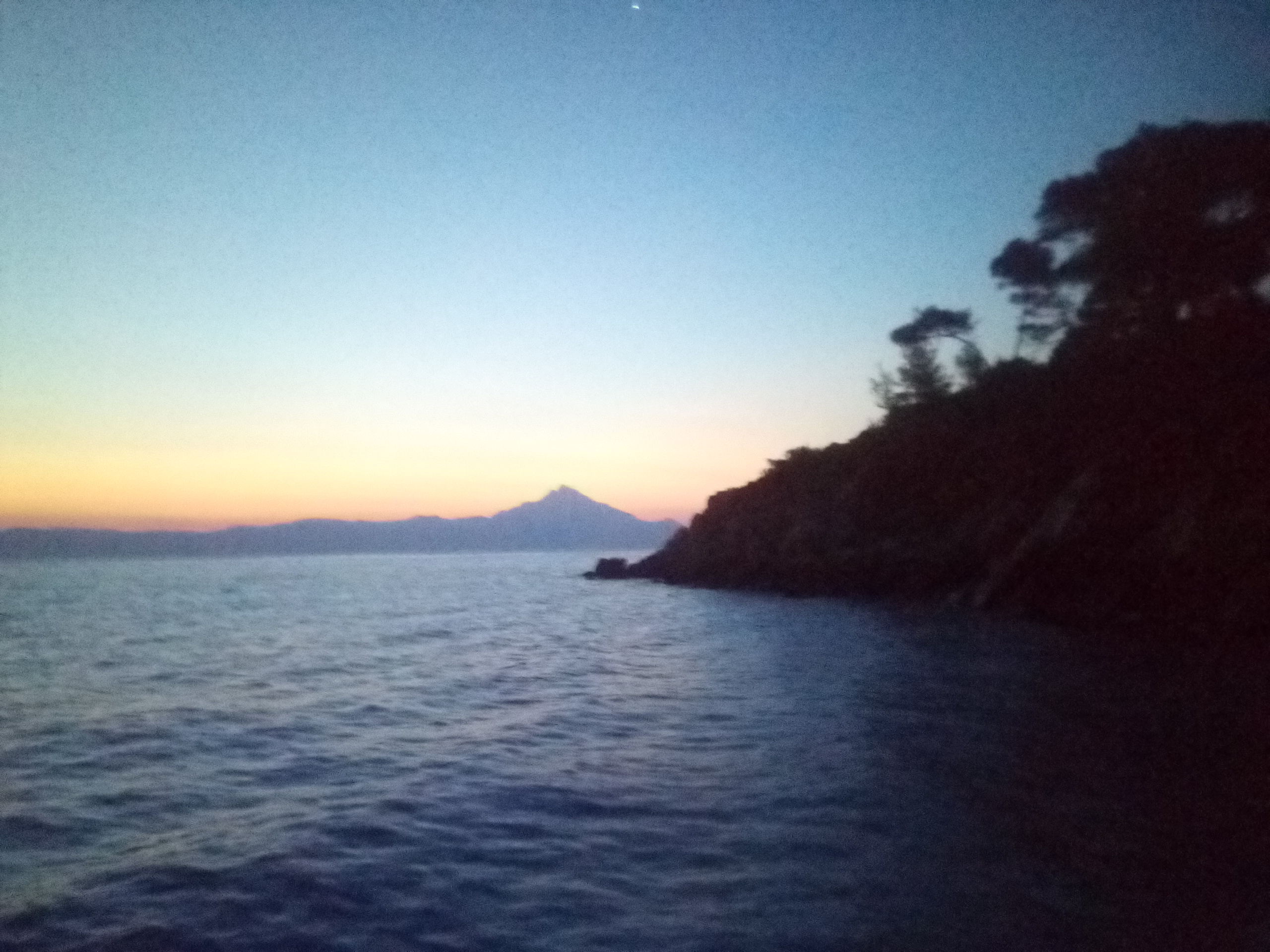
THE BEACHED SHIPS
‘The Acheans withdrew to the Hellespont’
In recent years a theory has arisen that Besika Bay – to the west of Troy – is where the Greeks landed their ships. Homer clearly states it was to the north, by the Hellespont. Two stalwart contenders for the tomb have been the burial mounds of Kum Tepe & Kesik Tepe, both facing the Hellespont. However, archeaology at the sites has only ever gone back as far as the 6th Century BC, meaning the real tomb is out there, elsewhere.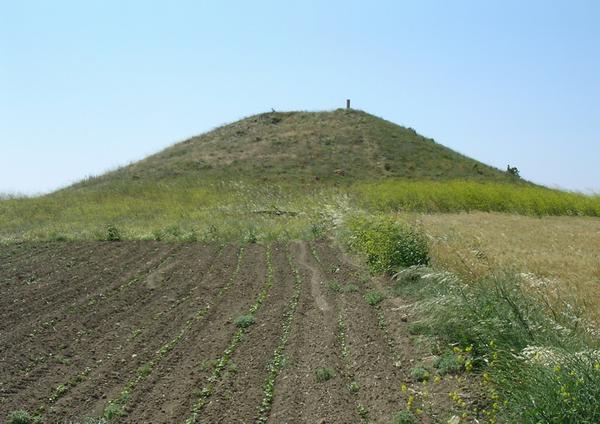
THE TURNING STONES
There is a dead tree stump, an oak or a pine, rotted in the rain, & it is flanked by two white stones. The road narrows at this point, but the going is good on both sides of the monument, which either marks an ancient burial or must have been put up as a turning-post by people of an earlier age. Homer is here describing the mid-way point of a chariot race. The turning post will be long gone, of course, but the two white stones might well stand in the same spot still. Homer also describes the turning-point as being ‘far away on level ground,’ giving us further detail.THE GULLY
Antilochus, that veteran campaigner, saw a place where the sunken road grew narrow. It ran through a gulley…
Between the beach & the turning point Homer is describing a narrowing of the road.THE BARROW OF ILUS
There is one final clue found in Book 24, in which Priam goes to plead with Achilles to stop dragging his son Hektor’s body about & leaving it the dogs. On the way we learn that once the old king of Troy & Hermes (in disguise) ‘had driven past the great barrow of Ilus & stopped their mules & horses for a drink at the river.’ So that’s plenty of info to start visualizing what to look out for when I get to the area. Also helpful is the fact that the Bronze Age coastline was apparently much closer to Troy than it is today, making my job that little bit easier. I’ll also be studying the rest of the Iliad for my clues – I’m reading it backwards at the moment actually, I find the first few books a bit heavy & stifling, & I want to retain my excitement about the project, to be frank.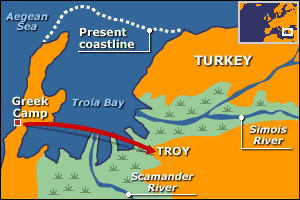 I shall finish the first of my Aegean Edicts with a couple of sonnets from my time so far in Greece. In the morning I am heading to Alexandroplis & from there by ferry to the island of Samothrace, arriving at sunset & within spitting distance of the Troad. Its good timing really, the Greek government this week has gone mask crazy making folk wear them in hotels & hostels & all public space. I think a rugged island away from all the world’s worries is the best place to be right now.
Sitra 29-07-20
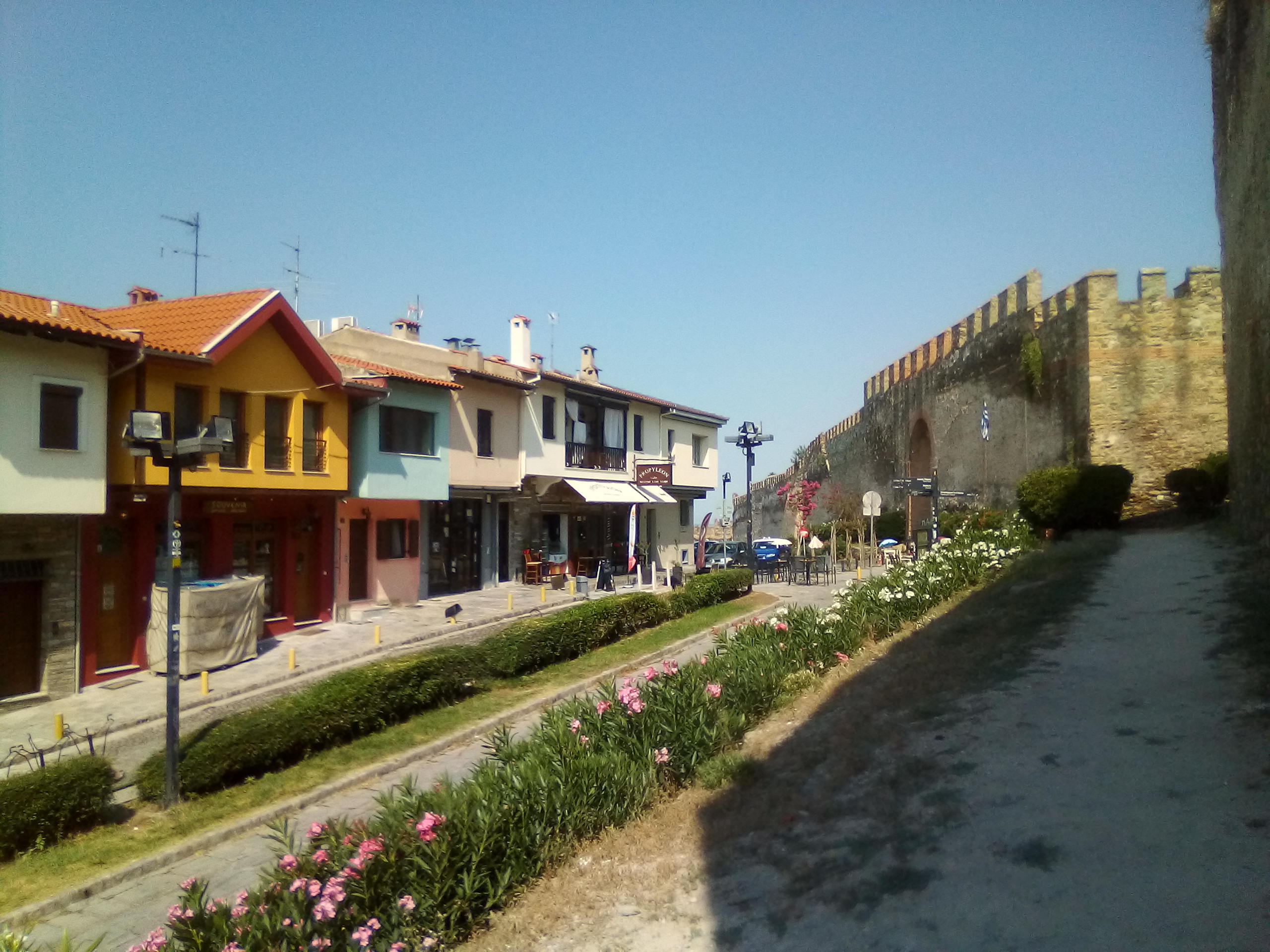
OVER THESSALONIKA
There is a heat they call the burn of Greec Beginneth in July, by Autumn screams Out in the day we English pray for peace In shady spots as lava spurts & steams.
In the labyrinth of Saloniki Street cats handsomely treated as they prowl Door to friendly door thro sweet, unsneaky Hunts for meaty morsels; fresh, fair & foul.
Adventuring against the mid-day sun Sauntering slow slopes up to Genti Koyle Hat soak’d in sweat, what buenavista won, From Mount Olympus, between sea & soil
The coast drove east to Chalkidiki’s hand, Three-finger’d, into blue Aegean fann’d!
SITHONIAN SUN
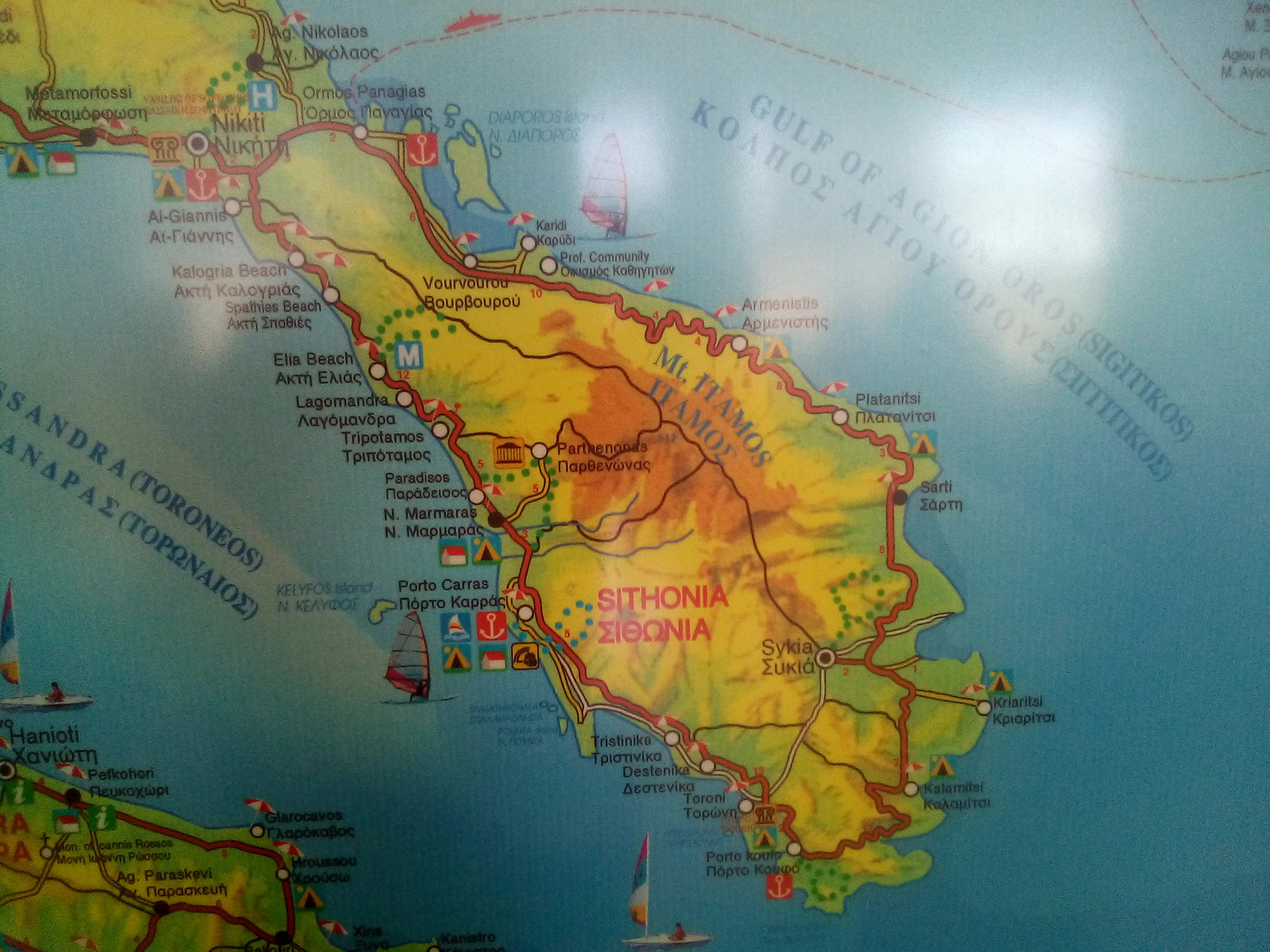
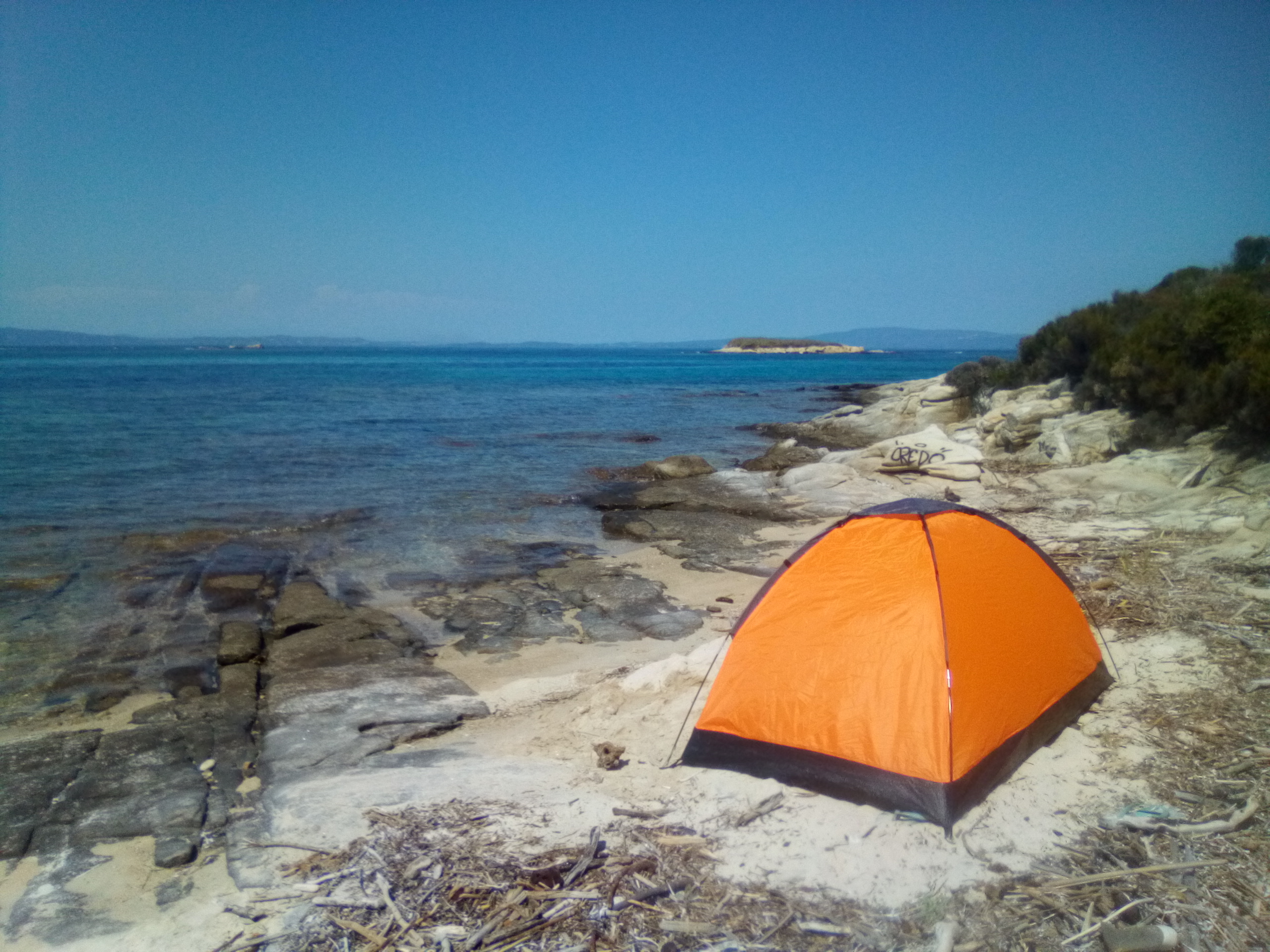
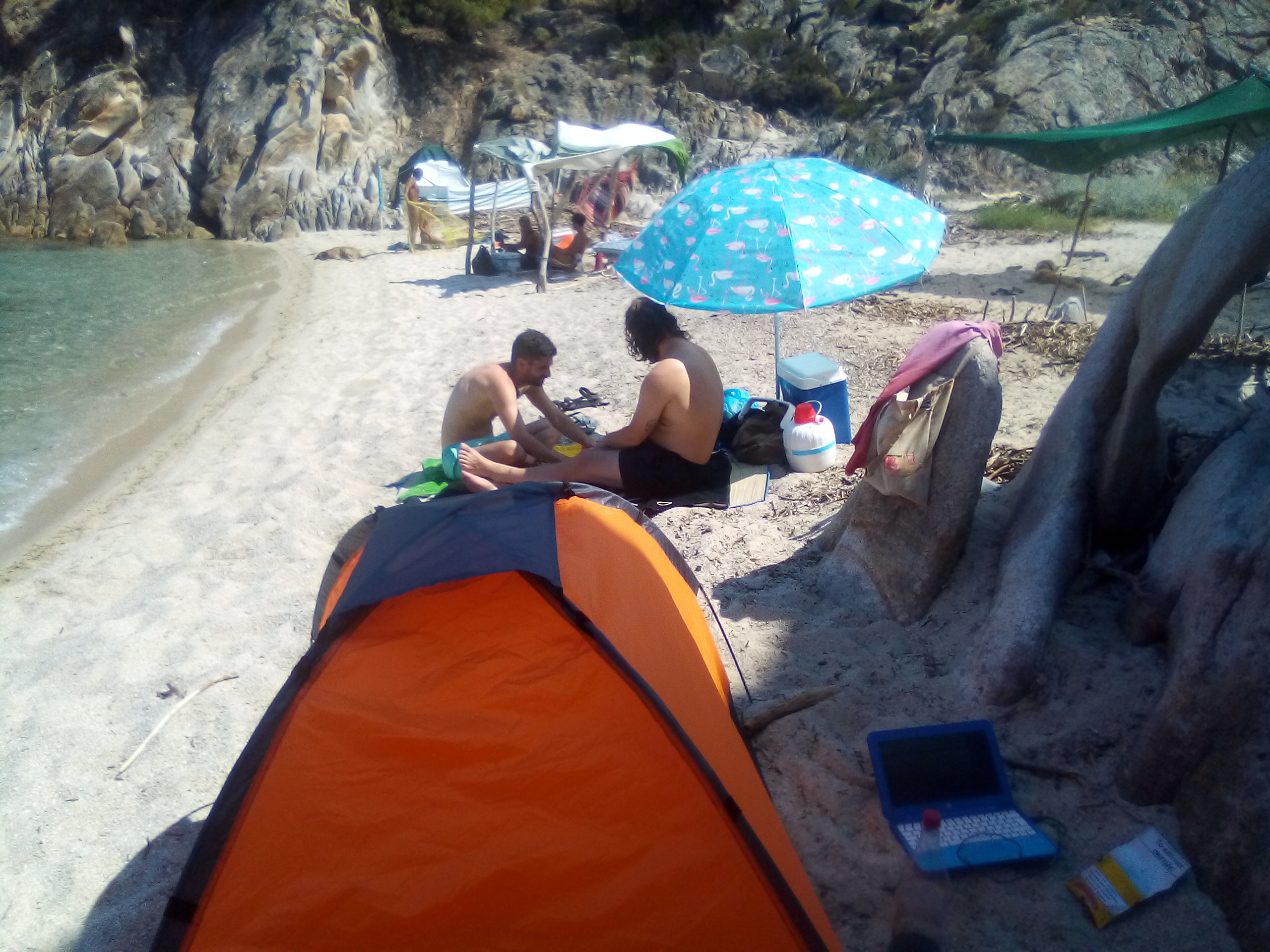
I found myself in Paradise a few K shy of Sarti I’d headed there solely beacuse it rhymes with ‘wild love party’ A wee secluded nudist beach with pyres of burnish’d driftwood So thought I’d stay a gracious while as Thracian poets should Across the soft, Singitic Gulf Mount Athos rose redeeimng All souls who gazed upon its point immortally updreaming As monkish men swam out to heaven seven times a day Libating skinsalt to exalted Thetis in the spray I gazed on Aphrodite & I swoon’d before Athean & then I saw Cassandra I’ll die happy cos I seen her; The infinite projectison of her body set me blushing Into a catacoombe of lust, libido wolves uprushing, Then in the rockshade softening I drank my surf-cool wine Watching Cassandra frolicing, voluptuous, divine.
Brunanburh, Beowulf & Egil Skallagrimsson
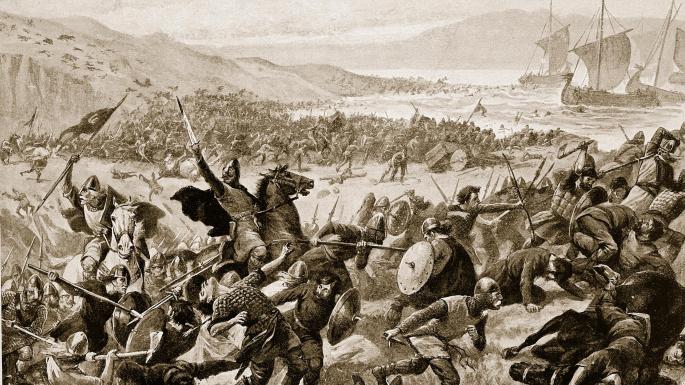
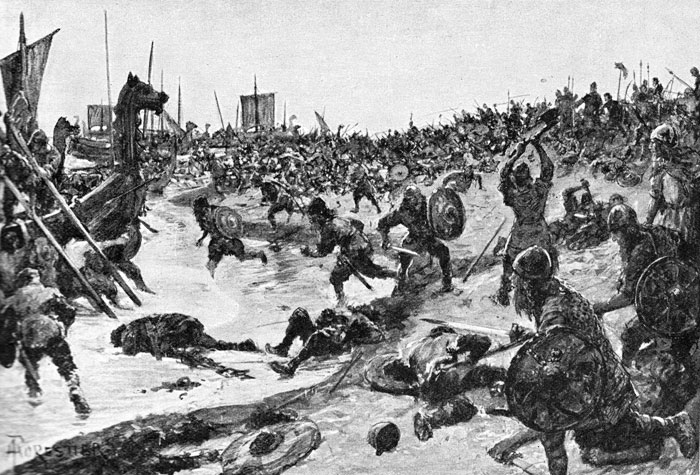
Brunanburh! Brunanburh! Brunanburh! This antique name was once attached to an Anglo-Saxon fortification, in whose locality was fought one of the most important battles in British history (937 AD). A massive showdown, it saw King Athelstan of England face off against a grand alliance of Scots, Vikings & the ‘Northern Welsh’ of Cumbria & Galloway. This confederacy had been galvanized into action by a young Viking prince called Analf Guthfrithson. Normally based in Dublin, Analf had momentarily managed to unite the entire Viking world behind him in an attempt to wrestle back their former control over England which had been lost to Athelstan’s grandfather, Alfred the Great. Despite such powerful forces arrayed against them, the Battle of Brunanburh was a comprehensive victory for the Saxons, since which day the borders of Britain’s three nations have been more or less constant. One could fairly admit that the Battle of Brunanburh was the moment when the British Isles were truly born.
The first mention of Brunanburh in the annals comes within the pages of the Anglo-Saxon Chronicle, that wonderful storehouse of early English history without which the Dark Ages would have been much, much darker. The entry for 937 is actually one of the most famous pieces of Anglo-Saxon poetry, the first & best of a series composed throughout the 10th century. Most entries in the ASC are written in rather mundane prose, but the rendering of certain events in poetry would naturally amplify their cultural importance. It is only through the Pegasus-flight of the poetic voice that humanity may truly record the incredible passions felt in the most turbulent of times. A fine example is the poetry of Wilfred Owen, without whose words our ability to feel the sensations inspired by the trenches of World War One would be much diminished. Similarly, the composer of the Brunanburh poem manages to reflect with consummate skill the spirit of battle, basing his words upon what appears to be genuine eye-witness accuracy.
In this year King Aethelstan, Lord of warriors,
Ring-giver to men, and his brother also,
Prince Eadmund, won eternal glory
In battle with sword edges
Around Brunanburh. They split the shield-wall,
They hewed battle shields with the remnants of hammers.
The sons of Eadweard,
It was only befitting their noble descent
From their ancestors that they should often
Defend their land in battle against each hostile people,
Horde and home. The enemy perished,
Scots men and seamen,
Fated they fell. The field flowed
With blood of warriors, from sun up
In the morning, when the glorious star
Glided over the earth, God’s bright candle,
Eternal lord, till that noble creation
Sank to its seat. There lay many a warrior
By spears destroyed; Northern men
Shot over shield, likewise Scottish as well,
Weary, war sated.
The West-Saxons pushed onward
All day; in troops they pursued the hostile people.
They hewed the fugitive grievously from behind
With swords sharp from the grinding.
The Mercians did not refuse hard hand-play
To any warrior
Who came with Anlaf over the sea-surge
In the bosom of a ship, those who sought land,
Fated to fight. Five lay dead
On the battle-field, young kings,
Put to sleep by swords, likewise also seven
Of Anlaf’s earls, countless of the army,
Sailors and Scots. There the North-men’s chief was put
To flight, by need constrained
To the prow of a ship with little company:
He pressed the ship afloat, the king went out
On the dusky flood-tide, he saved his life.
Likewise, there also the old campaigner
Through flight came
To his own region in the north–Constantine–
Hoary warrior. He had no reason to exult
The great meeting; he was of his kinsmen bereft,
Friends fell on the battle-field,
Killed at strife: even his son, young in battle, he left
In the place of slaughter, ground to pieces with wounds.
That grizzle-haired warrior had no
Reason to boast of sword-slaughter,
Old deceitful one, no more did Anlaf;
With their remnant of an army they had no reason to
Laugh that they were better in deed of war
In battle-field–collision of banners,
Encounter of spears, encounter of men,
Trading of blows–when they played against
The sons of Eadweard on the battle field.
Departed then the Northmen in nailed ships.
The dejected survivors of the battle,
Sought Dublin over the deep water,
Over Dinges mere
To return to Ireland, ashamed in spirit.
Likewise the brothers, both together,
King and Prince, sought their home,
West-Saxon land, exultant from battle.
They left behind them, to enjoy the corpses,
The dark coated one, the dark horny-beaked raven
And the dusky-coated one,
The eagle white from behind, to partake of carrion,
Greedy war-hawk, and that gray animal
The wolf in the forest.
Never was there more slaughter
On this island, never yet as many
People killed before this
With sword’s edge: never according to those who tell us
From books, old wisemen,
Since from the east Angles & Saxons came up
Over the broad sea. Britain they sought,
Proud war-smiths who overcame the Welsh,
Glorious warriors they took hold of the land.
Leaving aside for a moment the quest for the battlefield’s location (Burnley), I would now like to turn our digressional attention to a certain Egil Skallagrimsson. This guy is a true Icelandic legend, a warrior-poet of the 10th century who is the movie-star of the anonymously-penned 13th century Egil’s Saga. For me, he is the leading contender for authorship of the poem that was used by the Anglo-Saxon Chroniclers for 937 AD.
Egil was a widely praised poet – he composed his first at the tender age of three – & could well have been commissioned by Athelstan to compose a triumphant piece of propaganda. We know the poem was more or less contemporary to the battle, finding itself inserted into the ASC at least as early as 955, when it was written into the so-called “Parker Chronicle” ( Whitelock 1955). Egil was the best poet of his time & the poem is clearly the best in the Chronicle. Alistair Campbell (1938) notices how the original version of the poem contained many, ‘non-west saxon & archaic forms’ & declares, ‘who the poet was is impossible to say.’ He does, however, go on to describe the spirit of the poet, as in;
Although he owes much to his predecessors, the poet of the Battle of Brunanburh is by no means without merits of his own. He uses the conventional diction neatly & cleverly, & never becomes swamped in phrases… the two feelings which breathe through the poem are scorn & exhultation, & they are perfectly expressed. Lastly, despite the wealth of poetic diction at his command, he can be, at times, astonishingly simple & direct; the chief example of this is the description of battle from 20 to 40, where there is little repetition, & nearly every half-line advances the narrative… the poets subjects are the praise of heroes & the glory of victory… his work is a natural product of his age, an age of national triumph, antiquarian interest, & literary enthusiaism
My gut, litological instinct tells me that Egil was the author of the poem, based undeniable facts such as;
A – Egil fought at Brunanburh
His presence at the battle is without question & recorded extensively in the saga of his life by Snorri Sturlsson
B – Egil stayed at Athelstan’s court
A year or two after the battle, Egil returned to Athelstan’s court, & I believe it was at this time in & in the post-Brunanburh climate that the poem was produced. Although giving very little detail of Egil’s visit to Athelstan, the Saga definitely places him there, as in;
During the second winter that he was living at Borg after Skallagrim’s death Egil became melancholy, and this was more marked as the winter wore on. And when summer came, Egil let it be known that he meant to make ready his ship for a voyage out in the summer. He then got a crew. He purposed to sail to England. They were thirty men on the ship. Asgerdr remained behind, and took charge of the house. Egil’s purpose was to seek king Athelstan and look after the promise that he had made to Egil at their last parting.
It was late ere Egil was ready, and when he put to sea, the winds delayed him. Autumn then came on, and rough weather set in. They sailed past the north coast of the Orkneys. Egil would not put in there, for he thought king Eric’s power would be supreme all over the islands. Then they sailed southwards past Scotland, and had great storms and cross winds. Weathering the Scotch coast they held on southwards along England; but on the evening of a day, as darkness came on, it blew a gale. Before they were aware, breakers were both seaward and ahead. There was nothing for it but to make for land, and this they did. Under sail they ran ashore, and came to land at Humber-mouth. All the men were saved, and most of the cargo, but as for the ship, that was broken to pieces.
When they found men to speak with, they learnt these tidings, which Egil thought good, that with king Athelstan all was well and with his kingdom… in that same summer when Egil had come to England these tidings were heard from Norway, that Eric Allwise was dead, but the king’s stewards had taken his inheritance, and claimed it for the king. These tidings when Arinbjorn and Thorstein heard, they resolved that Thorstein should go east and see after the inheritance.
So when spring came on and men made ready their ships who meant to travel from land to land, then Thorstein went south to London, and there found king Athelstan. He produced tokens and a message from Arinbjorn to the king and also to Egil, that he might be his advocate with the king, so that king Athelstan might send a message from himself to king Hacon, his foster-son, advising that Thorstein should get his inheritance and possessions in Norway. King Athelstan was easily persuaded to this, because Arinbjorn was known to him for good.
Then came Egil also to speak with king Athelstan, and told him his intention.
‘I wish this summer,’ said he, ‘to go eastwards to Norway and see after the property of which king Eric and Bergonund robbed me. Atli the Short, Bergonund’s brother, is now in possession. I know that, if a message of yours be added, I shall get law in this matter.’
The king said that Egil should rule his own goings. ‘But best, methinks, were it,’ he said, ‘for thee to be with me and be made defender of my land and command my army. I will promote thee to great honour.’
Egil answered: ‘This offer I deem most desirable to take. I will say yea to it and not nay. Yet have I first to go to Iceland, and see after my wife and the property that I have there.’
King Athelstan gave then to Egil a good merchant-ship and a cargo therewith; there was aboard for lading wheat and honey, and much money’s worth in other wares. And when Egil made ready his ship for sea, then Thorstein Eric’s son settled to go with him, he of whom mention was made before, who was afterwards called Thora’s son. And when they were ready they sailed, king Athelstan and Egil parting with much friendship.

C – The poem is Bookish
Where JD Niles notices that scholars have, ‘drawn attention to the poem’s studied artistry, including its use of syntactic variation, studied antithesis, aural patterning, and an array of rhetorical figures that may be patterned on Latin models,’ Campbell (1938) tells us, ‘the poem is remarkably ‘correct’ in metre : that is to say, its half-verses are constructed with regard to the limitations, & bound together by alliteration with regard to laws, which are found in the earlier Old English poetry… the diction is almost entirely composed of elements to be found in earlier poems…. a large number of word s & expression which forcibly recall the older poetry.’ We must also observe that the poem does not rhyme, with Campbell stating, ‘as a final instance of the conservative nature of the versification of the Battle of Brunanburh, the absence of rhyme must be mentioned.’
I am a poet myself, & I understand the very tidings of poetic construction. Scholars have observed how the Brunanburh poem is packed full of direct lifts, or half-lifts, from the corpus of Anglo-Saxon literature. To my mind, although Egil would have been fluent in Old English, he may not have been so observant in its literature. To remedy this, during the composition of the Brunanburh poem I believe he made use of Athelstan’s library, in order to paint his epic, panygerical pastiche. Where Campbell tells us ‘it is evident that the Battle of Brunanburh shows no changes in the structure of the half-line : all its types can be paralleled in the older poetry, & practically all of them in Beowulf,’ in the poem, 21 half-lines occur identically in other OE poems, such as
eorla dryhten (Beowulf)
on lides bosme (Genesis)
wulf on wealde (Judith)
While 23 half-lines are nigh identical, as in;
faege feollan (Beowulf) = faege gefealled
on folcstede (Judith) = on dam folcstede
bone sweartan hraefn (Soul & body) = bonne se swearta hrefen
D – The poem is Skaldic
In the 10th century, the Icelandic poets – the Skalds – were the best in Europe, & their professional services were sought by many a wealthy king. That the Brunanburh poem has Skaldic roots is supported by JD Niles, who tells us;
By Old English standards, there is something unconventional about the poet’s voice as well. Granted that the distribution of praise and blame is central to the purposes of early Germanic poetry, still nowhere else in Old English is there such a quintessential poem of boasting and scorn. Athelstan’s triumph is celebrated not by a sober account of his actions, but by exultant allusion to the enemy blood spilled on the field and the number of enemy kings and noblemen cut down. The poet’s bloody-mindedness is matched by his emphasis on the losers’ shame. The survivors take to their ships xwiscmode ‘humiliated’ (56b), while the victors proceed home wiges hremge ‘gloating in battle’ (59b). The satiric element that runs through the poem is most prominent in the threefold repetition “hreman ne £>orfte. . .Gelpan ne J)orfte. . .hlehhanne Jjorftun,” 39b, 44b, 47b (“he had no need to gloat. . .He had no need to boast. . .they had no need to laugh”). The poet here makes sardonic reference to the grief of the aged Scottish king Constantine, who not only lost his son on the battlefield but was unable to recover the young man’s body.
The poet’s brusque indifference to carnage may remind one of the hard, cold tone that is characteristic of skaldic verse more than it calls to mind the heroic spirit of Beowulf or Maldon, let alone the melancholy and philosophical mood in which both the Beowulf poet and the poet of the Wanderer contemplate the spiraling tragedies of earthly mutability.
If Brunanburh has affinities to other early medieval verse, they are to such a poem as the Battle of Hafsfjord rather than to anything in Old English, as Kershaw has pointed out (vii). Both these poems celebrate a decisive battle by which a king established authority over the whole of his realm. In the Norse poem the king is Harald Fairhair, and his opponents are a coalition of Norwegians who opposed his expanding power in 872. Even more than the author of Brunanburh, the Norse poet takes delight in the image of boats manned by fleeing survivors, who in this poem are pelted with stones from behind while the wounded hunch shame-faced under the rowing-benches:
In Hafsfjord as in Brunanburh, the poet follows the customary mode of panegyric and calls attention to the distinguished ancestry of the victorious party: “konungr enn kynstóri,” 1.2 (“the king of noble lineage”). He also alludes in conventional fashion to the din of battle: “ísorn dúõu,” 2.4 (“swords clashed”), “hlömmum vas á hlífum,” 3.4 (“shields clanged together”). Brunanburh resembles nothing else so much as Hafsfjord drawn out to a more substantial and dignified length by an author who had at his command the full resources of Anglo-Saxon poetic speech and used those resources to honor his English king. In commenting on the “elliptical, allusive , non-narrative style” of the six encomiastic poems that are embedded in the Anglo-Saxon Chronicle, Opland suggests that this group of poems emerged due to the influence of the court poetry of the skalds (173). Leaving the other five Chronicle poems aside, since (with the possible exception of the poem on the capture of the Five Boroughs) they do not seem much like Brunanburh except in being occasional pieces, there is reason to think that the Brunanburh poet had at least passing acquaintance with the Norse language and skaldic poetic models. Several of the points of influence have been reviewed by Dietrich Hofmann (165-67); these consist of cnear ‘warship’ (35a) as a loanword, sceard ‘deprived’ (40b) used in a manner suggestive of Old Norse idiom, guöhafoc ‘war-hawk’ (64a) as a kenning for ‘eagle’, and – with less certainty – eorlas (31a) in the Norse sense of ‘jarls’. Other points worth identifying are the following.
There are a number of echoes between the Brunanburh poem & the poetry said to have been composed by Egil himself, as given in the saga.;
A
The warriors revenge
is repaid to the king
wolf & eagle stalk
over the kings sons;
Hallvard’s corpse flew
in pieces into the sea
the grey eagle tears
as Travel-quick wounds ES
They left behind them, to enjoy the corpses,
the dark coated one, the dark horny-beaked raven
and the dusky-coated one,
the eagle white from behind, to partake of carrion,
greedy war-hawk, and that gray animal
the wolf in the forest. ASC
B
There the North-men’s chief was put
to flight, by need constrained
to the prow of a ship with little company:
he pressed the ship afloat, the king went out
on the dusky flood-tide, he saved his life. ASC
My mother said
I would be bought
a boat with fine oars
set off with Vikings
stand up on the prow,
command the precious craft,
then enter port ES
C
The field flowed
with blood of warriors, from sun up
in the morning, when the glorious star
glided over the earth, God’s bright candle,
eternal lord, till that noble creation
sank to its seat. There lay many a warrior
by spears destroyed ASC
there before sunset we will
make noisy clamour of spears ES
D
They split the shield-wall,
they hewed battle shields with the remnants of hammers.
The sons of Eadweard, it was only befitting their noble descent
from their ancestors that they should often
defend their land in battle against each hostile people,
horde and home ASC
I have wielded a blood-stained sword
and howling spear; the bird
of carrion followed me
when the Vikings pressed forth;
In fury we fought battles,
fire swept through men’s homes,
we made bloody boodies
slump dead by city gates ES
E
They split the shield-wall,
they hewed battle shields with the remnants of hammers. ASC
I raise the ring, the clasp that is worn
on the shield-splitting arm ES
F
In this year King Aethelstan, Lord of warriors,
ring-giver to men, and his brother also,
Prince Eadmund, won eternal glory
in battle with sword edges
around Brunanburh. ASC
The wager of battle who towers
over the land, the royal progeny,
has felled three kings; the realm
passes top the kin of Ella. ES

5 – Egil was writing court poetry at that very time
Between arriving in Scotland & spending time with Athelstan (as given above) Egil found himself in York with Eric Bloodaxe, & ended up writing a substantial poem there. He’d got himself into a bit of bother alongside a certain Arinbjorn & ended up writing the poem to save their skins. The saga tells us;
Then they went in. Arinbjorn went before the king and saluted him. The king received him, and asked what he would have.
Arinbjorn said: ‘I lead hither one who has come a long way to seek thee in thy place, and to be reconciled to thee. Great is this honour to thee, my lord, when thine enemies travel of their own free will from other lands, and deem they cannot endure thy wrath though thou be nowhere near. Now show thyself princely to this man. Let him get of thee good terms, seeing that he hath so magnified thine honour, as thou now mayst see, by braving many seas and dangers to come hither from his own home. No compulsion drove him to this journey, nought but goodwill to thee.’
Then the king looked round, and saw over men’s heads where Egil stood. The king knew him at once, and, darting a keen glance at him, said: ‘How wert thou so bold, Egil, that thou daredst to come before me? Thy last parting from me was such that of life thou couldst have from me no hope.’
Then went Egil up to the table, and clasped the foot of the king. He then sang:
‘With cross-winds far cruising
I came on my wave-horse,
Eric England’s warder
Eager soon to see.
Now wielder of wound-flash,
Wight dauntless in daring,
That strong strand of Harold’s
Stout lineage I meet.’
King Eric said: ‘I need not to count the crimes on thy hands, for they are so many and great that each one might well warrant that thou go not hence alive. Thou hast nothing else to expect but that here thou must die. This thou mightest know before, that thou wouldst get no terms from me.’
Gunnhilda said: ‘Why shall not Egil be slain at once? Rememberest thou no more, O king, what Egil hath done to thee—slain thy friends and kin, ay, even thine own son to boot, and cursed thyself? Where ever was it known that a king was thus dealt with?’
Arinbjorn said: ‘If Egil have spoken evil of the king, for that he can now atone in words of praise that shall live for all time.’
Gunnhilda said: ‘We will hear none of his praise. O king, bid Egil be led out and beheaded. I will neither hear his words nor see him.’
Then said Arinbjorn: ‘The king will not let himself be egged on to all thy dastardly work. He will not have Egil slain by night, for night-slaying is murder.’
The king said: ‘So shall it be, Arinbjorn, as thou demandest. Egil shall live this night. Take thou him home with thee, and bring him to me in the morning.’
Arinbjorn thanked the king for his words: ‘We hope, my lord, that henceforth Egil’s cause will take a better turn. And though Egil has done great wrong against thee, yet look thou on this, that he has suffered much from thee and thy kin. King Harold thy father took the life of Thorolf, a man of renown, Egil’s father’s brother, for the slander of bad men, for no crime at all. And thou, O king, didst break the law in Egil’s case for the sake of Bergonund; nay further thou didst wish to doom his death, and didst slay his men, and plunder all his goods, and withal didst make him an outlaw and drive him from the land. And Egil is one who will stand no teasing. But in every cause under judgment one must look on the act with its reasons. I will now have Egil in keeping for the night.’
Then Arinbjorn and Egil went back to the house, and when they came in they two went into a small upper room and talked over this matter. Arinbjorn said: ‘The king just now was very wroth, yet methought his mood rather softened before the end, and fortune will now decide what may be the upshot. I know that Gunnhilda will set all her mind on marring your cause. Now I would fain that we take this counsel: that you be awake through the night, and compose a song of praise about king Eric. I should think it had best be a poem of twenty stanzas, and you might recite it to-morrow when we come before the king. Thus did Bragi my kinsman, when he was under the wrath of Bjorn king of Sweden; he composed a poem of praise about him in one night, and for it received his head. Now may we also have the same luck with the king, that you may make your peace with him, if you can offer him the poem of praise.’
Egil said: ‘I shall try this counsel that you wish, but ’twas the last thing I ever meant, to sing king Eric’s praises.’
Arinbjorn bade him try.
Then Arinbjorn went away, and had food and drink carried to the upper room. Egil was there alone for the night. Arinbjorn went to his men, and they sate over drink till midnight. Then Arinbjorn and his men went to the sleeping chambers, but before undressing he went up to the room to Egil, and asked how he was getting on with the poem.
Egil said that nothing was done. ‘Here,’ said he, ‘has sate a swallow by the window and twittered all night, so that I have never got rest for that same.’
Whereupon Arinbjorn went away and out by the door leading up to the house-roof, and he sate by the window of the upper room where the bird had before sate. He saw that something of a shape witch-possest moved away from the roof. Arinbjorn sate there by the window all night till dawn. But after Arinbjorn had come there, Egil composed all the poem, and got it so by heart that he could recite it in the morning when he met Arinbjorn. They watched for a fit time to go before the king.
King Eric went to table according to his wont, and much people were with him. And when Arinbjorn knew this, then went he with all his followers fully armed to the king’s palace while the king sate at table…. then Egil advanced before him and began the poem, and recited in a loud voice, and at once won silence.
‘Westward I sailed the wave,
Within me Odin gave
The sea of song I bear
(So ’tis my wont to fare):
I launched my floating oak
When loosening ice-floes broke,
My mind a galleon fraught
With load of minstrel thought.
‘A prince doth hold me guest,
Praise be his due confess’d:
Of Odin’s mead let draught
In England now be quaff’d.
Laud bear I to the king,
Loudly his honour sing;
Silence I crave around,
My song of praise is found.
‘Sire, mark the tale I tell,
Such heed beseems thee well;
Better I chaunt my strain,
If stillness hush’d I gain.
The monarch’s wars in word
Widely have peoples heard,
But Odin saw alone
Bodies before him strown.
‘Swell’d of swords the sound
Smiting bucklers round,
Fiercely waxed the fray,
Forward the king made way.
Struck the ear (while blood
Streamed from glaives in flood)
Iron hailstorm’s song,
Heavy, loud and long.
‘Lances, a woven fence,
Well-ordered bristle dense;
On royal ships in line
Exulting spearmen shine.
Soon dark with bloody stain
Seethed there an angry main,
With war-fleet’s thundering sound,
With wounds and din around.
‘Of men many a rank
Mid showering darts sank:
Glory and fame
Gat Eric’s name.
‘More may yet be told,
An men silence hold:
Further feats and glory,
Fame hath noised in story.
Warriors’ wounds were rife,
Where the chief waged strife;
Shivered swords with stroke
On blue shield-rims broke.
‘Breast-plates ringing crashed,
Burning helm-fire flashed,
Biting point of glaive
Bloody wound did grave.
Odin’s oaks (they say)
In that iron-play
Baldric’s crystal blade
Bowed and prostrate laid.
‘Spears crossing dashed,
Sword-edges clashed:
Glory and fame
Gat Eric’s name.
‘Red blade the king did wield,
Ravens flocked o’er the field.
Dripping spears flew madly,
Darts with aim full deadly.
Scotland’s scourge let feed
Wolf, the Ogress’ steed:
For erne of downtrod dead
Dainty meal was spread.
‘Soared battle-cranes
O’er corse-strown lanes,
Found flesh-fowl’s bill
Of blood its fill.
While deep the wound
He delves, around
Grim raven’s beak
Blood-fountains break.
‘Axe furnished feast
For Ogress’ beast:
Eric on the wave
To wolves flesh-banquet gave.
‘Javelins flying sped,
Peace affrighted fled;
Bows were bent amain,
Wolves were battle-fain:
Spears in shivers split,
Sword-teeth keenly bit;
Archers’ strings loud sang,
Arrows forward sprang.
‘He back his buckler flings
From arm beset with rings,
Sword-play-stirrer good,
Spiller of foemen’s blood.
Waxing everywhere
(Witness true I bear),
East o’er billows came
Eric’s sounding name.
‘Bent the king his yew,
Bees wound-bearing flew:
Eric on the wave
To wolves flesh-banquet gave.
‘Yet to make more plain
I to men were fain
High-soul’d mood of king,
But must swiftly sing.
Weapons when he takes,
The battle-goddess wakes,
On ships’ shielded side
Streams the battle-tide.
‘Gems from wrist he gives,
Glittering armlets rives:
Lavish ring-despiser
Loves not hoarding miser.
Frodi’s flour of gold
Gladdens rovers bold;
Prince bestoweth scorning
Pebbles hand-adorning.
‘Foemen might not stand
For his deathful brand;
Yew-bow loudly sang,
Sword-blades meeting rang.
Lances aye were cast,
Still he the land held fast,
Proud Eric prince renowned;
And praise his feats hath crowned.
‘Monarch, at thy will
Judge my minstrel skill:
Silence thus to find
Sweetly cheered my mind.
Moved my mouth with word
From my heart’s ground stirred,
Draught of Odin’s wave
Due to warrior brave.
‘Silence I have broken,
A sovereign’s glory spoken:
Words I knew well-fitting
Warrior-council sitting.
Praise from heart I bring,
Praise to honoured king:
Plain I sang and clear
Song that all could hear.’
King Eric sate upright while Egil recited the poem, and looked keenly at him. And when the song of praise was ended, then spake the king: ‘Right well was the poem recited; and now, Arinbjorn, I have resolved about the cause between me and Egil, how it shall go. Thou hast pleaded Egil’s cause with great eagerness, since thou offerest to risk a conflict with me. Now shall I for thy sake do what thou hast asked, letting Egil go from my land safe and unhurt. But thou, Egil, so order thy going that, after leaving my presence and this hall, thou never come before my eyes, nor my sons’ eyes, nor be ever in the way of myself or my people. But I give thee now thy head this time for this reason, that thou camest freely into my power. I will do no dastardly deed on thee; yet know thou this for sure, that this is no reconciliation with me or my sons or any of our kin who wish to wreak their vengeance.’
Then sang Egil:
‘Loth am I in nowise,
Though in features loathly,
Helm-capt head in pardon
From high king to take.
Who can boast that ever
Better gift he won him,
From a lordly sovereign’s
Noble-minded son?’
Arinbjorn thanked the king with many fair words for the honour and friendship that he had shown him. Then they two, Arinbjorn and Egil, went back to Arinbjorn’s house. After that Arinbjorn bade horses be made ready for his people. He rode away with Egil, and a hundred fully armed men with him. Arinbjorn rode with that force till they came to king Athelstan, where they were well received. The king asked Egil to remain with him, and inquired how it had gone between him and king Eric. Whereupon Egil sang:
‘Egil his eyes black-browed
From Eric, raven’s friend,
Welcomed. Wise help therein
Wife’s loyal kin lent.
My head, throne of helmet,
An heritage noble,
As erst, from rough rainstorm
To rescue I knew.’
I know thats quite a large extract, but its all pretty interesting stuff. I’ve put it in early to show how there is so much to the Brunanburh case as yet to be uncovered. Up until now, the best academics in the field halted before the Brunanburh poem’s author & declared him ‘unknowable.’ However, by simply suggesting that it could be Egil , suddenly all the strands of evidence suddenly coalesce & make him the clear favorite.
More evidence can be seen when immediately after the battle, Egil is writing militaristic, kenning-heavy praise poetry to Athelstan, as in;
‘Land-shielder, battle-quickener,
Low now this scion royal
Earls three hath laid. To Ella
Earth must obedient bow.
Lavish of gold, kin-glorious,
Great Athelstan victorious,
Surely, I swear, all humbled
To such high monarch yields.’
But this is the burden in the poem:
‘Reindeer-trod hills obey
Bold Athelstan’s high sway.’
Then gave Athelstan further to Egil as poet’s meed two gold rings, each weighing a mark, and therewith a costly cloak that the king himself had formerly worn.
This giving of rings even fits in with the ASC poem’s, ‘In this year King Aethelstan, Lord of warriors, ring-giver to men.’ So, using this platform as an investigation, I wondered if it could be at all possible that Egil Skallagrimsson could also have penned the great Old English epic – Beowulf. In support let us examine the following ‘flags.’

1 – Beowulf uses Icelandic folk motifs
In the introduction to Beowulf, edited by CL Wren & WF Bolton, we read the following passages;
The saga of the historical & well-authenticated Icelandic hero Grettir… attributes to him two fights against supernatural beings – the one closely resembling Beowulf’s fight with Grendel, & the other that which he had with Grendel’s mother in the demon-haunted mere. The resemblances are too close to be fortuitous; & one must suppose common folklorist elements lying behind both – since the late thirteenth-century Grettissaga cannot be supposed to have ‘borrowed’ these ideas from Beowulf, which was not known in Iceland.
What this tells us is that the author of the Icelandic Grettissaga was using the same motifs as the author of Beowulf, a situation which has baffled the academics. Peter A Jorgensen (Grendel, Grettir & Two Skaldic Stanzas: Scripta Islandica 24 / 1973) writes, ‘the most striking parallels are to be found in Beowulf’s battle with Grendel in the beleaguered Heorot, in which the hero eventually kills the intruder by tearing off its arm, & in Grettir’s fight with a monster in the harassed house at Sandhaugar, where the marauder is dispatched in the identical manner.’
If we see these folk-motifs as purely Icelandic, then we may assume that the author of Beowulf had access to Icelandic material – & thus most probably Icelandic.
2 – Haeft-mece / Heptisax
Where Wren/Bolton tell us;
There was evidently something important about a long-handled sword in the folk material which lies behind a fight with Grendel’s mother: for in Beowulf we find the unique haeft-mece & in Grettissaga an otherwise unrecorded instrument called a heptisax plays a part in the fight of Grettir against the female monster.
Jorgenson writes that most convincing;
is the occurrence of the much-discussed nonce word heptisax, found both in the second stanza & in the alleged prose expansion of the verses, corresponding to its generally accepted counterpart in Old English, the hapax legomenon Haeftmece (in Beowulf line 1457). It seems highly improbable that the word should occur only once in all of the extensive battle descriptions in Old Icelandic prose &, by chance, at precisely the same point in a narrative where the corresponding English text employs the cognate form.
There is a difference between the two poems, for in Beowulf it is the eponymous hero who uses the haeftmece, while in the Grettissaga it is the monster who wields the heptisax. In his paper Jorgenson concludes that, ‘the material to which the skaldic verses are eventually indebted stems from the same legend which also became part of the Beowulf epic.’ Again, we may suggest that the Beowulf author had access to Icelandic material – & was thus most probably Icelandic.

3- Compensation
In Beowulf, where Hrothgar pays compensation for the death of Beowulf’s warrior, Hondscioh, at the hands of Grendel, there is a parallel in Egil’s Saga. Here, Athelstan grants Egil two chests of silver as compensation for the death of Throrolf.
4 – The Dates fit
Egil was clearly around in the mid 900s, a period when the English had a great respect for the Danes. Nicholas Jacobs (Anglo-Danish relations, poetic archaism & the Date of Beowulf:Poetica 8 1977) writes; ‘From 927 onwards the Danes constitute a widely accepted element in English society, & an English poem complimentary to them is conceivable at least Down to the resumption of raids in 980.’ Roberta Frank (Skaldic Verse & the Date of Beowulf), remarks, ‘no linguistic or historical fact compels us to anchor Beowulf before the tenth century; if we do so, it is more from our emotional commitment to an early date rather than from hard evidence. Our one secure terminus is the palaeographic dating of the manuscript to around the year 1000.’
Where Walter Goffart estimated that Beowulf could not have been written with these historical details before 923 (Johnston Staver, Ruth (2005) :Placing Beowulf on a Timeline – A Companion To Beowulf), Jacobs gives us a probable terminus ad quem of the poem when he writes, ‘the first reference by a skald to an event associated with one of the Scyldings of Beowulf occurs around 965 when Eyvindr Skaldaspillir calls gold ‘the seed corn of Fyrisplains’ alluding to the story.‘ Eyvindr was the court poet of Hakon the Good, the English-speaking foster-son of Athelstan, who may well have heard the poem at first hand. His epithet skáldaspillir means literally ‘spoiler of poets’ – which could mean plagarist.
This means that the poem was written between 923 & 965. Returning to Frank for a moment, she tells us ‘the political geography of Beowulf fits comfortably into the period between Alfred & Aethelweard,’ & also suggests the presence of the Geats in Beowulf is a 10th century skaldic theme; ‘The fact that the Geats held together as a people into the eleventh century does not pinpoint the date of Beowulf, but it does suggest that they were as known & topical in the tenth century as in any preceding one – & perhaps more so.’
Conclusion
All this post is meant to do is scrape a little topsoil off the Egil-wrote-Beowulf theory. The thing is, he was the greatest poet of the age, he did spend time at the Royal English Courts, the Beowulf poem does contain Icelandic motifs & the poem seems to have been composed in his lifetime. This definitely makes him a serious contender not to be dismissed with ease.
The Young Shakespeare (1): Did He Even Exist?

Discovering the fascinating truth
Beneath Shakespeare’s missing years
‘God comes first,’ declared Heinrich Heine, ‘but surely Shakespeare comes next,’ & at some moment in our own lifetimes there might come the dawnflash when we truly understand the profound genius of a mind which conjured such a sequence of brilliant plays they shall remain in our collective consciousness forever. More than any other individual, Shakespeare’s natural creativity has improved & modernized the English tongue; while at the same time his uncanny penchant for the dramatic artform invented, fermented & cemented a theatrical tradition still thriving to this day. In the Elizabethan era, the art of English ‘biography’ was very much in its infancy. A first proper attempt to record actual details of Shakespeare’s life was made in the 1660’s, when John Aubrey included a gossipy sketch in his, ‘Short Lives.’ Another half-century would pass before anybody else tried to flesh out the bones of Aubrey’s brief work, when the poet-laureate-to-be, Nicholas Rowe, allocated to himself the task of modernizing Shakespeare’s language into the English of his day. There are other titbits & accounts scattered throughout the living memory of the Bard, such as this account by John Ward, the vicar of Stratford-upon-Avon and physician, whose Notebook for 1662-1663 reads;
I have heard that Mr. Shakespeare was a natural wit without any art at all. He frequented the plays all his younger time, but in his elder days lived at Stratford: and supplied the stage with 2 plays every year and for that had an allowance so large that he spent at the rate of £1000 a year as I have heard.
Combining Rowe, Ward & Aubrey gives us the tangible phantom of the historical Shakespeare, which is in essence moulded only upon a scrappy handful of unlikely anecdotes & second-hand memories. Into these we can stitch a few dozen ‘official’ details, such as; his marriage to Anne Hathaway; the christening records of their three children; legal affidavits; & his famous will. In official spheredom, six of Shakespeare’s signatures have been raked up from the ashes of historical bureaucracy, the last of which scratched loosely to his will. Remarkably, this final document of Shakespeare’s life contains the only known universally accepted handwriting we possess in his hand. Even then, this sample consists of only the four letters of ‘by me,’ or even ‘by mr;’ a scanty relic of our greatest writer’s gargantuan wordsmithery.

The best for Comedy amongst vs bee Edward, Earle of Oxforde, Doctor Gager of Oxforde, Master Rowley, once a rare scholler of learned Pembrooke Hall in Cambridge, Maister Edwardes, one of Her Maiesties Chappell, eloquent and wittie Iohn Lilly, Lodge, Gascoyne, Greene, Shakespeare, Thomas Nash, Thomas Heywood, Anthony Mundye, our best plotter, Chapman, Porter, Wilson, Hathway, and Henry Chettle.
Despite this glaringly obvious separation of Edward De Vere & Shakespeare, by an eye-witness even, the Oxfordians – as this largest sect of Antishakespereans are more commonly known – have been fiercely advancing the Earl of Oxford’s candidacy for decades. En route, wherever they meet with sound evidence which shows De Vere could never, ever, have been William Shakespeare, like tigers cornered in a cave they will thrash out with increasingly bewildering conspiracies to negate the challenge to their theories. Somewhere into this mix of baseless conjecture is sometimes toss’d a love child of Queen Elizabeth, & I am sure in one strand of the Oxfordian theories Shakespeare was said to have been his own father.

 The Garland explains how Stanley conducted a twenty-one year tour of the Continent (a clear exaggeration) via France, Spain, Italy, Rome & the mountainous Alpine parts of southern Germany known as ‘High Germany.’ Stanley then went to North Africa, visiting Egypt, Algeria & Morocco, before sweeping back north to meet the famous Elizabethan magus, John Dee, at the court of the Russian Emperor. Another grand sweep would see Stanley returning to the Mediterranean once again, in order to tour the Near East. After conducting the obligatory a pilgrimage to Jerusalem, before finding himself imprisoned in Constantinople for blasphemy against Mohammed. After his release at the behest of an infatuated Turkish woman, Stanley moved up to the frozen north, where he became stranded upon the island of Greenland. Fortuitously rescued by a whale-ship, he would eventually be dropp’d off in Holland, from where he boarded a boat for England & his homecoming at Lathom Hall. I think it hardly a coincidence that in the majority of places Stanley visited in the Garland we can site one or more of Shakespeare’s continental scenes.
France
Love’s Labour’s Lost – Navarre All’s Well that Ends Well – Roussillon, Marseilles
ITALY All’s Well that Ends Well – Florence Two Gentlemen of Verona – Verona, Milan, Mantua Romeo and Juliet – Verona and Mantua The Taming of the Shrew – Padua The Merchant of Venice – Venice Othello – Venice Titus Andronicus – Rome Coriolanus – Rome, Corioli, and Antium Anthony & Cleopatra – Misenum Much Ado about Nothing – Messina The Winter’s Tale – Sicily The Comedy of Errors – Syracuse
HIGH GERMANY The Winter’s Tale – Bohemia Measure for Measure – Vienna
To NORTH AFRICA Twelfth Night – Illyrian coast
NORTH AFRICA Anthony & Cleopatra – Egypt Tempest – Between Tunisia & Sicily
GREECE Timon of Athens – Athens A Midsummer Night’s Dream – Athens
THE LEVANT Othello – A sea-port in Cyprus The Comedy of Errors – Ephesus Pericles – Pentapolis, Lybia, Tarsus, Antioch, Tyre Troilus and Cressida – Troy, Turkey

THE YOUNG SHAKESPEARE
Letters from Crete IV: Formal Free Verse
The time is 3.30 AM Cretan o’Clock. I am currently having a mild asthma attack on account, no doubt, of a series of cats which hover about our Agios Ioannis home waiting for scraps. Making love to m’lady on the outside bed & thus releasing a snowstorm of dander didn’t help things, while the altitude hangs like a Sword of Damocles over my lungs. Another bone of contention is the massive battle I’ve been having with the native mosquitos, & after two hours of carnage I’ve decided to just go out onto the verandah & type an essay through the night. There is a fresh-laid coffee by my side. The goat’s bell is tinkling.
The subject shall be my recent endeavouring with Free Verse. A Parnasssian at heart, formal versification has been my mantra for many years, but I am not completely ignorant to realise that Free Verse has enjoyed, & is still enjoying, a sustained period as the standard. In recent times I have been deliberating that a Pendragon of this particular epoch should formalize & codify the nuances within Free Verse. There was once a time when the highways had hardly any traffic regulation, when Ford Model Ts career’d all over the place with motorized abandon. Such a lawless state is similar to the one in which Free Versifying finds itself today.
Ever since Whitman elongated his lines, voyeurs of fashion began to look upon the form-poem as a faded, rattling jurassic, & turned to the new, to the fresh, to the exciting vogue of vers libre. ‘I would as soon write free verse as play tennis with the net down,’ piped Robert Frost whimsacally in 1935, by which time the political tide had turned, so to speak, & Free Verse poets were more & more taking up seats in the Senate.
I have personally had the odd dabble with Free Verse since my inception as a poet, including one huge vomiting of material in 2003, a piece entitled Bohemia, which contains one my favorite pieces.
THE LOST POEM
I wrote a poem once,
At Hatfield, not far from the scene of disaster
My friend was driving there one sunny day
Smoking reefers & talking about life’s changes
We ended up in a funky metal scrapyard
One of those places you never thought existed
Like when you were younger & joked
About where all the lost odd socks went
But this place was the real deal,
Full of Volkswagon carcasses,
Camper vans & Beetle hulks
& a couple of greasy mechanics,
chilling with the sun
While my friend looked at a ninety-nicker bumper
I was suddenly inspired to write a few desolate lines
About the decaying Earth & the dwindling fuel reserves
& finished it off with an arty kind of twist
About discovering an old photograph of myself
Holding a pretty young lady, she was wearing beads
Sat upon the beach of, perhaps, San Remo
It never happened like that, but all poems need an end
While my friend looked at a ninety-nicker bumper
I was suddenly inspired to write a few desolate lines
About the decaying Earth & the dwindling fuel reserves
& finished it off with an arty kind of twist
About discovering an old photograph of myself
Holding a pretty young lady, she was wearing beads
Sat upon the beach of, perhaps, San Remo
It never happened like that, but all poems need an end
So I stashed it away,
A single sheet of paper folded several times
Constantly forgetting to type the blighter up
Until it turned up in a book I was reading
Livy’s remarkable Early History of Rome
I’d packed it to study on my mission round the Baltic
Where trawling about the soft streets of Stockholm
Wondering what the hell the plastic cows were for
Every time I picked it up the sheet fell out the pages
Constantly reminding me that I should make it safe
It would only take a second, but I never took the time…
I found myself having one of those moments
The sun setting sublimely as I ate my evening meal
Upon the forecastle of the hotel boat I was staying on
The splish-splosh of the waves & a gust of sea breeze
Blew out the sheet as I turned a page
To float on the air like a falling feather
Time was standing still but the paper started F
A
L
To slip thro the narrowest of cracks tween the L boards
To be found one day in the distant future I
By somebody breaking up the hold for scrap N
G
I was gutted at first,
Like the time my girlfriend ran off with a German
But as I ponder’d home to my cabin empty handed,
Past painted memorials of the age of sail
I had a remarkable epiphany
At last my poem had a proper end!
The Lost Poem is pure free verse. No rhyme, no rhythm to speak of, with a piece of aesthetic ‘concrete’ wordplay to boot. Thirteen years after penning the piece, I feel obliged to consider Free Verse now in a formal way, to record its invented ‘species’ just as the Welsh Bards recorded their native forms. In recent weeks I have completed my first survey into the possibility of formalizing 24 Free Verse Forms (FVF), a number identical to the official Welsh metres as codified by Einion Offeiriad & Dafydd Ddu Athro. As exercise is always superior to theory, I utilized these FVF throughout the composition of my ‘Sylvermane: The Last Wolf of Scotland.’ The majority of the FVF were taken from poets of the last few decades, which like stars in the sky I have named after their ‘discoverer,’ or in some cases the actual poem itself. On analysis of my efforts, I have come to the conclusion that although most are quite satisfactory, certain FVF didn’t quite hit the mark, & should be replaced by others at a future reassessment. A dozen, however, have passed my own critical standards, which I would definitively like to offer to the senate of posterity. The poetry they contain is from Sylvermane.
I The Hugo: After the poem ‘April in Cerignola’ by Richard Hugo.
This is Norway, esteemed. The sun is mean
all summer, but underneath the Watchers
gaze on trollskin forests, trunks support
Valhalla on columns of adamantine granite,
misty mountains stitched with river silver,
lynxes prowl by wolverines, brown bears
& tremendous gangs of wolves, among
whom prospers, exhausted, Sylvermane.
II The Respiro: After the collection ‘Journey Across Breath’ by Stephen Watts, translated as ‘Tragitto nel respiro,’ by Cristina Viti.
Upon ancient Cruachan,
Long-lost hill-fort, mossy
gums, rings of gorse, Hipp
olytes’ spear, amber-heade
d, shaft thrust in cavern so
il : Millennia before; in thi
s den tonight a she-wolf e
mpties slowly her womb f
or Old White, these pricele
ss births AT LAST! AT L
AST! & manifesting the di
vine, four wonderful pups;
III The Tomlinson: A staccato stanza From Charles Tomlinson’s ‘Ode to San Francisco.’
The Red Dawn spreads
& did suffuse
sufficient pinks
horizon turns
milky white
a splodge of paint
hits holy canvas
from Culbin’s rooves
early birds
gawp in awe
bauble orchards
ivy creeps gladly
up sunlit walls
IV The Thorpe: After the poem ‘Putting the Boot In’ by Adam Thorpe.
Malcolm waits
for full-faced moon
he loved hearing tales
of Cruachan’s Carlin
he comb’d the locks
of Morag, by rivers
he heard the thunder
stun green-robed Watchers
‘Fetch me, my love,
my bier & my bow
rough-clefted arrows
& strings so supple’
V The Aygi: After the poem ‘Playing Finger Games’ by Gennady Aygi.
Malcolm welcom’d heartily – the Hunter Poet, whose fresh-spirited lines, in these very halls, have been repeated by lesser-breathing bards – they had stood proudly before the Campbells of Glenorchy – of these, Sir John of Bredalbane had made Kilchurn a barracks – it stands, knifepoint sharp, at the bare throat of cattle-tracks
VI The Wheatley: After the poem ‘A Skimming Stone, Lough Bray’ by David Wheatley
Unseen forces
lift the lid of sleep
twitching limbs, raising heads
lick her mouth
belly’s filling
blood-flow growing thicker.
Months pass by
happy playtimes
burgeoning hierarchies settle
ears flatten
tails between legs
pointing straight at Sylvermane.
VII The Barnstone: After the poem, Family, by Willis Barnstone.
Two years fly by & the pack
Is changing fast, Sylvermane
his brother
& his sister
after the season of snows
tension rises with the sun
day of fangs & claws
broke oer Cruachan
it was a mighty match-up ‘til the last
when Sylvermane saw sense & slinked
away, alone
a refugee

VIII The Tempest: A wild, stormy, random & meandering form used by Kate Tempest in her ‘Let Them Eat Chaos.’
Angry winds batter land
Climate change
Climate
Changing
Sun dimmer than memory remembers
Music
Of
The
Spheres
Intermingles melodical
Conducting feebly bleating sheep
IX The Gaer: From the poem ‘The Hill Fort (Y Gaer) by Owen Shears.
Since the day she was taken
fuscous darkness stains the mountains
despite gloriously daybreaking worlds
Sylvermane ensared by sadnesses
torturous sensations of stagnancy
of life forfoughten – he paws loosely
Raven swoops by, depress’d by
His doomdrunk dolour, pitying
His gait’s subsidence… a fly drifts by
X The Insom: After the poem ‘Insomonia; By Sydney Lea.
The pack has grown perilously small;
Beside the alpha mates,
in perfect genuflection,
only her parent & brother for protection
& Goldenfang’s nulliparous womb,
‘Let us try again for the Spring’
She nuzzles her beloved
The famous Old White whose thunder-howls pierce
the Trossachs’ sculptured stillness, since him born
his Fur always grey, but his name
was given under noble circumstances –
His mother watched him as a pup
sat stone-still on stones below peaktops hidden
by tottering cumuli, where flashes of cyan sky
erupted in the whiteness of the whitest cloud,
jaws gape open… an old, old soul
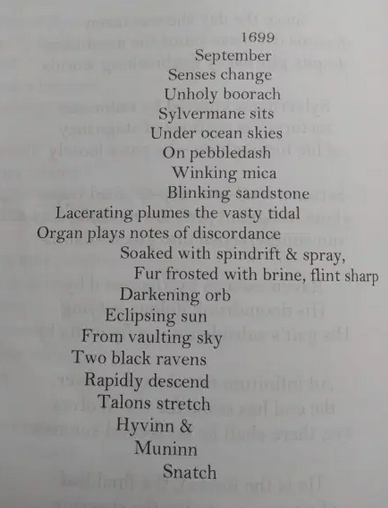
XI The Concrete: The universal term for poetry that has both meaning & ashthetic qualities.
XII The Kazantzis: From the collection, ‘The Rabbit Magician Plate’ by Judith Kazantzis
Flipping in her iron-forged talons
she brings back fish for the feasting
Sylvermane coughs up bones
Days pass, stength increases,
cunning accumulates & speed
accelerates as teeth gnaw sharper
Night falls, as was the custom
wolves set off in single file
silently treading, & softly
The scent is caught upon the tracks
red deer, hot blood throbs thro’ veins
churning with bestial intent
From chaos, then, comes order, or at least a semblance of order. Times & tides & of course tastes will change again, that is certain, & new modes of poetic creation will come into play & Free Verse will become confined to fringes along with all the other forms that had been invented, utilized & then put out of fashion by newly-forged forms. The old forms do not go to a graveyard, however, but to a library of mechanisms able to be accessed by the student poet, or the practitioner who feels their soul connected to a particular form. Where we have our Sonnetteers, let us also have our Freeverseers. For the latter, the directorial words of Ezra Pound, one of the leading exponents & standard bearers of free verse, should suffice;
I think one should write vers libre only when one ‘must,’ that is to say, only when the thing builds up a rhythm more beautiful than that of set metres, or more real, more of a part of the emotion of the ‘thing’, more germane, intimate, interpretative than the measure of regular accentual verse; a rhythm which discontents one with set iambic or set anapaestic
In this essay I have made the first tentative steps into organising free verse & bringing the mould into the accepted family of forms. Of course, Free Verse by its nature has needed tidying up a bit, given a close shave, & supplied with the proper lessons of decorum as given to any dilettante, but as with all young rebels, the form must bow to the inevitable & realise it is just a minor prince in a wider nation of princes. The Risorgimento has come.
Agios Ioannis
14/07/17
Walter Scott’s Epic Voice

Hark, from yon misty cairn their answer tost:
“Minstrel! the fame of whose romantic lyre,
Capricious-swelling now, may soon be lost
Sir Walter Scott – The Vision of Don Roderick
The concept of the Accertamento Grande is essentially a process of re-reading the poetry in existence & trying to establish some kind of order or preferment, the most pristeen models through which we can teach our future poets & bards. As an example of the process, I would like to restore a quite a forgotten poem to the public consciousness. It was composed at the height of the Napoleonic phrenzie, in the summer of 1811, by Sir Walter Scott. Coincidence or not, the poem was divided into the same Spenserian stanzas as those the young Lord Byron was dividing his Childe Harolde’s Pilgirmage, a poem which he gave to his publishers on returning from his European tour in that same year of 1811.
Let us now examine looking Scott’s ‘Vision,’ from a certain angle, that is the way he managed to fashion a sumblime & excellent rendition of the poetic voice first used by Homer. The rest of Scott’s poetic output is rather insipid: the verse-ballads, while selling extremely well they contain little of the true juices of Parnassus. Of this poet, Walter Bagehot describes an artist who, ‘had no sense of smell, little sense of taste, almost no ear for music (he knew a few, perhaps three, scotch tunes, which he avowed that he had learnt in sixty years, by hard labour & mental association) & not much turn for the minutiae of nature in any way. The effect of this may be seen in some of the best descriptive passages of his poetry, & we will not deny that it does (although proceeding from a sensuous defect), in a certain degree, add to their popularity. He deals with the main outlines & great points of nature, never attends to any others, & in this respect he suits the comprehension & knowledge of many who know only those essential & considerable outlines.’

Not the most complimentary of words – yet as we shall see Scott’s ‘Vision’ at times matches the solemn grandeur of Homer & Dante & especially Milton, whose meter was caught by Scott’s ear & transferred into his own poem. This, ‘The Vision of Don Roderick,’ was printed at Edinburgh by James Ballantyne & Co. in 1811, before Napoleon’s march on Moscow & at a time when he held most of Europe in his clutches – only the Iberian peninsular was proving to be a problem, with the Spanish revolting against Napoleon’s brother’s rule, assisted manfully by the Portuguese & British with the whole confederation led by the Duke of Wellington, Arthur Wellesley. The poem was written to celebrate this great moment, when the British were holding their own against a megalomaniac, led by a true hero in the vein of Achilles or Aeneas. The chief contents are based upon an episode in Ginés Pérez de Hita’s Guerras civiles de Granada, a book which Scot devoured as a boy. The mimesis stored for years in his memory banks suddenly had a channel through which to pour, the force of which elevated Scott’s poetic voice from rustic piper to Olympian bard. Scott’s own introduction reads;
The following Poem is founded upon a Spanish Tradition, bearing, in general, that Don Roderick, the last Gothic King of Spain, when the invasion of the Moors was depending, had the temerity to descend into an ancient vault, near Toledo, the opening of which had been denounced as fatal to the Spanish Monarchy. The legend adds, that his rash curiosity was mortified by an emblematical representation of those Saracens who, in the year 714, defeated him in battle, and reduced Spain under their dominion. I have presumed to prolong the Vision of the Revolutions of Spain down to the present eventful crisis of the Peninsula, and to divide it, by a supposed change of scene, into, THREE PERIODS. The FIRST of these represents the Invasion of the Moors, the Defeat and Death of Roderick, and closes
with the peaceful occupation of the country by the victors. The SECOND PERIOD embraces the state of the Peninsula when the conquests of the Spaniards and Portuguese in the East and West Indies had raised to the highest pitch the renown of their arms; sullied, however, by superstition and cruelty. An allusion to the inhumanities of the Inquisition terminates this picture. The LAST PART of the Poem opens with the state of Spain previous to the unparalleled treachery of BUONAPARTE, gives a sketch of the usurpation attempted upon that unsuspicious and friendly kingdom, and terminates with the arrival of the British succours. It may be further proper to mention, that the object of the Poem is less to commemorate or detail particular incidents, than to exhibit a general and impressive picture of the several periods brought upon the stage. EDINBURGH, June 24, 1811.

Here we have an epic tri-parted echo of Dante’s Divine Comedy. Strangely, Scott thought the poem was a mere ‘Drum and Trumpet performance’ (letter to William Hayley, 2 July 1811), but this reminds us of Virgil, who wanted to throw the Aeniad into the flames, before being persuaded to preserve his epic for the Roman people. In the ‘Vision’, Don Roderick, the last Visigothic King of Spain, descends into an enchanted cave to learn the outcome of the Moorish invasion. This also has echoes of Virgil who sent Aeneas into the underworld to see prophesies upon the Roman Republic.
Scott’s handling of an epic sweep through Spanish history propels his wordsmithery to heights he never before or after got close to. Here are some examples of Scott’s work; a passage from his famous ‘Lay of the Last Minstrel’ & Marmion, followed by a stanza from the ‘Vision.’
They bid me sleep, the bid me pray,
They say my brain is warp’d & wrung
I cannot sleep on Highland brea,
I cannot pray in Highland tongue
But were I now where Allan glides
Or heard my native’s Devan tides
So sweetly would I rest & pray
That Heaven would close my wintry day. Last Minstrel
Not far advanced was morning day,
When Marmion did his troop array
To Surrey’s camp to ride;
He had safe-conduct for his band,
Beneath the Royal seal & hand,
And Douglas gave a guide;
The ancient Earl, with stately grace,
Would Clara on her Palfrey place
& whispered in a undertone… Marmion
So passed that pageant. Ere another came,
The visionary scene was wrapped in smoke
Whose sulph’rous wreaths were crossed by sheets of flame;
With every flash a bolt explosive broke,
Till Roderick deemed the fiends had burst their yoke,
And waved ‘gainst heaven the infernal gonfalone!
For War a new and dreadful language spoke,
Never by ancient warrior heard or known;
Lightning and smoke her breath, and thunder was her tone. Vision
There is no doubt we get a different sensation from reading the first two stanza than the third. They seem different voices, but what has happened is that Scott is speaking with the immortal tones of the epic voice. Similarily, the voice Milton used in his Paradise Lost was different to those used in his Nativity Ode or his Lycidas; Virgil’s Aeneid is different from his pastoral Eclogues & Dante’s Vita Nuova is different from his Divine Comedy. The separating factor is the poet has altered his output in the same way a comedian may don the guise of several different characters during a performance.

I shall now elucidate more of Scott’s usage of traditional epic themes through stanzas taken from the ‘Vision;
The Epic Hero
Lives there a strain, whose sounds of mounting fire
May rise distinguished o’er the din of war;
Or died it with yon Master of the Lyre
Who sung beleaguered Ilion’s evil star?
Such, WELLINGTON, might reach thee from afar,
Wafting its descant wide o’er Ocean’s range;
Nor shouts, nor clashing arms, its mood could mar,
All, as it swelled ‘twixt each loud trumpet-change,
That clangs to Britain victory, to Portugal revenge!
The Invocation
But we, weak minstrels of a laggard day
Skilled but to imitate an elder page,
Timid and raptureless, can we repay
The debt thou claim’st in this exhausted age?
Thou givest our lyres a theme, that might engage
Those that could send thy name o’er sea and land,
While sea and land shall last; for Homer’s rage
A theme; a theme for Milton’s mighty hand
How much unmeet for us, a faint degenerate band!
Tribute to Older Epics
Ye mountains stern! within whose rugged breast
The friends of Scottish freedom found repose;
Ye torrents! whose hoarse sounds have soothed their rest,
Returning from the field of vanquished foes;
Say, have ye lost each wild majestic close
That erst the choir of Bards or Druids flung,
What time their hymn of victory arose,
And Cattraeth’s glens with voice of triumph rung,
And mystic Merlin harped, and grey-haired Llywarch sung?
Here, Milton is alluding to the poem Y Gododdin, etched by the 7th century bard Aneirin. On its discovery in the 18th century, a startled Lewis Morris proclaimed to Edward Richard (1758);
Who do you think I have at my elbow, as happy as ever Alexander thought himself after a conquest? No less a man than Ieuan Fardd who hath discovered some old MSS. Lately that nobody of this age or the last ever dreamed of. And this discovery is to him & me as great as that of America by Colombus. We have found an epic poem in the British called Gododin, equal at least to the Iliad, Aeneid or Paradise Lost. Tudfwlch & Marchlew are heroes fiercer than Achilles or Satan
The Plea for Immortality
For not till now, how oft soe’er the task
Of truant verse hath lightened graver care,
From Muse or Sylvan was he wont to ask,
In phrase poetic, inspiration fair;
Careless he gave his numbers to the air,
They came unsought for, if applauses came:
Nor for himself prefers he now the prayer;
Let but his verse befit a hero’s fame,
Immortal be the verse!–forgot the poet’s name!
Epic Geographical Sweeps
“Explore those regions, where the flinty crest
Of wild Nevada ever gleams with snows,
Where in the proud Alhambra’s ruined breast
Barbaric monuments of pomp repose;
Or where the banners of more ruthless foes
Than the fierce Moor, float o’er Toledo’s fane,
From whose tall towers even now the patriot throws
An anxious glance, to spy upon the plain
The blended ranks of England, Portugal, and Spain.
Supernatural Agents
Grim sentinels, against the upper wall,
Of molten bronze, two Statues held their place;
Massive their naked limbs, their stature tall,
Their frowning foreheads golden circles grace.
Moulded they seemed for kings of giant race,
That lived and sinned before the avenging flood;
This grasped a scythe, that rested on a mace;
This spread his wings for flight, that pondering stood,
Each stubborn seemed and stern, immutable of mood.
Fixed was the right-hand Giant’s brazen look
Upon his brother’s glass of shifting sand,
As if its ebb he measured by a book,
Whose iron volume loaded his huge hand;
In which was wrote of many a fallen land
Of empires lost, and kings to exile driven:
And o’er that pair their names in scroll expand –
“Lo, DESTINY and TIME! to whom by Heaven
The guidance of the earth is for a season given.”
Heroic Speeches
That Prelate marked his march–On banners blazed
With battles won in many a distant land,
On eagle-standards and on arms he gazed;
“And hopest thou, then,” he said, “thy power shall stand?
Oh! thou hast builded on the shifting sand,
And thou hast tempered it with slaughter’s flood;
And know, fell scourge in the Almighty’s hand,
Gore-moistened trees shall perish in the bud,
And by a bloody death shall die the Man of Blood!”
Catalogues
From Alpuhara’s peak that bugle rung,
And it was echoed from Corunna’s wall;
Stately Seville responsive war-shot flung,
Grenada caught it in her Moorish hall;
Galicia bade her children fight or fall,
Wild Biscay shook his mountain-coronet,
Valencia roused her at the battle-call,
And, foremost still where Valour’s sons are met,
First started to his gun each fiery Miquelet.
There are many other stanzas throughout the poem, WHICH YOU MAY READ IN FULL HERE. One of them in particular has the true epic ring;
As that sea-cloud, in size like human hand,
When first from Carmel by the Tishbite seen,
Came slowly overshadowing Israel’s land,
A while, perchance, bedecked with colours sheen,
While yet the sunbeams on its skirts had been,
Limning with purple and with gold its shroud,
Till darker folds obscured the blue serene
And blotted heaven with one broad sable cloud,
Then sheeted rain burst down, and whirlwinds howled aloud:-
Here we have the best example amongst the Romantic poets of the Epic – or Heroic – simile. This is an elaborate piece of showcasing, a wonderful learned little ornament that adds dignity & variety to a poem. Another example would be Milton’s;
He stood & called
His Legions, Angel Forms, who lay intrans’t
Thick as Autumnal Leaves that strow the Brooks
In Vallambrosa, where th’Etrurian shades
High overarch’t imbower
That Scott mentions Milton a couple of times in his poem & has fashioned a similar sounding epic voice tells us that Scott would have had a copy of Paradise Lost before him as he wrote. This is only natural, for all new poetry should contain the waters of pParnassus, to which is added a poet’s own personal outpourings of fortified poesis. That Scott had Milton before him can be truly discerned from the following two stanzas – where we have Napoleon as the satanic anti-christ attempting to storm Spain, which is portrayed by Scott as another Eden.
“Who shall command Estrella’s mountain-tide
Back to the source, when tempest-chafed, to hie?
Who, when Gascogne’s vexed gulf is raging wide,
Shall hush it as a nurse her infant’s cry?
His magic power let such vain boaster try,
And when the torrent shall his voice obey,
And Biscay’s whirlwinds list his lullaby,
Let him stand forth and bar mine eagles’ way,
And they shall heed his voice, and at his bidding stay.
“Else ne’er to stoop, till high on Lisbon’s towers
They close their wings, the symbol of our yoke,
And their own sea hath whelmed yon red-cross powers!”
Thus, on the summit of Alverca’s rock
To Marshal, Duke, and Peer, Gaul’s Leader spoke.
While downward on the land his legions press,
Before them it was rich with vine and flock,
And smiled like Eden in her summer dress; –
Behind their wasteful march a reeking wilderness.
One of the key components of an epic is its narrator, & Scott plays the role to an almost perfection – perhaps the poem gets lost a little in the middle. The epic voice is an elaborate creature which must be sustained throughout an entire production. Scott’s was a rush job, & unfortunately the poem shows moments of melancholia & dullness – but the attempt is a noble one & there are genuine moments of clear magnitude, which if sustained throughout the rest of his ouvre, would have placed him at the top of the Romantic tree. With Calliope at the helm, however, despite her brief visitation, Scott’s blood-drenched poem possesses a wonderful music & portrays at all times that ever-present focus of Scott’s powers which produced the ‘Drum and Trumpet’effect he wrote of, which has become in his hands an epic voice. Scott maintains his pitch & rhythm all the way through his poem with perfect uniformity – an excellent performance. It is a little Iliad of regions, wars, & heroes, & should rightly belong to the class of poems called Epyllia, or ‘little epics.’ We are whisked about European history like a ravishing whirlwind, from William Wallace at the Scottish Wars of Independence, with Scott often distilling massive sweeps of time & space into a couple of lines at most.

With the Vision, Scott is moving his imagination out of Britain onto the European – again a precursor for Byron’s Childe Harolde, whose scenes of continental travel fired the imaginations of a book-buying public trapped on their island by Napoleon’s European blockade. Byron would then go on to fashion his own epic voice, which manifested itself best in his rambling & operatic Don Juan, yet Scott’s ‘Vision’ has primacy & it also raised 100 guineas for the war fund. Written when the real struggle for Europe was about to begin, I believe this piece of poetic propaganda would have inspired the hearts of British Soldiers at the time – I don’t think any man reading it at the time would have failed to have been moved militarily to match the feats of the great heroes of whom Scott’s epic voice had sang.
Letters From Crete IV: Framing the Sonneverse
While lazing in the Cretan hills these past few days I have been chiefly editing my sonnet sequence, The Silver Rose, which has led me to finally finalize the contents of this essay. The Sonneverse has been running around my head since about 2008, when I used to muse on its essence on the long walk from Heather Lodge to Dunbar. One occasion is especially memorable, as I sat on Spott Dod overlooking East Lothian, with the universe surging from my mind. The general thesis is that there is a corpus of human works known as the Sonneverse, an ever-expanding collection of poetry in the sonnet form. Imagine the very first sonnet ever written to be the Big Bang, kinda thing. I have written a sonnet, of course, elucidating its properties;
Every stanza is a planet
Every sonnet is a star
Fourteen sonnets constellations make
But brighter skies by far
Are galaxies of constellations
Fourteen in each one
Stretching epic metaverses,
& when one’s works are done
A host of sonnets ye shall choose
Full seven score & fourteen gems
Most lucious whisp’rings of thy muse
Set in those precious diadems
Crowning the sonnetteer who sings
From Ceasars to our petty kings
When the opening couplet reads, ‘Every stanza is a planet, Every sonnet is a star,’ the meaning is simple. A sonnet is powered by the same energy which emanates from a star; i.e. the fiery light-giving force which giving life to its planetary system. In terms of the sonnet, this energy will then bring to life the poem’s planets – the stanzas – & whether the star’s energy is powerful or weak will depend upon the quality of the sonnet. William Blake once said that the genius & creative spirit of mankind was poetry & it is in the sonneverse that we gain our most natural reflection of the Untold Universe at large.
In one of my Pendragon Lectures of two years ago, I formulated the theory that poems stood upon four pillars – Music, Mood, Mould & Measure.Let us now apply this theory to the exploration of the sonnet form, retaining the ‘quatordicci’ element that seems natural in soneteering, ie the omniprevalent usage of the number 14. The MOULD of every sonnet is bound by a 14-line restriction. Each sonnet, however, may be divided into staves, or stanzettas as I like to call them. These are the planets in orbit around the sonnet’s star. The Petrarchean, for example, contains two stanzettas, of 8 & 6 lines respectively. During my time as an explorer of the Sonneverse, I have mapped out a number of typical planetary systems.
Petrarchean
X X X X X X X X – X X X X X X
Shakesperean
X X X X – X X X X – X X X X – X X
Couplets
X X – X X – X X – X X – X X – X X – X X
Pentastaves
X X X X X – X X X X X – X X X X
Each planet of a starsystem can be mapped out via its MEASURE. There may be seven Archilochian Couplets, for example, or the 3/3/3/3/2 Oriental system, i.e. four stanzettas of 5-7-5 Haiku, follow’d by the concluding 7-7 couplet. If one had decided upon a structure of 5/5/4, then for your pentet staves you could use a Limerick, perhaps, or the South American Wayra, whose syllable counts are 5-7-7-6-8. There are vastly numbered variants; including irregular sonnets which look & feel like Free Verse, hefty Alexandrines in solid blank verse blocks, & so on, into infinity, one expects.

Every planet also possesses an atmosphere, or MOOD. These could be a Prosodion to Apollo perhaps, or a precious Paean to a new-found paramour. A bubbling Barzelletta; a sensuous Ghazel; a Senryu to a silly friend, a weeping Epicedium; a Protreptic plea to passion; or a soul-stirring Aubade. For the budding sonneteer there are many, many possible ways in which to create one’s words. These are instilled with a poem’s MUSIC, the animated life of both line & the stave, where the poets weave their symphonies utilising elements such as cynghanned & rhymes both internal & line-ending.
The planetary systems created by the sonetteers oscillate between barren anisometric rocks of sterile worlds, or are occupied by single & gigantic fertile planets, buzzing with the operatic voices of man, beast, bird & insect, just as is heard in this fabulous land of Creta. In one corner of the sonneverse, for example, the hardy explorer may encounter the Onegin giant devised by Alexander Sergevich Pushkin for his Eugene Onegin, a novel in verse. Stanzas have 14 lines of iambic tetrameter rhyming ababccddeffegg, & the rhymes may be feminine & masculine.
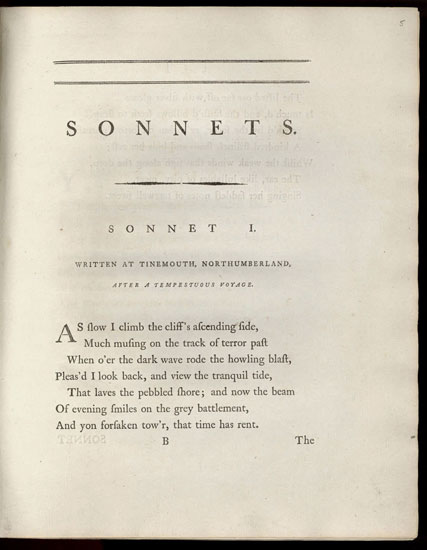
Returning to my sonnet given earlier, where we read ‘fourteen sonnets constellations make,’ in the purest sense of the physics, fourteen sonnets make a traditional sequenza, ie 14 star-systems closely linked in time, in space & by the aforementioned ‘constellation’ of sonnets. ‘The Fourteen Sonnets, Elegiac and Descriptive. Written During a Tour. Bath and London, 1789,’ by William Lisle Bowles are a perfect example. Each sonnets is Petrarchian in mould, iambic pentameter in measure, & are unified by the observatory mood of a travelling poet. In my own experimental periods with the constellation, I tried diversifying the measures, sometimes utilizing the same one for 14 stanzas, sometimes using 14 different ones. I also did the same with the Moods, such as;
Vista : Composed from a high viewpoint
Odes : A tribute to people or places
Pastoral : Poetry describing rural scenes
Amoebean : A conversation between 2 speakers
Ensenhamen : A didactic poem
Epistle : A poem addressed to a friend
Barzelletta : A funny story
History : A poem about a past event
Ghazel : A poem concerning lovemaking
Quasida : A place which recalls lamented lost love
Sutra : A treatise
Tantra : A religious treatise/sermon
Fable : A moral narrative
Geste : An account of deeds / adventures

Of the next step up in the Sonneverse, I wrote there are, ‘galaxies of constellations, fourteen in each one.’ i.e. 196 sonnets again unified by a grand theme we shall call the Gestalt. I have composed several of galaxies; a tour of the far North of Scotland, a tour of Edinburgh, & a tour of India. Of these, the Ediniad galaxy was the most technical, for each of the 14 constellations were unified by a singular measure, such as 14 alexandrines, 14 ottosyllabics, etc. As for the mould, the first sonnet of each constellation would be a dense block of fourteen lines, the next would be seven couplets, the next would be 3/3/3/3/2, the next would be 4/4/4/2 & so on. A incredibly complex, but quite satisfying essay into the possible architectronics of sonnetry. For me, a royal suite of sonnets would be a galaxy in which every sonnet would have a different mould of fourteen varieties, a different metre of fourteen varieties & a differnt mood of fourteen varieties. I have never attempted to create one, but on those lofty walks in the foothills of the Lammermuirs I definitely ruminated upon such… a glimpse through my psychic telescope into the far-flung reaches of the Sonneverse.
Agios Ioanniss
13th July
READ MORE POETICAL ESSAYS
***

Love, Wine & Nature in the Everliving China III: Feng from Ch’en, Wei, Ch in & Ch’i
Continuing the selection from William Dolby’s
Majestic translations of ancient Chinese poetry
HUNTING DOGS
Ch’i
His hunting dogs’ bells jingle
He himself is handsome & moreover gentle
His hunting dogs have double rings,
He himself is handsome & moreover has good-looking hair;
His hunting dogs have big doubkle chains,
He himself is handsome & moreover strong in ability
RIVER FEN STAGNATED INTO MARSH
Wei
Where yon River Fen has stagnated into swamp
Oh, I pick the flaxen plant
That young gentleman there is immerasurably handsome
Immeasurably handsome
Quite different from the minister’s bastard-sons in charge of the duke’s carriages
In one area by yon River Fen,
Oh, I pick the mulberry-leaves.
That young gentleman there is as handsome as amethyst
He’s as handsome as amethyst
Quite different from the men in charge of the duke’s war chariots
DAWN BREEZE FALCON
Ch’in
Swift-flying is yon Dawn Breeze Falcon
& luxuriant is yon North Forest;
I haven’t met my young lord, my beau
And my troubl’d heart frets unable to forget him
What can I do? What can I do?
You’re truly so very forgetful of me.
On the mountain there are lush-bushy ioaks
In the damp hollow there are mottl’d camphor trees,
I haven’t yet met my young lord, my beau,
& my troubl’d heart is joyless.
What can I do? What can I do?
You’re truly so very forgetful of me.
On the mountain there are lush-bushy Prunus-Japanica trees
In the damp hollow there are sui-trees
I haven’t yet met my young lord, my beau,
& my troubl’d heart is as if drunk
What can I do? What can I do?
You’re truly so very forgetful of me.
WHITE ELMS AT THE EAST GATE
Ch’en
White elms at the East Gate
Oaks upon hill-on-hill Hill
The young gentlemen of the Tzu-chung clan,
Whirl around in dance at the foot of the helm
They’re choosing a fine morning;
On the plain of the southern region;
They’re not twisting their hemp thread,
They’re whirling in dance in the market-place
They’re going off ona fine morning,
Ah, they stride along together;
“We regard you as high-mallow flowers,”
They give us gifts of a fistful of pepper-plants
WILLOW BY THE EAST GATE
Ch’en
The willow by the east gate
Its leaves are so sleek & lush
We fixed the date fotr dusk
But now the dawn star, Venus, is dazzling shimmering
The willow by the east gate
Its leaves are sio luxuriant
We fixed a date for dusk
But now the dawn star, Venus, is sparkling splendid
SLOPING SIDE OF THE MARSH EMBANKMENT
Ch’en
By the aloping side of that marsh’s embankment
There are cattails & lotus-plants;
There’s a certain handsome man,
In my grief what can I do about him?
Waking or sleeping abed, I can’t do anything about it,
My sobs & snivel pour down like heavy rain
By the sloping side of that marsh’s embankment
There are cattails & fragrant thoroughworts;
There’s a certain handsome man,
Mighty big & moreover lissome fair
Letters From Crete III: The Trojan War
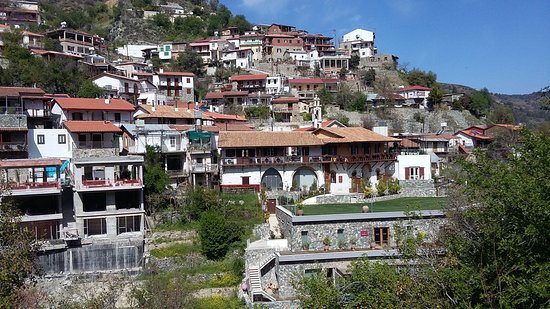
I am writing this overlooking the Libyan Sea, high up in the mountain village of Agios Ioanis. We reached here three days ago, calling in at Gortys along the way – the ancient capital of Crete – in 39 degree heat, & far too hot to explore very much. I did pick up a copy of the oldest Law Code in Europe however, & have a mind to mixing it in with some classical poetry Emily gifted me as translated by Robin Skelton. All in the relatively near future of course. From Gortys, we took a wrong turn & ended up back at busy Heraklion, which was perhaps serendipitous as it allowed the girls to have another blast at Star Beach.
At 5 in the evening we set off for our next residence, crossing the island again from sea-to-sea as far as Ireapetra. As we drove south I was delighted to see the stone boat sunk by Poseidon near Pseria, the island I presume to be that of the Phaecaens of the Odyssey. I had searched for the stone boat in vain on Google Earth, thinking it would be hard at the Pseria’s twin Minoan harbours – but is instead closer to the mainland & the Minoan city of Gournia, which may be of some significance.
Agios Ioannis is a 9K drive to the head of a wonderful olive-smitten U-shaped mountain recess. Stacked white against the mountains, it is half dilapidated & half regenerated in the Calcata fashion. Once a bustling town, in the 70s & 80s the inhabitants drifted to easier lives in the city & by the coast, leaving an insanely beautiful ghost-town. Even today, in the winter, there are only six full-time residents. Our house is large… two wings behind an excellent garden tended by the grey-bearded Adonis. Five cats, three dogs & a timid goat contribute to the safari-like nature of our domicile, along with all those grievously nasty mosquitos that are ravaging the girls. There are no shops & only two places to eat; the modernistic, uniquely-detailed Route 55 Café Bar & Kristina’s tavern, where we can take away genuine Greek food to eat at varius places at our homestead & garden. It is over one of these meals, with wine to hand, in the gentle evening light, sat at the table on our porch, that I shall now ruminate on the true Trojan War.
As I have stated in previous essays, the Homeric epics are a grand jumble of creochisps; a wooly ball of well-woven threads of numerous origins. Having extracted the Menalean string at Karames, let us now examine the orgins of the war which Homer clearly sets in NW Turkey. We begin with the supposed date, deduced by examining The Life of Homer – said to have been penned by Herodotus (scholars prefer to call him Pseudo-Herodotus) – which tells us that the poet was born 168 years after the Trojan War & 622 years before the Persian invasion of Greece by Xerxes I. With the Xerxean battle of Thermopyles taking place in 480BC, if we wind back another (622+168=) 790 years, we may assume the Trojan War ended in 1270 BC. This year also fits information supplied by Herodotus’, ‘Pan who was born of Penelope… came into being later than the wars of Troy, about eight hundred years before my time.’
To Herodotus the Trojan War was fought before 1250 BC. To this period, we may also pin the Locrian Curse, which gives us the exact year of the fall of Troy, 1264 BC. The story goes that the Locrian hero Ajax was shipwrecked by Poseidon for raping Cassandra in the temple of Athena just after the fall of Troy. Swimming for his life, when he reached the coast of Eobea he was struck by a bolt of lightning & slain. Lycophron, in his ‘Alexandria,’ describes the Locrians as being subsequently cursed for a thousand years, & were forced to send two unmarried maidens to the temple of Athena at Ilion of Athens each year, where they would spend the remainder of their lives. It was only in 264 BC that the Locrians finally satisfied the curse’s conditions.
Another route comes via combining the date given by ‘Timaeus the Sicilian,’ for the foundation of Rome, who says it was founded at the same time as Carthage, in the thirty-eighth year before the first Olympiad. This year would be 814 or 813. Anchoring our investigation on this date, when we examine the writings of the celebrated 2nd century BC orator Porcius Cato – Cato the Elder – we learn that the Trojan War occurred 432 years before the foundation of Rome. This gives a date of 1246/45.
As for where this war was fought, up until the end of the nineteenth century the enlightened opinion of academia considered the Trojan War to be a battle non gratia, on the basis that nobody could actually find a city called Troy. It took the financial fortune & dogged persistance of Heinrik Schliemann to uncover the long-lost capital citadel of Ilium. As a boy he had been entertained upon his father’s knee by the tales of Achilles, Helen, Paris & Menaleus. Growing into manhood, these stories gripped his imagination more & more, until he decided to plunge his business fortune into a search for the city of Troy. Choosing a site where the Roman ‘New Troy’ had been built – & very much to the scoffs of the scholars – Schliemann began to excavate a certain Hisalrik Hill in NW Turkey. The results were simply astonishing as he & his team of Turkish workers, toiling daily in the sun, slowly unearthed the massive cyclopean walls of a great citadel; the long-lost ‘high-towered Troy.’ Schliemann also discovered a great entranceway, which he dubbed the Homeric ‘Scaean Gate,’ leading him to declare to the planet, ‘I have proved that in a remote antiquity there was in the plain of Troy a large city, destroyed of old by a fearful catastrophe, which had on the hill of Hisalrik only its Acropolis with its temples and a few other large edifices, southerly, and westerly direction on the site of the later Ilium; and that, consequently, this city answers perfectly to the Homeric description of the sacred site of Ilios.’
Scholars were unsurprisingly skeptical as to the size of the city; such a palace, though undoubtedly large, could never have housed the massy legions which swarmed on the Trojan side. Schliemann would eventually die dissapointed that he had not discovered the true Troy. But, to please his ghost, since his passing, layer by layer, like the skins of a field-fresh onion, archeologists have uncovered a series of Troys dating back thousands of years, including parts of a long wall which would have encircled Hisalrik hill, vastly enlarging the city’s size. In total, there are seven ‘layers’ to Troy, ranging from 3000 BC to the aforementioned ‘New Troy,’ built by the Romans c.100 AD. These seven cities are divided into sub-stratific layers, of which Troy VIh & VIIa are the most interesting. Troy VI was initially built on massive scale c.1400 BC, a solid edifice of carefully fitted ashlar blocks, with two of its towers erected not long before the destruction of VIh by an earthquake, about the year 1300 BC.
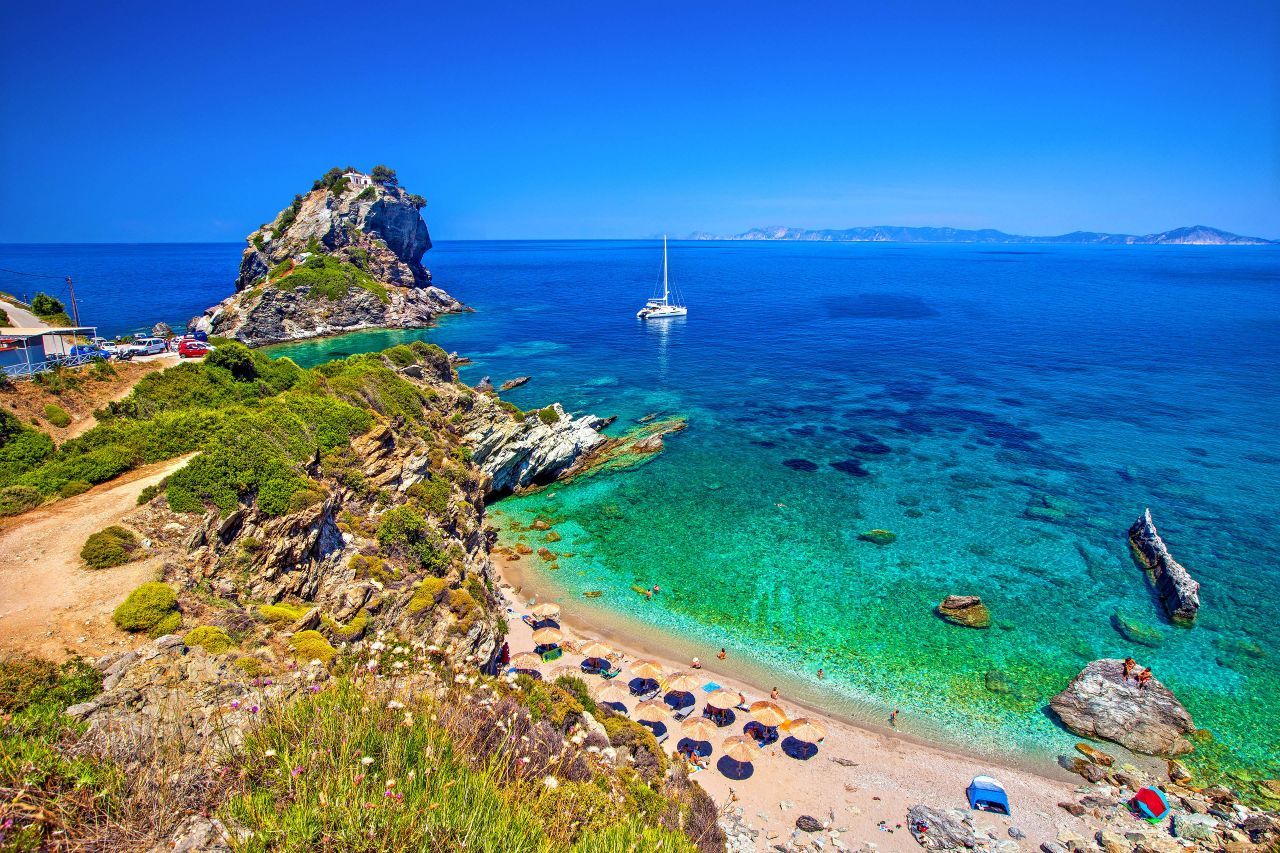
It is possible to match these events to a creochisping mythomeme of a demigod called Herakles, & his own destruction of Troy. According to Herodotus (c.450 BC), Herakles was born ‘about nine hundred years,’ before his own time, ie c.1350. The legend of the demi-god’s destruction of Troy, as found in the Iliad & the Bibliotheke of Apollodorus, shows Poseidon, The Earthshaker, attacking Troy with the help of a sea-beast, a probable euhemeristic account of an earthquake & tsunami striking the shores of Asia Minor. The Roman historian Strabo tells us;
Poseidon, as the story runs, became angry with Laomedon the king of Troy in connection with the building of its walls, and sent forth from the sea a monster to ravage the land. By this monster those who made their living by the seashore and the farmers who tilled the land contiguous to the sea were being surprised and carried off. Furthermore, a pestilence fell upon the people and a total destruction of their crops, so that all the inhabitants were at their wits’ end because of the magnitude of what had befallen them. Consequently, the common crowd gathered together into an assembly and sought for a deliverance from their misfortunes, and the king, it is said, dispatched a mission to Apollo to inquire of the god regarding what had befallen them. When the oracle, then, became known, which told that the cause was the anger of Poseidon and that only then would it cease when the Trojans should of their own free will select by lot one of their children and deliver him to the monster for his food, although all the children submitted to the lot, it fell upon the king’s daughter Hesionê.
Luckily for Hesione, Herakles turns up just in time & offers to slay the monster in return for some of Laomedon’s quality horses. After Herakles upheld his side of the bargain & slew the beast, Laodemon then went back on his word, resulting in a very angry demigod sacking Troy. Another Roman historian, Diodorus Siculus, writes;
Aye, what a man, they say, was Heracles in might, my father he, steadfast, with heart of lion, who once came here to carry of the mares of King Laomedon, with but six ships and scantier men, yet sacked he then the city of proud Ilium, and made her streets bereft.
During the slaughter, Herakles killed Laodemon & all of his sons except a young Priam, the Homeric king of Troy. Hesione also survived, marrying Herakles’ companion Telamon & settling in Greece. According to the myths, Herakles placed the young Priam on the throne of Troy. The actual foundations of this story can be discerned through certain letters discovered at Hattusa, the capital of a Near Eastern empire ruled by the Hittites. In them we may read how, in about the year 1290BC, a certain Tawagawala, the brother of the King of Ahhiyawa (Grecian Achaea), supports a certain Piyamaradu in southern Turkey. It is time to assemble a couple of babel-chains;
Tawagawala
Awag-awala
Herak-awa-la
Herak-la
Herakles
Piyamaradu
Piyam
Priam
That Herakles is Tawagalawa is supported by the Hattusa letter placing him in Lycia, a region on the southern Turkish coast. ‘When the men of the city Lukka transferred their allegience to Mr. Tawagalawa, he came into these lands. They transferred their allegience to me in the same way, and I came down into these lands.’ These events are also mentioned by Panyassis of Helicarnassus – a student of Herodotus – whose epic poem on Herakles, the Heracleia, has the hero rescuing certain Cretan colonists in Lyica. ‘It is certain,’ states Christoper Prestige Jones, ‘that Panyassis’ epic brought Heracles to Lycia, & here too the poet may well have followed local tradition.’
The Hittite letters describe Piyamaradu as a renegade ‘adventurer,’ who at one point tries to reassert his dynastic claim to the throne of Troy, called Wilusa in the letters. We also learn how he married his daughter off to Ata, the ruler of Millawanda, or Miletus, the very same city where Hesione is said by the Greeks to have sought refuge from her unwanted marriage to Telamon. From Miletus, Piyaramadu launched his quest to regain the throne of Troy, at which time was occupied by a certain Alaksandru. This name is the Hittite philochisp of Alexandros, a confusing alternate name given to Paris in the Iliad. According to the Hattusa letters, Alaksandu wrote to Muwatalli II asking for assistance against Piyaramadu, which resulted in a treaty between Troy & the Hittites, concluded about 1280 BC. Troy was now a vassal state of its neighbouring superpower, & the treaty was guaranteed by a god named Apaliunas, ie Apollo, a diety of the Iliad who stands firmly on the side of the Trojans. Just after the treaty was signed, the ancient world was witnessing an epic conflict being played out between the Hittites & the other near-eastern superpower, Egypt.
It very much seems that the battles of Troy were less the greatest conflict of the heroic age, more a side-show in a much larger conglagaration in which was fought the famous Battle of Kadesh on the Orontes River near the border between Syria & Lebanon. The gargantuan struggle would last for two decades, between 1278BC & 1258BC, into which time-frame fits the historically dated Trojan War. That the Trojans were involved in a larger war can actually be seen in the Iliad, where Hittites are listed as among the allies of Troy. The city’s location as the watchtower over the vital Dardanellian gateway to the Mediterranean, would have been motive enough for either side to want its control.
There is a problem, however, & that is the date given for the fall of Troy by the normally reliable & accurate 3rd Century Greek geographer, Eratosthenes; 1184BC. This date. However, falls extremely close to the destruction layer of the next Troy. After the destruction of Troy VIh the builders of its successor, Troy VIIa, patched up the fortification walls & created a city which would last until 1190 BC – the date of its destruction layer being supported by pottery styles discovered in that strata. This layer seems to record the city being razed during the invasions of the so-called Sea Peoples. King Ammurapi of Ugarit, writing about 1185, describes the onslaught;
My father, behold, the enemy’s ships came (here); my cities were burned, and they did evil things in my country. Does not my father know that all my troops and chariots are in the Land of Hatti, and all my ships are in the Land of Lukka…Thus, the country is abandoned to itself. May my father know it: the seven ships of the enemy that came here inflicted much damage upon us.
What exactly went on up there in turbulent, windy Troy is uncertain. The Sea-Peoples attack may even be remembered in the Iliad as the army of ships beached on the sands of Ilium, forming another ingredient in the Homeric soup. Mixing all the names & dates together suggests that Priam was replaced on the throne of Troy by a man – Alexandros – who could not have been his son as stated by Homer. A chispological embellishment seems evident, with Homer understanding Priam & Alaksandu were both in Troy at the right time, but got things muddled up whether purposefully or not. As for Alexandros being also called Paris, this supports my theory that the Helen abduction motif was played out in Egypt three centuries before the battles in NW Turkey. Paris was perhaps the name of the 16th Century BC abductor of Helen, while Alexandros was the chieftan of the 13th century BC citadel at Ilium. In the same way, the Egyptian Troy was conflated with the Turkish Ilium by Homer, the fusion of which created something more-than-real, something majestic enough to become the subject of his superhuman poetry.
Agios Ioanniss
13th July, 2017
READ MORE POETICAL ESSAYS
***
Letters From Crete II: Finding Menaleus

I am currently sat on the patio of an air B&B in Karemas, southern Crete, overlooking the Libyan Sea. It is morning. In the foreview to my left are the double rocks of the pretty Paximadian Islands, upon which the Cretans say Apollo was born. To my right is Gavdos, the most southerly point of Europe. There is a high wind blowing fiercely, as it has been for four days now, we are told. We drove here yesterday, first calling in at the many-peopled ‘funfair’ that the Knossos site has become; then entering & crossing the Cretan hinterland, a mixture of beautiful hills dotted with olive trees as if they were woven into some starlet’s hair, roughed up here & there by rather desolate villages. After stopping in at the oasis watering hole that are the Goanesque beaches of Agia Galini, we took a serendipitous wrong turn which snaked us out through the heart of the quite breathtaking Kedros range, via the villages of Apodolou, Nithavris, Agios Ioannis & Agia Pareskevi. Another wrong turn later & we were high up in the idyllic hilltop village of Vrisses, where, finally swapping our tourist map for a more detailed & accurate one contained in my portable library’s 1995 book on Crete, we finally came to Kerames.
On arrival we were met at the mini-market by stylish Kleopatra, a teacher of ancient Greek & Latin in Athens, who returns to her home village to rent out the house to erstwhile travelers. Built in the 16th century, it has been the home of two saints & a Cretan governor, & has also played host to many a village dance. An excuisitely beautiful building, made from a mixture of searocks & quarried stone, it is a geologist’s dream, & is ours for last night & the next two to come. Kleopatra delighted in showing us around the house, its history, & also walking us through the village so the locals knew we were with her. The encounter with her plump mother was amusing to say the least; with the mother mocking Kleopatra’s slight build & saying she was far too thin, that she was like a little girl, & that she needs to eat more… much to the agreement of the other plump women of a certain age sat on chairs in the vicinity.
Roll on three days & I am finishing this off in the pinkening sunrise on the lazy morning on the 10th of July. On tour first full day, upon a visit to the amazing Preveli Beach, via a rough & twisting Himalayanesque mountain road & reached only by footpath as in Gokarna; after swimming in a lagoon I suddenly found my foot pierced by a palmleaf spine &, well, ouch. The next dawn, me & Emily left the girls sleeping & drove to nearby Spili & its free health centre. Cue two female doctors writhing at my poor wound, trying to drag the thorn out. At one point one of the nurses turned her to mine & looking at me with a most solemn stare, said quite plainly, ‘pain?’ Through my acute grimacing I could only nod. The thorn, alas, was buried too deep & so with prescription in hand we returned to Agia Galini for another day at the beach & to buy some antibiotics. During that sunkissed day I collated my notes for this essay, which I am polishing off the now. Last night was very special, with us all getting dressed up & hitting the village square for a wonderful meal of native meat & salads which cost only 22 euros – our hostess refusing a tip & also joining us in the complimentary ouzo shots!
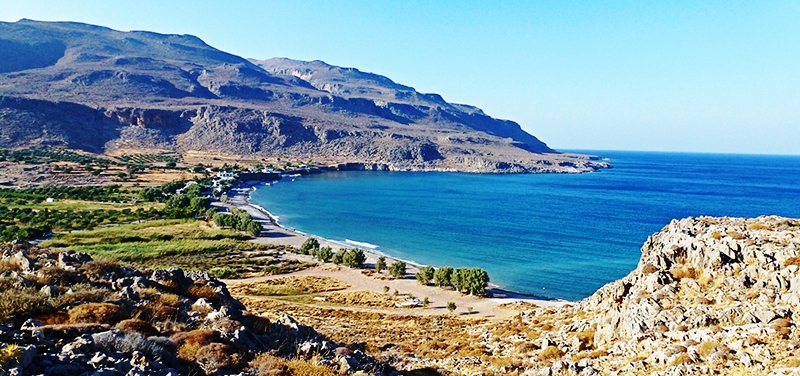
Kemares village is a white-washed, narrow-streeted affair in the Italian style, & rather the perfect place to work upon one of my thornier essays – that of the character of Menaleus, appearing in the Homeric epics. In summary, I believe he was not actually around in the thirteenth century BC to fight the traditionally dated Trojan War, but was instead active three centuries earlier, & that his deeds were later superimposed upon the story of the Trojan War by Thales. I believe his story was one of the ‘Homeric fragments’ discovered by Lycurgus & that the Trojan War in which Achilles fought was a different fragment altogether, with Thales splicing them together into a single story. I also believe that the War which Menaleus fought – in order to retrieve Helen – was not in NW Turkey, but in Egypt.
We shall anchor our investigation upon a figure in Greek mythology called Phineus, son of Bellus, the brother of Aegyptus & Danaus. Analyzing the contextus of Phineus, we discover a certain tale – as given by Ovid – in which he brandishes a spear against Perseus while squabbling over the daughter of Casseiopeia, who had been declared by her mother to be more beautiful than the Nereids. The names & situation massively reflect a Biblical figure called Phinehas, in whose tales we see an incident with remarkable echoes to that of Phineus. For Casseiopia we have a certain idolatrous Cozbi, & we may observe the Biblical Phinehas also brandishes a spear. The ‘most beautiful woman’ motif contained in Ovid finds its Biblical reflection in Flavius Josephus, who asserts that the enemies of the Israelites sent their most beautiful women to seduce the Jews into idolatry. Josephus explains the result was the slaying of Cozbi by Phinehas, after which God rewarded him & his posterity with the covenant of an everlasting hereditary priesthood.
The Biblical priestly Phinehas is said to have assisted Moses throughout the Exodus, even being master of the sacred Ark of the Covenant. Also active in those ‘days of Moses’ was a certain Gaythelos, or Goidal Glas, whose name seems to contain part of the Hebrew moniker for High Priest – the ‘Kohen Godal.’ According to Irish sources, the grandfather of Goidal Glas was a certain Fenius Farsaid. Thus Fenius, the grandfather of a Hebrew High Priest, can be matched on ethnological & phonetical grounds with Phinehas, one of the holiest men in the entourage of Moses.
The crux of the matter comes with the observance that between Fenius Farsaid & Gaythelos comes, according to John of Fordun, a ‘certain king of the countries of Greece, Neolus.’ Variant names given in other medieval sources include Nel (Lebor Gabala Erenn), while Geoffrey Keating gives Fenius two sons, Nenual & Niul, which seem to be a genflation of the same person. It is time for a wee babel-chain.
Nenual
Menual
Menal
Menaleus
Me-Neolus
Me-Niul
Me-Nel
At the heart of this babel chain we see the name of Menaleus, whose eloping wife Helen initiated the Homeric Trojan War. In support of the Menaleus-Neolus connection, three ancient sources state that Menaleus had a son called Aithiolas, being the Scholion to Homer’s Iliad 3 (175th); Eustathius of Thessalonica & the Byzantine Suda (alphaiota 124). It is by no stretch of the imagination to see how the name Aithiolas transchispers into Gaythelos, or better still Gaithelos, as given by other records.
In my book, The Chisper Effect, I showed how Gaythelos was a prince with connections to Minoan Crete, & by studying the lineage of Menaleus, we can see why. The old tales have it that a certain Cretan king called Catreus begat a daughter called Aerope, who became the mother of Agamemnon and Menelaus, either by Plisthenes or by Atreus, in Mycynae. This means that Gaythelos was Minoan on his mother’s side, explaining why the treasures found at Mycynae contain, according to Martin Bernal, ‘an increase of the Minoan influences.’
The ancient city of Mycenae was sited in the northwest corner of the Plain of Argos, on the Peloponnese, in which place Pausanius, the Greek travel writer of the 2nd century AD, recorded, ‘the underground chambers of Atreus & his children, in which were stored their treasure. There is the grave of Atreus, along with the graves of such as returned with Agamemnon from Troy.’ In the late 19th century, a renegade amateur archeologist from Germany called Albert Schliemann excavated the site, discovering fabulous grave treasures which included the ‘Mask of Agamemnon,’ proving that the Homeric epithet, ‘Mycenae, rich in gold,’ was no exaggeration. Dated to 1550 BC, scholars have suggested that the treasures cannot be connected to the Mycynean leadership fighting a Trojan War in the 13th Century BC. But unraveling the factochisp & moving Menaleus & Agamemnon back three centuries, when Schilemann telegraphed the King of Greece that he had, ‘gazed on the face of Agamenon,’ his proud & swoony statement may bear out to be true, although not in the way standard Homeric scholarship has imagined.
When examining the other Homeric epic, the Odyssey, we encounter certain adventures of Menaleus which may be dated to the 16th Century BC. ‘It was nearly eight years,’ he says, ‘before I could get home with my fleet. I went to Cyprus, Phoenicia and the Egyptians; I went also to the Ethiopians, the Sidonians, and the Erembians, and to Libya.’ Each of these regions saw military activity during the reign of Amenhotep I (1546 -1526 BC); where the tomb biography of Ahmose Pen-Nekhebet says Amenhotep fought in Kush (Ethiopia) so Menaleus places himself in that same land; where Pen-Nekhebet states Amenhotep campaigned in Kehek – ie against the Qeheq tribe – so Menaleus places himself in Libya; where, in the tomb of Amenhotep I, we find a hostile reference made against the Transjordanian Qedmi, so Menaleus places himself among the Erembians, or the Arameans, the nomadic Bedouin tribes of the Syrian Desert.
It seems that the Mycyenean leadership of the 16th Century BC has been poetically superimposed onto the basic narrative infrastructure of the Trojan War. On investigating the matter deeper, it seems that there was a siege of Troy in order to reunite Menaleus with his errant wife, but this was not the citadel in NW Turkey, but was a site near Memphis in Egypt. In the Bronze Age, the city we now know as Troy was in fact Illium, or Wilusa, hence the Iliad. The earliest time the name ‘Troy’ is applied to Ilium was Homer’s poetry, i.e. the 9th century BC. As we are slowly discerning, the poet appears to have blended several strands of material from different periods & places in order to create his poems. That the Trojan siege occurred in Egypt fits well with the question mark that has hung since antiquity over the war’s causus belli. Stesichorus, for example, stated that Helen never went to the Turkish Troy & that the war was fought for a phantom. Euripides elaborated further, saying that Hermes took Helen to Egypt where she would spend the entire war. The grand old donjon of history himself, Herodotus, also raised serious doubts as to a Turkish Troy, making a serious study of the matter, from which we may read;
When I inquired of the priests, they told me that this was the story of Helen. After carrying off Helen from Sparta, Alexandrus sailed away for his own country; violent winds caught him in the Aegean and drove him into the Egyptian sea; and from there (as the wind did not let up) he came to Egypt, to the mouth of the Nile called the Canopic mouth, and to the Salters’. Now there was (and still is) on the coast a temple of Heracles; if a servant of any man takes refuge there and is branded with certain sacred marks, delivering himself to the god, he may not be touched. This law continues today the same as it has always been from the first. Hearing of the temple law, some of Alexandrus’ servants ran away from him, threw themselves on the mercy of the god, and brought an accusation against Alexandrus meaning to injure him, telling the whole story of Helen and the wrong done Menelaus. They laid this accusation before the priests and the warden of the Nile mouth, whose name was Thonis.
This mention of Thonis is interesting, as a remembrance of Helen in Egypt slipp’d into the Odyssey, where she is said to have had, ‘such ingenious drugs, Good ones, which she had from Thon’s wife, Polydamna, an Egyptian.’ Homer continues;
When Thonis heard it, he sent this message the quickest way to Proteus at Memphis: “A stranger has come, a Trojan, who has committed an impiety in Hellas. After defrauding his guest-friend, he has come bringing the man’s wife and a very great deal of wealth, driven to your country by the wind. Are we to let him sail away untouched, or are we to take away what he has come with?” Proteus sent back this message: “Whoever this is who has acted impiously against his guest-friend, seize him and bring him to me, that I may know what he will say.”
Hearing this, Thonis seized Alexandrus and detained his ships there, and then brought him with Helen and all the wealth, and the suppliants too, to Memphis. When all had arrived, Proteus asked Alexandrus who he was and whence he sailed; Alexandrus told him his lineage and the name of his country, and about his voyage, whence he sailed. Then Proteus asked him where he had got Helen; when Alexandrus was evasive in his story and did not tell the truth, the men who had taken refuge with the temple confuted him, and related the whole story of the wrong. Finally, Proteus declared the following judgment to them, saying, “If I did not make it a point never to kill a stranger who has been caught by the wind and driven to my coasts, I would have punished you on behalf of the Greek, you most vile man. You committed the gravest impiety after you had had your guest-friend’s hospitality: you had your guest-friend’s wife. And as if this were not enough, you got her to fly with you and went off with her. And not just with her, either, but you plundered your guest-friend’s wealth and brought it, too. Now, then, since I make it a point not to kill strangers, I shall not let you take away this woman and the wealth, but I shall watch them for the Greek stranger, until he come and take them away; but as for you and your sailors, I warn you to leave my country for another within three days, and if you do not, I will declare war on you.”
This, the priests said, was how Helen came to Proteus. And, in my opinion, Homer knew this story, too; but seeing that it was not so well suited to epic poetry as the tale of which he made use, he rejected it, showing that he knew it. This is apparent from the passage in the Iliad (and nowhere else does he return to the story) where he relates the wanderings of Alexander, and shows how he and Helen were carried off course, and wandered to, among other places, Sidon in Phoenicia.
In the 16th century BC, there was an Egyptian city called Troy, of which Diodorus Siculus recorded (in the first century BC); ‘even to this day exists on the bank of the Nile.’ Strabo gives us more gloss on the Egyptian Troy;
In the neighbourhood of the quarry of the stones from which the pyramids are built, which is in sight of the pyramids, on the far side of the river in Arabia, there is a very rocky mountain which is called “Trojan,” and that there are caves at the foot of it, and a village near both these and the river which is called Troy.
Diodorus describes Menaleus crossing into Egypt where facing the Trojans of the Egyptian Troy he, ‘maintained a warfare until he granted them safety and freedom.’ The actual story behind the original Trojan siege may be embedded in an account of Herodotus, who places both Menaleus & Helen in Egypt;
When I asked the priests whether the Greek account of what happened at Troy were idle or not, they gave me the following answer, saying that they had inquired and knew from Menelaus himself. When these were let inside the city walls, they demanded the restitution of Helen and of the property which Alexandrus had stolen from Menelaus and carried off, and they demanded reparation for the wrongs; but the Trojans gave the same testimony then and later, sworn and unsworn: that they did not have Helen or the property claimed, but all of that was in Egypt, and they could not justly make reparation for what Proteus the Egyptian had. But the Greeks, thinking that the Trojans were mocking them, laid siege to the city, until they took it; but there was no Helen there when they breached the wall, but they heard the same account as before; so, crediting the original testimony, they sent Menelaus himself to Proteus.
Menelaus then went to Egypt and up the river to Memphis; there, relating the truth of the matter, he met with great hospitality and got back Helen, who had not been harmed, and also all his wealth, besides. An idea is arising here that Menaleus thought Helen was at a city by the ‘Trojan’ mountain, known today as the Hill of Toorah near Memphis. After raising its citadel he discovered that Helen was in fact at Memphis, perhaps whisked there by the Pharaoh on discovering Menaleus was attacking the Egyptian Troy. That is all a great big ‘perhaps’ of course, but there are too many factors & facts pointing to an Egyptian locality for denoument of the kidnapping of Helen. Other memories of Menaleus in Egypt can be found at Canopus, an ancient coastal town, located in the Nile Delta & named after Menealeus’ pilot. Legend describes how Menelaus built a monument to his memory on the shore, around which the town later grew up. This leads us to a passage in the Odyssey, one of the ‘Cretan Lies’ told by Odysseus which distinctly remembers a military campaign in Egypt;
We came to fair-flowing Aegyptus, and in the river Aegyptus I moored my curved ships. Then verily I bade my trusty comrades to remain there by the ships, and to guard the ships, and I sent out scouts to go to places of outlook. But my comrades, yielding to wantonness, and led on by their own might, straightway set about wasting the fair fields of the men of Egypt; and they carried off the women and little children, and slew the men; and the cry came quickly to the city. Then, hearing the shouting, the people came forth at break of day, and the whole plain was filled with footmen, and chariots and the flashing of bronze. But Zeus who hurls the thunderbolt cast an evil panic upon my comrades, and none had the courage to hold his ground and face the foe; for evil surrounded us on every side. So then they slew many of us with the sharp bronze, and others they led up to their city alive, to work for them perforce. But in my heart Zeus himself put this thought—I would that I had rather died and met my fate there in Egypt, for still was sorrow to give me welcome. Straightway I put off from my head my well-wrought helmet, and the shield from off my shoulders, and let the spear fall from my hand, and went toward the chariot horses of the king. I clasped, and kissed his knees, and he delivered me, and took pity on me, and, setting me in his chariot, took me weeping to his home. Verily full many rushed upon me with their ashen spears, eager to slay me, for they were exceeding angry. But he warded them off, and had regard for the wrath of Zeus, the stranger’s god, who above all others hath indignation at evil deeds. “There then I stayed seven years, and much wealth did I gather among the Egyptians, for all men gave me gifts.
Further support for a 16th century BC date for the Menaleus-Helen story turned up in finds excavated at the 16th century BC palace near Xirokambi, just to the south of the Menalean kingdom of Sparta. Cups excavated at the site are both Minoan & Mycynean in origin, while Xirokambi’s bull motifs are evocative of images found at Knossos & Avaris. The latter connects with Menaleus’s Minoan son, Gaythelos. Furthermore, tablets found at Xirokambi indicate that the palace there was a center of two productions – perfume & fabric – which have strong echoes in the Odyssey. The following passage sees Helen at home in her native Sparta;
While he was thus in two minds Helen came down from her high vaulted and perfumed room, looking as lovely as Diana herself. Adraste brought her a seat, Alcippe a soft woollen rug while Phylo fetched her the silver work-box which Alcandra wife of Polybus had given her. Polybus lived in Egyptian Thebes, which is the richest city in the whole world; he gave Menelaus two baths, both of pure silver, two tripods, and ten talents of gold; besides all this, his wife gave Helen some beautiful presents, to wit, a golden distaff, and a silver work-box that ran on wheels, with a gold band round the top of it. Phylo now placed this by her side, full of fine spun yarn, and a distaff charged with violet coloured wool was laid upon the top of it. Then Helen took her seat, put her feet upon the footstool, and began to question her husband.
One final piece of evidence I shall include in my lecture are a couple of references to a Bronze Age Libyan peoples called the Meshwesh. Their first historical mention occurs during the 18th Dynasty during the reign of Amenhompet III (1386-1349 BC), being cited as a source of cattle provided to the palace at Malkata. The actual origin of the Meshwesh is defined by Herodotus himself;
West of the Triton river and next to the Aseans begins the country of Libyans who cultivate the soil and possess houses; they are called Maxyes; they wear their hair long on the right side of their heads and shave the left, and they paint their bodies with vermilion. These claim descent from the men who came from Troy.
This definitively places the Meshwesh after the ‘Trojan War’, which means that, as they existed during the reign of Amenhomet III, the Trojan War must have occurred before his floruit in the the 14th century BC. That the name of the tribe, Maxyes or Meshwesh, can be transchispered into Mycynae with relative ease suggests that the tribe was indeed founded by the soldiers of Menaleus. To conclude, it appears that Homer discarded the true story of Helen’s kidnapping & instead wanted to resituate his epic during the siege of Ilium in the 13th century BC, rather than in Egypt in the 16th century BC. In my next lecture I shall attempt to understand why.
Kerames
10th July, 2017
READ MORE POETICAL ESSAYS
***
Love, Wine & Nature in the Ever-Living China II: Feng From Cheng
Continuing the selection from William Dolby’s
Majestic translations of ancient Chinese poetry
I BEG YOU, SIR SECOND SON
I beg you, Sir Second Son, oh,
Don’t jump over into our village,
Don’t snap the wolf-berry shrubs we’ve planted;
How would I dare to grudge them! –
But it’s out of awed respect for my father & mother!
You’re worth my yearning, Sir Second Son,
But my father & mother’s words
Are also deserving of respect.
I beg you, Sir Second Son, oh,
Don’t jump over our wall,
Don’t snap the mulberry-trees we’ve planted;
How would I dare to grudge them! –
But it’s out of awed respect for my elder brothers!
You’re worth my yearning, Sir Second Son,
But my elder brothers’ words
Are also deserving of respect.
I beg you, Sir Second Son, oh,
Don’t jump over into our village,
Don’t snap the sandalwood-trees we’ve planted;
How would I dare to grudge them! –
But I’m afraid of people’s talking a lot!
You’re worth my yearning, Sir Second Son,
But people’s talking a lot
Are also deserving of respect.
***
SHU’S OUT HUNTING
Shu’s out hunting,
& in our lane there’s no man left
No, of course there are some men left,
Just that none of them’s up to Shu,
So truly handsome & gentle.
Shu’s out chasing with the hounds,
& in our lane there’s no man drinking wine.
No, of course there are some men drinking wine!
Just that none of them’s up to Shu,
So truly handsome & good.
Shu’s gone off into the wild countryside,
& in our lane there’s no man breaking-in horses.
No, of course there are some men breaking-in horses,
Just that none of them’s up to Shu,
So truly handsome & warrior-like.
***
PUPPY-WILY LAD
Yon puppy-wily lad,
Won’t talk with me.
All your fault I can’t tough my food
Yon puppy-wily lad,
Won’t sup with me.
All your fault, I can’t sleep a wink.
***
***
LIFTING HER SKIRTS
If you’ll yearn for me with kindly love,
I’ll lift my skirts & wade even the River Chen to you.
And if you won’t love me,
Do you think there’s none other will –
Oh silliest of fickle lads!
If you’ll yearn for me with kindly love,
I’ll lift my skirts & wade even the River Wei to you.
And if you won’t love me,
Do you think there’s no other gentleman will –
Oh silliest of fickle lads!
***
WOMAN SAYS, “COCKS ARE CROWING”
Knight says, “It’s still only pre-dawn gloaming.”;
“Get up & look at the knight”, she says,
“The Morning Star, Venus, is still somewhat freshly shining,” he says
“They’re about to flap their wings, about to glide the air,
Shoot the ducks & wild-geese with line-attached arrow!” she says.
“If you shoot & hit them with line-attached arrow,” she says,
“I’ll prepare them nicely for you,
& when I’ve prepeared them nicely, we’ll drink some wine.
I’ll be with you through old age, the two of us together,
a dulcimer & zither being played together,
Everything without exception will be tranquial & fine.”
***
GOING OUT THROUGH THE EAST GATE
Going out through the East Gate,
Saw there were girls as many as the clouds;
But even though there were as many as the clouds,
They weren’t what my longings were dwelling on.
Plain white-silk dress & pale grey maiden’s head-cloth, –
She’ll make me merry for the while.
Going out through the city-gate terrace watch-tower of the curved city-wall,
Saw there were girls as many as the bulrush flowers;
But even though there were as many as the bulrush flowers,
They weren’t what my longings were dwelling on.
Plain white-silk dress & madder-dyed maiden’s cloth, –
I can divert myself with her for the while.
 Mumble Words