Adventures on an Indian Visa (Week 3): Arambol

Day 15
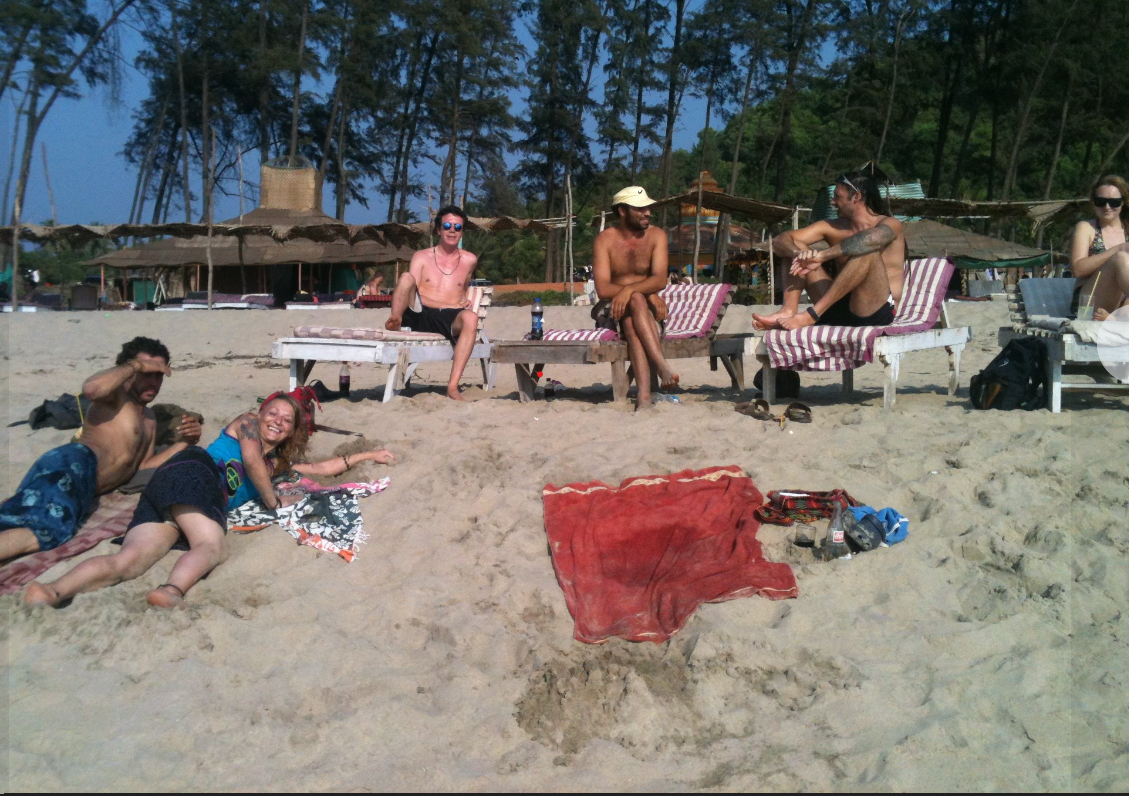
Back on the road, my first port of call was Chapora – a narrow cowboy-style frontier town with folk riding in on mopeds. It’s mellow by the day, but at night it comes into its own, with the bars knotty with half-cut travellers drinking beer & smoking chillumgees. The clientele all seem to be something out of Camden – lots of neo-punks & tattoos. There are some major long-termers here, whom on asking where they’re from, despite their thick Austrian accent, reply ‘I am from nowhere’ – bloody hippies. The nicest part was the harbour, calm with chilling fishermen & a few stray dogs, but pungent with the smell of fish. There are about twenty multicolour’d fishing boats all flying the flag of India, & among them I shook the hand of Raj, his skin as rough as treebark, & I soon found the reason why, as I helped him haul in a boat using thinnish rope, ripped my hands to shreds in the process!
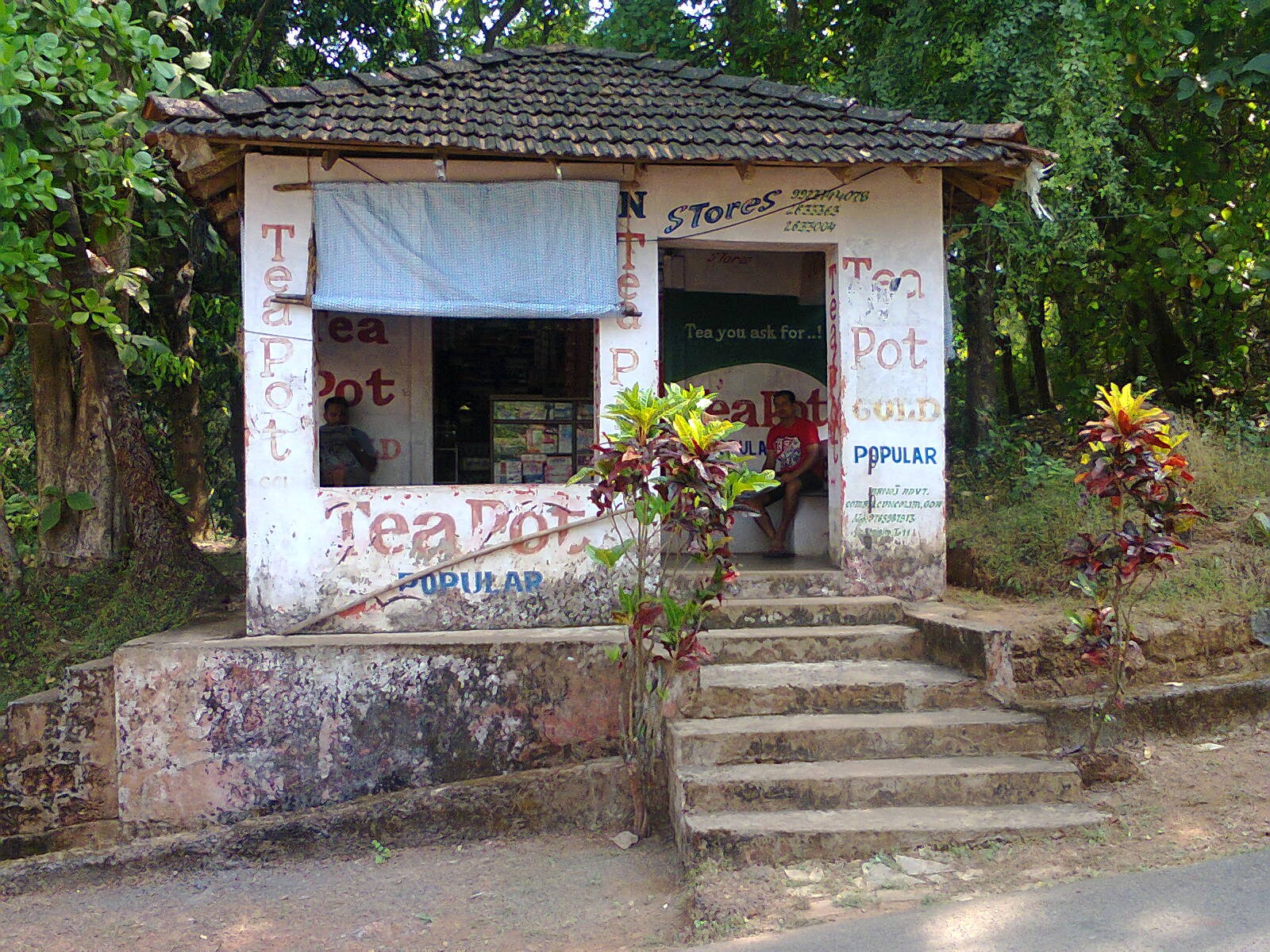
Spent the evening very stoned – when in Rome, & all that, & Chapora does actually have some very fucking strong weed. I’ was chilluming the stuff in Bee’s Bar, named after Brixton Bob who used to manage the Stray Cats. A cool guy.
Day 16
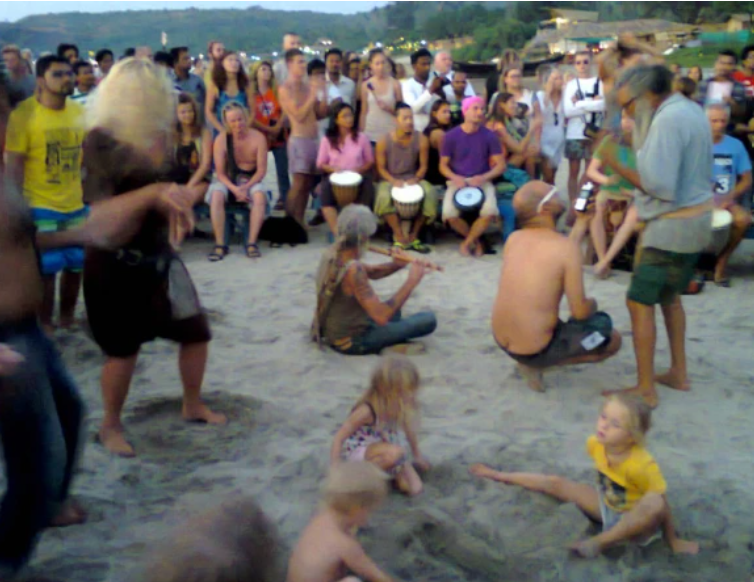
I’ve just reached Arambol & its plethora of market stalls. The quality of goods is great, & there are a few places which specialise in sending your buys home via air & sea. The theme is generally arty throes & bedsheets. At first, I was a bit miffed about the vibes, but I’ve just spent the evening by a gorgeous pinkness of sunlight setting into the sea, dancing with about a hundred folk to a load of bongo players on the beach, & even jammed along on this guy’s guitar – very good for the soul. I’ve got a well plush pad, perched between a tai-chi school & a yoga centre, for 6 quid a night. Our neighbour is the lovely Helen from Stevenage, a married woman out her on her own. There was definitely chemistry, however, & a theme is developing to this trip, I think. QPR bird, BBC bird & now stoner bird, who passed me a charas joint at hers which induced my first sick-surf whitey in a long time, swiftly rushing from her pad to fall asleep in the road – the irony is I was only ten seconds from my own house.
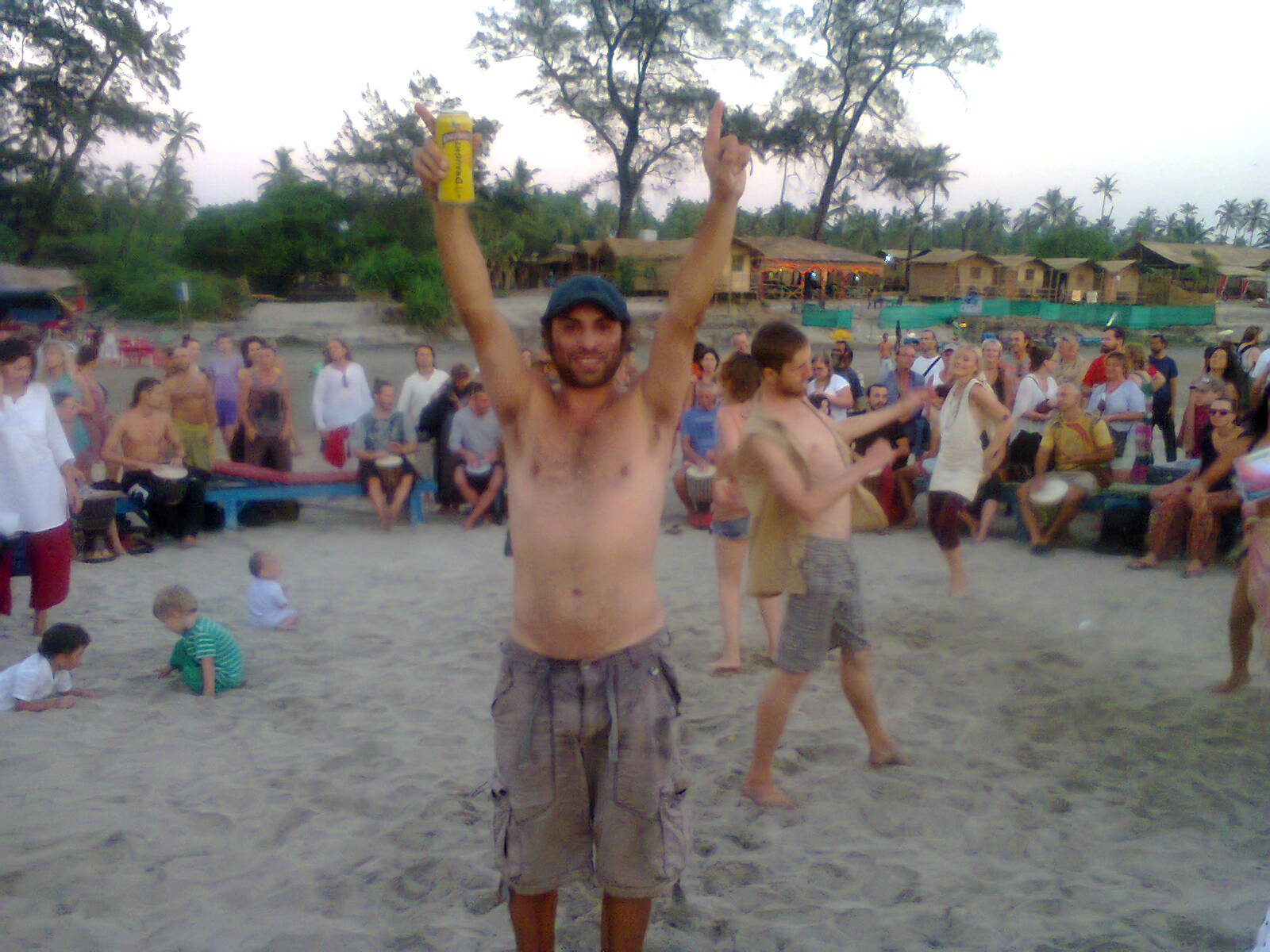
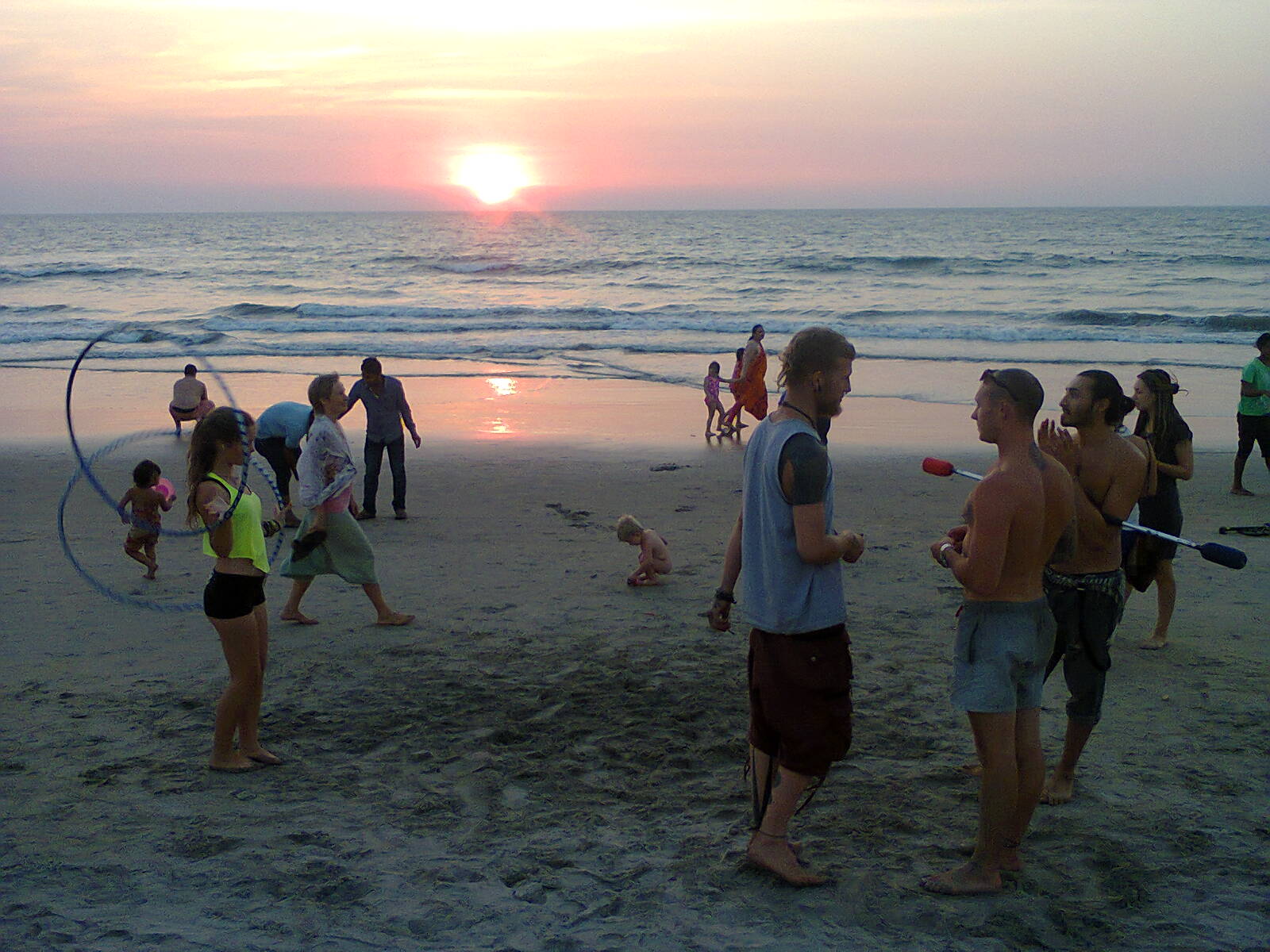
Also here is my mate Kern from Aberdeen. I bump’d into him quite randomly at the sunset jam & we went from there to an open-mic night at a place call’d the Surf Club, hosted by Phil, the 60-year old owner, & a right old raver, who used to supply pills in 250,000 consignments to Bristol. There were some great acts on – it was like this quality international jamboree –; Russians, Africans, Americans & me singing ‘Ye Jacobites By Name’ on guitar with Kern accompanying on trumpet. We were so good the owner, Phil, offer’d us a gig, introducing us to this mad Russian bird called Katia who will play drums. Also on board was Dirk, a sound German who will lend me his bass guitar.
Day 17
Arambol is great – full of Russians & hippies, & seems to be a drug-filled, fun-heavy festival of a place. The night life is buzzing & there’s some beautiful coastal walks to tranquil beaches. I’ve also been taking out my landlord’s very handsome black dog. I can’t bear to see it on a chain all day, so I’ve been struttin’ the beach with him, disturbing all the strays who hang about for free food. Then, when we’re strutting the main shopping street, for once I don’t get disturbed at all by the cowering shopkeepers – trust me, this dog is that big. It also made me look cool when I approached the Coco Loco, a beach bar, & blagg’d a DJ gig later in the week when my mates from Scotland arrive – they said sure, why not, & so my career as a top Goan Dj continues.

Arambol should also be known as the place where I invented a new adverb – Stevenaged, – an experience not for the faint-hearted, believe you me. This entails meeting a mad group of birds from Stevenage who get you high, laugh a lot reyt loudly, drink you under the table, & then… you know the rest. Helen was not impress’d, however, when after all her inner turmoil about flirting with me & being married, I was ‘intercepted’ by her mate & taken back to a beach hut for carnal adventures. I then get a phone call from Helen who invited me to hers for a smoke, where I’m currently typing up this after she seduced the fuck out of me. I’d love to go on, but this black acrobat guy from Kenya’s just dropped off some crack & Helen has fixed up a bloody mary, ‘I Am The Ressurection’ has just come on the stereo, & so for the second time this year, after visiting my mate Charlie in Brixton & that mad night with Ketamine Karen – I’m thinking it’ll be too rude not to toot.
Day 18
Waking up in Helen’s bed I decided it was not the best time to become a crack head, & swiftly decamped on an 8k scooter-ride north to the island-like Kerim, at the northernmost tip of Goa; one side of which faces a river estuary, one side the Arabian Sea, & the other side crown’d by a long, wall-like hill which paragliders chuck themselves off thro’ the day. There’s only one road in – by the river – or it’s possible to walk here along the hazardous, overgrown coastal paths up to Arambol.
On route I got chatting to this Irish guy in a restaurant, who mentioned there was a place for rent near his mate’s house in Keri. His name is Martin & only has one leg – bitten off by a shark he told me. A funny guy tho’, we’ve swapp’d numbers & will hook up soon.
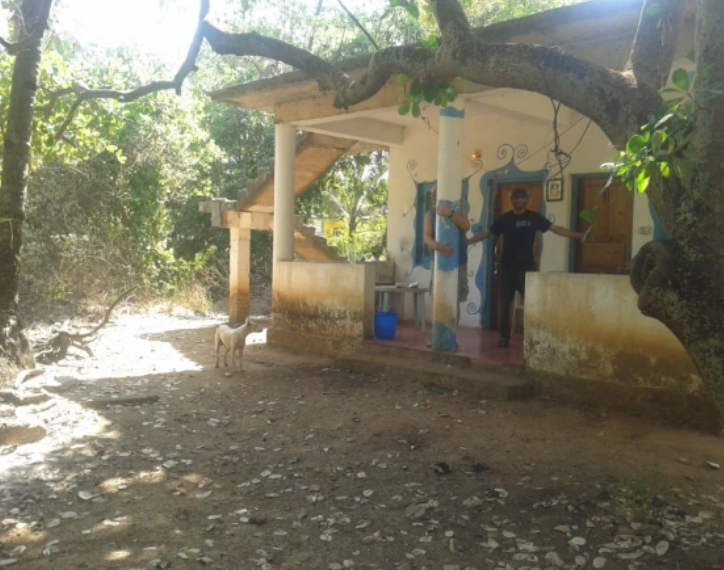
So I got to my Keri & found Martin’s mate, who led me to this like a four roomed bungalow divided into two, with a toilet at the back of each half. There’s a kitchen, a lovely porch where you can set up a mattress, & stairs up to the roof for a sun-bathe – & my half of the house is costing only £2 a night. For another £2 a day I’ve got a sexy yellow pussy-wagon of a new scooter from a local lad.
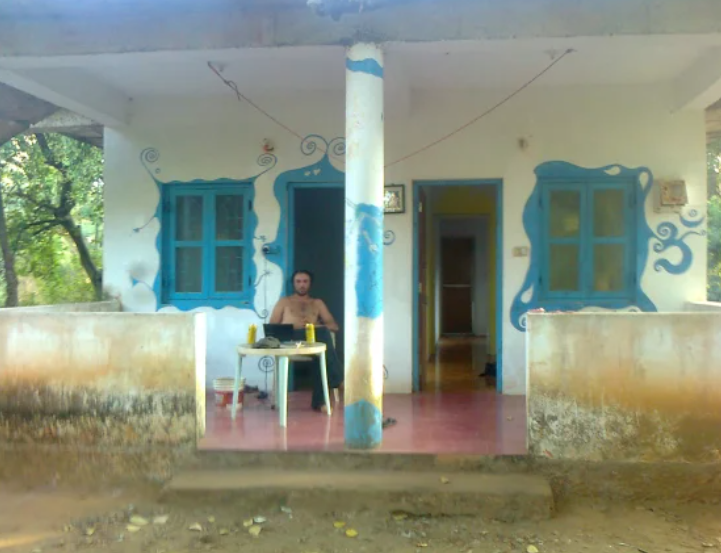
Keri village itself is quite widely dispersed, with a few ex-pat English gangsters avoiding cops at home & the Russian imperial venture at Arambol. The places possesses a gorgeously vast & tranquil beach, & a ferry that takes you across the river to the next state of Maharashtra.
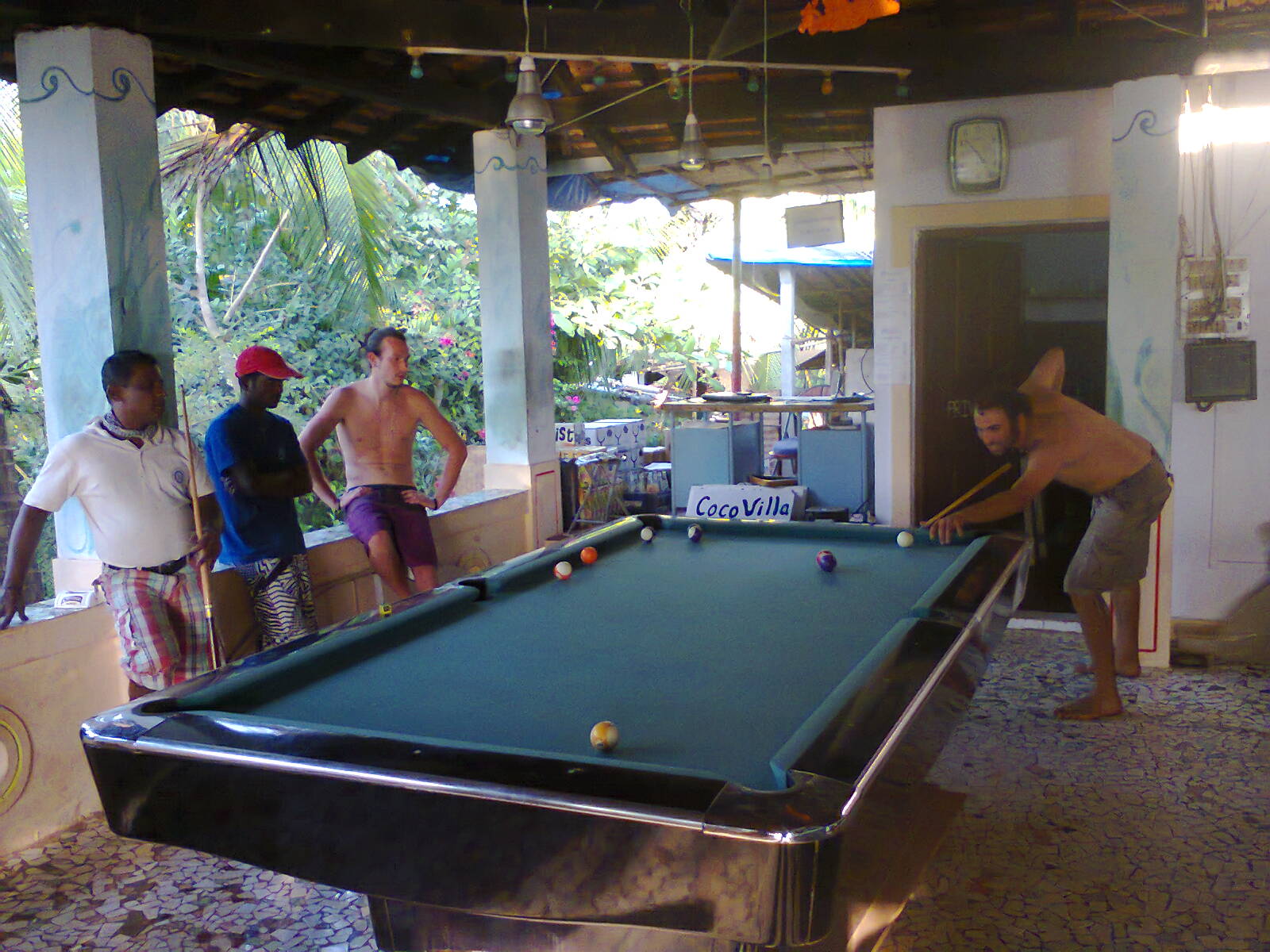
Back in Arambol, the Surf Club gig was wicked – we got paid in money, beautiful tandoori & a free bar – which of course I availed myself of wholeheartedly. I also met Albina, a tall & very hot Russian lass from beside the Black Sea & after the gig I drove her back to Keri where she is currently snoozing off our lovemaking in what appears to be a curious dialect of Russian.
Day 19

This morning with a ‘goodbye sweetie’ Albina went off to work at an international nursery school & I thought I’d drive the 35 k south to Anjuna, pausing every now & then to watch a bit of the cricket. On the way back, I stopped off at the Mango Tree for a beer, & met two cute 20-odd year teachers from England, fresh off the plane from where they work in Dubai, & looking for a rave. After informing them that Arambol was wicked, they promptly said they’d come up that night. Which they did, & after scoring some quality MDMA in the back room of a dodgy shop, we proceeded to have one of those classic Goan experiences; dancing to trance, partying on the beach, etc. It was funny as, I mean they really were hot girls & I went round telling everyone they were my wives – a little bit of kudos for the new-boy in town. Come the early hours, the girls were ready to go home, so I sorted them out a taxi & watched them sail off into the distance, before hopping on my scooter & driving to a bar. There a 25 year-old Pakistani lass call’d Simi was DJing & we soon got chatting, I gave her a dab, she let me play some tunes. Her idea of disco & my idea of disco were very differeent things, however once off we went back to her pad we were definitely playing the same kind of music. My mojo is proper rampant at the moment, you wouldn’t believe!
Day 20

My guitarist pal from Edinburgh, Al Roberts, turn’d up today, with his guitar slung over his shoulders, along with George & Shady – two lads from Galloway. Their plan is to buy bikes & drive around India like madheads. Cue beers & drugs & jamming on Al’s rooftop with all & sundry including Kern & Martin, with the latter almost falling off the roof after trying to stand up drunk on his fake leg.

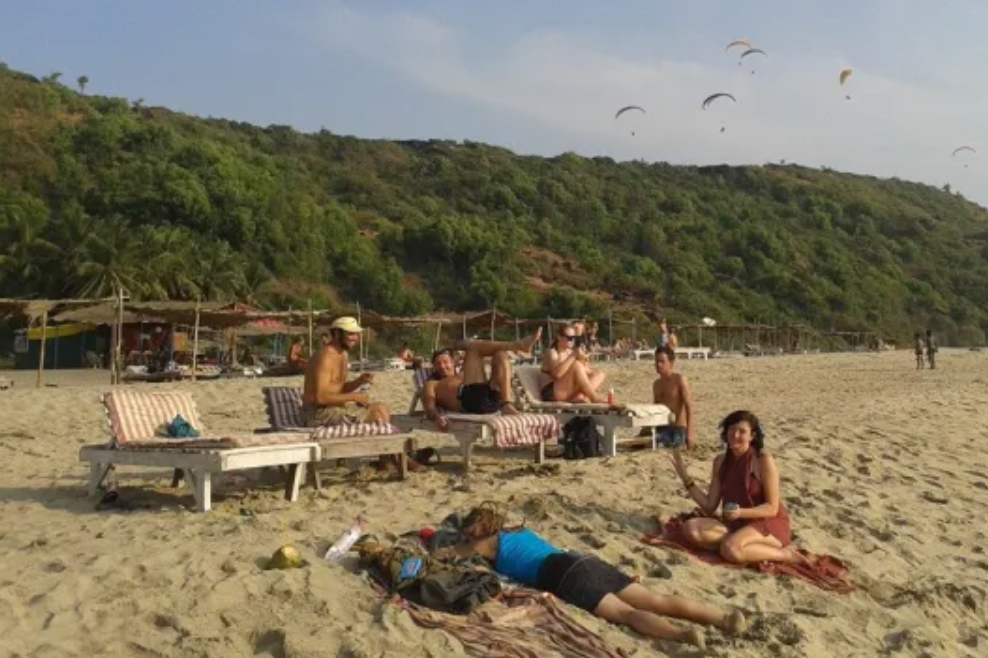
Then, in the afternoon a Scottish lassie I know turned up; my ubercool DJ pal ‘Needle Sista’ Teri, along with Cornish Stella & Glaswegian Lorraine, who were both in India for the first time. So, I tells them about Keri & we all agreed to go & get dinner down there & catch the last of their first day’s sunshine, where I penn’d the following sonnet.
I watch’d the reaching out of Dawn’s arms red,
Both wrapp’d about the beach on which I led,
Saw little twitters skip the zenith crest
Of waves flung shorewards, falling foam abreast;
Ahead, the full moon gave the waves good gold,
Behind, deep-banded amber branding bold,
When starry rays made way for planets three,
They, too, into the blue illume did flee.
As round the moon rose-fingers floating meet,
Morn’s cyan-curtain’d opening complete,
As fishermen & dogs began day’s dance
Still on the sands I lay, a man entranc’d,
For as full moon thro’ blinking cloud distills,
What flaming sun-chink winks out from the hills!
That evening Albina turns up wanting to see ‘her Damo,’ with her sister on the book of their scooter visiting from Russia. By now most of the group had gone back to Arambol – Ttere was just me, Martin & his mate. Albina’s sister took an immediate shine to Martin ‘I looovveee him’ – she drawl’d, & they ended up driving off to Arambol, while of course Albina stay’d at mine.
Day 21
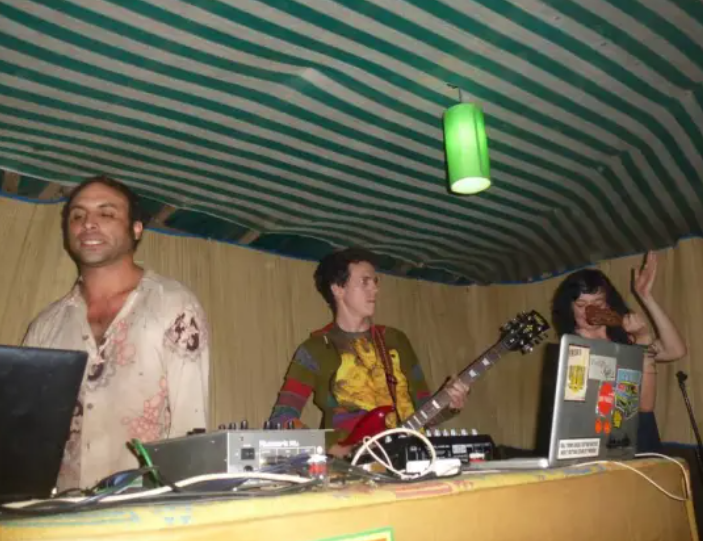
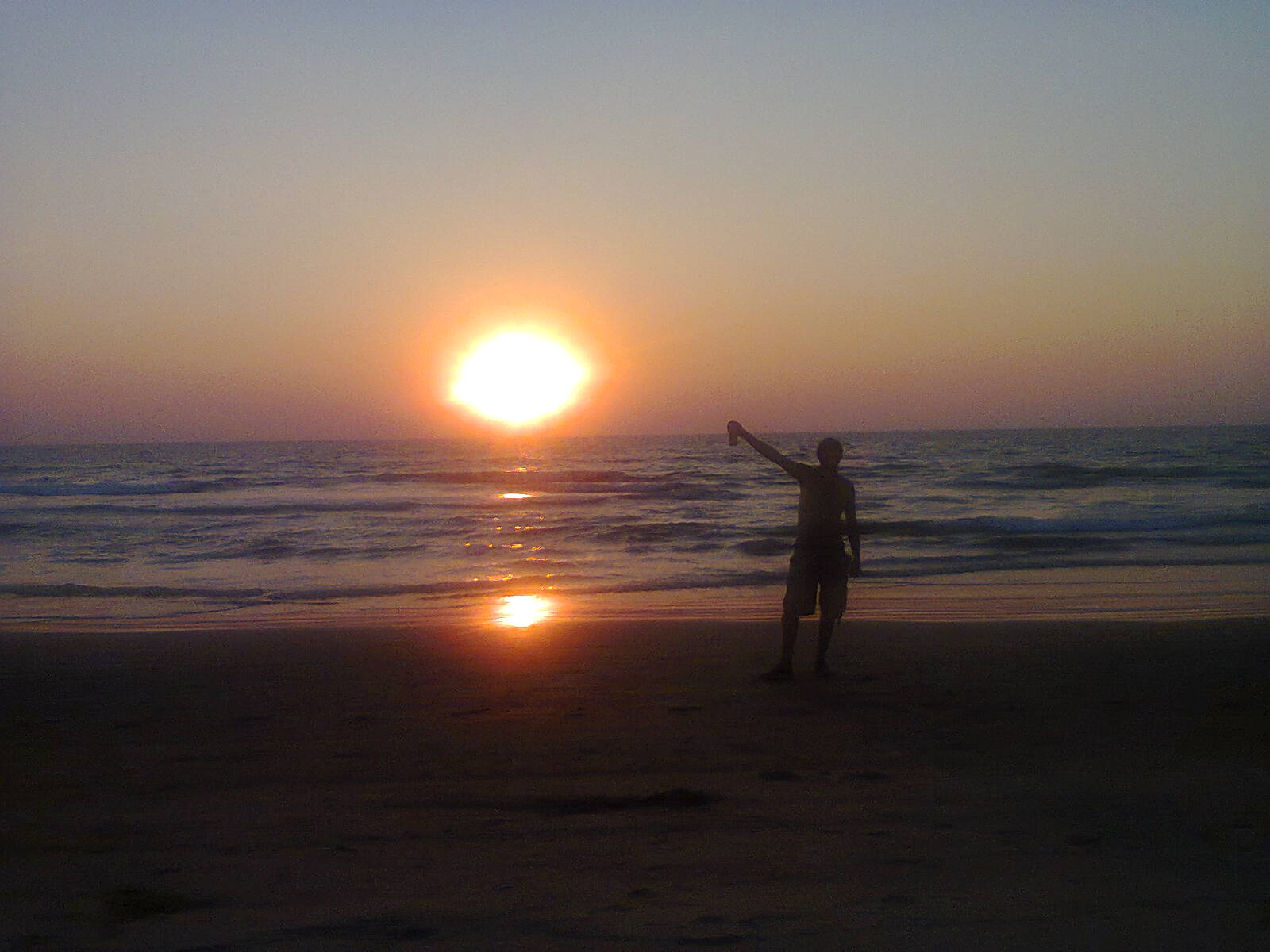
It turns out Albina wants a baby with me. It’s definitely time to leave Arambol for that & two other reasons. The first is the banging night put on by me, Teri & Al at the Coco Loco – we called it Tinky Disco & was a blend of DJing & live guitar, all proper good fun & the punters were loving it including our massive posse. Mission accomplish’d. The other reason is a bit fucking dark. Earlier in the day, after leaving Albina’s sister’s place, Martin had an argument with some Indians in a bar who ended up battering him with his own fake leg. He must have been well piss’d off because not long after he’d gotten into another argument with this Swedish guy he was living with in Arambol, hit him over the head with the Swedish guy’s own drum & actually fucking killed him. The police caught up with him about 40 k away & that’s him fuck’d, for what’s gonna be a very long, long time. Totally mental! I didn’t find out about this until quite late on at the Casa Loco, but the vibe of Arambol has suddenly alter’d drastically. Goa has its highs, but also clearly has its lows. Too much drugs, too much sunshine, & when the fun flips to fuck’d up, all hell breaks loose!
Adventures on an Indian Visa: Week 2 (South Goa)
Day 8
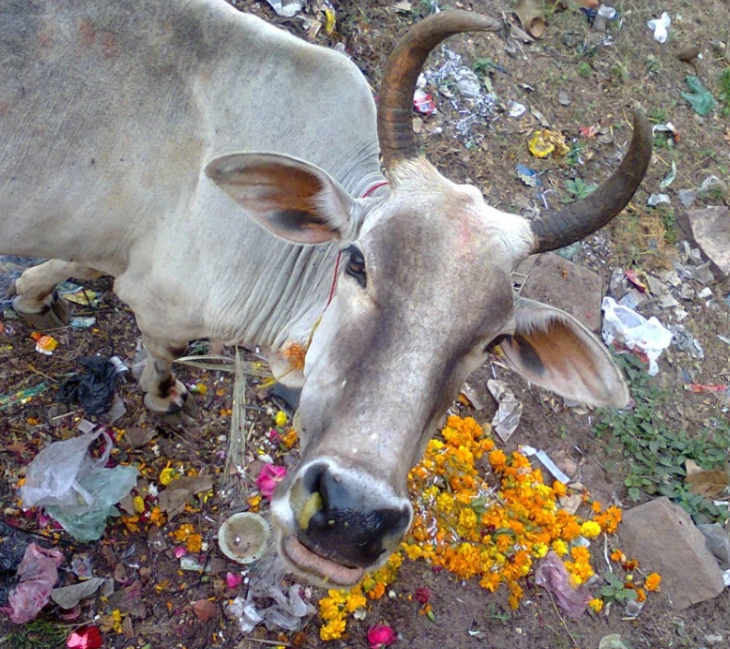
Today I bumped into my Scottish mate, Barry, who persuaded me that a couple of k away to the south was the gorgeously mellow Patnem beach. It makes Palolem look like Benidorm & I immediately felt more comfortable. The beach is lush, while the waters, tho’ a little cloudy, are silkily dive-in-able; warm & wet 24 hours a day. As for India’s sacred cows, on the beach there’s a herd of about 20, while on the back road near the beach there’s another herd, haunting the rubbish dump for snacks. Inbetween are all the shops and villas and huts, then the crescent of beach-kissing restaurants & bars.
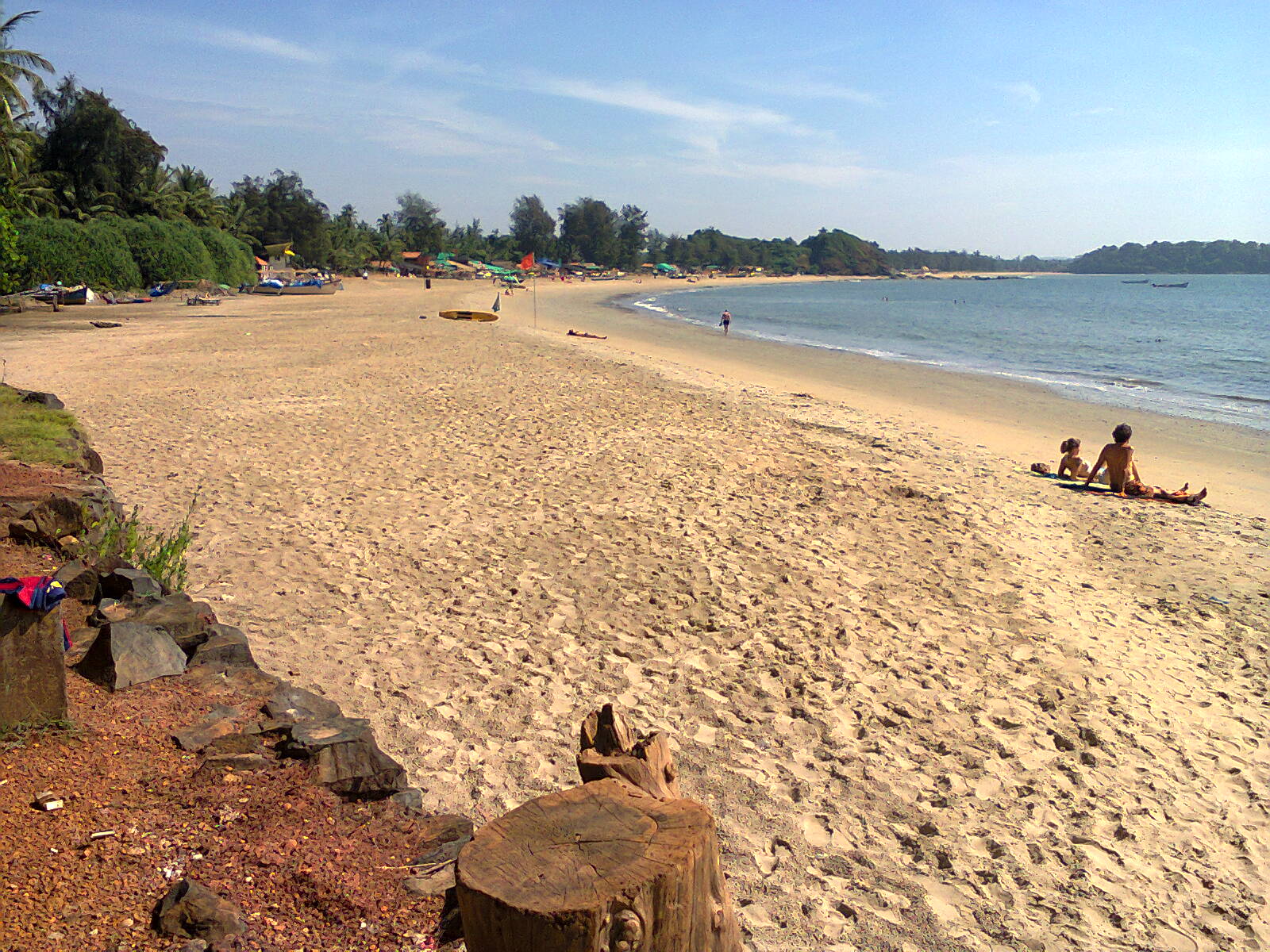
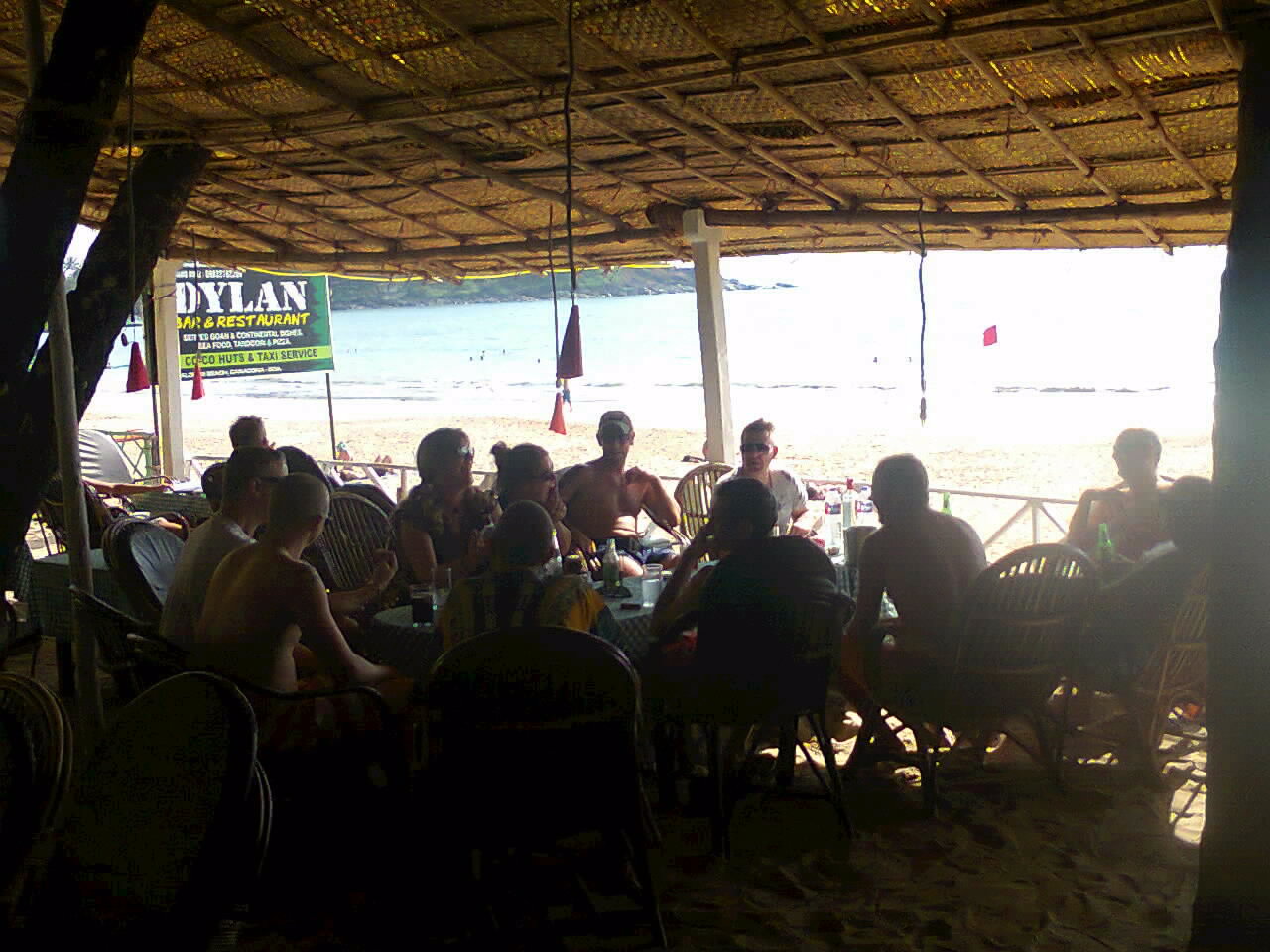
I settled in straight away, buzzing about on my scooter, finding idyllic spots to study in, then spending the rest of the day relaxing, swimming & eating, messing about in the giant adult playground that is Goa. It reminds me of the Shelleys/Byron mentality as they lived in Italy, something which has always inspir’d my life. Being in Patnem, however, does have echoes of when the Shelleys hit Bagnia di Lucca & declared it quite sardonically to be full of the English. They, & of course the Scots, really have taken over Patnem.
After m’lady departed for other shores this morning, it seems she had left me with a revitalised mojo. First to pick up on it was a nurse from Hastings. I’d gone out for few beers, playing pool in beach bars & stuff, which led to a riotous rave at a headphone party where we I had my first proper dancing session in Goa ata place call’d the Alpha Bar – an open-air affair with great aesthetics & a stage. After. Cue some wild driving, an all-night party & a morning frolic in the waves with the aforementioned nurse. Her boyfriend is a QPR fan & she said, ‘I won’t tell him you’re a Burnley fan, he hates Burnley!’ I was like, ‘you’ve got a boyfriend, why don’t you just not tell him about me at all!’
Day 9

At some point along the wild roads of last night’s drunken shennaningins I managed to total the front of my scooter, which Dinesh says will cost £35 to repair – ouch! However, it looks like I might be able to pay that back from real wages, because on returning to the Alpha Bar I have managed to secure a gig in a few days of my very own. After a few business–like chats with the boss, sat on chairs drinking chai & arguing over prices like any other Indian transaction, I pulled the thing off. God bless Saraswathi! There are two channels going at the same time so I will be playing alongside someone, but also to about 300 punters, half of which will be birds in varying degrees of hotness.
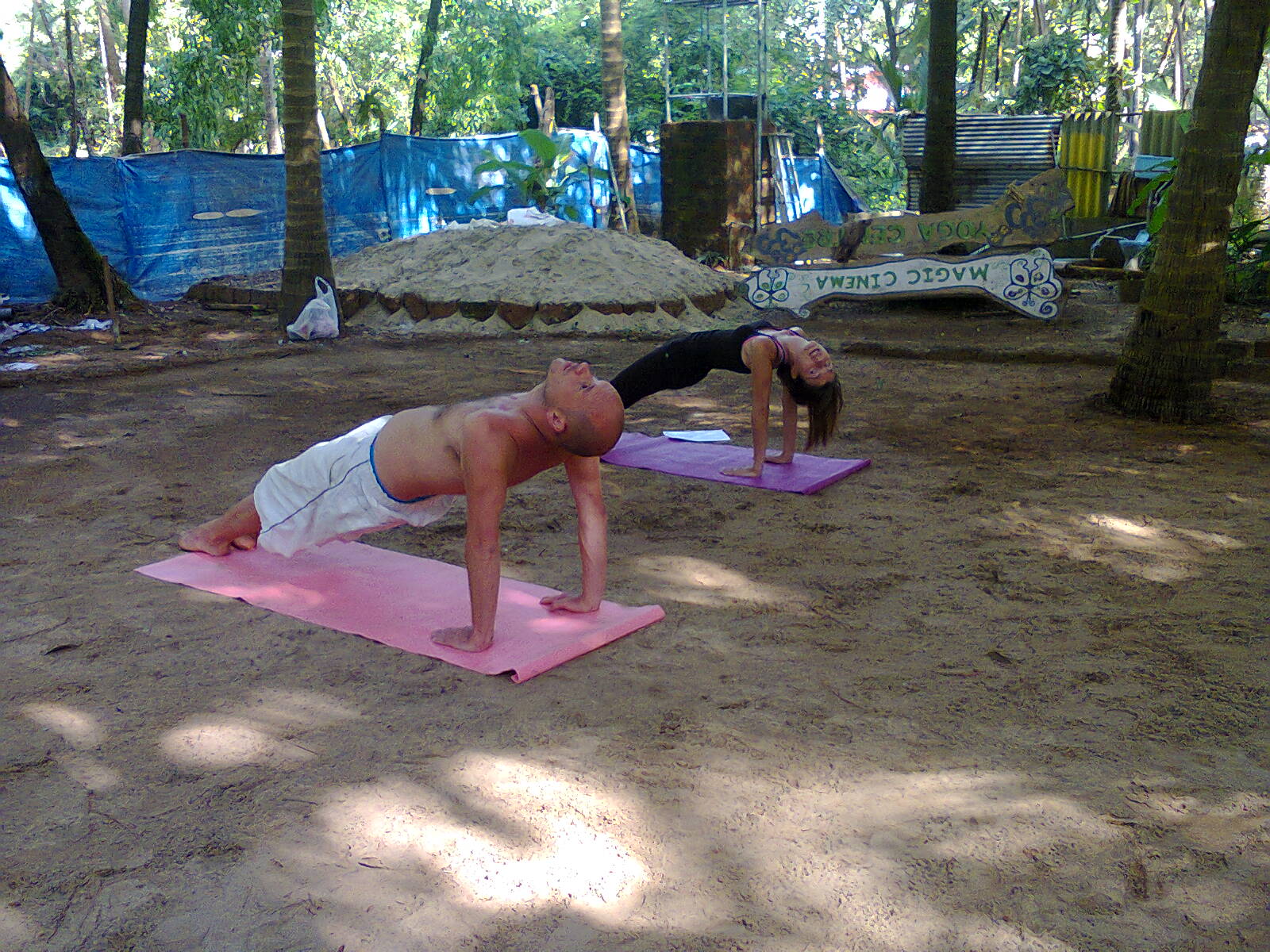
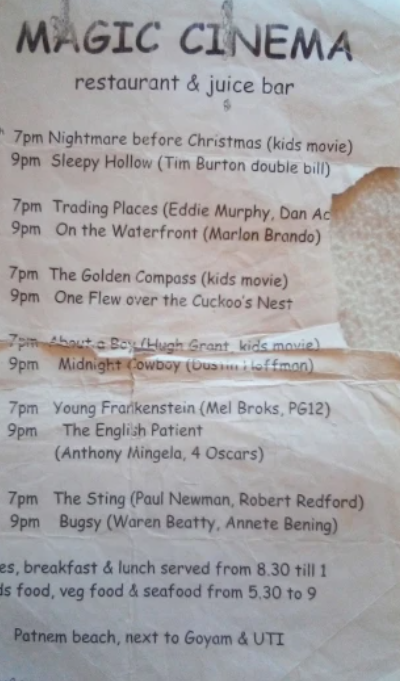
I’ve also moved to a beach hut at a place call’d the Magic Cinema, ran by this guy called Jimmy Van de Mere. I met him last night & he invited me along to see his place – I moved in straight away. Its stuffed full of hippies & healthy food, & shows a couple of wicked films each night in an open air cinema – tonight was one of my favourites, The Sting. I loved hanging out there during the day, shaded by the coconut boles & palm trees, playing chess with this mad German bird & one of Jimmy’s mates call’d Steve, whose here with his girlfriend, an Australian call’d Kate. They are the most relaxed, hedonistic couple I have ever known.
After the Sting, me, Steve, Kate & Barry bought some ‘happy pills’ from the chemist, hoping they’d be amphetamine based. At first they seemed to work, but after a while we levelled out & Kate discovered that they were, in fact, Prozac. It was time to resort to plan B. This involved chipping in together to buy a bottle of liquid ketamine from a chemist in Chaudi, the local amenity-laden town. It was shipped in on the 9 PM bus by a nice young chemist & by 10 PM it had been cooked up. Kate professionally held a metal pan over 4 candles & after a few minutes the liquid suddenly turns into white powder, smooth as untrammell’d snow.
Ketamine’s a tricky drug, you have to find the right length of line or else you fall into the K hole. However, experience & common sense paid off & we managed to have a great time at the Neptune’s Point disco, a wave-lapped promontory full of Goan party heads. Me & Barry decided to have a couple of lines on the bar & b4 long we’d met these pill’d up Norwegian birds who gave us our ecstasy lead – Curlie’s Bar in Anjuna. “We’re gonna have to go Damo, it’s what I do,” said Barry.
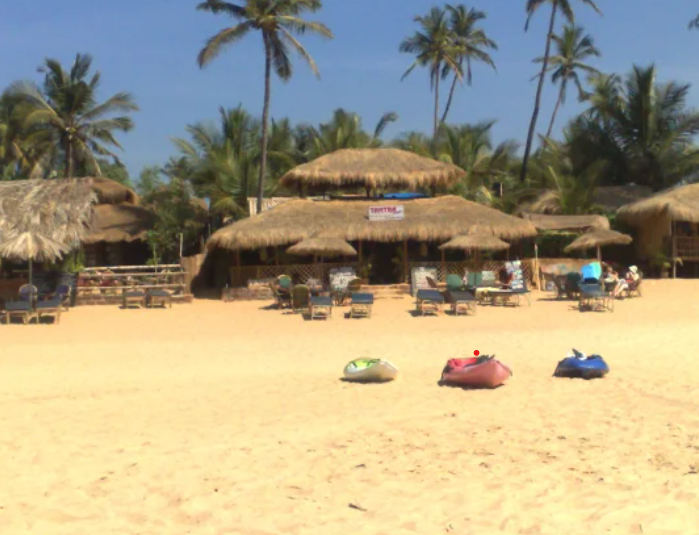
Day 10
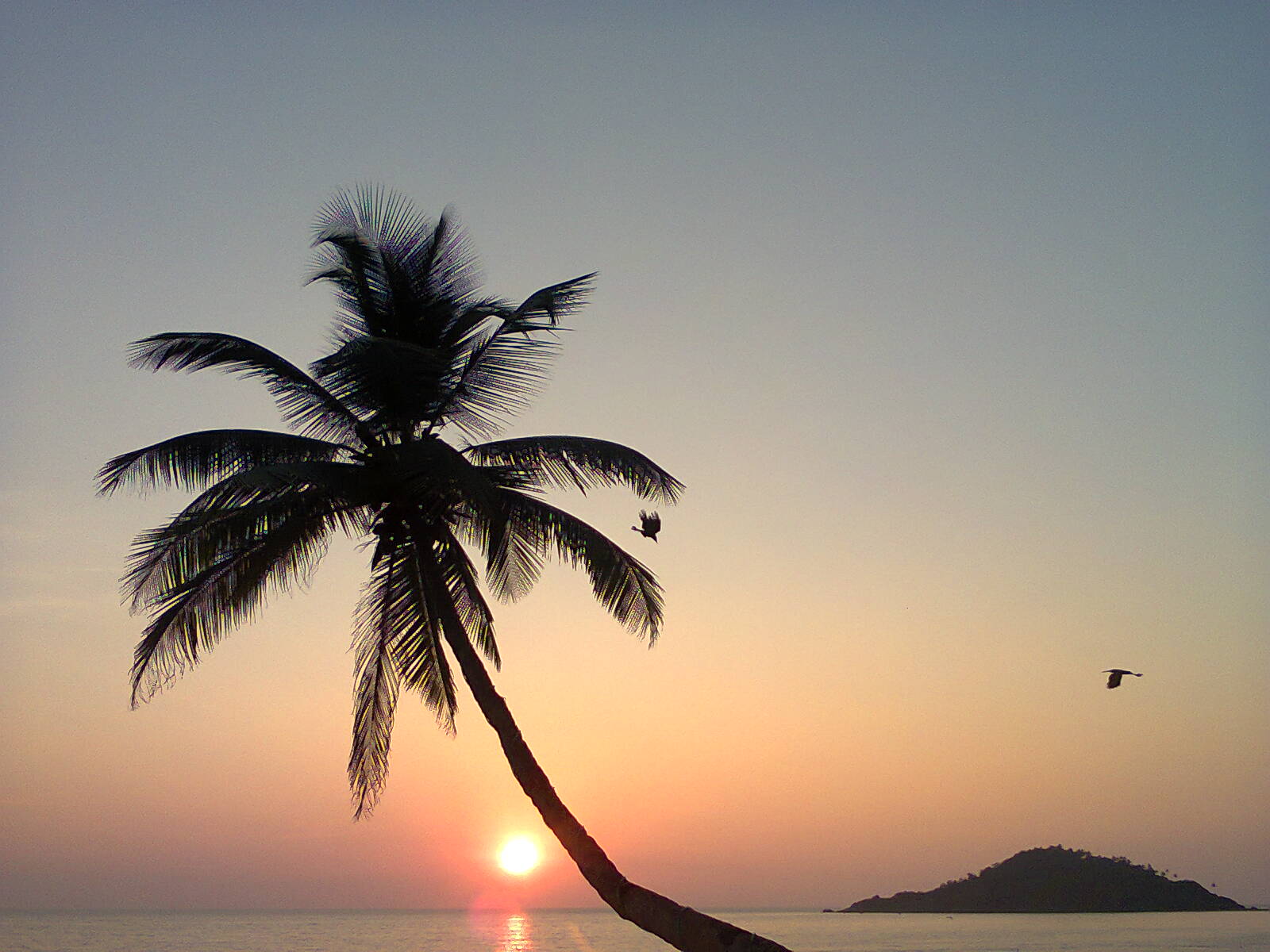
We didn’t go to Anjuna today. I found Barry still sleeping off on an all-night drinking binge commonplace round these parts. Barry knows some Scots out here, who basically hang out all day at the same restaurant (the Tantra). A few of the ‘in crowd’ hang out there also, from Cornish DJ’s to the long-locked Londoner Leigh, who runs the open mic nights on Patnem & Palolem. Yesterday they’d all gone off to see if some baby turtles have hatched, a story which is currently gripping the local geaches. Apparently they are all still in their eggs yet.
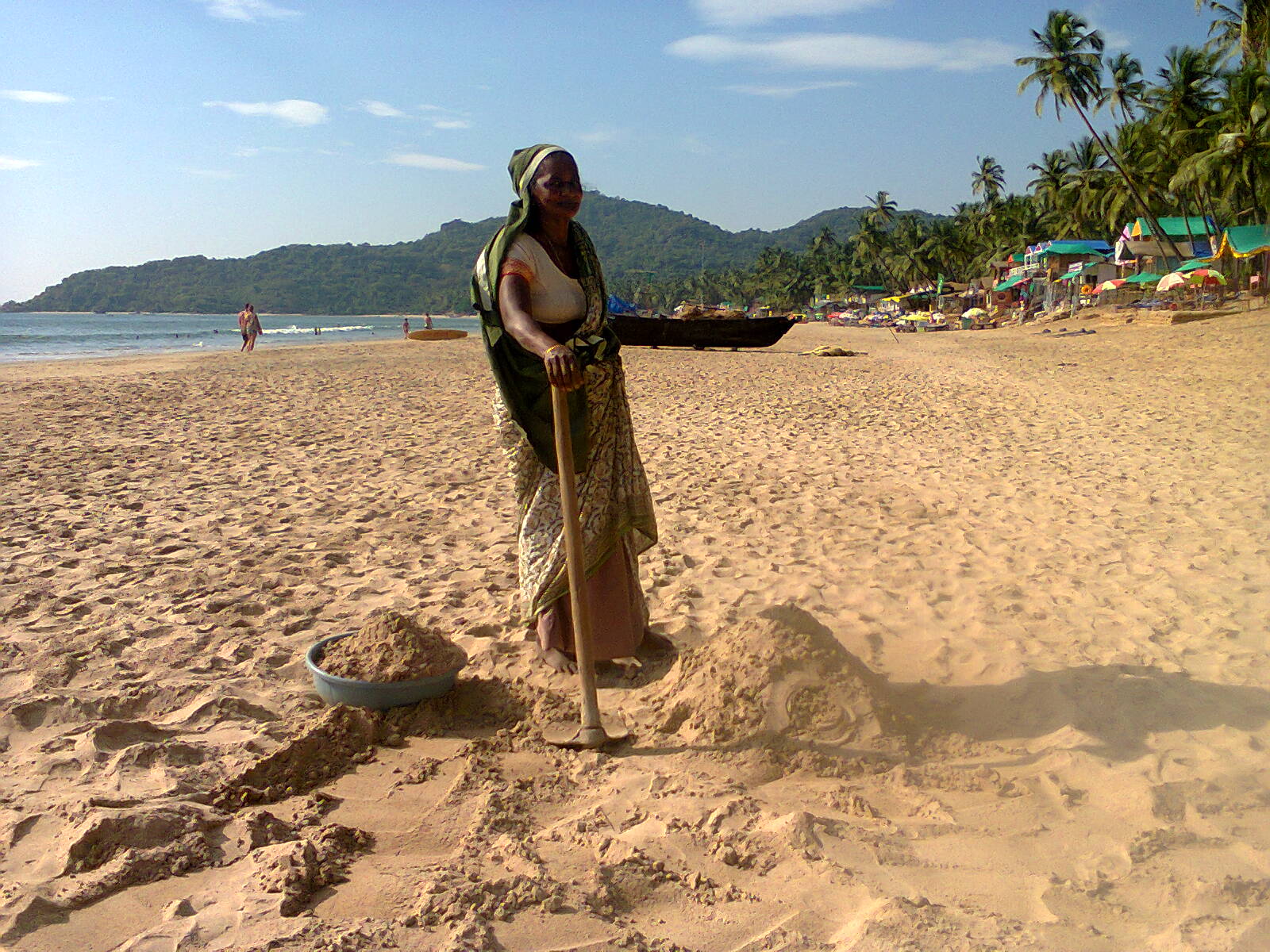
Today I learnt the lesson that drink-driving is fine if ya going slow, but drinking, driving & smoking charas is a definite no-no. I almost ran into this group of Indians – not touching one, mind – when all of a sudden each one began clutching mythical broken shoulders & screaming in agony. I saw one of ‘em later on, who declares he’s been to hospital, it cost him 6000 rupees & he’s complained to the police – apparently he took my photo & registration number – & if I give him the 6000 rupees he’ll take back the complaint. ‘Mate, I’m from Burnley,’ I replied – he didn’t understand what I meant, but he got the intent – you can’t blag a blagger, end of. I mean, I’m a top Goa Dj now & I’ve only been in India a week.
Day 11
This morning began with me shaking Barry awake & stuffing him into the waiting taxi. It was time to score some pills. Anjuna is in north Goa, the original home of the Goan party scene in the 90s, but now a shadow of its former self, turning into something of a middle-aged Majorca. However, you can still get pills there, & we arrived at Curly’s Bar in our getaway taxi, where after initial contact, a couple of hours pass’d by slowly as we waited for a shady young lad called ‘Roy,’ who Barry swore had tried to sell him drugs just up the road a few years previously. We shared the haggling between us, & left north Goa 30 pills to the good & one each down our necks. The journey ‘home’ was magic – quite euphoric on what were flying fucking pills. Whether it was my 2-month abstinence or just their sheer strength didn’t matter so much, suffice it to say that after the scenic two-hour drive, past the deep fjord-like, jungle-backed rivers of Old Goa, I was well off my head & so was half of Patnem Beach an hour or two after our return. Another Silent Disco ensued, this time inland & surrounded by palm trees, where a wee line of ketamine initially sent me to heaven, but then spun me out for a good two hours.
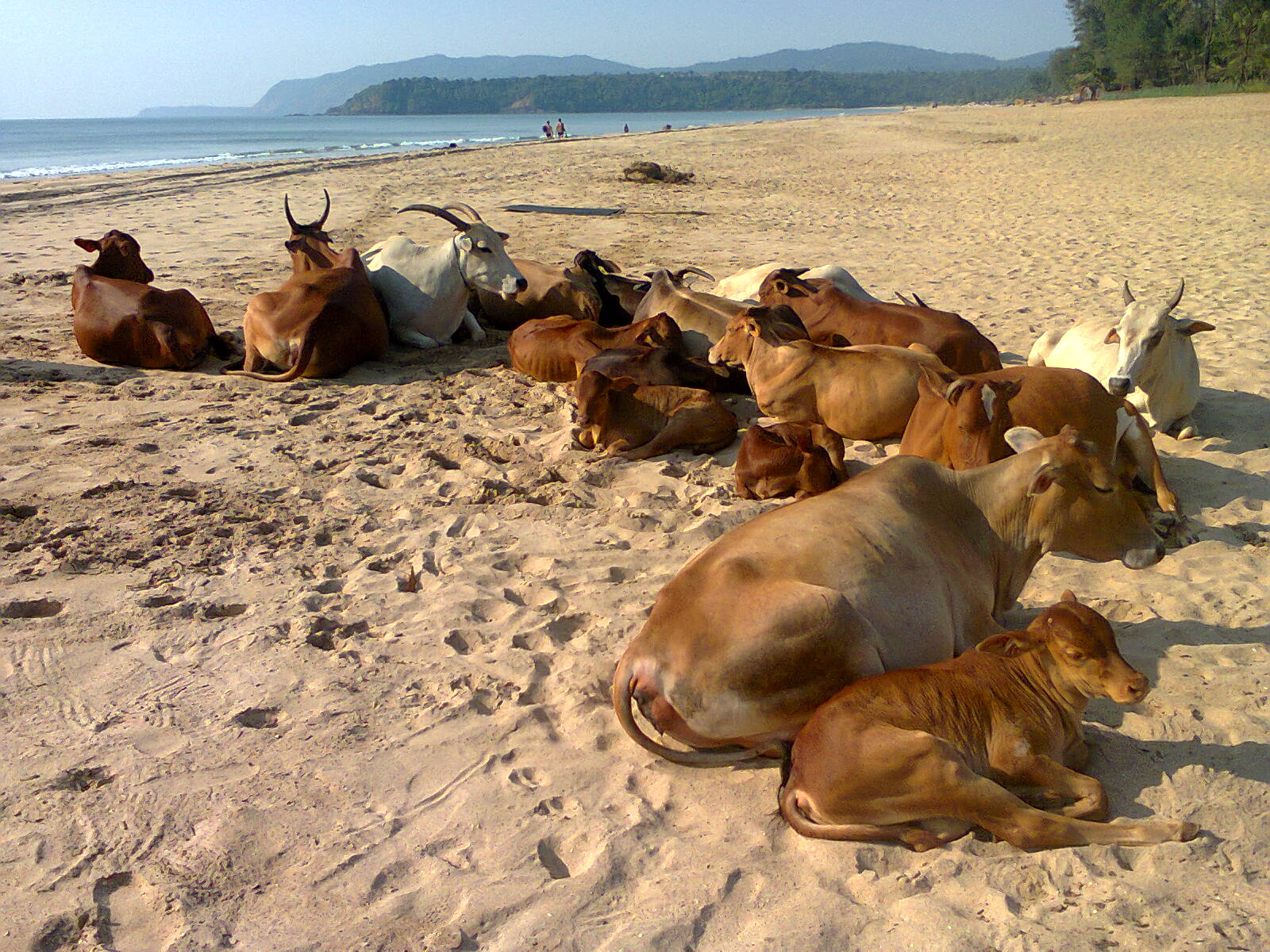
“You know the thing about ketamine,” said Barry, “is that people always go on about it.” He was right, my mind was verbalising its fight back to relative sanity (I was on pills remember) – & the whole psychic mess was cured only by another cheeky half. It was then time for a damn good rave, ending up at the all night Palolem strip, whose mile-long chain of restaurants & beach bars become at night a multi-coloured ribbon of neon light – & then to Cleopatra’s Bar for pool. At daft-o-clock me & Steve drove back to Patnem, leaving his missus in the capable hands of Barry. A few hours later Steve got a rickshaw back to rescue Kate from Barry, who by now had donned some English woman’s feminine attire in full tranny flow, fuell’d by some anti-narcolepsy tablets, which contained the grail-like amphetamine kick much needed in times like these.
Day 12
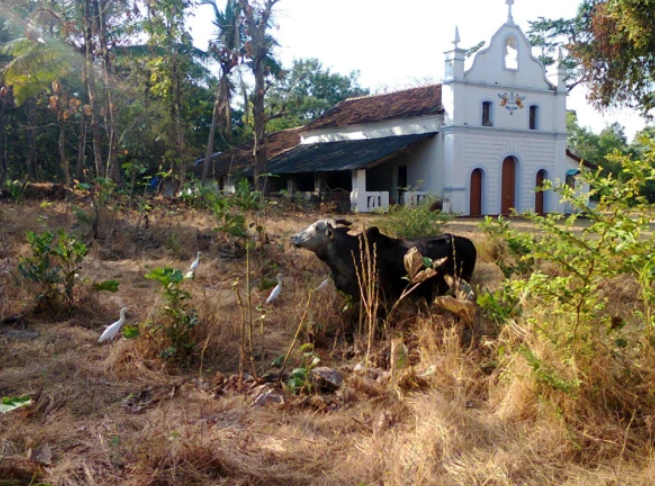
It seems the Siberian snap that has recently hit Europe has penetrated the subcontinent – here’s a report from the Times of India.
Panaji – the mercury dropped to its lowest this season as meteorologists recorded a minimum temperature of 19.6 Celsius yesterday morning.
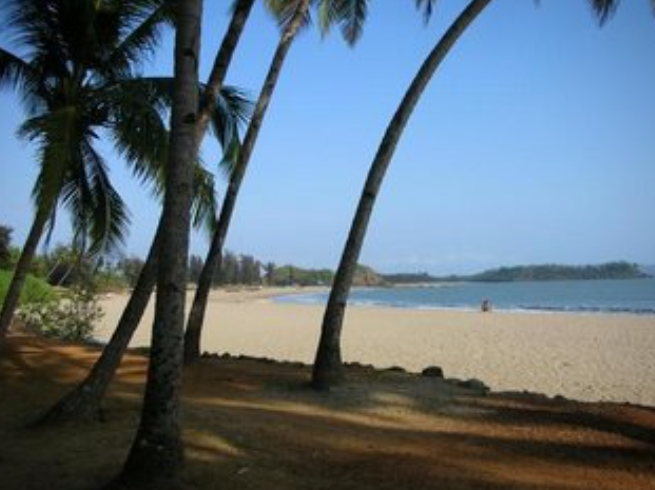
I must admit, I had to turn my fan down a couple of notches in the night to keep out this unwanted coolness.
Today I met an old mate. I was sitting in this chai & samosa hut, recovering, when I heard ‘I think I know you.’ I turned round & there was Danish Rita – she used to see my mate in Bognor Regis – clutching a new-born baby. It turns out she’s married now, has two kids, & has the ability to heal people through her hands with ‘the light.’ Her husband is cool, despite not having a drink in ten years, & it was lovely getting to know them. It turns out they adore a place call’d Thiruvannamali, in a southern Indian state call’d Tamil Nadu & I should definitely check it out if I’m in the area.
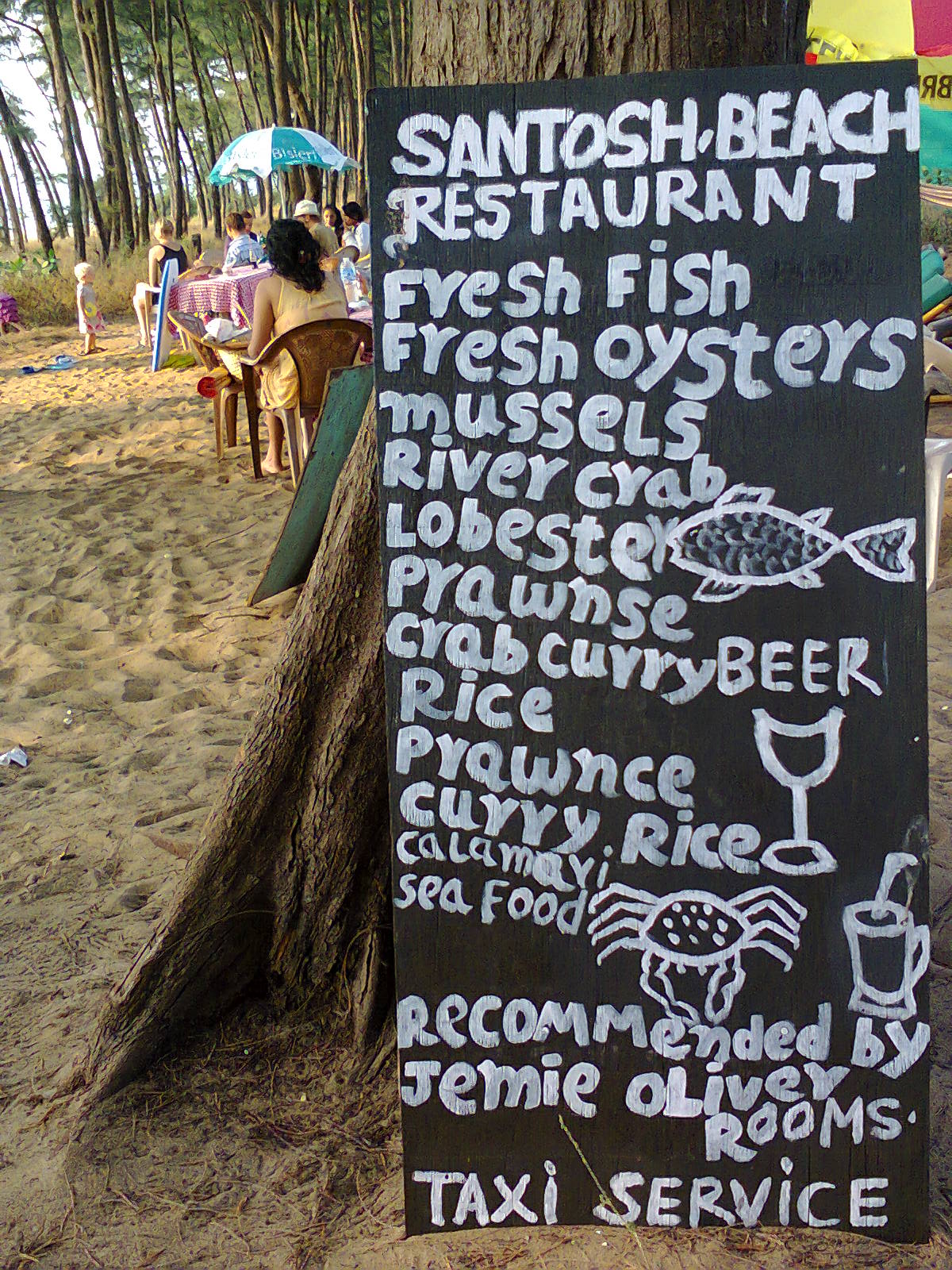
At the Magic Garden, the newly-arrived Phillipa had a bottle of liquid acid, which gave my day a myriad-hued glow. Jimmy had also taken some acid & took us out to Galgebag beach, where the sea turtles had still not hatched, their eggs protected by human fencing. There’s a cluster of restaurants at Galgebag, one of which comes recommended by Gordon Ramsey, while the one next door is recommended by Jamie Oliver. Whether this is true or not, the oysters were great & the beach sands are lush… Happy Days indeed!
That night saw a party on in a place called the Secret Garden. That was pleasant enough, ‘til the police halted it mid-flow; so a big bunch of hippies, led in some vague fashion by Jimmy, hiked over to Neptune’s Point for more silent disco fun, & a little flyering for my own gig tomorrow!
Day 13
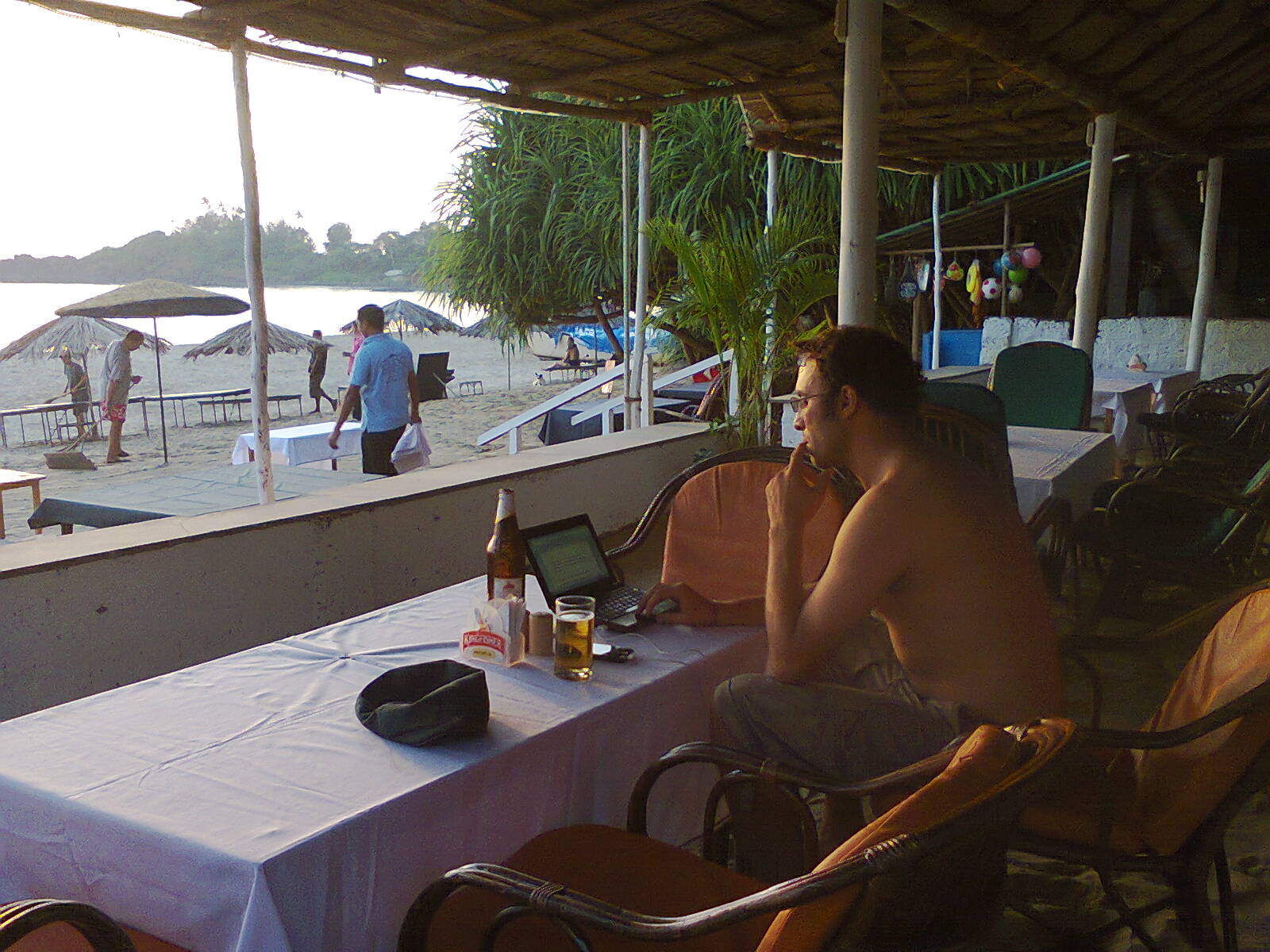
There’s something about being a DJ which is an aphrodisiac for the ladies. lt was my debut at Alpha Bar’s Silent Noise night – the flyer says Palolem’s premier outdoor nightclub. It was wicked actually, a really pretty space illuminated by purple laser beams. Earlier in the day I’d been handing out said flyers along the beach – a great way to get chatting to folk actually. Come 8.30 I was the opening act, & for two hours played mi tunes out loud thro’ the speakers before the 10.30 watershed when Goa turns its music off. Then the headphones come into play & as the venue filled up, people began dancing. I couldn’t tell if they were dancing to mine tunes or the guy’s next to me. He was a nob actually, proper DJ ego. It was great to see folk dancing, tho’. & having a good time, singing along to the classics I squeezed in among the disco. Because it’s all silent, it’s a bit like Weatherspoons with everyone having epileptic fits – the only music one can hear is the cricket opera from the surrounding jungles.
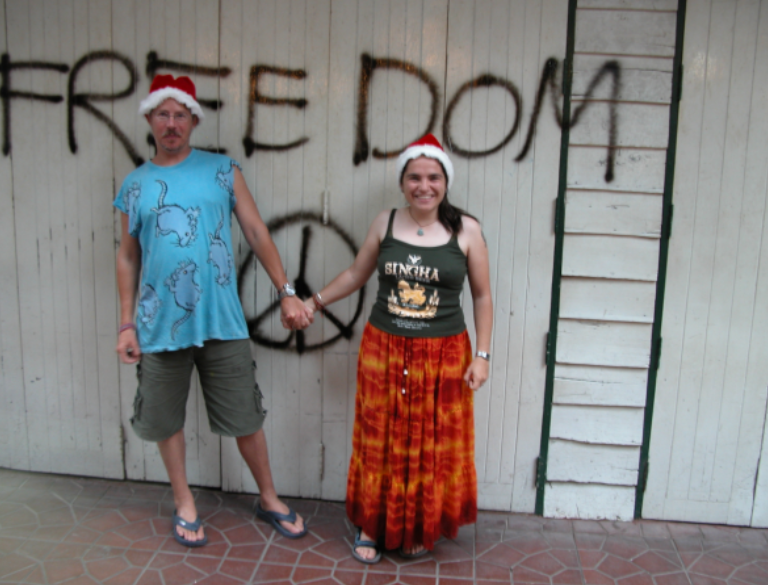
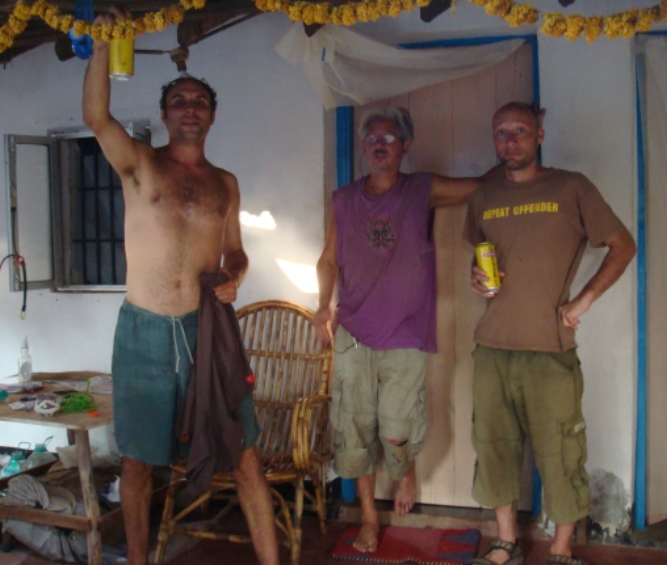

After my set I was ‘pulled’ by this hot English lady who I first noticed was dancing to Cats In the Cradle by Jonny Cash, one of my favourite tunes, showing she was a cultured woman. I was soon proven right because she actually works on the Culture Show for the BBC, & after a skinny-dip at dawn I woke up beside her delectably naked form, upon silken white sheets, at her mate’s gorgeous Portuguese villa. ‘So do you have a boyfriend at home?” I asked – & it turns out she’s actually married. Apparently, she’s never done such a thing before, or ever will again – but she’d told her husband he couldn’t expect her to sleep with one guy for the rest of her life & it turns out I was the lucky fella! It was a lot of pressure to be a charming young plaything actually. I read her a little Keats & sang a song or two like a proper cavalier servente, but if this is what happens when you’re a DJ, I’m thinking about packing in the poems!
Day 14
There was an episode of Eastenders a few years back – I remember it distinctly – when Alfie Moon turn’d up at the square at the beginning, & by the end of it was firmly entrench’d behind the bar of the Queen Vic. A similar thing has just happened to me. By a blend of timing, tenacity & sheer front, I am now a Goa DJ shaggin’ a hot BBC producer. She tracked me down herself & we hung out again all day, including a moonlit drive to Galgebag where the baby turtles were finally hatching – a divine sight indeed & my lady friend was so full of the romance of the moment, she took me right there on the beach.
So, it’s time to move on – it’s gonna be hard to top that moment again in south Goa – while a few of my pals are arriving quite soon at a place call’d Arambol in north Goa. Tomorrow morning I’m gonna burst my Patnem pleasure-bubble & sneak out of my lady’s bed – I’m in her villa at the moment writing this – & head north.
Adventures on an Indian Visa: Week 1
Day 1
I am nearing the end of my last full day in Britain for a while. I’ve just had the delight of a little farewell fling with a bonnie philosophy graduate. I told her she was something of a champagne bottle that smashes against a ship’s hull as it sets off on its maiden sailing – with better curves. She’s gorgeous, with really curly red hair & delectable lips. I’d met her at a hairdresser friend of mine’s house, where she was trying to get a 60’s style bouffant, but I said it looked more like a volcano – this brutal honesty endeared her to me & we took it from there.
After a night of wine & her fine efforts at cooking a steak, my journey to India began early this morning, departing her lovely warm bed, & continuing onwards up the long slope of Edinburgh’s Leith Walk, my pavement slapping flip-flops conjuring in my direction a number of funny looks.
It was then the long boring, drawling, droning haul on the megabus to Victoria coach station in London, from where I’ve just caught the tube to Heathrow, bought myself a beer & am writing this with a couple of hours to wait til my flight to India, & to say I am excited-slash-shitting myself is a massive understatement.
Day 2
Rudyard Kipling once mused, ‘East is east & west is west & never the twain shall meet,’ & boy was he right. The flight to the sub-continent began in a dull pre-dawn, slowly permeating the skies above the galaxy of stars that is the city of London. The capital was surrounded by the bright, wavy circuit of the M25 & thro’ the murk it seemed like the delicate golden stitching on some Chinese emperor’s sable suit. Then everything disappeared as we burst through the thick cloud into the strange & eerie nothingness of the upper stratosphere.
We got a break in the clouds as we flew over Turkey & the southern shores of the Black Sea. Beyond a coastal strip of towns, the rest of the landscape bubbl’d with beautiful khaki-coloured hills, some of which were skipp’d with snow. In the distance I could make out the Caucasus, while underneath came the Tigris, & I mused upon the start of mankind, where Mesopotamia irrigated these very plains between the Tigris & the Euphrates, from which culture rose the first cities 8000 years ago.
It was now time to change planes & we dropp’d into Abu Dhabi, a part of the oil-rich United Arab Emirates, seven princely states who joined together about 40 years ago to exploit the petrol-guzzling nations of the world. The airport was a bit mad, full of guys in white shirts, sporting red & white chequer’d tea towels on their heads, fastened in place by two black rubber rings. There were models of formula one cars everywhere, & an amazing departure lounge that looked like the inside of a curling ball, whose hexagon-pattern’d central pillar fanned out like a vase. to merge curvingly with the roof. Then we were off again, for the three & a half hour hop over the Sea of Araby to the subcontinent, towards the end of which I penn’d the following sonnet.
37,000 ft
Across Europa we have both progress’d,
By foot, by boat, by tram, by bus, by train,
But this hour, from a cool & pleasant plane,
Sees me sailing air on a grander quest,
The scenes by cyan skies & soft cloud blest,
How seldom seen & varied the terrain
Of ashen peak, urban sprawl, verdant plain,
Gleaming sea, wastes of sand & wylde forest.
As soon as we abandon Europa,
I could already taste the eastern scent,
The sun was setting west of Syria,
The starry heavens singing its lament,
As somewhere yon the grey Arabia
My pilot was beginning his descent.
So I arrived in Mumbai, the former Bombay, another wonderful galaxy of stars in what was to me an obscure corner of the universe. My first impressions were the stench… it stinks! The sweat of a billion people mingling with pollution & sulphur emissions – like one of my own more lethal moments of flatulence, but permanent! After showing my passport & my shiny new six month Indian tourist visa, it was deep in the wee hours & being slightly fucking scared mate I shared a taxi with an innocent & very clean Australian, & off we hurtl’d through the epic sprawl of Mumbai. The city is huge, about 30 million souls rushing around its virtually identical roads, & I felt we were like a couple of white blood-cells surging around the arteries of some phantastical chimera of the days before legends. The taxi driver took us to a reasonable hotel – I think he got commission for it too – & I’m sharing a room with the Australian at this very moment.
So I’m now in India; the diamond of the Victorian crown, a mad labyrinth of a billion souls, a vast myriad of language, race & faith, an empyrean melting pot of empires to explore. Bring it on, I am definitely ready to do this!
Day 3
My first full day in the very European Mumbai – complete with red double decker buses straight from the Strand – was a sensory montage of sights & smells. As I cut a swathe thro’ the city, all a-sweat with lips parch’d dry, I was assail’d at all sides by various beggars, touts & conmen – but you can’t blag a blagger & I even managed to haggle down the cost of my first score – a strange blend of Indian weed, which proper works!
My first target was the Britannia-topped, Empire-kitsch wonder that is the Victoria Train Station. I bought a ticket for Goa departing the next morning, wanting to get out of the crazy days as soon as possible. Unfortunately, I will have to head across town to my train via the Mumbai rail network, the busiest in the world. In fact half of all India’s trains come in & out of Mumbai, with people clinging to every spare bit of atom, hanging off the roof & sides – I guess it’s gonna be fun.
Leaving the VTS I was soon bless’d by a priest of the elephant-god, Ganesha, & painted with a bindi – the spot in the centre of the forehead which represents the third eye. Ganesha is one of the major deities in the epic Hindu pantheon. ‘In religion,’ said Mark Twain, ‘all other countries are paupers; India is the only millionaire,’ & there are over three million of them here, emanating divinity thro all sorts of obscure things, but the most fascinating one appears to be Kali, a goddess who wears a necklace of shrunken male heads & a dress of sever’d arms. Her whole vibe reminds me a bit my ex, Sally, when she was rife with PMT. Very fucking scary!
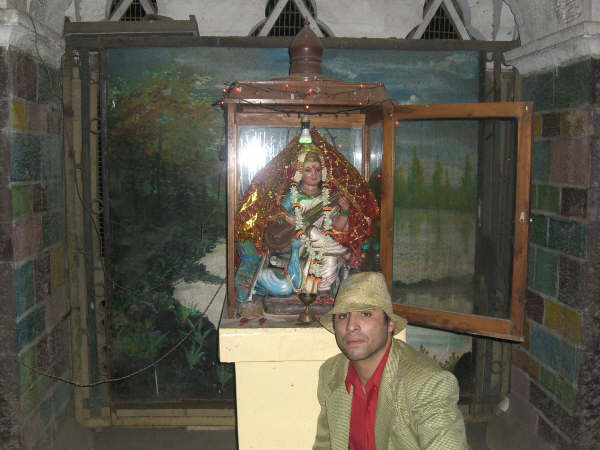
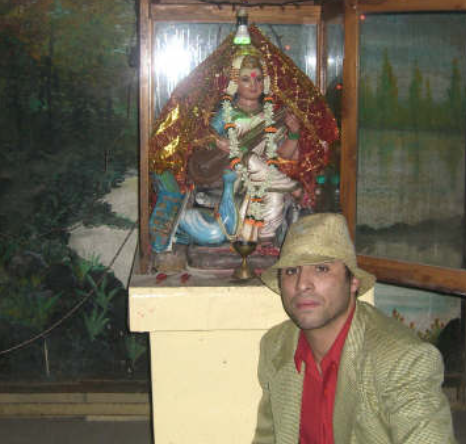
My protector goddess, however, seems to be Saraswathi. I was immediately drawn to her, sitting cross-legged playing the sitar, with my favorite bird, the swan, in the background. Turns out she’s the goddess of the arts & wisdom, which is kinda me really, & she’s quite hot too, the whole experience of which led to me penning the following sonnet;
GODDESS MINE
I fixt mine inner eye upon a star,
In darshan stood disturbing deity,
Lull’d by the tantric strains of her sitar,
This purest drop of goddess flew to me
Upon a swan of hue ambrosial,
Her fertile smile still’d time, her luted look
Consorts my heart – sublimely cordial,
She read from the Pustaka’s sacred book;
“Wand’rer, welcome thou art to India,
This sari I have sewn know as thy guide,
Where e’er she willows there stay close behind!”
She closed the page, sail’d high skies to Brahma,
Performing blissful duties of the bride,
Rare have I seen such beauties in my mind.
I then tried my first proper Indian food & tuck’d into a thali; several mini pots of curry + rice bready things, all for 40 rupees (60p). The money is mad; I got 5000 rupees all in fifty notes & feel pretty loaded. I then went down to the beach and somehow ended up renting an elderly ‘friend’ for a hundred rupees (about a pound) who told me where all the Bollywood stars lived (basically pointing at random houses and saying the name of a random Bollywood star). He then took me for a ridiculously cheap & exquisitely hot curry in a kind of shack cafe on the edge of a shanty town call’d Dharavi, made famous by the recent film Slumdog Millionaire. His chat was disturbing, all about his childhood in 1947 when at the dawn of Indian independence, he watched Hindus massacre Muslims in the city streets.
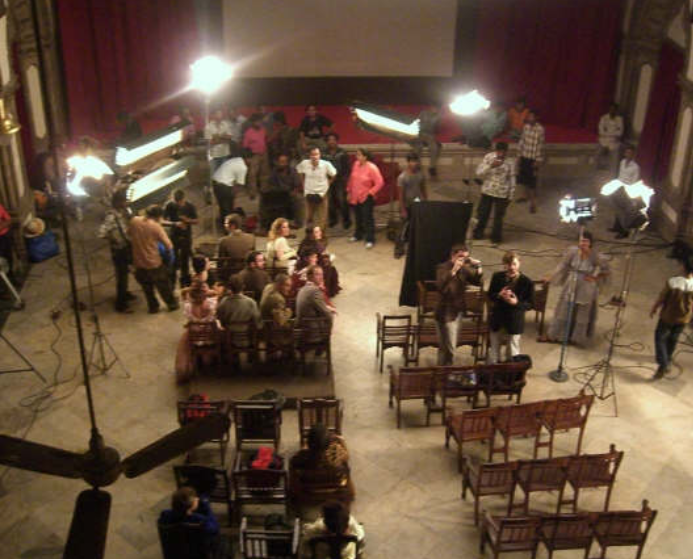
On my way back to the hotel, I visited the Asiatic Society’s Library. A splendid old, white building which still uses cards to catalogue its books. It is also full of life-size, marble Graeco-Roman statues of not very famous Britons, who had all been involved in the Empire. It reminded me that India is a land of opportunity, the essence & energy of which exploded upon me that very evening. I was just about to chill out for the night, y’know, catching up on some sleep, shake off the last of my jet lag, when I was approach’d in the street by this fifty-year-old English reprobate, all long hair, criminal-slouch & drug-abuse-strained drawl, who goes ‘do you wanna be an extra in a Bollywood movie.’ Of course I said yes – I knew I’d regret it if I didn’t – & soon found myself on a bus with about twenty other young travellers spinning through Mumbai. At first, I thought it was like Nightmare on Elm Street 2, or Jeepers Creepers 2, & we’d all get slaughtered – but before long we were at this old English school, eating some wicked food & dressing up in Edwardian costumes. The women looked especially wicked, but apparently the silk arm-gloves itched & they were murder to get into. Anyway, the shoot took about six hours & we got paid 500 rupees to do it! All we had to do was sit in a big hall & be an audience. The film will be at next year’s Cannes festival & goes by the name of HARISHCHANDRACHI FACTORY. It tells the story of the first ever Indian filmmaker – Dadsaheb Phalke – who took his film to England where I would be in the audience!
Day 4
After about three hours’ kip I was back on the road, jumping the morning commuter trains out of VT station. My journey was relatively peaceful, but the grand tide of humanity passing by me in the other direction was mental – Indian office workers taking up every inch of room on the trains, inside & OUT!
On the outskirts of Mumbai I had to change for the Goa train, & met a Canadian who was going south too. We spent a couple of hours in the vicinity, chilling in a temple while swapping books & literary anecdotes. He’s called Danny, a nice guy, who looks a bit like Jim Morrison & was brought up in India at an expat school. Apparently, the weed he smoked there had been laced with opium, which helps to explain the otherworldliness in his ambience.
The Goa train came in & Danny took 2nd class sleeper while I took a first class carriage for about a tenner. The journey was pretty nice actually, about 12 hours of air-conditioned easiness, punctuated by hand-delivered hot meals, watching the monsoon-fresh greenery of middle-India pass me by. I was sat with these Catholic Indians; a violin player named Errol, his lovely wife & their eighteen-year old daughter who kept giving me the eye. They were fans of Alexander McCall Smith & were amazed when I told them that I used to live on Scotland Street… but were disappointed to discover there was no number 44.
At one point Danny found me & ask’d if he could hang with me for a couple of days. I was like sure mate, & we soon found ourselves at about midnight in sea-girt Benaulim, about two thirds of the way down Goa, at about midnight. Unfortunately, all the hotels were shut, so we ended up squatting a half-built villa for the night. A nearby guard dog had seen us & proceeded to bark its head off for about an hour & half – the last thing you need when you hadn’t had a decent night’s sleep for four nights.
Day 5
On waking up, the dog turned out to be a tiny thing (with big lungs), & Benaulim was a bit boring. We then shared a taxi to a place call’d Baga, where speedboats whizz people in parachutes high over the Arabian Sea & we found a wicked cottage right on the beach. The weather’s great – night & day – about 32 degrees in the mid-day sun, & thanks to a hairdryer/sirocco-like breeze blowing in from Arabia, about 25 at night!
I am staying next door to a cool Indian family, sharing their garden & toilet – which is in the middle of the street! The other streets roundabout are narrow, sandy & really serene. An old woman visits my patio with a fruit basket on her head, while a cheeky little scamster (who beat me at pool) will get me my food from the restaurant – for a small fee of course! Beyond my little domestic heaven Goa is better than its rep, believe me. Even tho’ I cannot drive I have hired the funkiest looking moped for 100 rupees a day & have been cruising round the sandy roads, listening to my tunes, dodging the cows & burning the straights. My petrol ran out on one occasion, so I blagg’d some from a roadside shack & headed for my pad in Baga. On the way back I pass’d my first elephant – all truss’d up in psychedelic garb, stomping his way thro’ the street. As for partying, there was a crazy taxi ride to a sunset techno bqsh in Vagator – reminiscent of the Hackney squat raves, but on a balmy evening & cool’d by a soft sea breeze. This was follow’d by a game of snooker with a mad Scotsman & a chill out with some Camden girls on a rooftop terrace drinking beer, listening to the tunes I just happened to have in my pocket – my first DJ slot in Goa! In a world full of comedy characters & cheap bear I felt that I had well & truly arrived at the party.
So, Goa is like Glasto, only more strung out – Glasto on bikes!
Day 6
I woke up buzzing & went for a walk along the coast when I penn’d the following sonnet;
THE EAR CLEANER
Stepping out one golden Goan morning,
Drowsy with the sunken sun’s adorning,
Content was I to be in nature’s hand,
Soul-freshen’d as bare feet sunk into sand,
From out of nowhere stept a wizen’d man,
“Sahib! cleaning your hearing well I can!”
Shows Western praises in his little book,
Black blocks of wax from both my ears he took.
I shook the hand that scrubb’d my hearing clear
Said fond farewells & watch’d him disappear
Round red & rugged hill flank’d by the view
Of Konkan coast careering into blue,
When first found I the profits of his fee
I’d never known how sweetly sounds the sea!

It was then time to head south, following the advice of the Camden girls who I’d been partying with yesterday. Apparently it’s even better down there. So, leaving Danny to the cottage – he was happy to stay – I caught a train to Canacona station & walked towards a place called Palolem. As I strode its long curvature of bar-lined luscious beaches, a huge smile broke out on mi face – this was proper paradise!
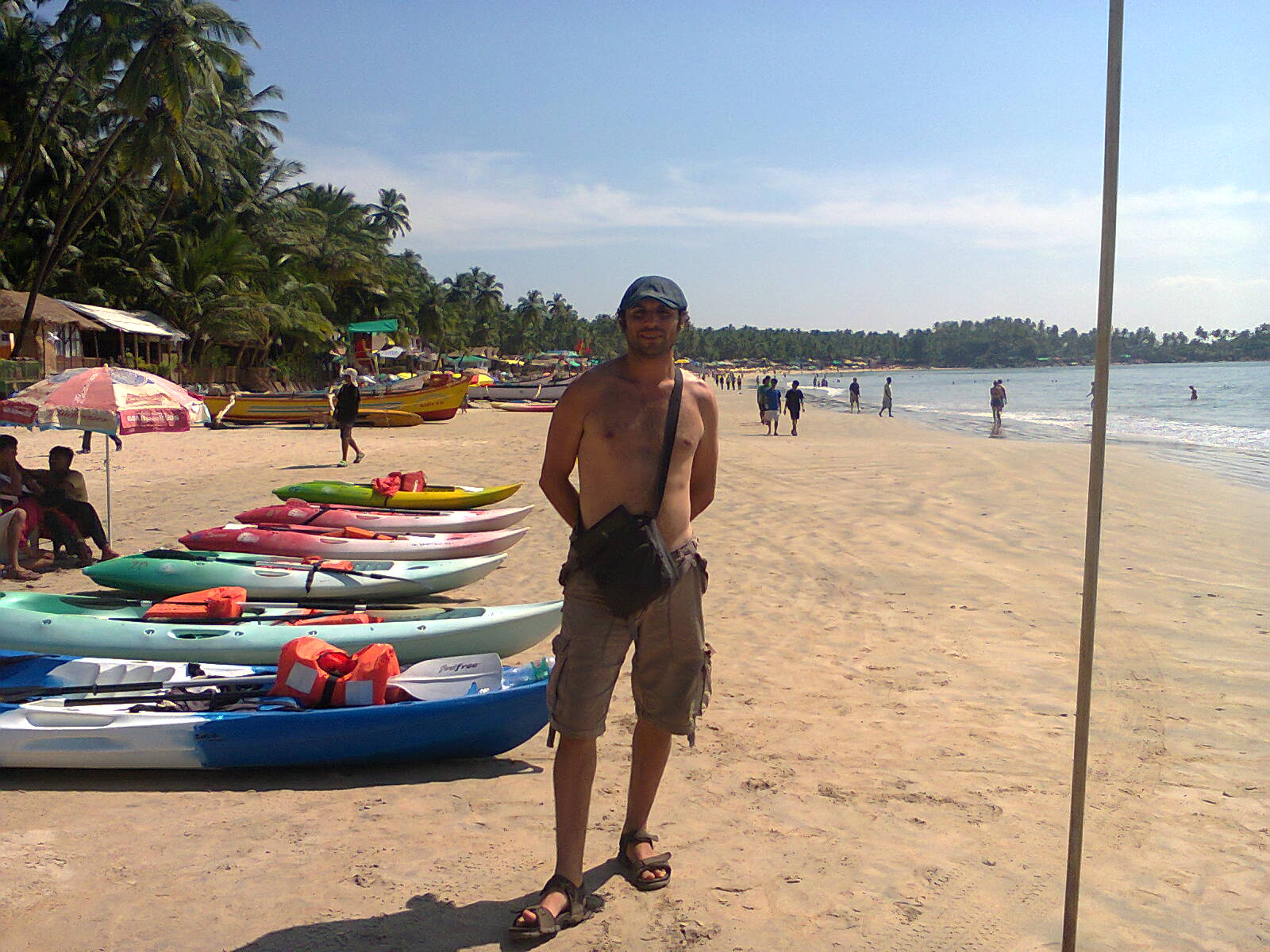
Taking a beach hut & a moped from a lovely guy call’d Dinesh, I’ve really enjoyed the area, buzzing about from bar-to-bar on my shiny green moped. The scenery is semi tropical, & South Goa is backed by these lush hills call’d the Ghats & its all very amazing to be here. Things got even better when that night Saraswathi parachuted me in a wee muse to help me in my work. She is a cute 30-year old journalist from Limerick in Ireland, & a woman of infinite patience. I got free beers for playing some tunes in a bar, & let’s say I was pretty steaming. That didn’t put her off though, & she kindly escorted me back to her 2000 rupee a night posh hut. Come morning I blinked myself awake to be met by, ‘Do you remember what happened last night?’
‘No,’ I replied sheepishly.
“Well, Damo, I woke up to you pissing in my suitcase, after which you knocked the window pane out of my door.”
There was a certain karmic irony to this, as back in the spring I’d gotten all high & mighty on mi drummer, after he’d smashed a similar pane of glass in Cagliari, after an argument with his girlfriend over whether he could take the local stray street-cats home. In this instance I was just clearly pissed, for which I apologised profusely, did some cute kissing & shit & seem’d to get away with it.
Day 7
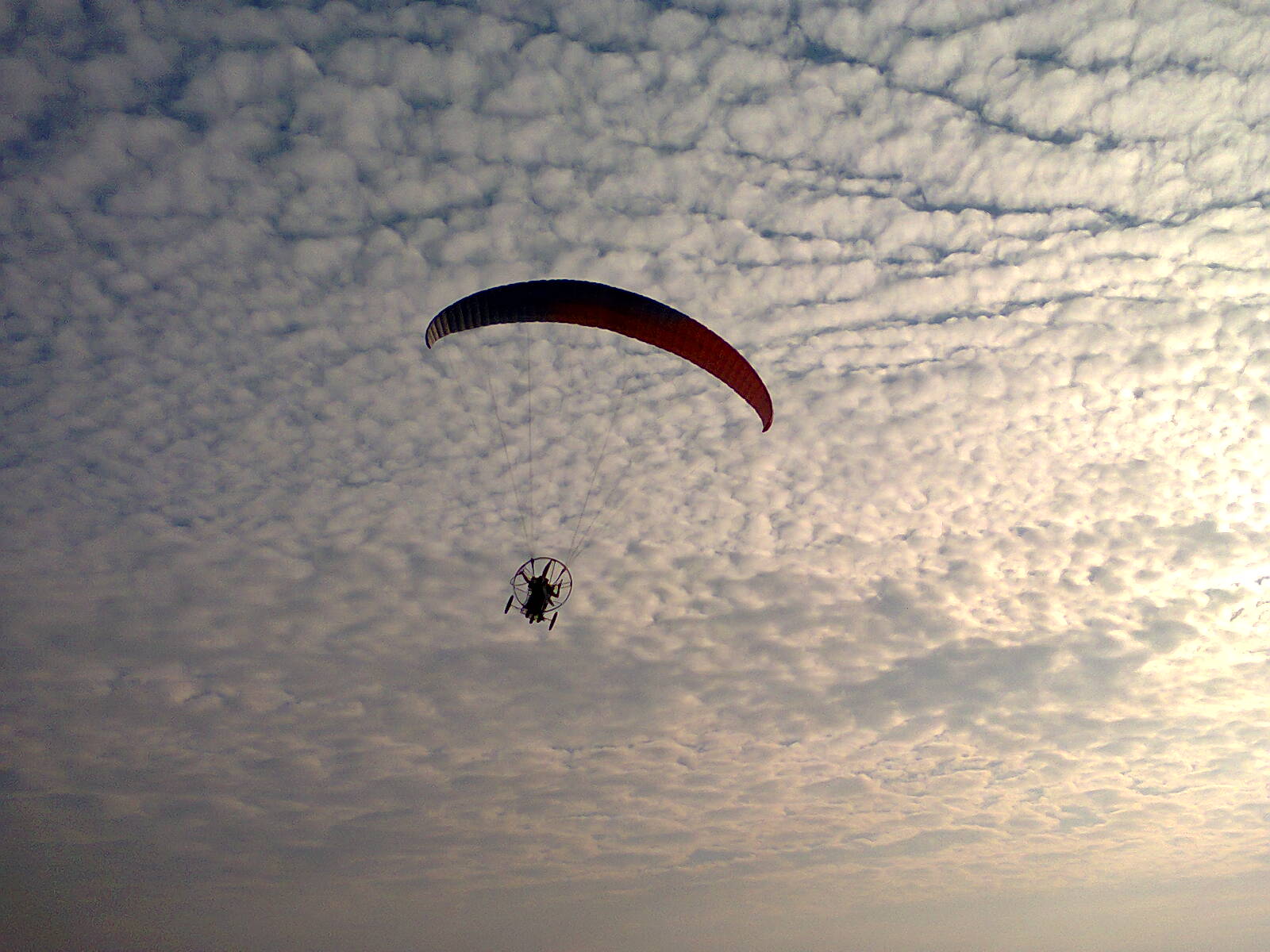
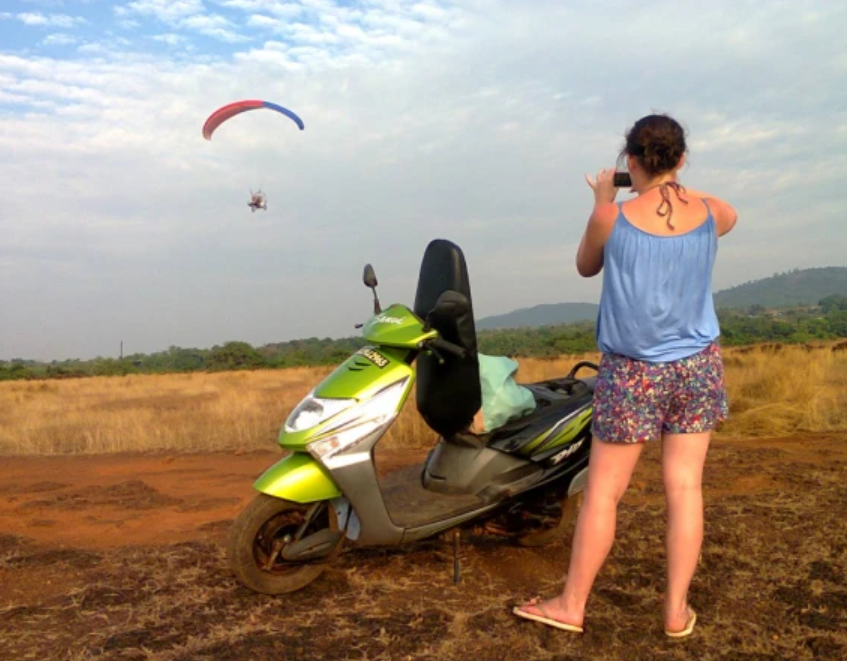
After apologising to my new lady friend, the rest of the day was quite Eat Pray Love which seem’d to make up for my nonsense the previous night. First port of call was Kola beach, a lovely spot at the end of a terrible road, with wild waves & a freshwater lagoon to paddle in. After this we continued north to Cabo de Rama, an old Portuguese fort with splendid views of a miraculous bay, at the other side of which we observed a restaurant clinging to the cliffs. Driving out there, we passed a mad Russian flying a three-wheeler wheelchair-paraglider, & then just as the red sun was dipping below the clouds, we walk’d along a practically deserted beach to reach the restaurant. So romantic! Cue fresh fish & wonderfully warm sensations of having a lovely time at a place called, appropriately, ‘Mi Amore.’
We drove back a good hour thro the night, accompanied by the constant chorus of chirping insects, cutting thro swathes thro moody junglerie. Then, back at Palolem, we drank wine on the beach, ending a perfect day in the horizontal fashion in a tired, but the happiest of glows. It was to be our last night together, alas, for she was heading to Thailand the next day. Our liaison was brief but beautiful, & yeah, I’m fucking loving India, me!
Robert McLellan Poetry Award 2022
Arran Community Theatre
Lamlash
August 27th 2022
On the very last Saturday of the Edinburgh Fringe, 3 weeks after my first of far too many reviews there, I found myself culturally convalescing on my home island of Arran. Looking at the listings as one does in the dog days of summer, I suddenly noticed the Robert McLellan festival was in full flow. My pal lives next door to his idyllic white cottage at High Corrie on Arran, & it is not hard to figure out why he was such an important literary artist to Scotland, so inspirational is that scene. I personally find his dialectical Scots even harder to penetrate than Burns – but I did crack the latter after 6 years of living in Scotland & I’ve only been on Arran sixteen months, so let’s give that one time to gestate.

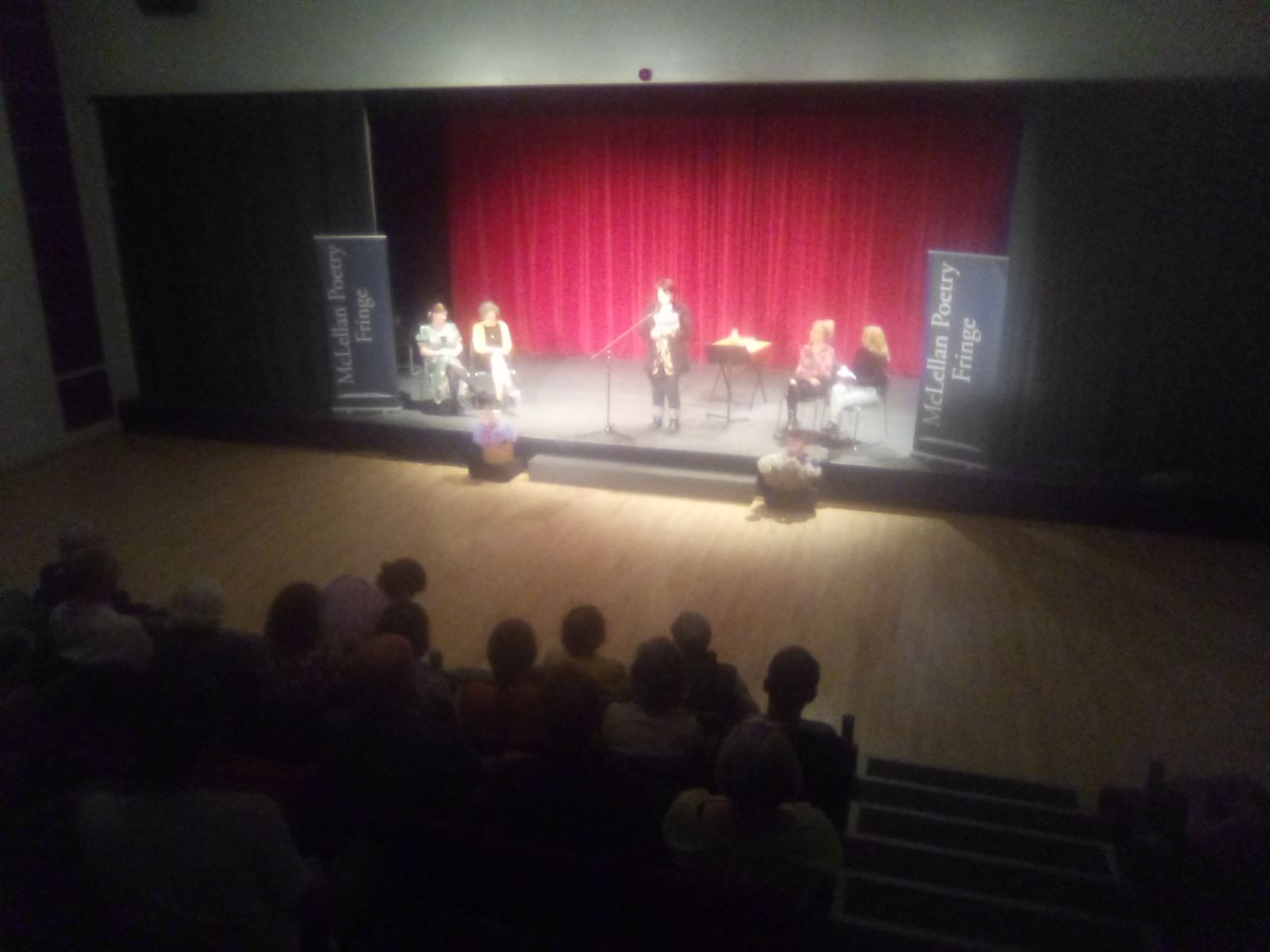
So… to the poetry prize given in Robert McLellan’s honour, the fifteenth in succession. A hefty whack of cash goes to the winners, & it was ‘awards night’ last night. The winners were to be announced after Hollie McNish had chosen the ‘best’ from a shortlist of 114, whittled down to 8, the finest quintessence of this year’s seven hundred entries. These had trickl’d & thunder’d in from all over the world, & there will be a comprehensive awards night on Zoom later in the year to celebrate the victorious pantheon. Yestreen, however, saw two of the ‘commended’ poets & the winner all poised to perform on stage, all female, & all clearly serious agents of the ancient art of poetry. Of the ‘commended,’ Penny Shutt gave a rather prosaic poem about her crush on an English teacher, while Morag Smith endear’d us all into an internal exploration thro’ her poem call’d ‘Lost.’

Our winner, Annaliese Broughton, from not faraway Ayr, is currently in the ascendency. A poem of hers, New Meanings, is being animated by the BBC, & fangirling (her own expression) next to Hollie, she nervouslessly took the stage & deliver’d the prize poem in that orphean pitch that lies somewhere between the common tongue & the discourse of the gods. A gritty, edgy & heart-warming epistle to child poverty, it resonated even more in such a middle-class enclave as Arran.
After our three poets had left the stage, they were replaced by the recent gregarious joint-winner of the Edwin Morgan award, Michael Mullen – a fellow Rutherglennian like Mr Morgan -, oozing confidence, & a poet of some substance as he bounces toxic masculinity of his kevlar-armour’d bardic brain. As an award-winner he wryly asided something along the lines of, ‘I’m an award-winner & can read out what I like now,’ & continued to do so, excavating his oeuvre for some proper classic barb’d wire down the brain, but in what felt like couplets of heptameter & Sanskrit sloka. ‘Sad Boy’ was well good, especially. I could definitely tell how his talent first brought him to prominence.
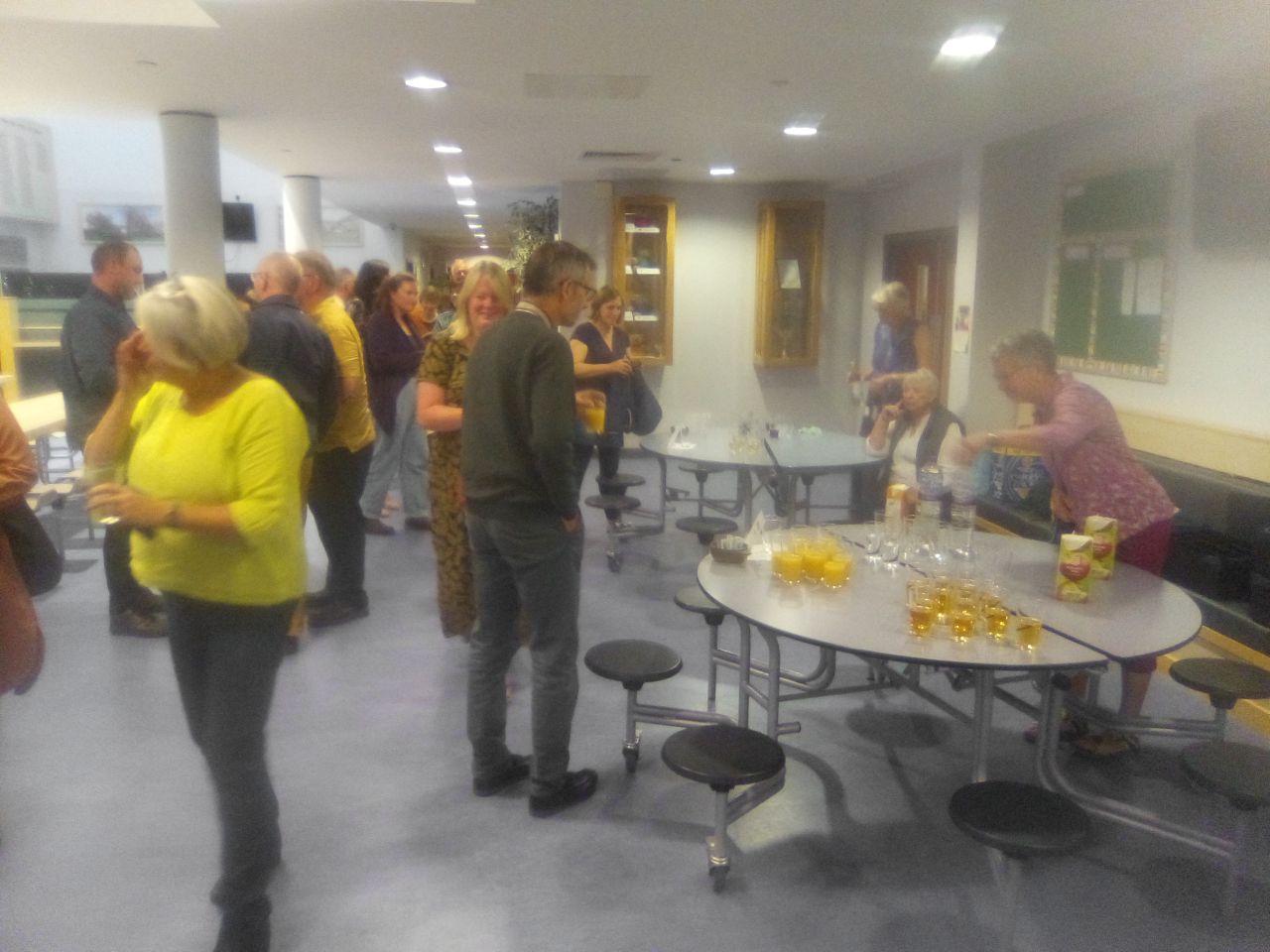
It was now the interval, & the wine was on donation in the Brodick High School, where Arran’s fine community theatre resides, but as I enter’d the day’s twilight I was suddenly struck with the will to walk home & chew the ambrosial morsels I’d just ingested on a hike back to Brodick. I’d already travers’d most of the route on the way to the show earlier on. Burnley had won 5-1 at Wigan & in such a supremely happy mood I thought let’s get all poetical on the day’s ass – & hiked off up the hill to Lamlash. I veered off at one point, found a Pictish stone I’d never seen before hidden in a gorgrous forest clearing (how Arran), got stuck in a bog – which was luckily dried out it being quite droughty these days-, then dragg’d my way through prickly thorn-bushes (why did I wear shorts?) onto the Lamlash golf course & the safety of the main road. Sweeping my legs for possible sheep ticks (why did I wear shorts?), I realised I was now in quite a receptive mood for the poets once I reach’d the school. In fact I was mad for it.
The way back was much more convivial, fired up & fuell’d by the spirit of poetry, & with the dwindling twilight never quite striking blackness I made it home in time watch Burnley’s highlights – yet more poetry, especially the second goal -, then took out a copy of Attilio Bertolucci’s ‘The Bedroom’ & drown’d myself in the Italian language. I can darely say, after three weeks of reviewing the Fringe & my very recent isit to the 15th Robert McLellan Poetry awards, my own poetry mojo is back!
Damo
Edinburgh International Book Festival 2022
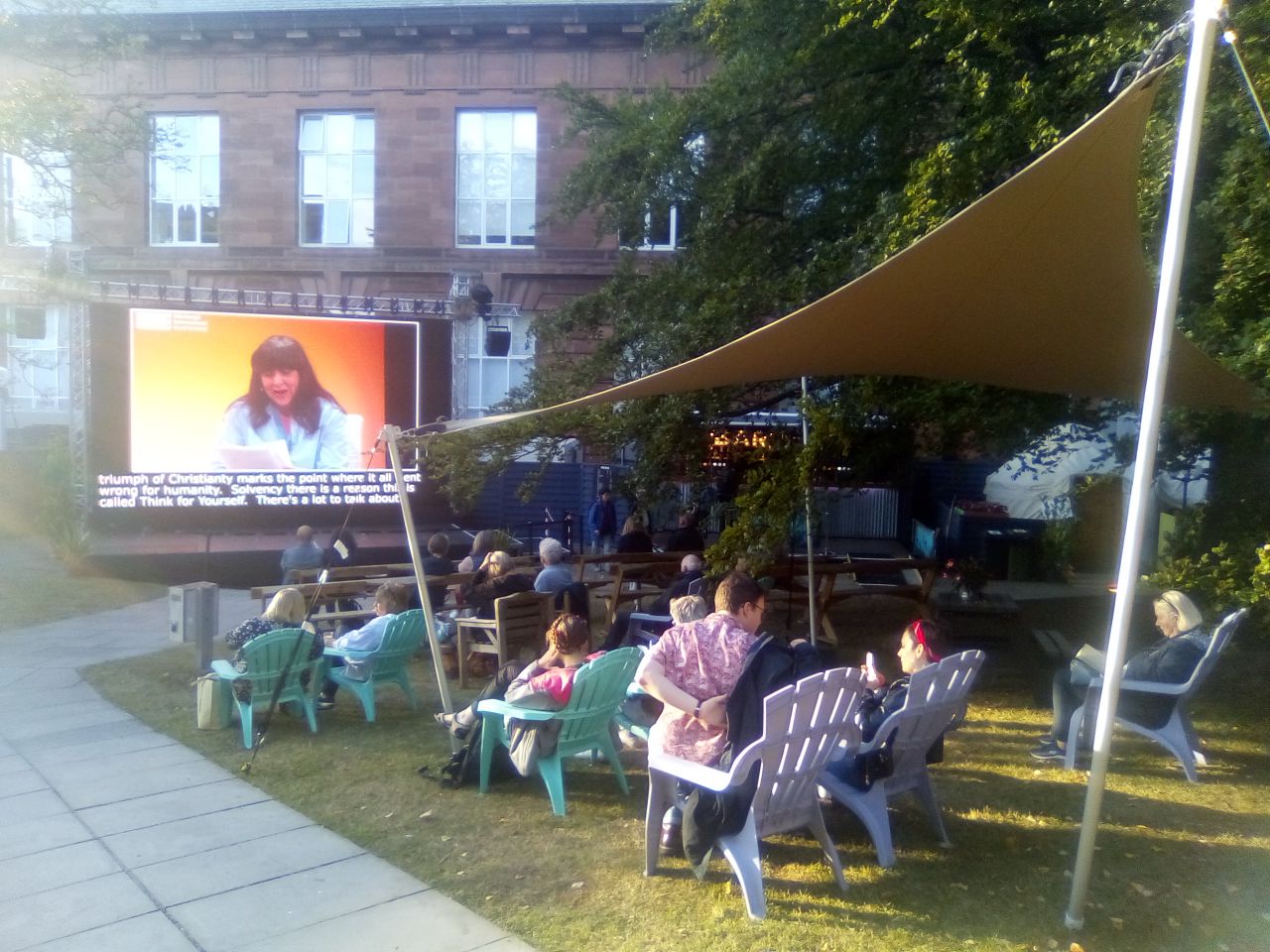
I am now on a train heading from Glasgow to Ardrossan, returning from Edinburgh for the third time this Fringe. I have been reviewing, quite fastidiously, the Fringe festival, in the middle of which I visited the Edinburgh International Book Festival twice over two days for my annual pimms & poetry session.

It began more than strangely for we were no longer in Charlotte Square, on the grass, under the grandiosity of the New Town. Instead we were tuck’d into the grounds of the Art School for a different, but interesting alteration in the vibes. The theatres were now in the old lecturing halls, or whatever the spaces were used for in the throes of academe.
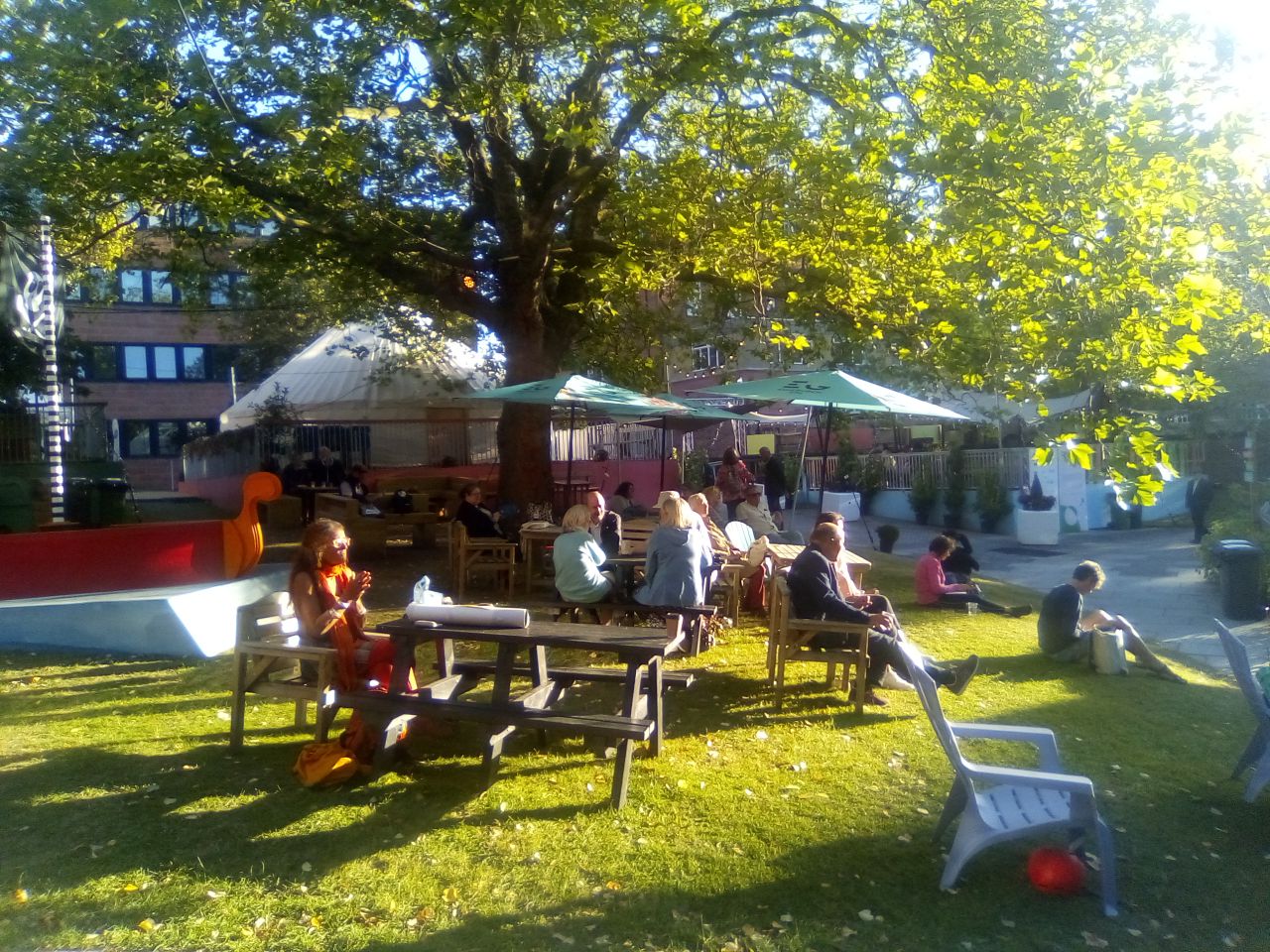
A new factor was the open air big screen, open to the public for free, which streamed a steady supply of online chits & chats, while the main events were also available online – the festival is now truly living up to its name.
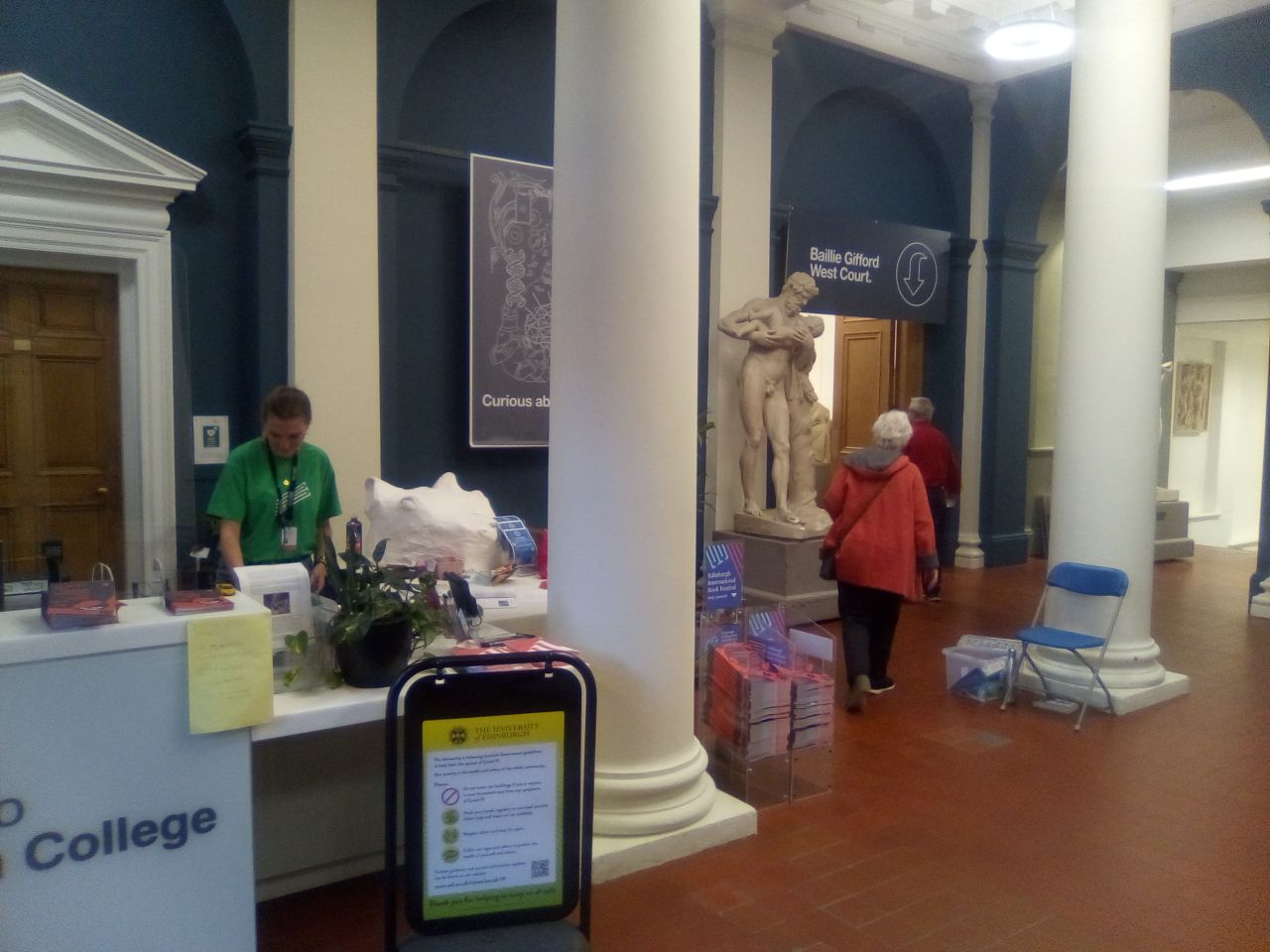
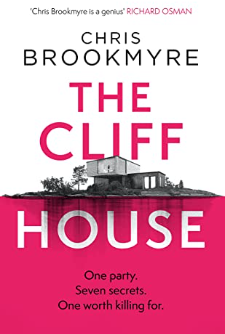
I saw two talks of over the two days – a small slice of the 550 authors that were heading to Edinburgh. The first was Scottish thriller Tsar, Chris Brookmyre, talking about the Cliffhouse, his new book set on a Scottish island where every member of a Hen Party are sitting on potentially deadly secrets. It was lovely to hear him read a section, filling the chit-chat patter of partying women with a naturality that belies his sex.
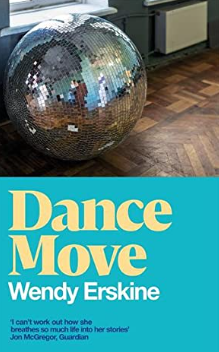
The next day I spent a delightful hour with Northern Irish short-story writer, Wendy Erskine, whose Stories of Belfast was an hour of praising the short story as a vital form, & also a chance to explore some of her second collection, Dance Move, full of modernity & magic, & of course Belfast.
It was great to be back at the Festival, I had a couple of nibbles, & next year I’ll be knee-deep in it all. A highly successful & enjoyable scouting mission to the Edinburgh Art School.
Damo
The Death of Shelley: Bicentenary
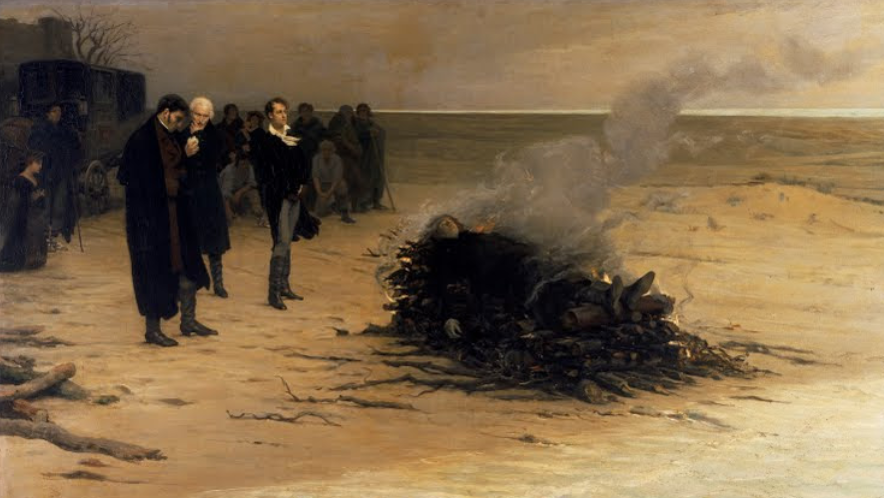
Being an account of the Drowning of Percy Shelley
July 8th, 1822
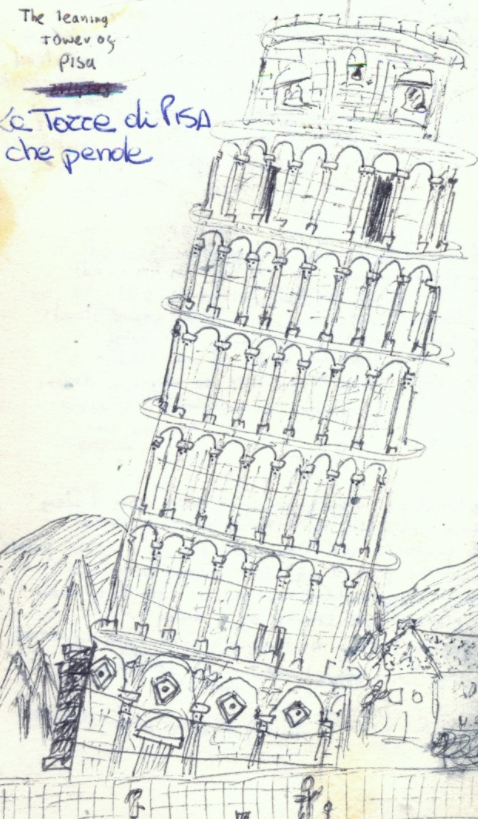
The sticky noontime heat of the month of June moves,
Trails rainbow shimmers glimmering in sommer’s honey’d air,
Baking the clay-caked walls & the rouge-blush’d rooves
Of Leghorn’s sleeping house-huddle, nestle’d seaside fair,
The simple clip-clack of the cart-horses’ hooves
& the fruitsellers fly-whip disturb the dusty square –
Yet see amidst the hazy mist of lazy lethargy,
Down by the docks, a busy lot, lock’d in activity.
Each is a stranger to these sultry lands,
Drawn by th’eternal sommershine gold,
Hunt unravels the main sail, wipes his hands,
Williams disappears into the hold,
& by two local Polizie nobly stands
Trelawney, like some arab hero of old,
“We’re ready to sail!” Shelley shrills in delight –
Above hover seagulls in vulture-like flight.
Trelawney & Hunt are refused this tide
A local lad swells the crew to three,
From steely moorings the ropes are untied,
The boat slips sheepishly into the sea,
Tween th’oak beam’d berth & the stout ship side
Friendly farewells part this good company –
Thus as they go gliding oer wide, rolling realm
Sheely strides proudly to master the helm.
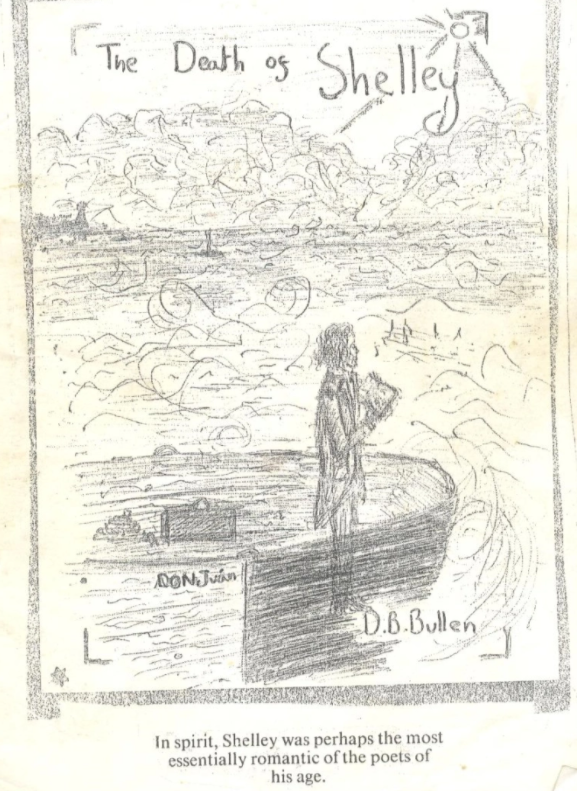
The mainsail puff’d proud, a mountain goat’s chest,
Thro the tall, wall’d docks that serpent-lock the sea,
Past the citadel that rests, maternal lioness,
& the snail-paced, sail-graced fuggazi
They cruise, til alone, two views to digest,
Serene on the green twinkling tranquillity;
The empty nothingness of the nautical line
& the ever dwindling narrowness of Leghorn behind.
The sun blasts vermeil rays as Viareggio passes by,
Beyond stand an ancyent row of volcanic antiques,
A brotherhood of mountain kings to touch the Tuscan sky
Clothed in piny forest robes & crown’d with cloudy peaks
Silent as the nymphean sea where Naiads go to die
Thro the vivid, velvet blue the sailboat ploughs & creaks
Now Shelley’s eyes rest on the wide horizon’s ochre shine,
Where looming black, doom-laden clouds have grimly fill’d the line.
With the might of many armies the storm-swept seas came,
Trumpeted in thunder by Zion’s cymbal crash,
The Ariel pierc’d by slashing arrowheads of rain
As fierce, charging cavalryman’s flashing lances slash,
The crew engaged in battle tho they battle now in vain,
For thro the splint’ring ranks of planks pours the deadly wash –
Cries Williams, “Dear Percy, for sure we all must drown!”
Now words heard in reply, just a curt & curious frown.
A spiral whirlpool flows at he center of the tempest,
What swirling wall of water – into a hand it grows,
Crushes the poor Ariel within its liquid fist,
Each smash’d-up piece of broken boat flies thro the sky like crows,
Into the air, with streaming hair, Shelley spins with a twist,
& leaves behind two helpless cries as the wild wave throws
Him hard into the churning foam of violent, ridg’d expanses
Now Shelley shall find Heaven in just seven lonely stanzas
Lone, all alone with the sublime cold
& the storm-adorn’d view of the jaded lime
The thirsty sea takes its icy hold
So close to the end of a young man’s time
Whose last living moments shall slowly unfold
Forever engraved on a true poet’s mind;
Above the emerald empire, where with a ducking motion
& the expectancy of death he is suck’d into the ocean.
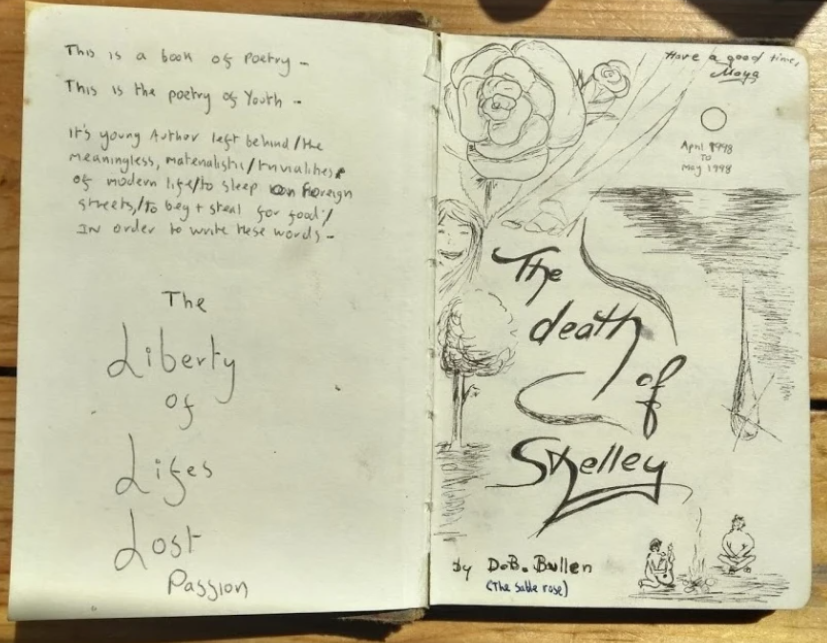
There dwells a special peace ‘neath the underswell skies
No more by the storm-blast batter’d & bruis’d
A whispy green mist overfloweth the eyes,
He swears he sees the shape of his dear, departing muse
So his heart, for the last time, sings to seize a prize
With effervescent energy his essence is enthused
For from this faerie offering the fires of poesy’s blissdom
Fuel the thoughts that crown his short life’s search for truth & wisdom
On the strength of a swan’s dying song he shall draw
Bends his long legs like the strings of a bow
Extends their full length with a kingly roar
Thrusts through the scene as a singing arrow,
Like a champion of war, blood-soak’d & drench’d in gore
He bursts fits first through the Earth;s drifting flow
Thumps’ through the air in triumphant defiance
His lungs drawing deep in an age-old alliance!
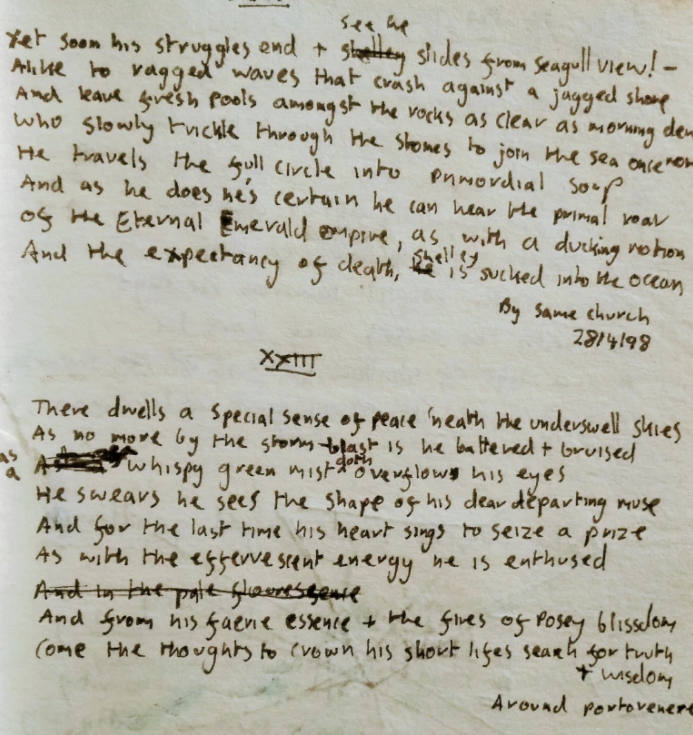
In solitude, alive, upon the wave highest,
Viewing a crack in the black, cloudy dome,
Towards him a bright shaft of gold gently flyest,
Starbright sign of the flight of the storm,
As he sinks, inch-by-inch, the sweet heaven sighests,
His curls flow unfurl’d on the crest of the foam,
As into the deep sea, quite calmy, he slips
Dissapearing… arms… wrists… palms… fingertips…
“What is death, but the final gate
That bars the fair path to Paradise,
Unless a life was consumed by hate,
Eternity, then, is not so nice
Still, we all walk to the whims of fate
& time is measured on chessboards of rice!”
Thinks Shelley, now ready for the fond farewell
To life’s precious breath – death, Heaven or Hell!
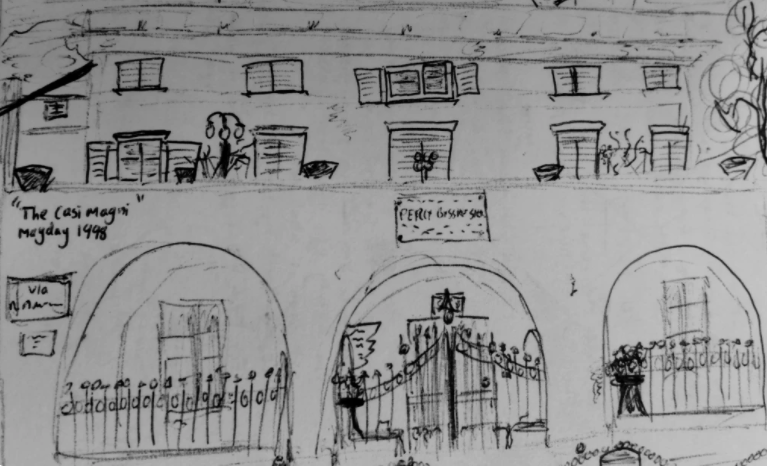
He drifts forlornly to the deep
Slowly onflowing the serene
Land of slumbers, as asleep,
His spirit shifts into a dream
Death’s pale shadow’s ghastly creep
Man’s soul’s aura’s ghostly sheen
Bright luster fading from the eyes
Then gone, as the one we call Shelley dies.
Upon the twilit, silent surface ropes & timber glide
Flotsam & Jetsam, whose presence bears the proof
Of three romantic sailors taken by the Tuscan side
This day has lost a poet to the dangers of his youth,
Through the dusk descending walks the Dark Knight’s bride
Lady moon enflows her starry dress across the roof
Night draws the seven hues from the air, the land, the sea
Then paints the wider world with such a wonderous ebony!
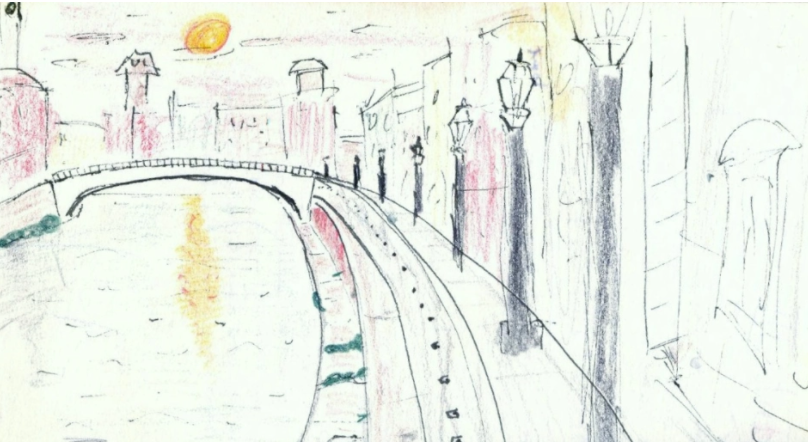
The River Arno is a gentle thing
As it makes his way from the Florentine
Hills, & is clean & as fresh as Spring,
Being bless’d with a music soft, serene,
Like the chorus of church bells that ring
Out over an evening Pisan scene,
Where sits Lord Byron, sketching the sunset,
In thoughts for a friendship he’d never forget.
As the stars rose above his verandah
He solemnly look’d on the sullen moon,
Allow’d his clouded mind to meander
Upon a poet’s death, all too soon,
Beneath lay the makings of a great stanza,
But quickly he lost this Aeshylean boon,
For dowsed was the muses’ mysterious flame
By a man down the street, running, calling his name.
Twas Leigh Hunt who came on O so fast,
Bringing bad news to below Byron’s window,
“By George, George, we have found him at last,
Wash’d up on the sands of Viareggio,
The anxious waitings of these ten days pass’d,
Bears sad fruit as his fate we now now!”
“Very well,” said his lordship, “We sleep here tonight,
Then tomorrow we rise & ride with first light.”
Onwards, onwards, onwards rides the plot,
Soon all of the players shall be in their place;
Past the hovels of Viareggio two horses trot
As tho’ drawing a hearse at a funeral pace,
They reach the long beach, ever humid & hot,
Today the sands lie like a dead, desert waste,
Then stride to the side of the shimmering sea –
Awaiting with handshakes is grim-faced Trelawney!

In the minute of which a lonely lifetime lasts
The swollen sands are stack’d into a heap,
Hunt stands agape, Byron stands aghast
As Shelley is unslumber’d from his sunken sleep
In horrid exhumation! his life’s light has pass’d,
Leaves a crack’d & blacken’d corpse where rotting flesh-things creep,
“Is – is – that a body?“Byron whispers, bleeding white,
“Aye!” sighs Trelawney, “Tis not a pretty sight!”
With quickening quiet comes the onrushing roar
Of the hush’d seawashes in violences,
Shelley’s featherlite frame two young brutes bore,
Carried to the pyre amidst silences,
& crown’d! Hunt begins to over him pour
Frankincense & other oily essences –
A poet soon burning upon the gutted gyre,
His soul to the stars, his body to the fire.
& so, a poet’s death, a deepfelt, tragic thing,
Enough to rouse Apollo from his dusty throne,
With waking, honour’d horror I am shaking as I sing,
For one dark day this grim event shall be my very own –
& wonder whether my demise inspires a flowering,
Or be a fading epitaph upon a jaded stone?
& what did I learn of my musing on death –
This life is too special to waste precious breath.
Damian Beeson Bullen
Composed 1998 whe he was just 21
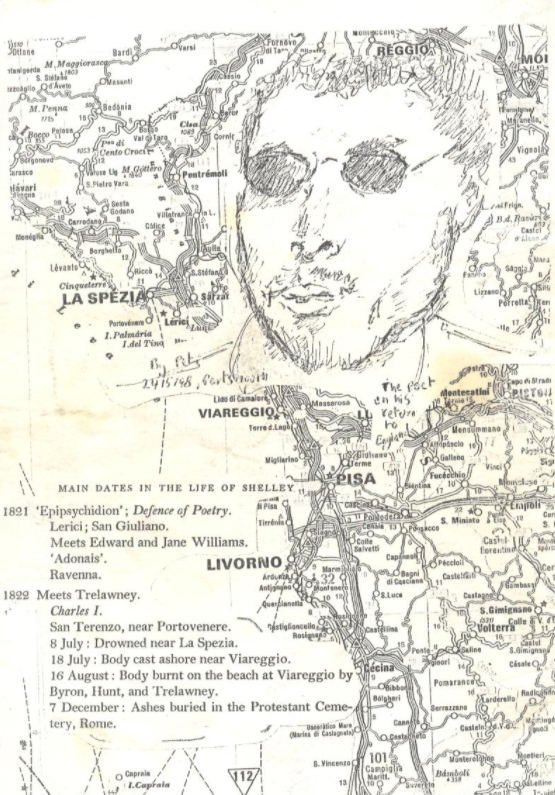
SEEING SALLY CINNAMON Part 1: Westenders {to} Love At First Sight
Serializing Damian Beeson Bullen’s
SEEING SALLY CINNAMON & THE SCENTED SUTRA
WESTENDERS
Twas a quintessential English evening
All about town & the capital’s core,
On my arm a wonderful flutterling,
Perfectly amenable to the tour.
We met in a wine-bar off Trafalgar,
To delve within a cosy eaterie,
Then took our places at the theater
For the Mousetrap’s befuddling mystery.
O! The night brimm’d a goblet romantic
& our spirits, yes, they sparkl’d as the stars,
Rosie was a gentle alcoholic,
Floating, flirting, thro’ her favorite bars;
When to the chimes of Big Ben’s booming bells
We jump’d the last train down to Tunbridge Wells
ROSIE’S SCHOOL RUN
OH MY GOD! I’m having a nightmare,
Fuck, look at the fucking time!
“SHUUTTT UUUPPP!!!”
The kids are doin’ my head in
With their school-stuff everywhere,
“Here’s yer shoes, here’s yer socks,
Heres yer fuckin’ sandwich box!”
“MUMMY… don’t swear!”
OH MY GOD! Its ten to nine now,
& my car-keys JUST AREN’T THERE!
Will it rain, will mum call,
Will I end up on the dole
O MY GOD! Its five to nine now
& the traffic’s hit a WALL!
THIS IS MY COUNTRY
Good Morning Great Britain
Still great, still Britain
The sun is shining, 10:45 AM
£296.26 pence in my pocket
Time to bet it all on black & hit the road again
If time is a mere scratch & life is nothing
& nothing that occurs is of the slightest importance
Aberdeen to Birmingham, Arundel & Deal
Dullis Hill to Rotherham, Bristol & Peel
Inverness to Liverpool, Leeds & Palmer’s Green
Lewisham to Padiham & all the pubs between
Badminton to Twickenham & Barton-in-the-Beans
‘Til my bardic breath expires
This is my Time, this is my Rhyme,
This is my Country!
TRAINING IN THE ART OF FARE EVASION
The Fader Code
1 Remain alert
2 Always keep your cool
3 Trust your instincts
4 Never show your money
5 Know your stations
6 Another five minutes won’t hurt in the loo
7 Know your enemy
8 Know your postcodes
9 The train’s going there anyway
10 When in doubt, clout
11 Trains always comes when ya skinnin’ up
12 It is every Fader’s duty to baffle & confuse
13 Always remember your free cup of tea
14 No need to rush unless you’re being chas’d
RECOLLECTIONS: FIRST KISS
Partridge Walk, Burnley
I was a six-year-child when first I felt
My soul entwining with the fairer sex,
Em’rald-eyed neighbor, who, one starry night
Said, “Have you ever kiss’d a lass before?”
“Of course!” I yelp’d, but grandmas do not count
& as we kiss’d she giggled at my lips
Closed shut & clamp’d by frigid innocence,
& said, “No, not like that, ya kiss like this!”
& show’d me how my mouth should act a fish.
Soon sprinting home, embarrass’d at the deed,
That never was repeated I believe,
For looking back, I was, in tender days
Contented with the kisses of grandmas
& nee-owwwwing with little Corgi Cars.
PAISLEY
I’m cringing every time I see a garish Paisley tie,
I’d just popp’d hungry into Greggs a hottish pie to buy
& chose a steak & kidney offer’d up for ninety pee,
I took the pie, she took the change & said, “It’s ninety-three!”
I said, “Love, that’s false advertising,” stormin’ out the door,
But never mess with Weegie Birds, they’re all fuckin’ hard-core,
& leaping from her hum-drum she pursued me down the street,
Looking as if an earthquake were shaking a slab of meat,
& panting now beside me squeez’d the pastie from my hand,
Smugging with satisfaction at her petty jobsworth’s stand
& turns her tail in triumph, as back to her shop she skips,
You coulda balanced ninety-three bridies on those fat hips,
Then looking down on what was left, my skin all bruis’d with mince,
I thought I’d catch the first train out – ain’t ever been back since!
LOVE AT FIRST SIGHT
Being virgin to Eros & his sighs
Spectral seconds attend the growing soul
Hearing a lute-string’d aether-breathing call
I turn’d to see her star-wreath’d, lustful eyes
My eagle-lashed, Latvian poetess,
My pearl-eyed raven in her Persian dress,
My Spanish pea-hen spangling as she comes,
My nude Numidian banging djembe drums.
Like mountain men & archipelagos
Or young sweethearts sniffing a first red rose
Like money men glimpsing a glint of gold
Or distant kin returning to the fold
Long time, for this fair moment, did we wait,
Which two sure hearts attaches into one,
& felt us fair as fairly dealt us fate
As, with a gasp, we match empyrean!
We are the music of the finches green
We are two pussies purring by a fire
We are the fragrance of a vernal scene
We are two frogs full throated with desire
We are the thistle of your bonnie land,
We are twa rabbits sprinting cross the glen,
We are the seaweed strewn across the sand,
We are twa badgers snuggled in their den
Like songbirds witnessing the world’s first dawn,
Or proud parents cooing their babe’s first yawn,
Like virgins witness to the breast exposed,
Or an exploring of the always closed,
We are morning in the Tuscan enclaves,
We are night on the Sea of Galilee,
We are swans a-gone gliding between white waves,
For we are one in nature, you & me.
Indiana Byron
From the Travel Epistles of Damian Beeson Bullen
Two weeks in Thiruvanamalai, Tamil Nadu
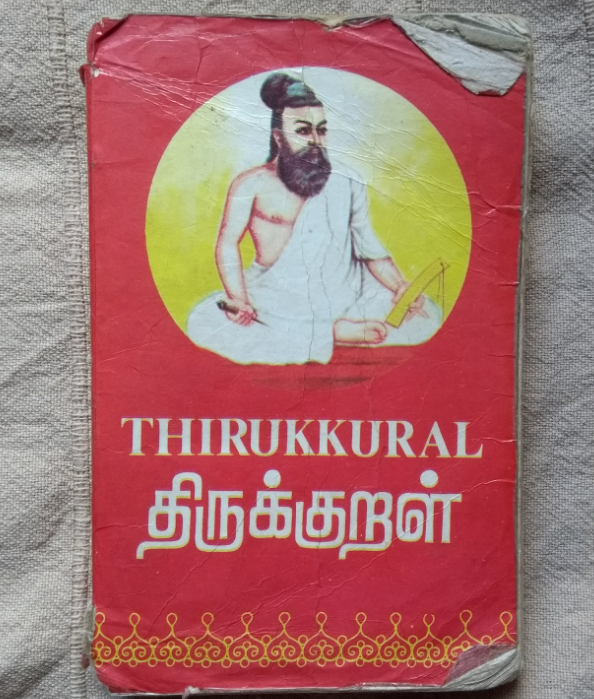
I’ve finally made it to Tamil Nadu. Seven years ago I picked up this book of sayings called THIRUKKURAL, written by the Tamil saint, Thirruvalavar. Since first flicking through the book in an opium induced haze in a dodgy Madurai hotel, I have always intended to to render a poetic English version. So, here I am, finally starting to do it all on a hotel balcony overlooking the main chaotic drag of Thiruvanamalai. Below me there are tarmac layers vying for road space with rickshaw on rickshaw as the gridlock inches closer & closer to wherever the fuck it’s going.
Yesterday morning I was still in Gokarna. I’d spent a whole week in ‘Paradise,’ but I reckon the brain begins to turn to jelly after too much bumming about on the beach. It was well wicked though, boating from beach to beach & eating some fine cuisine in the the wave-lapped restaurants. The forests above the coast were also lovely, & I saw my first ever Kokava’s… crazy white heron-type birds that follow their chosen cow/buffalo everywhere, nibbling on the insects that nibble on the cows. Here, both bird & beast come across as a perfectly happily married couple.
Leaving Gokarna involved catching a sleeper bus to Bangalore – an overnight journey of 12 hours that tossed me into the air every time we hit a bump – even the bottle of whiskey & two valiums couldn’t keep me asleep. This was cool, though, as it let me watch our entrance to Bangalore. Honestly, I’ve never seen so many trucks, lining the roads for about 3 miles on the western approaches to the city. I got dropped off into the heart of Bangalore at rush hour (about 8am), where many a western clad youth was hurrying off to their call centre work. Bangalore is the principle centre for telecommunications in India, nick-named the notorious ‘Silicon Valley’ – & odds on when you get an Indian callworker in Britain they’ll be based here.
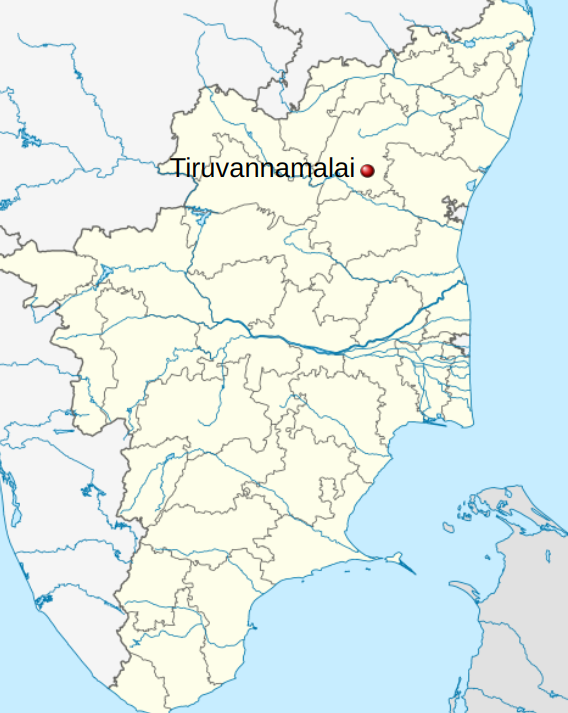
I don’t know how I did it, but somehow I managed to find a bus out of there… there were several bus stations & about a million buses to choose from, with mine sweeping me over the state border & into Tamil Nadu. So far, TN seems to consist of a verdant flat plateau, interspersed with solitary bouldery peaks – remnants of ancyent volcanoes. One of these pointy rocks is the Annamalai hill, beneath which Thiruvannamalai nestles. It is a very holy place & its temple is huge. I’ve booked into a cool hotel (Hotel Ganesh) for a week or so – taking a single room for 125 rupees (1 pound fifty). Downstairs is a restaurant where I get my Thali (a mixture of dishes) served on a giant banana tree leaf. Makes sense really, perfectly bio-degradable. The hotel owner has also agreed to help me with my translations of Thirukural – it’s basically the Tamil Bible – & the reception on mi telly is wicked for the weekend’s footy. I think staying in a madcap town off the traveler’s trail is gonna be a nice way to get used to Tamil culture, seeing as I’m kinda stuck here now for the winter translating this obscure fuckin’ poem.
Thiruvannamalai
18 – 11 – 08
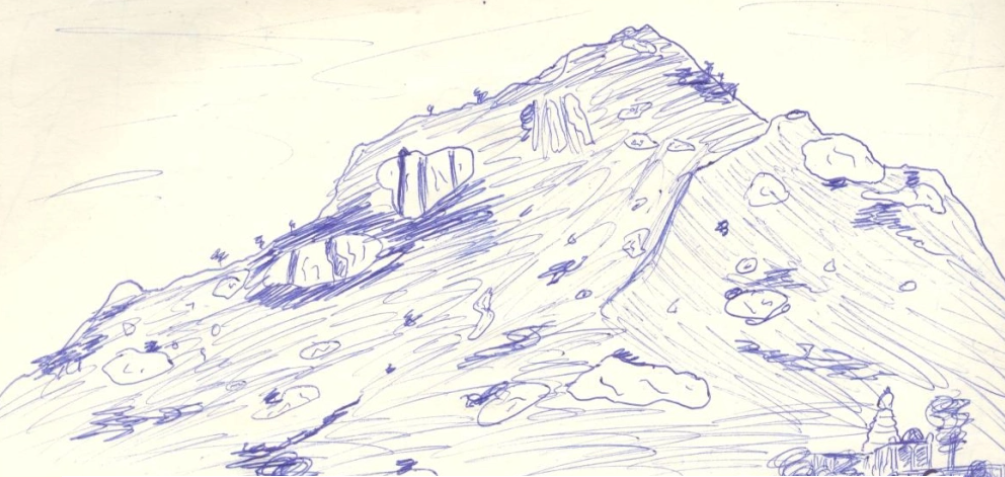
As Edinburgh is the Athens of the North, I would like to declare Thirruvannamalai the Edinburgh of the East. I swear down, Mount Arunachala is just like Arthur’s seat, with the town curled around its base – there’s probably a few other comparisons to be made, but to tell you the truth Scotland seems a long way away right now, bombarded as I am by all this bullshit. Did I say bullshit? I meant to say life-reaffirming, spiritually awakening, international cultural exchange.
My hotel is wicked – a quiet oasis among the electric buzz of the city. I’m paying 125 rupees (1.50) for a room with a toilet & tv. Alright, there’s a few ants crawling about at the front door – but I figure if I leave no food in my room then no ants will invade. The hotel also runs a catering & management college next door & gets the students to do work experience, which involves cleaning my room whenever I want, & bringing food to my room & other little errands – very Agatha Christie. I’m on the top floor of the place, which means I’m among the rooftops of the town, always a cool sight. It’s made a lot sweeter, however, by the great mountain that fills up the panorama less than half a mile away.
There’s a few mosquitoes about & their bites are itchy as fuck. After two days & nights of being bit, plus splattering them (& my blood inside them) all round my room’s walls, then thinking I’ve got the last one, settling down to sleep & hearing the hungry buzz of YET ANOTHER ONE hovering around my neck like a vampire, I bought myself a mosquito net. Funny thing is, their corpses have attracted the ants who have been streaming into the room like vultures & polishing them off one by one.
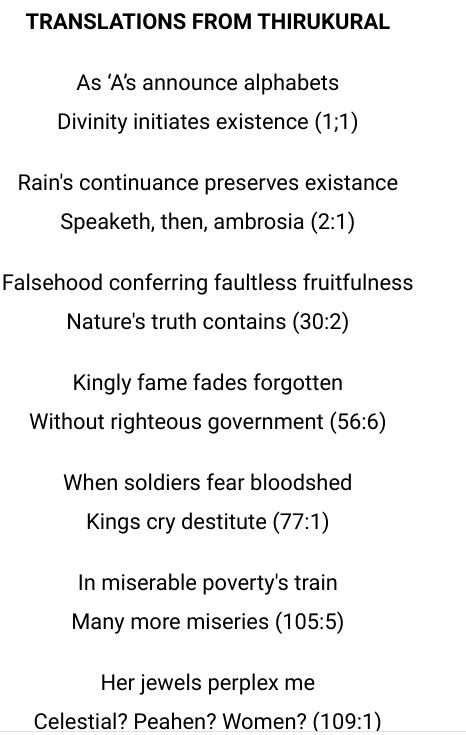
At the foot of the mountain is the Sri Ramana Ashram, full of brainwashed westerners who wouldn’t know a good time if it bit them on the ass, never mind a fuckin Jock Stock. I tried to blag some free food there the other day, but they saw through my attempts at self-realization – & I’d even paid ten rupees for a bindi painted between the eyes. However, I do get to use their library, & that’s a fuckin’ godsend. I’m currently spending my mornings & afternoons there at the moment, under a fan & transcreating the Thirukural. I don’t speak Tamil, but I’ve got several English translations spread in a semi-circle about me, plus a dictionary & thesaurus. Additional help comes from my personal librarian, who is assisting me with the thornier moments thrown up by classical Tamil. It’s actually a very cool experience – Indiana Jones meets Lord Byron – & the Tamils are quite taken aback by a Burnley Boy poeticizing what is to all extents & purposeless their Bible!
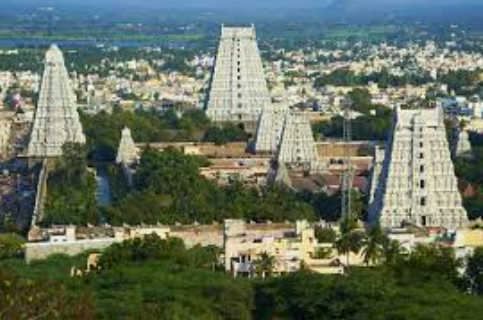
I’ve been walking to my studies every morning & afternoon without fail, passing herds of immaculately uniformed schoolkids & guys wobbling about on bikes laden with steaming chambers of chi. Next comes these massive decorated festival carts with wheels as big as two men; well what I really mean are two western men – apart from some geezers down the ashram I’m the tallest man in town, which is kinda weird.
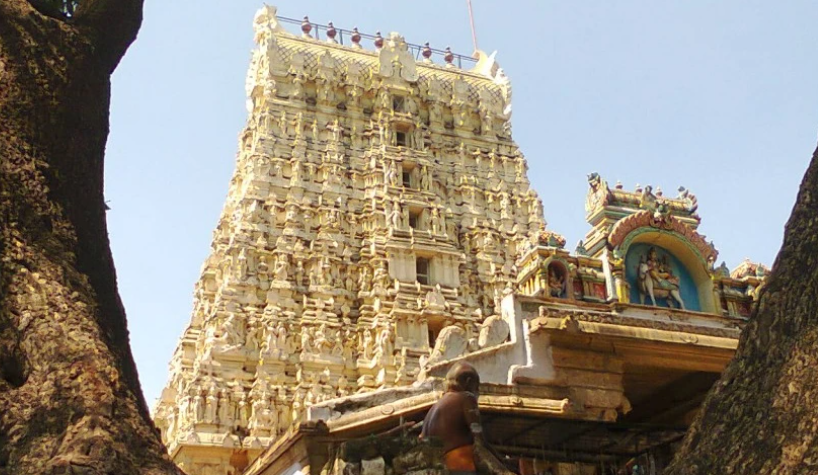
I then pass the great temple, whose four god-carved gates tower over the town; then the busy markets, before walking down a poor village type road, full of rubbish, chickens & bricks – it’s got that industrial-age, Burnley feel where everyone kind of lived in the street. Then comes a glorious ghat (reservoir) whose green water is quite surprising on the eye. Beside this is a middle class suburb, lots of one floor villas with rooftop terraces overlooking the ghat. These have name boards hung proudly on the outside, for example one was a health educator & another was the sub-inspector for the local police force. After this comes the ashram area, where the westerners flock & chill out, spending a lot more money on their generally inferior food. I mean, I’ve been eating wickedly & struggling to spend more than three pounds a day on food.
There’s quite a few orange-clad babas hanging about the ashram – after some enquiry I have discovered none of whom support Holland in the world cup. I have also discovered, on one of my sidestreet walks, that they are unscrupulous rogues. I saw a couple of them eagerly emptying their metal carry-tins of cash – loads of it – with a lot more vigor than their semi-pathetic attempts to get some rupees out of you. They were huddled together far from the eyes of the more gullible westerner, like a couple of cockney gangsters, dishing out loads of rupees & swigging back a very large bottle of whiskey.
So what is life like in small town Tamil Nadu? It’s certainly not a redneck place, quite affluent really, I guess gaining an element of prosperity from the influx of pilgrims. The place is full of pedestrians & bikes – pedal & petrol – mingling with the Tamil animals; don’t-give-a-shit-Cows nuzzling through the roadside rubbish tips or planting themselves in the centre of the busiest roads; abandoned puppies & the same dog everywhere; grotesque rats & deformed ponies; giant horny oxen trotting through the streets hauling produce-laden carts; cats, bats & monkeys haunting the rooftops. I chucked a paul-daniels-faced monkey a banana the other day & chuckled to myself as his little hands unpeeled it – just like a human!
Eating out is a bit weird; you are attended on hand & foot, with refills for food & water arriving from a team of waiters. This state of affairs, coupled with my cleaner boys at the hotel, is perfectly satisfying my colonial pretensions – all I need now is a tiger hunting blunderbus & a bridge club. The maddest thing I’ve seen was a sleight of hand con guy, who had set up a little shrine & had two snakes & a rodent & just kept chatting non-stop & banging this little drum as he did his ‘magic’. Actually I was quite enthralled, as were the Indians, but the point to it all was beyond me.
All the shops are the same size, & everyone is a specialist (Tesco’s would have a fit). There’s shops which contain only penny sweet jars, coconut warehouses, spice merchants with multicoloured sacks, pharmacists, clinics, speaker shops, bookshops, 20 rupee an hour internet places, garland makers with bright fluffy flowers, tailors sat sewing to the world, the most delicious looking cakes you’ve ever seen (with complementary chewy fly), busy barbers, banks, mobile phone shops, modern looking shoe shops & guys sat in the street surrounded by old flip-flops cleaning & repairing peoples footwear (one of these guys fixed my hat)… & even an interior decorators. There’s also the chicken marts, which are a real sad thing to see. Proud cocks & white hens stuck together in cramped cages, watching agitatedly as one-by-one they get the chop right in front of their sad little eyes – I tell ya, my chucks back at Heather Lodge don’t know how lucky they are!
At one point I sampled the wears of a fried fish stall – very delicious but too many bones. More palatable have been the samosas; other fried street foods (3p) & the bananas (2p) which you buy in bunches of ten from gypsy-type women in the street. These in turn come from the banana wholesalers, where bunches of up to a hundred green bananas cling to a bamboo style stalk. The leaves have been stripped off by now & even these are sold off in the street to guys from the restaurants – that’s in the street remember, & I’ve gotta eat off em. Other food you can buy on the street-carts include apples, oranges, grapes, banana fritters, peanuts, ready-to-eat corn-on-the-cobs & fresh coconuts, which they crack the top off for you so you can drink the milk with a straw, then crack in half so you can eat the creamy flesh inside.
Fashion sense is not that varied. All the women wear saris & the men have only four possible combinations of outfits – either a pair of trousers or this kilt thing to cover the legs, with either a short sleeved or long sleeved cotton shirt (in stripes or checks, so I guess that six combos). The flip-flop is the footwear of choice, though about a third of the folk go about barefoot. They hardly ever use the paths & invariably compete with road space with everything else… mainly because the paths run over stinking sewers & are full of holes. Most of the roads themselves have strange delusions of concrete, but these are basically under a pile of crud, which during the recent rains has turned to ghostbuster goo.
For me, the weather’s been great, actually, quite cloudy & rainy – the top of the mountain is often obscure by mist – tho’ warm enough to sleep naked. I’m not a big sunlover, so a bit of respite from the heat is wicked. In a few days, once the novelty of disciplined writing wears off, I’m gonna get green scooter-bike for 75 rupees (1 pound) to explore the countryside. I’m a bit nervous, actually, as the roads are certifiably insane, & all those raring buses blaring in my ear is making me, actually, fuckin deaf!
Tonight’s been a bit crazy in town – the leader of Tamil Nadu – Karunanidni of the DMK party – has just turned up & the centre has been bedecked with banana trees, light statues & a hell of a load of Belgium flags. Apparently it’s the flag of the DMK, but just like Belgium, the rally was pretty boring so I didn’t stay for long. The guy sounded just like the one at Wigton Cattle auction, but a bit slower.
So to conclude, I have been in India almost 3 weeks now – only 3 months to go – the poems going well & my poo has finally hardened, though is still maintaining its curious yellow colour. India at present is a pretty funky place to be. I mean, it’s come along way even in the few years I’ve been visiting, slowly turning into the global superpower that a democracy of a billion people must support. At the moment they have the smartest guy on the planet – Vishy Anand has just become world chess champion – the best cricket team – they’ve just walloped the Aussies – & they’re the only ones who’ve been willing to do anything about the Somalian pirates, sinking one of their mother ships only recently. What, with Usain Bolt & Lewis Hamilton being the fastest men on the planet, Barrack Obama being the hardest (thanks to several trillion pounds to spend & quiet a lot of nukes), & the Chinese being the best Olympic nation on the planet, it looks like the world is tilting on a 21st century axis & the darkies are taking over.
Thiruvanamali
22 – 11 – 08
That spot of rain I was talking about last time turned out to be the annual monsoon – apparently they get it later in the years this far south – it’s been proper pelting it down! This rain then apparently drives all the snakes indoors – including cobras. Luckily I’m on the top floor.
The other day I decided to climb Arunchala, the extremely sacred mountain which overlooks Thiruvanamalai. Waking at six, I caught Glenda with a quick STD (they are the international phones), her slightly slurred voice telling me she was still up & drinking (surprise) at one in the morning Scots time. My ascent then began in light drizzle, which follow’d a series of arrows & religious graffiti painted on the scattered boulders, all pointing upwards. As I climbed, the view of the town & surrounding area began to increase. Thiruvannamalai is not as big as I thought, & shaped like a dolphin’s fin protruding from the southern flank of the sacred peak. Beyond it lies a flat, nameless plain – very green – with a range of hills about 10 miles away or so. Their proximity, & the fact that the crazy town streets quickly fade into verdant champaign re-inspired me to get a bike & go cruising.
After about an hour I reached the summit – a pleasant sensation made even more so by an encounter with the local guru. He is 30 – an orphan – & has been living in a shack just off the summit for ten years – 10 fuckin years meditating & shit. He’s the guy who’s painted all the graffiti – including one funny one indeed… his own fuckin’ website. Talk about 21st century asceticism. He even has a mobile phone – no reception on the top of the mountain however – but I’ve got his number if I ever need to meditate with him. He was a nice guy & gave me a glass of chi & taught me a little Tamil. If I make it back up I’ve promised to bring him some tea & brown sugar.
The descent was delightful, passing through a little corner of the world that the gods promised the Dragonflies. After musing on the possibility of anyone being eaten alive by dragonflies, & coming to the conclusion that they properly hadn’t, I paused for a while. About a hundred of them were buzzing around me, with some of the braver ones coming almost to my nose & hovering with their four delicate wings for a few moments, before darting off awhile. Further down the flanks of Arunachala I came across the two caves that Sri Ramana had lived in at the turn of the century. He’d been doing a similar thing to the guy at the top of the mountain, basically meditating for years. I guess that after a while enough people turned up & gave him 50 rupees (like me) for him to steadily improve his living quarters. First he built a house around his original cave – where devotees still sit in silent candlelight to this day – then he moved to another cave higher up the slopes & built a villa around it. His final port of call – for 27 years – was the ashram at the bottom of the hill.
The Sri Ramana Ashram is quite a funny place – full of meditating souls, Asian & Western, with everyone leaving shoes at the door of what is quite a large temple complex. I witnessed quite a spectacle while I was there, sat cross-legged on a marble floor before the shrine where Ramana’s body is buried. A few brahmin – men & boys – were sat down singing with deep intonation some Vedic hymn like the drone of a Miltonic canto. It took the form of a question & answer thing, the acoustics of the room echoing their voices even further, & while they sang a few devotees wailed ceremoniously round the shrine. To me it was rather like a Lenard Cohen single played at 33 rrp. I even joined in for a couple of circuits, the music sending vibrations through my chest – but just before the Stepford Wives & their spiritual tupperware party had persuaded to give my brand new sandals away & move into a cave, I quickly reclaimed my shoes & fled to the safety of the library across the road.
All this brought up the question of religion for me. The closest I’ve ever been to god was down the ‘Dads & Lads’ night on Fridays down Woodtop Church in Burnley, where after singing a few hymns we were given tea, biscuits & got to play pool. But to the Indian faith & devotion is totally ingrained into the psyche. It was the same for the English not two centuries ago, but modernistic materialism is the new religion now – coinciding with the end of the age of Pisces… Jesus was a fisherman, remember, & the age of Pisces began when he was born. Will India be affected by atheistic modernism. I believe ultimately it will, but the change will take centuries, not the mere decades it took the West to wake up & smell the bullshit. Besides, Christianity was based on fear of the afterlife – Heaven & Hell – while most eastern religions believe in some form of Moshka – the release from the never ending cycle of birth & death. By this reasoning, eventually there will be no one left in the east to believe, because they will all be in Moksha
The few westerners who come to India seeking ‘salvation’ are a funny bunch – but looking at the predominance of middle-aged ex-hippies wandering about the ashram it is my conclusion that most of them took too much acid in their youths. I mean, so did I like, but there’s no need to turn into a thrill-less mind-junkie, lost in your own thoughts & only ever getting laid when its tantric (ie no quickies).
Thiruvanamali
26 – 11 – 08
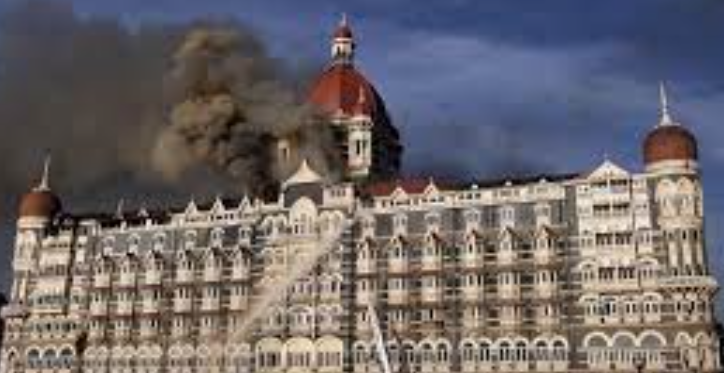
Well it’s no use pretending anymore, you’ll all find out my real name soon enough. I am Yawansum Avadabadis, a senior member of the Deccan Mujahadeen who are now gloriously attacking the heart of Tony Blair-loving India. I am currently positioned on the 19th floor of the Trident hotel, Mumbai, writing this on some dead American’s laptop, his Yankee blood curling crimson pools around my feet. For many years now I have lived in the west, sleeping with your women, drinking your terrible-tasting Tennent’s lager & studying your infidel ways – preparing for the day when we at the Deccan Mujahadeen can strike like a cobra at your dollar-loving, Anglo-Saxon imperialism…
Well, not really, but it’s been pretty cool watching they blanket coverage of the still ongoing terrorist strike against Mumbai. I presume you guys know about it in the UK – mainly for the fact that the English cricket team has cancelled its tour of India – a convenient excuse really as they were 5-0 down in the series. The action started a couple of nights ago, with mentions of a gun battle on the streets of Bombay – the very same ones I was walking three weeks ago. Hour-by-hour the flashpoints escalated over a number of locations, with hotels being taken over, police cars being used by the terrorists to shoot up civilians, petrol stations being blown up, top cops being killed, footage of blood in the streets, all followed by the slow, methodical counter operations of the Indian government. The NSG (National Security Guards) had to make its way thro’ traffic in clapped-out trucks for god’s sake – a far cry from the SAS in 1980. As I left my hotel for a walk, the commandoes had just commenced their final mopping-up operations, searching for the last couple of young Kalashnikov-toting, grenade-tossing Fedayeen that still stalk the Taj hotel, Mumbai’s greatest landmark.
It is all very 9-11, marking the Obama age with a sanguinary relish, & I wonder if it’s going to affect my stay in India. No-one seems to give a shit about it down here in Tamil Nadu. The papers are more interested in the 50 people that have died from the week-long cyclone that’s been hanging over the state. “Call that rain,” I said to a series of astonished Indians, swaggering through a downpour the other day listening to a bit of disco on my mp3 player, with the arrogance of a Burnley boy who, like Eskimos & snow, knows 500 different names for rain.
Four days on & I wish it would bloody stop. The sight of Indians in umbrellas & dodgy macs, coupled with river-like, sewage-bearing streets doesn’t fit into my sun-kissed winter soiree with the Tamils. They seem happy, though, the ghats are overflowing & the state’s water supply should have enough now to see them through until next summer’s rains. The weather is also keeping me in Thiruvanamalai – the hotel is very dry & the storm-ravaged coast of my next destination doesn’t seem so appealing right now. Unfortunately Aranachala is perpetually swept in cloud, spoiling my view of the sacred mountai. This led to a brief conversation with my Landlord as to getting my money back – or at least get a reduction for the rain. I think he told me to fuck off in Tamil. Talking of which, I’ve learnt about 15 expressions so far – it’s a lovely language & quite accessible.
To finish, here’s a flurry of numbers
Days without smoking – 9
Days without alcohol – 11
Today’s sit ups – 42
Today’s press ups – 21
Kural completed – 410
Kural to do – 920
Days down in India – 23
Days to go – 83
Thiruvanamalai
28-11-08
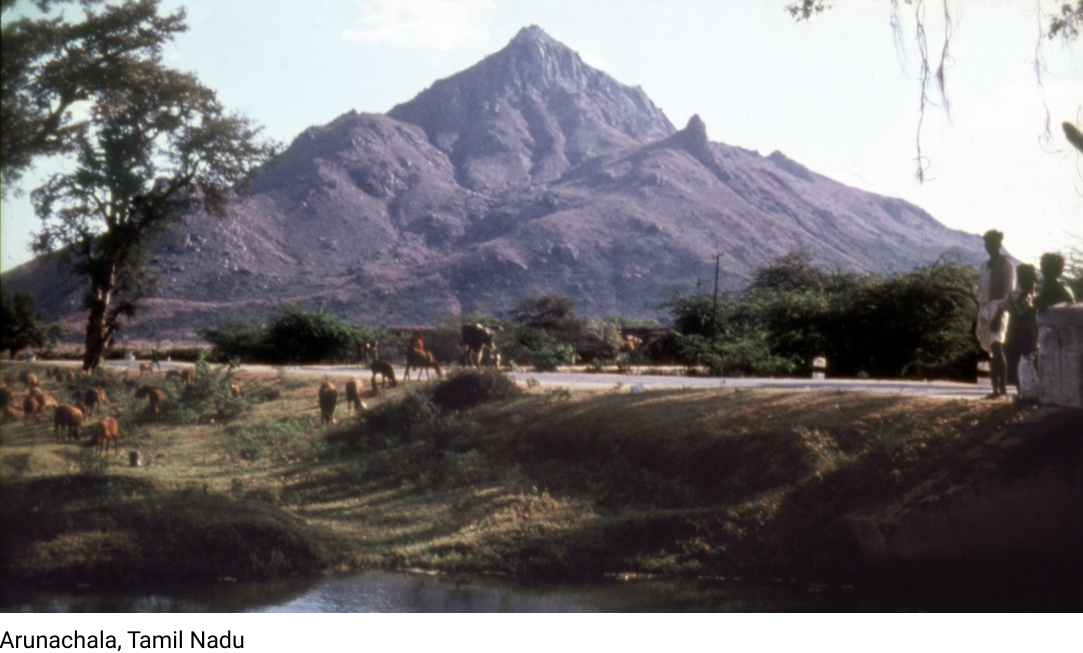
I have finally left Thiruvanamalai. For a week I was caught between two cyclones – The Operation Cyclone that the NSG called their anti-terrorist actions in Mumbai, & Cyclone Nisha that has been ravaging Tamil Nadu. In the last couple of days the rains finally ceased & now I am in Mamallapuram, next to the choppy waters of Bay of Bengal. It was definitely time to leave the old temple town, especially as my room was progressively turning black with damp. One morning I woke up to find fungus everywhere – my hat, my bag, some clothes & even my chess pieces all had a furry look & feel.
Perhaps it wasn’t the best room in the world after all. On one occasion I was in my mosquito net chilling out, when I felt a wee tickle. It turned out to be an ant, which I casually flicked away. Then putting my feet under the covers I touched something weird, turning out to be a few hundred ants chomping on a bit of banana which had previously stuck to my foot & came off in the bed. I found this quite a disturbing experience, which resulted in me flailing around like a madman & vigorously shaking sheets & mattress onto the street below.
One of the most interesting sights in my last few days at Thiruvanamali was a circus-like spectacle of an eight-year-old girl balancing on a rope about my head high. While her dad sold popcorn; her mum knocked out some funky rhythms on a metal pan; & her older brother did the bass on a djembe, her legs wiggled wiggled left & right like a supersonic pendulum. Then, she did all that again, but this time balancing a pot on her head!
I have also been to the movies – situated in a fine building – to watch Death Race dubbed in Tamil. It was quite cool actually, for dialogue wasn’t really an essential pillar of the movie. There was also an old-fashioned interval, when the audience of 100 percent males dived for the samosas being sold by a couple of cheeky kids.
I have finally visited the famous temple that I’ve been walking past several times a day for two weeks. It begins with leaving one’s shoes at a little shack just outside for two rupees, then wading through several decrepit beggars & a police electronic bomb detector unit just to get inside. On the way in, a very cheeky monkey came & stole some food from a toddler’s hand, whose pathetic cries accompanied me inside the sacred space. Aranachaleswaram temple is a fine affair, consisting of 3 concentric rectangles leading to the inner temple at the heart of the complex. The inner courtyards are entered through similar gates to the main ones – n, s, e, w – gleaming white majestic edifices with the entire Hindu pantheon poised in many poses.
Deeper into the temple I saw my first elephant of the tour, which turned out to be the ultimate penny arcade machine. After being hypnotised by the gentle pacing, left & right, of his two massive front legs… I placed a rupee in his trunk. The elephant than patted me on the head with said trunk & gave the now mucus-dripping rupee to his trainer. Better still was watching him, ever so politely, use the loo. He took a few steps to one side, separated his back legs & pooed & peed AT THE SAME TIME – a feat we humans can only dream about. This got me looking at his penis – not in a gay way – the outer skin looked just like a big black brain & the ‘nob’ was as polished as an ebony jewel. It was the elephant’s eye which I found the most remarkable; possessing an otherworldly, almost alien aura, & with the loveliest eyelashes in the whole of nature.
On my last day in Thiruvanamali I saw both a lovely sunrise & a soul-searing sunset. In the morning the clouds had finally dispersed, revealing the landscape which I hadn’t seen for a week… all round me mountains peeked out of the milky distance like nervous children. The sunset was amazing. I had just settled down on the rooftop, listening to my MP3 player & reading a spot of Shakespeare, when just as ‘patience’ by Take That came on, I looked at Arunachala. There is a legend that it was here that the dreadlock’d god Siva produced a lingam of fire – a measureless column – & won the submission of Vishmu & Brahma. Perhaps it was some mythological memory of an ancyent eruption, but I swear down, as the sun was setting the clouds were in just the right place to produce the same effect – a mighty golden column coming out of the mountain. At the very same time there was a wee cloud just big enough to cover the very peak of the mountain, in the same spot where I was blessed in Siva’s name by that Guru. I really did feel it – the mind monkeys had cleared from my mind on that occasion & this time I felt that Siva was saying ‘nice one son’ & wishing me well on my way
The next day, just as I was about to leave, I woke up to the sound of the rain. ‘Not again’ I cursed, wanting to hit the road, but then the rains cleared & Aranachala was revealed in all her glory, a scintillating rainbow arched perfectly from flank to flank. Remarkably, the same wee cloud as yesterday was again at the summit. ‘That Siva’s at it again’ I thought & finally left town. Three buses later, beyond those scattered heaps of boulders that form the regions hills, I was heading towards the coast, passing several large lakes where paddy fields once were – the devastating consequences of the recent rains. Apparently in the state these past couple of weeks there have been landslides, 700 bridges have collapsed, over a hundred dead
Mamallapuram is a bit of a tourist hotspot, with a fine beach & some amazing temples carved out of the rock. It got wiped out by the Tsunami in 2004, but is well back on its feet again. I’m staying in a far-too wicked room for 300 rupees. I’m basically paying 2 pounds fifty more than last time – which was only 1.50 itself – but now I get a massive marble-floored room, this huge oak table (perfect for writing), a clean double bed, a wicked fan, a big TV with all the channels & a cool balcony overlooking the street – with not a hint of damp or mosquitos anywhere! Suffice it to say I blagg’d the price down off a naive young guy, who got a proper rollicking off the boss when he found out. (I should be paying at least 500). Negotiating the cheaper price meant buying in bulk, so I’ve been forced to hole up for a week. By the way, I haven’t seen one advent calendar as of yet – the chocolate would probably melt – but I still miss them. I reckon there is a market for traveler-friendly portable advent calendars, with wee little fans to keep the chocolate cool (Dragons Den here I come).
Mamallapuram
2/12/08
The Conchordia Folio: An Update
After taking a relatively long break since my last completed Conchord – the Siege of Gozo, composed in Malta in November-December 2020 – the composition of the Folio has resumed. I have just begun the first scenes of the Madchester trilogy, which will be the 14th, 15th & 16th conchords of the 39. It seem’d an apt place to rest after the Gozo concord, the 13th, reaching the natural third-way point in the attempt to emulate Shakespeare’s canonical 39 plays.
So what happens when you give yourself to the muses & ask their help in such a grand project as the Conchordia Folio. In my case, after completing the aforemention’d first third, it was time to leave my Edinburgh base & see where the wings of my pegasus shall fly. This was in early March of 2021, & exactly four months later I found myself living in a lovely property own’d by a lover of poetry, sited on a lovelier Scottish island, & opening a wee bookshop to fill with, well, books. The latter would then be opening many a fresh vista for the lore-learning & allusion-making that shall enrich my procession through the next third of the Folio.
It has taken seven months to settle into a psyche fit for the demanding intellective rigors of Conchordia composition, during which period I completed an epic ballad cycle, so the poetry kept flowing, & to a fairly high standard I feel.
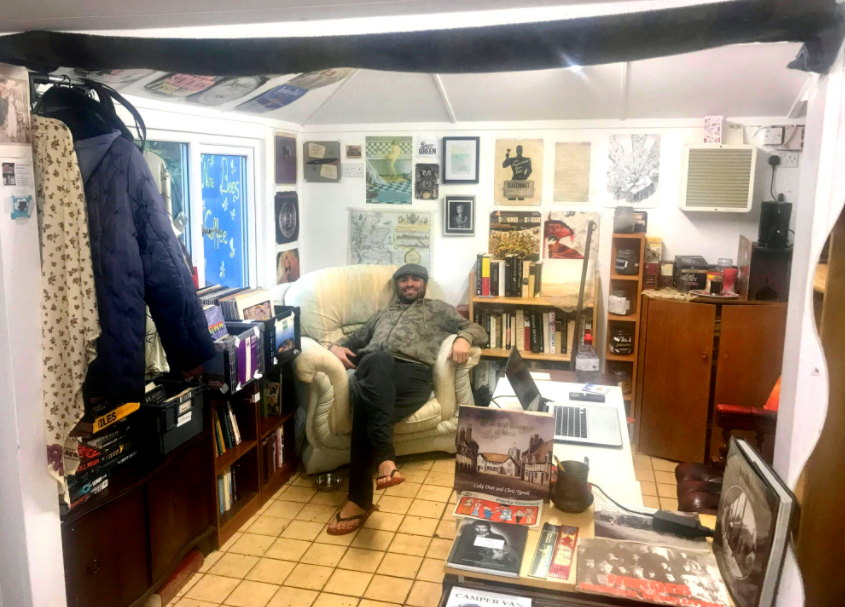
By February 2021 – now – I intend to compose scene of the Folio most mornings, finishing by ten at the latest, & spending the rest of the day being a poet at semi-leisure, but spending some time on research for my composition notes, aware that in just a few hours after a decent sleep I shall be composing a new scene. There is an element of combining two poetical periods here. One is the Byronic Don Juan period, where he just set off composing stanza after stanza & canto after canto – he got to 16 or 17 before going off to fund an army in the Greek War of Independence against the Turks, before dying of malaria & leech-bleeding at Missolonghi. The other is the Miltonic composition of Paradise Lost, where the blind poet’s daughter would act as his amanuensis every morning after Milton composed his poetry in his head in bed.
I was recently reading Matthew Arnold’s essay on Worsdworth, & found a couple of morsels which reflect the spirit of what I am trying to achieve in match Shakespeare’s folio with one of my own;
A nation, again, is furthered by recognition of its real gifts & successes; it is encouraged to develop them further
But let me have the pleasure of quoting a sentence about Shakespeare, which I met with by accident not so long ago in the Correspondant, a French review… “Shakespeare is the king of poetic rhythm & style, as well as the king of the realm of thought.”
Thus, in essence, I wish to develop & extend the Shakespearean style for the benefit of the nation, & thus the English-speaking world. Picking up the histories from his Henry VIII, in a way.
My 13 Conchords thus far have ranged in length between 14 & 35 scenes, so let’s say an average of about 20. Theoretically, then, I could finish a conchord every three weeks, while adding ten days of rest & normal life days means I could compose one conchord per month. Add a couple of months for vacation, a couple of months just purely researching, & a major edit month, then we’re looking at about 18 months to complete the next third of the Folio – if I remain focus’d of course. It took about the same amount of time to complete the first third, actually, tho a good half of it was already written.
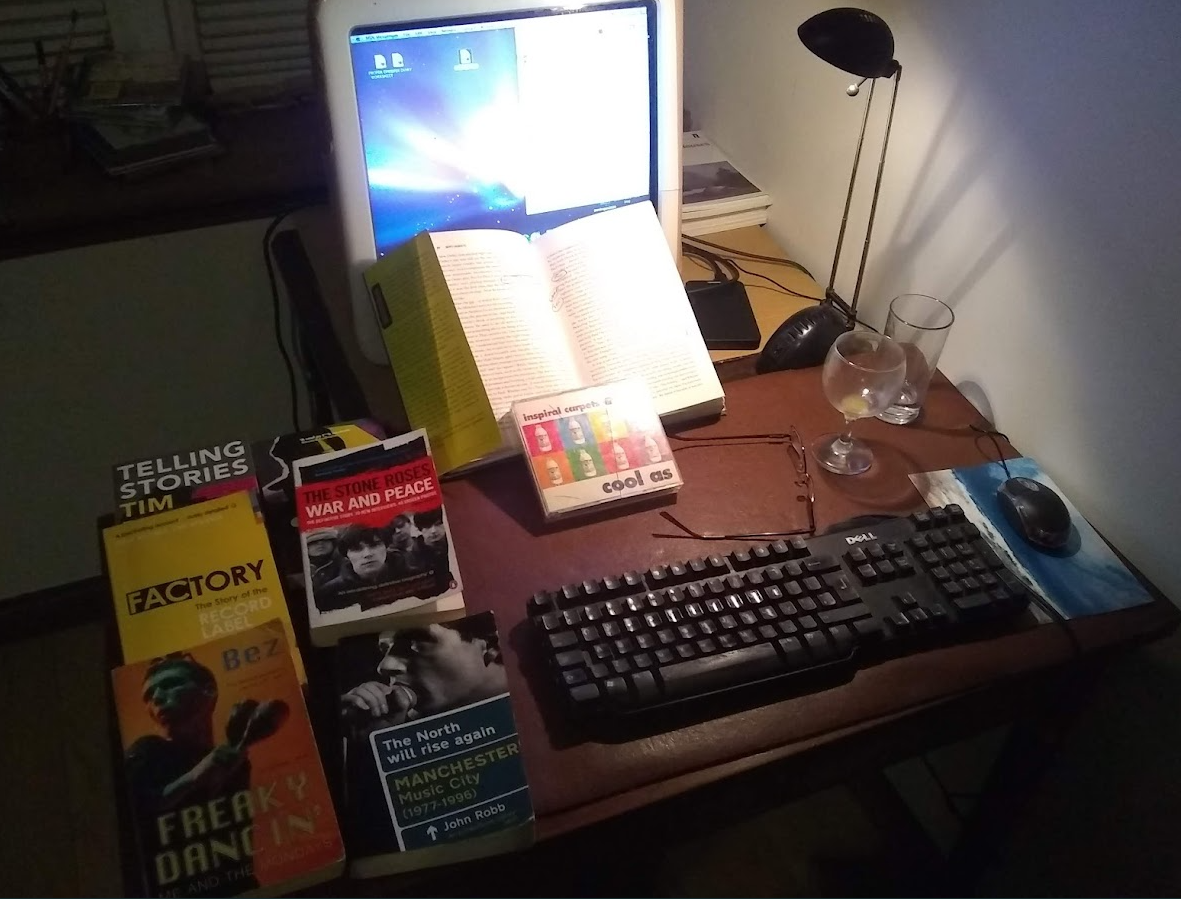
These are the next seven conchords which I shall be composing throughout 2022.
THE MADCHESTER TRILOGY: A three parter telling the story of the rise & fall of the Madchester movement, 1979-1991. You can follow it here
THE KING & THE SPIDER: The story of Robert The Bruce in exile. I will be using Scottish folk songs as the music.
THE RUMBLE IN THE JUNGLE: The third conchord in the Gods of the Ring trilogy telling the story of the Muhammad Ali – George Foreman fight in Zaire, 1974
THE LION & THE EAGLE: This might also be call’d ‘The Day of the Griffin.’ It tells the story of a meeting between Churchill & Von Ribbentrop in the lead up to the Second World War.
That will take the total to 20, which is no mean feat in itself, & also beyond the half-way mark in the quest for 39.
Damian Beeson Bullen
www.conchordiafolio.net
Seeing Sally Cinnamon (1)
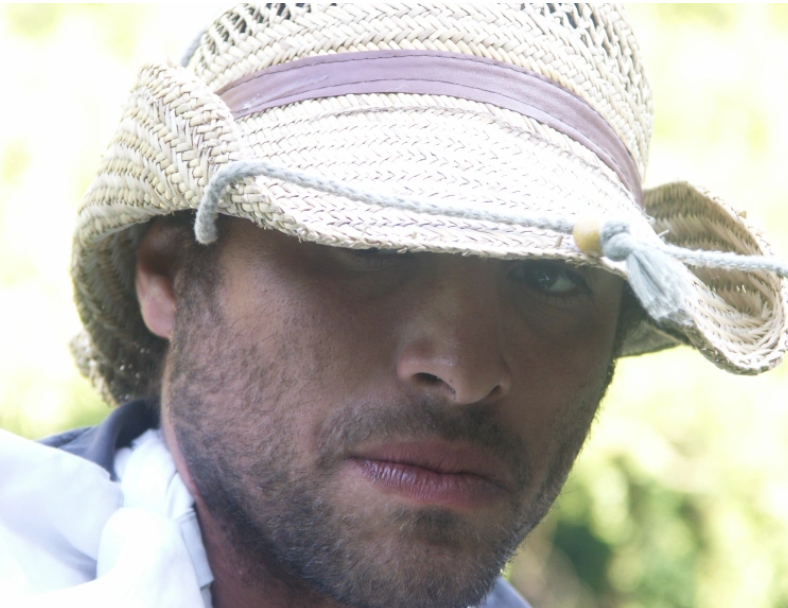
WESTENDERS
Twas a quintessential English evening
All about town & the capital’s core,
On my arm a wonderful flutterling,
Perfectly amenable to the tour.
We met in a wine-bar off Trafalgar,
To delve within a cosy eaterie,
Then took our places at the theater
For the Mousetrap’s befuddling mystery.
O! The night brimm’d a goblet romantic
& our spirits, yes, they sparkl’d as the stars,
Rosie was a gentle alcoholic,
Floating, flirting, thro’ her favorite bars;
When to the chimes of Big Ben’s booming bells
We jump’d the last train down to Tunbridge Wells
ROSIE’S SCHOOL RUN
OH MY GOD! I’m having a nightmare,
Fuck, look at the fucking time!
“SHUUTTT UUUPPP!!!”
The kids are doin’ my head in
With their school-stuff everywhere,
“Here’s yer shoes, here’s yer socks,
Heres yer fuckin’ sandwich box!”
“MUMMY… don’t swear!”
OH MY GOD! Its ten to nine now,
& my car-keys JUST AREN’T THERE!
Will it rain, will mum call,
Will I end up on the dole
O MY GOD! Its five to nine now
& the traffic’s hit a WALL!
THIS IS MY COUNTRY
Good Morning Great Britain
Still great, still Britain
The sun is shining, 10:45 AM
£296.26 pence in my pocket
Time to bet it all on black & hit the road again
If time is a mere scratch & life is nothing
& nothing that occurs is of the slightest importance
Aberdeen to Birmingham, Arundel & Deal
Dullis Hill to Rotherham, Bristol & Peel
Inverness to Liverpool, Leeds & Palmer’s Green
Lewisham to Padiham & all the pubs between
Badminton to Twickenham & Barton-in-the-Beans
‘Til my bardic breath expires
This is my Time,
This is my Rhyme,
This is my Country!
TRAINING IN THE ART OF FARE EVASION
The Fader Code
1 Remain alert
2 Always keep your cool
3 Trust your instincts
4 Never show your money
5 Know your stations
6 Another five minutes won’t hurt in the loo
7 Know your enemy
8 Know your postcodes
9 The train’s going there anyway
10 When in doubt, clout
11 Trains always comes when ya skinnin’ up
12 It is every Fader’s duty to baffle & confuse
13 Always remember your free cup of tea
14 No need to rush unless you’re being chas’d
RECOLLECTIONS: FIRST KISS
Partridge Walk, Burnley
I was a six-year-child when first I felt
My soul entwining with the fairer sex,
Em’rald-eyed neighbor, who, one starry night
Said, “Have you ever kiss’d a lass before?”
“Of course!” I yelp’d, but grandmas do not count
& as we kiss’d she giggled at my lips
Closed shut & clamp’d by frigid innocence,
& said, “No, not like that, ya kiss like this!”
& show’d me how my mouth should act a fish.
Soon sprinting home, embarrass’d at the deed,
That never was repeated I believe,
For looking back, I was, in tender days
Contented with the kisses of grandmas
& nee-owwwwing with little Corgi Cars.
PAISLEY
I’m cringing every time I see a garish Paisley tie,
I’d just popp’d hungry into Greggs a hottish pie to buy
& chose a steak & kidney offer’d up for ninety pee,
I took the pie, she took the change & said, “It’s ninety-three!”
I said, “Love, that’s false advertising,” stormin’ out the door,
But never mess with Weegie Birds, they’re all fuckin’ hard-core,
& leaping from her hum-drum she pursued me down the street,
Looking as if an earthquake were shaking a slab of meat,
& panting now beside me squeez’d the pastie from my hans,
Smugging with satisfaction at her petty jobsworth’s stand
& turns her tail in triumph, as back to her shop she skips,
You coulda balanced ninety-three bridies on those fat hips,
Then looking down on what was left, my skin all bruis’d with mince,
I thought I’d catch the first train out – ain’t ever been back since!
LOVE AT FIRST SIGHT
Being virgin to Eros & his sighs
Spectral seconds attend the growing soul
Hearing a lute-string’d aether-breathing call
I turn’d to see her star-wreath’d, lustful eyes
*
My eagle-lashed, Latvian poetess,
My pearl-eyed raven in her Persian dress,
My Spanish pea-hen spangling as she comes,
My nude Numidian banging djembe drums.
Like mountain men & archipelagos
*
Or young sweethearts sniffing a first red rose
Like money men glimpsing a glint of gold
Or distant kin returning to the fold
Long time, for this fair moment, did we wait,
*
Which two sure hearts attaches into one,
& felt us fair as fairly dealt us fate
As, with a gasp, we match empyrean!
We are the music of the finches green
*
We are toa pussies purring by a fire
We are the fragrance of a vernal scene
We are two frogs full throated with desire
*
We are the thistle of your bonnie land,
We are toa rabbits sprinting cross the glen,
We are the seaweed strewn across the sand,
We are twa badgers snuggled in their den
There was an instant karma to our touch,
*
As if we had belong’d since time began,
For how can two new strangers feel so much,
Thro’ times like these life serves the higher plan
*
Like songbirds witnessing the world’s first dawn,
Or proud parents cooing their babe’s first yawn,
Like virgins witness to the breast exposed,
Or an exploring of the always closed,
*
We are morning in the Tuscan enclaves,
We are night on the Sea of Galilee,
We are swans a-gone gliding between white waves,
For we are one in nature, you & me.
A DAY IN THE LIFE OF LOVE
We talk’d last night
& after we made love
I read to you the Lao-Tse Tung;
In my voice rose ancyent chimes,
Funell’d thro’ the Jiayuguan Pass
In elegant simplicity –
Lass, after we made love, I cherish’d thee!
Night comes again,
The drift of day deserts us,
The dusk is all that matters now, my love,
The light is dimming, but thine eyes are bright,
As cradl’d in these arms
You smile to me once more,
Love, let us talk again.
 Mumble Words