Uncategorized
Postcapitalism: Paul Mason and Nick Srnicek
I was very excited to listen to this talk between Paul Mason (well known to many from Channel 4 News) and Canadian Nick Srnicek. However, this was like being on a very serious, earnest rollercoaster, thrilling in its twists and turns, but leaving me feeling dizzy, frustrated and slightly disappointed at the end of the ride. I wanted to hear what ideas they had for a postcapitalistic world, as this is a subject I am passionate about. Paul Mason began like a firework, with a highly articulated, forcefully delivered summary of the ideas outlined in his latest book, Postcapitalism. The moderator was unusually engaging, and amusing too, but at times making assumptions about the audience’s viewpoints on Scottish independence. Maybe she knew her Glasgow audience better than I did. Nick Srnicek, a young Canadian author, there to discuss his book (written with Alex Williams) Inventing the Future, drew the short straw in a way, as he understandably wasn’t up to speed when the discussion invariably turned to Scotland’s independence.
Paul Mason suggested that utopias based on work are over and that people are no longer defined by their work. This is quite a North American/Eurocentric idea, surely, which most of the debate seemed to be. Various case studies in Europe, in countries such as Greece and Spain were cited to show how extremely individualistic the UK is, and indicated as having the lowest level of cooperatives in Europe. Nick Srnicek suggested that the mindset of competition that we live and breathe was now an extreme of neo-liberalism and this continual need to brand yourself in order to get a job had the direct effect of breaking down communities. Mason suggested that we are seeing a very new stage in capitalism and that there is something unique about the most recent boom-bust cycles that we have seen. With the vast explosion in information, much of it becoming free, prices were starting to dissolve and the idea of work becoming disconnected from wages. Modular work; both increasingly decentralised and horizontally organized was becoming the norm but that it was actually highly unusual for capitalism.
The Many Faces of Scottish Comics: Alan Grant, Frank Quitely & Metaphrog

Mitchell Library, Glasgow
March 19

The crowd was excited to see the ‘behemoth’ of comics, as he was introduced by the young fan from the Scottish Book Trust, Alan Grant, famed for his work on Judge Dredd and Batman. You could tell immediately he was going to be amusing, a laconic elder Scotsman with his wild hair, louche outfit and laid-back posture. Good-hearted banter back and forth between the panelists kept the atmosphere light, a bit like a bunch of mates enjoying a beer on someone’s sofa, as Alan told personal stories of starting his career being forced to write for teenage girls’ magazines with names like Honey and Loving, his stories like ‘I had a Hell’s Angels boyfriend’, proving the most popular. Frank Whiteley is his sometime artist collaborator and famed for his work on New X-man and All-Star Superman. They were joined by ‘Metaphrog’, pioneering graphic novelists, John Chalmers and Sandra Marrs (The Red Shoes and Other Tales).
A discussion ensued about the popularity of comics in Scottish culture, and Sandra confirmed John’s observation that they are pretty ubiquitous in France and enjoy a slightly higher status in the world of art. John explained that even though comics are still slightly looked down upon in the UK, they were fantastic for pushing against conformity and asking some big questions by hiding fresh ideas deep in the subtext. ‘The Broons’ remain best sellers in Scotland, all these years later. They put the snobbery down to Scottish guilt over doing ‘what you enjoy’. A hush descended on the audience when Alan showed his damaged left hand that was beaten severely with a belt over the course of his first two years at his primary school, when he arrived at 4 the only pupil able to read and write (thanks to his granny and the Beano), but unfortunately with his sinister ‘left’ hand. He began to write with his right hand, even though the sentences all came out backwards, but was never able to draw in the same way again.
They talked about the contrast between indie presses and large press houses, and the consensus was that you have more creative freedom with independent presses, and self publishing (by Metaphrog) allowed ultimate freedom. They all seemed to enjoy the different challenges and opportunities that came with different collaborations, the essence of which could change completely depending on the subject matter. Metaphrog worked in tandem, and Alan and Frank tended to work with complete scripts, and Frank was often inspired by taking photographs. John explained that his former career as an engineer gave him good discipline to work on his stories. All of them had been pretty much self-taught, but Frank suggested that his training in anatomy and perspective had been invaluable.
They gave lots of advice to budding graphic artists, on how to begin, how to refine their technique and how to get a foot in the door. They suggested the best way was to read as many comics as possible, especially to understand the subtleties of the best layout, edit other people’s work, join writers’ and artists’ groups, watch online tutorials. They were very encouraging to audience members who asked for specific advice. Sandra suggested that they send out unsolicited work, and John said that editors were keen to see finished work, even if it wasn’t yet perfected, as that proved that you were capable of working to deadlines. They’d never had any failures or disasters, and obviously all love what they do, whether in solitude or in collaboration. However, the most important phrase of friendly advice from our experts was ‘just do it!’
Reviewer: Lisa Williams
Are We What We Eat?
Joanna Blythman and Bee Wilson
Mitchell Library
Glasgow
19th March

 Journalist and broadcaster Joanna Blythman and columnist Bee Wilson, both the well-known authors of several books, held a fascinating discussion about the state of food consumption in the UK. Blythman’s new book Swallow carefully researches the secret world of the food processing industry and Wilson’s First Bite draws on neuroscience and psychology to understand how our habits, preferences and desires are shaped by both our early family influences and the availability of certain types of food in our immediate environment. Blythman opened with a funny story about her childhood longing for a Vesta Chicken Curry TV dinner and Wilson a touching one about the struggles with disordered eating and emotional memories that specific food types can trigger.
The Blue Chair: Extra Second – Love Is…?
15 March 2016
The Blue Chair
Glasgow
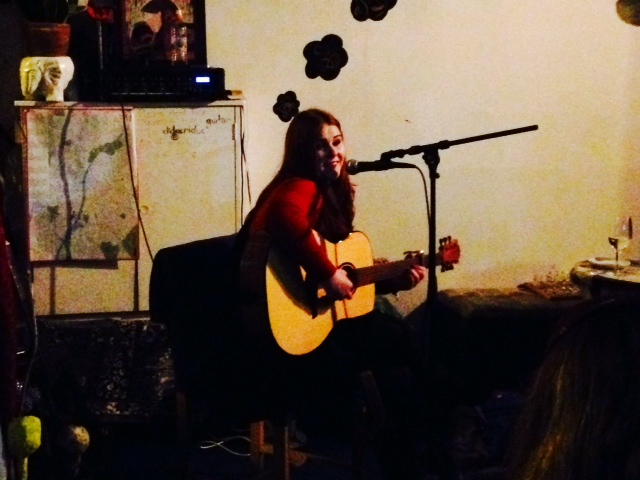
Not so much a twitch but rather a wild, obstreperous thing has rejuvenated the Glasgow spoken word scene over the last few years. Not that pre-2013 poetry in the city’s cafes, bars, and favourite hang-outs did not already conduce a compelling evening, but a highly welcome resurgence in the art-form has stirred from a number of highs and lows which have affected the city in recent times. List them – the Scottish referendum, the Clutha Vaults tragedy, the Commonwealth Games, the Art School on fire, MTV EMA’s, the George Square bin lorry accident, and so on. Subsequently, this has trebled the number of spoken word nights held across the city as voices, both young and old, have jostled for time on the microphone to air their grievances, ecstasies, and stories addressing what has been happening in their lives during these turbulent times, and also demonstrated stellar minds which have reflected on what is happening across the rest of the world – from Trump cards to astronaut housekeeping.
Towards the end of 2015, rapper and lyricist Johnny Cypher (Spence) launched ‘Extra Second’, a new spoken word event which considered a different themed subject each month and deliberate over its meaning, purpose, hopes, and experience. Cypher explains “A lot of the time at a full gig with loud music, it was sometimes hard getting the subject matter across in the songs. I loved the idea of stripping the music away and laying the lyrics bare. Starting my own night was really just a way to have some control over the themes and try bring together people from the hip-hop community and the poetry community”. Certainly stimulating issues such as self-image and the role of the artist have both previously been tackled by poets, MC’s and wordsmiths this year, with an increasing list of performers featuring each month at this popular event. March 2016’s subject considered “Love Is…”, and Cypher’s deliberate title-ambiguity allowed the subject matter to be widely cross-examined by a number of performers.
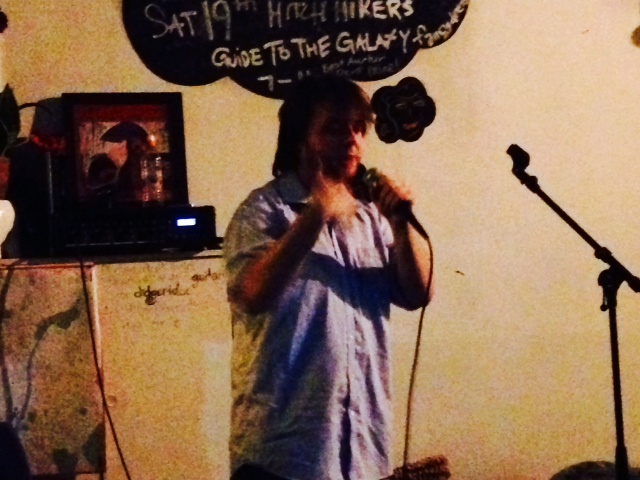
Opening with an hour-long open mic session at 6.30pm, this allowed inquisitive teatime passers-by on the High Street to poke a curious nose or ear into the Blue Chair and catch a flavour of what the rest of the evening had to offer. The café has become a significant gang hut for Weegie poets over the last twelve months, much as the Roxy Club had formerly presented, supplying an adequate artistic space where people of all ages, creeds, and colours can read their poetry in a safe and welcoming environment. “The Blue Chair reminds me of a scene in Carl Sagan’s cosmos”, remarks Cypher – “He referred to a time in Germany where people would meet in cafes and discuss the cutting edge of scientific topics of the time; an atmosphere of learning and discussion, and this was the feeling I got when I first visited here”. Cypher further added “It was the very friendly, exciting and challenging environment I enjoyed most – welcoming to newcomers as well as veterans”. Among the open mic voices this evening were the generous tones of Monica Pitman fondly recalling the incredible Jimi Hendrix, and an engaging poem by Sunny Govan Radio’s Sindigo (Sarah Simpson) which yearned to fill a hole in a damaged heart. Both ladies warm personalities were the perfect start for the evening ahead.
Proceedings kicked off with Cumnock’s Jim Monaghan proclaiming to have no love poems in his repertoire, but with ample charm and charisma the Ayrshire man delivered a fine dose of humour and nostalgia in his set which included “Lies About Iraq”, a tribute to Adrian Mitchell’s 1965 classic verse, To Whom It May Concern. This was followed by arguably the star turn of the evening as Victoria McNulty waltzed through stunning poem after stunning poem. McNulty’s zest was infectious as she flapped her arms and tossed words out like we were dogs fetching sticks, recalling tales from the Gallowgate, friends, family; the Stone Roses. Watch out for this one – the confidence is high and the poems are incredible. Occasionally, the poetry was interspersed with short acoustic sets including Lisa Gilday’s winsome melodies which carried dusky undertones mirroring the setting sun outside. Lines including ‘You’ve changed for the worst / never put me first’ soared above the gentle strumming and inviting smile upon the young musician’s face.
Between the poets and musicians, the rap-influenced styles of Cypher, Paul Wardrop, and Edinburgh’s Jyothis Padmanabhan (Joe With The Glasses) injected a healthy measure of intricate word play and rhythmic form which were greeted by the sounds of seal-honking (Is this a Glasgow thing? Seal of approval? I get it – brilliant) and applause from the predominantly youthful audience. Scottish rap is on the ascendency at present due to artists such as Young Fathers, Loki, and Stanley Odd and it was encouraging to see the rap-poetry crossover happening in a High Street café in Glasgow on a Tuesday evening. Unfortunately, one audience member was clearly so engrossed that an ill-advised ‘boyakasha’ slipped out – here’s hoping that one never rears its head again. Cypher’s own contemporary hip-hop poetry was especially encouraging as the next line of would-be rappers made their voices heard.
If there is one feature about the café which could be criticised then it would be the discomfort caused by the open kitchen. This may simply be a personal qualm but mid-way through the evening, reeking smoke emanating from the kitchen area stung my eyes, closed my throat, and left a highly unpleasant burger-smell on clothes and bags. Poor ventilation within The Blue Chair does make it a difficult visit at times, and while it is appreciated that the excellent Save The Blue Chair campaign was successful in keeping the premises open, it may be something which the venue could consider in efforts to make the dining/poetry experience more pleasant for future visitors to the café. There were a few minor technicalities on stage too – a broken microphone stand, time-wasting mobile phones at the microphone which would eat into performers sets later in the evening, preambles that were entirely unnecessary, etc but on the whole, these mild irritations were few and far between.
Cypher’s assertion about “tapping in to real emotions” being key to Extra Second’s winning formula continued with the rugged tones of Paisley linchpin Shaun Moore. In last month’s show, Cypher insisted that Moore “blew me away” with his tender, yet cautionary, poem ‘Man Up’. Tonight’s set was no let-down as poems about Motorhead’s Lemmy, grandparents, and the Clutha Vaults were delivered with the good grace of Glaswegian patter and sincerity as Moore led us through the Billy Boys, the Tims, the taxi drivers, and men in Turbans. Not to be outdone by the boys, the terrific Cee Smith and Michelle Fisher both delivered unsystematic tones of romance in poems such as “Persephone” and “Colour Me In” which left the audience smitten with the flaws and imperfections which we are all guilty of procrastinating over far too much. The haunting melodies supplied by pink-haired and pink-shoed Marli Kerr on guitar, including a sublime cover of Outkast’s ‘Hey Ya’, fitted perfectly with the vibe which Cypher is working so hard to achieve at these Extra Second events.
If love was the theme, then Extra Second was a basket of puppy dogs let loose; predominantly under control but with the occasional shit stain on the carpet which could easily be cleaned up. One could not help but admire the eclecticism of the night, and be encouraged that Glasgow is in safe hands, intelligent minds, and broken microphones.
Next month’s theme is “What pisses you off?” – make sure to check it out for yourself on Thursday 21 April 2016.
Reviewer : Stephen Watt
Past & Present

St Andrews Town Hall
5th March 2016
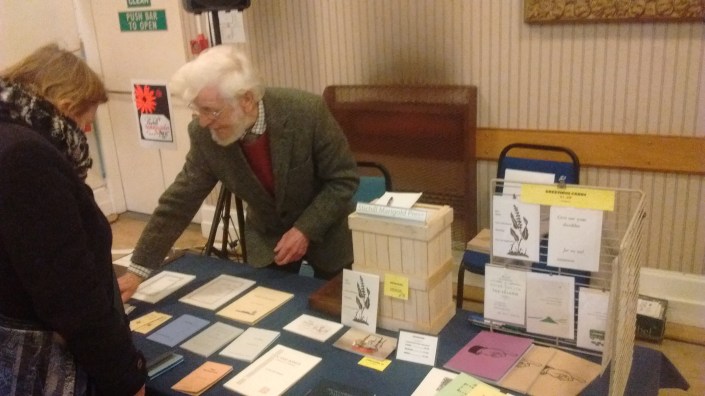
For my first cherry-popping visit to Stanza, Scotland’s long-running poetry festival set in the heady spectacularness of sea-girt Saint Andrews, I opted for three of their ‘Past & Present’ readings. Eleanor Livingstone, the director, does a wonderful job at piqueing any poet’s particular penchanterie, providing an eclectic forum for eclectic tastes. I dabble with the art form myself from time-to-time, & was curious to experience the thought-processes of other exponents of the craft, to feel if I was unique or one of the multi-winged creatures that swarm across Scotland’s holiest city for a few wind-swept days in early March. Scattered across several venues, for me I would be making camp in the Chambers Rooms of the Town Hall, above the bustling, busy, chit-chat tizzying stalls where publishers such as the effervescent Nell ‘Happenstance’ Nelson were plying their wares.
————–
Alan Riach
 Alan Riach is a professor of Scottish Literature in Glasgow, & the theme of his talk was his recent poeslation, The Birlinn of Clanranald. This mid-eighteenth century Gaelic poem, first invoked by Alasdair Mac Mac Mhaighstir Alasdair, is a nautical wonder, & should rank alongside the great seagoing poems such as the Odyssey, Childe Harolde’s second canto, The Rime of the Ancient Mariner & the Lusiads by Portuguese poet, Luís Vaz de Camões. Composed just after Culloden, Riach describes it’s creation as a metaphor for the survival of the Highlanders, & their ability to, ‘recover strength after passing a terrible storm of devastation.‘
Riach has treated this ‘deeply meticulous’ poem with great reverence, & despite not speaking Gaelic, has used the assistance of native speakers in order to fuse together a wonderfully cinematic poem, where image after images flashes in the minds eye. I loved the way the word ‘oar’ – those melodious oars – kept popping up, as this 16-manned boat was driven through the furrowing channels between the Scottish islands. This is poetry as it should be & really helped to summon the salty-spray into one’s psyche, far better than say, De Bussy’s La mer. The best parts of the poem followed the arrival of the Clanrald chief – the elixir of the Highlands – it created a sense of urgency, really changing the energy & I could almost feel the chieftan in the chambers – an excellent alteration in mood.
———————————
Sarah Holland-Batt

Like many others at the reading, I had not heard of Jack Gilbert an American poet of the Beat era, though not a Beat Poet at all. This is something that regal-voiced Australian, Sarah Holland-Batt, clearly wishes to correct, an acolyte as she is of Mr Gilbert & read us almost immediately the following lines..
When the King of Siam disliked a courtier,
he gave him a beautiful white elephant.
The miracle beast deserved such ritual
that to care for him properly meant ruin.
Yet to care for him improperly was worse.
It appears the gift could not be refused.
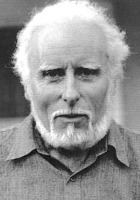 I was already intrigued. Sarah went on to give us a great little biopic of Gilbert; how he’d shunned massive fame, eschewing the literary world in order to travel the planet on the edge of poverty, to experience life to its fullest & devote himself with ‘unabashed ardour’ to his art.
Gilbert’s hermetical life reminds me of two canonical poetical maxims – Robert Graves; ‘There’s no money in poetry, but then there’s no poetry in money, either,’ & Oscar Wilde’s; ‘He lives the poetry that he cannot write.‘ For me, the tales of Gilbert’s life, so passionately delivered by Sarah, were more interesting than his poetry – although all were of a fine standard. He flew against the contemporary current into an orientalian schema, his uncluttered thought flowing from him with a simple & proud beauty, to whom his best work was inspired by his muse-women. The final poem Sarah read to us encapsulated all of this, devoted to his Japanese wife who died of cancer at 36, it describes him searching for her hairs in their house – an amazingly poignant piece.
Married
I came back from the funeral and crawled
around the apartment, crying hard,
searching for my wife’s hair.
For two months got them from the drain,
from the vacuum cleaner, under the refrigerator,
and off the clothes in the closet.
But after other Japanese women came,
there was no way to be sure which were
hers, and I stopped. A year later,
repotting Michiko’s avocado, I find
a long black hair tangled in the dirt.
—————————–
Martyn Crucefix
 Martin Crucefix, a prolific & pretty poet, has turned his craft to a new rendition of the ancient text, the Daodejing. He began with the legend of its composition – of Lao Tzu leaving 5000 characters on the ‘Ten Thousand Things’ for the keeper at the Gates of China, before disappearing into the distance forever. From the early example he gave us, that a king should ‘govern a nation as you would cook a delicate fish,’ Crucefix cast a spell over the audience, transcending the yawning ages & cultural differences between we westerners & classical China.
 Crucefix loves the Daodejing, connecting personally with its laconic, laid-back style, its economy & its enigmaticness. His own versions of those epigrammatical pearls of wisdom are simple & effective & imbued with true poetry. This was a fascinating talk, whipping a wee bit of the ‘Way’ into Scotland at the very same spot where Saint Regulus brought a selection of Saint Andrew’s bones to impress the Picts on the absolute necessity of Christianity.
——————
I’d had a wonderful afternoon in Saint Andrews – including Jemima Foxtrot’s performance poetry & all-inclusive pie & a pint at lunch – all three of the P&P readings were interesting for me & delivered with the professionalism of these poetical practitioners. I had been taken on a journey, visiting many regions of the planet in that hour & a half – & the whole experience was something listening to a three act radio play. This is the wonder of a festival, there are always different things going on, & for anyone who loves, likes, or even doesn’t mind poetry – a visit to Stanza should become a fixture on your calendar – I will certainly be attending next year & for more than a single afternoon.
Reviewer : Damo Bullen
Border Crossings: Valerie Laws & Aase Berg
St Andrews Town Hall
4th March 2016, 2.15pm
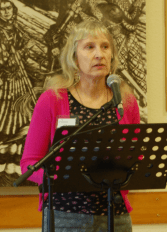
The idea behind ‘Border Crossings’ is to bring together two poets, neither of whom is from Scotland, into a single session. This wasn’t the first StAnza to include events of this nature, and I don’t think it will be the last. It’s a fixture. This particular two-voiced reading featured a poet from England and a poet from Sweden.
Valerie Laws, whose wonderfully-titled poetry collection The Facebook of the Dead came out in 2014, is also a writer of crime-thrillers, a dramatist, and once (infamously) spray-painted poems on live sheep to celebrate the quantum theory. You heard me right. Apart from all the above, she is currently writer-in-residence at the Gordon Museum of Pathology in London. I’ll bet you didn’t even know a museum of pathology had a writer-in-residence. Well you do now.
So if I tell you that she writes poetry that shows ‘a funny side to dementia’, for example, you won’t be too surprised. That was precisely the way she launched her reading in today’s ‘Border Crossings’. In her poem ‘My Mother’s Two Lovers’ she celebrates ‘the men’ – that’s what her mother called her husband, Valerie’s father, convinced in the early stage of her dementia that he was two separate men, and that she was having an illicit affair with one of them and had thereby ‘doubled her marriage’. Valerie at the time was facing single life, having recently divorced. All was not lost, however, as subsequently she met a younger man at a funeral with whom – before the ashes of the departed were cool, no doubt – she got it on with, big style!
I think by now you have grasped the mood of the readings. What followed included: a poem set in a dissecting room, where ‘veterans of the war on gravity’ gave their silent, passive contribution to medical knowledge, their genitals, amongst other parts of their bodies, still remarkably solid; a poem where jars in the pathology museum were occupied by 19c deformed fetuses, ‘such little characters’; getting her five-year-old son used to the idea of death by taking him to see his dead grandmother – a woman who, while alive, routed Jehovah’s Witnesses from her doorstep and ‘all along their Watchtowers’* – and he asks “Will she be stuffed and in a glass case?”; ‘The Facebook of the Dead’, the poem inspired by Lee Halpin that leads her collection of the same name, and which depicts the deceased’s Facebook presence continuing ‘like racehorses whose jockey has been jettisoned’; and finally a poem about the sex life of slugs, who ‘build bridges between two equals’ and afterwards stroll the pavements, fearless of rape.
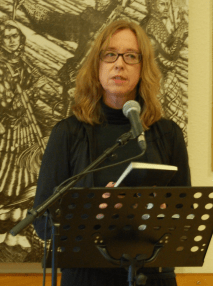
Valerie had deposited us in strange territory. Aase Berg took us deeper into it. I am sitting here thinking ‘Scandinavian’ and trying hard not to add ‘noir’. Oops. Oh well. Let me, then, tell you how appropriate that might be: Aase appeared before us dressed entirely in black, she planted herself at the microphone and did not move, did not sway, she read in… in… no, not monotone but monochrome. This description sounds dreadful, BUT as Aase writes and reads in a place somewhere between dourness and calm, this delivery draws attention directly to the words themselves. For a while the audience shuffled in their seats, then they were silent, then they were mesmerised. First she gave us one of her poems in Swedish so that we would appreciate how her original work sounds – its rhythms, its musical value – and then continued with the translations by Johannes Göransson.
There was an abstract quality to her poems. It often seemed as though a phrase or an image in one gave rise to the title or theme of the next, and the effect of that was that her entire reading almost seemed like a single poem, even when she changed from one collection to another. Each image was, in a way, discrete and distinct, and nevertheless the listener connected them, constructing a narrative the way we do with dreams when we awake. Is it relevant that she started with crystal structures and ended with parasites in snails, on the way referring to men as ‘manipulative fuck-obsessives’? Not to the experience today. I was left with the impression of beauty – don’t ask me how! Here are some of her telling lines:
… one always holds the harpoon alone…
…I want to be a bird
birds are never free
they are in complete control…
With their slugs and snails and all in between, Valerie and Aase in combination merit a whole nickel’s worth of stars.
Reviewed by Paul Thompson
*You have to be of my generation to get that one.
Poetry Lunch with Jemima Foxtrot in Melody
Byre Theatre [Studio Theatre], St Andrews
5th March 2016
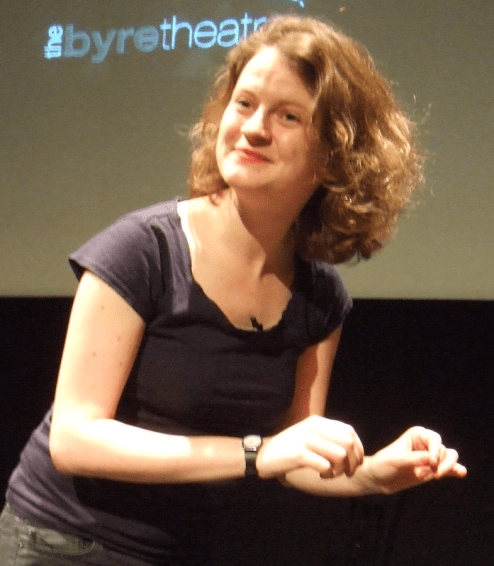
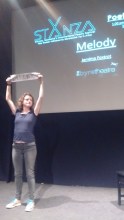
In t-shirt, jeans, and gold-coloured, turquoise-laced daps, the little pilgrim Jemima Foxtrot enters in a series of wallaby-hops, sampling hip-hop and songs from the first Bob Dylan album, making them vie for earworm status.
… I am my own boat, mast, and sails…
‘Melody’ is a continuous performance lasting about fifty minutes. It combines spoken words, singing, dancing, movement, musical interruptions from the sound system, words written on rolled-up paper or body parts… Part way through I realise that it is a walk, from point (a) to point (b), or maybe from point (a) to point (a) via point (b), and I am being taken along, listening to a life-story as I go. Her previous life as a cowboy? That’s in there. Little pilgrim dreams of the free life of a traveller, a drop-out, but also of wealth and opulence – ‘I want both’. She pauses on a park bench bearing the name ‘Albert Greaves’, as though someone has given the bench itself a moniker. In her gaze, children transform themselves, having seen pre-teenagers posing as teenagers while sunbathing on the beach. In her experience ‘love is like hot-wiring a sports car’, but come-ons from men are deliciously phoney
… I smell bullshit, but spread it all over me like liniment…
and sex can be boring. The comedic, the playful, the laughable gives way though, as a suddenly-static Jemima delivers the patient’s half of a medical conversation. The doctor’s half exists in our imagination. Little pilgrim’s bounce is replaced by a tremor, as she describes being sick onto a picture of Gwyneth Paltrow, the cover of a magazine in a hospital waiting room. I’m unsure what we’re looking at in this episode – pregnancy? stillbirth? termination? – I’m unsure whether we’re supposed to be sure, but it’s a poignant passage in the little pilgrimage.
In a way, the walk has been from childhood to adulthood, but the adult who finishes the walk is one who chases pigeons to prove that she can change things, and adult for whom childish things still signify, still matter. Jemima is also a master of the clearest enunciation. A conversation I had at this year’s StAnza had to do with the reception and interpretation of spoken performance using lip-reading. Jemima’s lips are a treat to read!
One slight tarnish was the cueing of the music/sound. I don’t know how deliberately the recorded material came and went, but on a few occasions it drowned out Jemima’s voice, and on others it seemed either to jump in or lag. Some care needed on the sliders! But all-in-all this was a damn good way to spend a lunchtime. If you missed it, she has shows coming up in Bristol, Clapham, Newcastle, and Leicester. Be a co-pilgrim!
Reviewer : Paul Thompson
Neu! Reekie!
February 26th
When Reggae is Racist
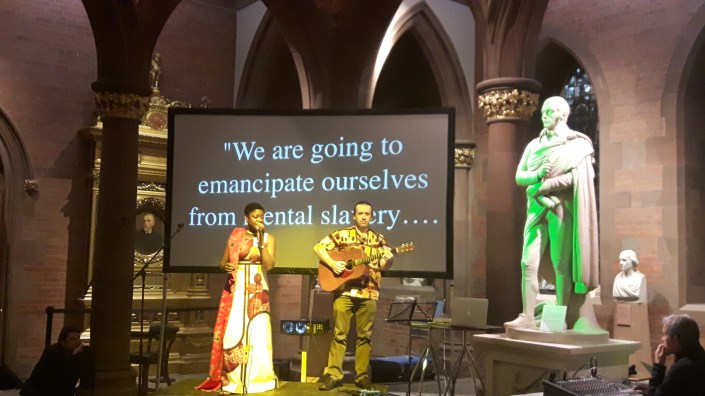
It was strange to sit in a hall of sculptures amongst a crowd made up mostly of bohemian middle class white folk, watching a film about Jamaica. The thing is, that some pretty nasty shit happened a few hundred years ago. In fact, the British actually enslaved vast numbers of Africans, and shipped them off to the island of Jamaica to work on sugar plantations. Then, the Empire poured the money made from the backs of slaves into their institutions and estates, as well as thieving as much stuff as they could from loads of other countries, and piling it into big fancy buildings they called “Museums” and “Galleries”. Don’t be surprised, dear reader, if many of the pieces in Edinburgh’s portrait gallery – like the grand buildings of Glasgow – were paid for by slave money. A lot of shit.
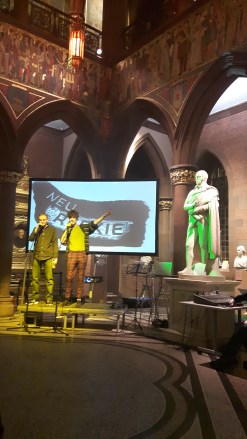 Fast forward to February 26th, 2016, a day in which loads of white middle class people gathered in the portrait gallery to watch some footage shot in Jamaica – featuring men singing reggae and talking about their lives, the shops they run, the way they live, what it means to live a good life. The footage was beautifully shot, and the director had obviously spent a great deal of time accessing the lives of people a world away, gaining intimate footage -and trust. Yet I couldn’t help but feel as though I were part of a crowd at a zoo, peering through the bars. Several of the older folk muttered behind me, finding the Jamaican’s dialect hard to understand. Many of them cackled with laughter at the men smoking weed, which – by the way – goes hand in hand with freedom.
It should be no surprise that ignorance abounds still. Racism is still rife. Equality is not yet met, and people still live who came to England in the 1960’s to escape the abjection they were left in by the British, and found themselves trapped in this soggy racist country.
 So on one hand, these kinds of events are good – they give powerful poets like Jean ‘Binta’ Breeze a platform to educate and remind her audiences of the legacy colonialism left. But on the other hand – they are not comfortable, and they emulate a dynamic of power – that of the black voice as entertainer; the white audience as the entertained, feeling as if they have the right to appraise and evaluate and monetize the voice of the black performer.
Luckily, both poets were tremendously talented, and did not hold back from delivering their politicized messages. Salena Godden performed her hilarious piece “Tits” which looked at feminism through the guise of boobies – rather optimistic, but entertaining none the less. Whilst some of her work is a little too on the clichéd side, overall she is a delight – confident, just abrasive enough, and genuine as hell.
Jean ‘Binta’ Breeze is a world of her own, every word she utters crackles with power, and she is unabashedly angry; direct; passionate. Please, just listen to her. Brina – a beautiful ray of light with a powerful voice provided a hilarious mash up of reggae and bagpipes, and tried tremendously hard to show respect to the bust of Robert Burns standing alongside the stage.
The guys at Neu Reekie are obviously brilliant curators, with access to some tremendous locations. I’m surprised by the audiences they are gathering together, which lack in youth and diversity. Given Loki is part of their upcoming billings, and the student/young population of Edinburgh and Glasgow form an enormous part of the growing Spoken Word scene in these parts of Scotland, I would hope to see them gain some traction with less people wearing tweed. Unless it’s ironic.
Reviewer : Charlotte Morgan
Poetry Lunch with Kirsten Luckins
Byre Theatre [Studio Theatre], St Andrews
4th March
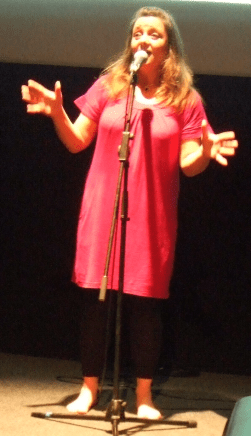
By way of preamble (hello StAnza 2016!), I have just seen a group of people sit down in the lounge at the Byre Theatre, at a table on which were free poetry books. Every single one of them took out a lap-top or a mobile device, busied themselves with it, and ignored the books. However is this any wonder? Where do most of us come across poetry – or any words – these days except on line…
‘Kirsten’, by the way, is pronounced ‘Shirsten’, or so she tells us. Cards on the table: whenever I come to StAnza I come away with at least one major poetry crush. First up Kirsten Luckins, enter my poetry crush for the year. Kirsten is originally from Hartlepool, but her performance takes us on a journey via London, Varanasi, Hong Kong, and Goa. She tells us she has a ‘monstrously big ego’ and that therefore we must clap after every poem. We do. We can’t help it. Her first poem ‘Inkless’, marvelously physical in delivery, channels all the frustration of a poet with writer’s block sneering with envy and bile at ‘some other poet’ who doesn’t. It has wonderful lines like:
… a word that might bring a posse…
… between shopping lists and suicide notes…
… that’s what ‘some other poet’ would say. Only better…
Her voice changes with the mood, the voice, the intensity of each line of each poem, whether the poetry is about washing a corpse in the Ganges (actually rather a beautiful image!) or eulogising the Star Ferry in Hong Kong:
Dock to dock
the Star Ferry rolls her hips
birthing passengers like lotus pips
Ten thousand things and all of them plastic…
Kirsten describes her personal philosophy as ‘Buddhish’, and takes the mickey out of herself by describing how irritated she was with a ‘girl from London’ on a mindfulness retreat:
… I took out my gun and opened her third eye…
Her final poem was quiet. She can do quiet. Words repeated became the sound of raindrops bouncing off all things Goan. Oh my, oh my, over too quickly, you have to follow her and find her. Every star a five.
Reviewer: Paul Thompson
Book Review : Optograms

“This child will meet God
Not on account of a malfunctioned organ
but an elephantine skull
unladen of burden.”
Stephen Watt’s Optograms is a harrowing and enigmatic collection of poems which combines an anarchic use of language (no doubt derived from Watt’s obsession with John Cooper Clarke and other punk writers) with shattered visions of the everyday.
Each poem is concerned with the death of an individual, some known to the writer, some not. The word “Optogram” itself refers to an image on the retina of the eye. It was widely believed during the late 19th and early 20th centuries that the eye “recorded” the last image seen before death, and the idea is still pervasive within certain films and pieces of literature to this day.
Unsurprisingly, death pervades this collection. Most of the pieces are bereavements – recalling the deceased through the bitter signs of their demise – needles, clothes on a mannequin. In “Digits”, a man murders a woman. Yet neither body is present: “CCTV hindsight turns him into a pronoun”; “her texture is pariah”; and the poem ends on “an innocent admirer’s phone number” which “lies sealed inside a police production bag.”
By tracing each death through these spaces, these signs, Watt creates surreal vignettes characterized by a constantly shifting perspective. The vision is not that of a camera lens, nor a painting – it is a kaleidoscope, comprised of sentences that zoom in and out, circling an unspoken and unresolved sorrow.
 The strongest poems in this collection are sonorous, rhythmic pieces bristling with internal rhymes. “Trouble was Someone Else’s Kids” is dense with expertly crafted sound patterns and vibrant images, a poem which would work well read aloud. From the first line “Trouble was someone else’s kids./ We moved in shadows, kept the lid/ on” … to the nested echoes of “Other neighbourhoods sizzled/ with pyromaniacs and politics,/ alcoholics who played tin whistles/ when Di and Charles got hitched” – the singsong pattern of constantly rhyming words captures the merry go round feel of childhood.
Others hint at urban vistas or infamous lives – going so far as to invoke the elephant man, eulogize a holocaust victim, touch on slavery. Whilst beautifully written, these poems do not work quite as well – particularly when the subject matter feels forced. Watt’s Optograms work best when they are formed of specific scenes and images which represent the departed. In “Goldfish” for example, Watt writes “Half the cards cannot even spell ‘condolences’” and “The long, black car door lies open,/ like the abyss”. The mundanity of death is packed into a poem as tightly wound as a clenched fist. There are moments here and there which could be tightened slightly. But as a whole, the best poems – “Taxoplasmosis”; “Prayers to Aliens and Satellites”; “Trouble was someone else’s kids”; “Strangeways” – paint surreal and shattered images of a place, a person who was real to the writer.
“Your Clothes Are Hanging in the Charity Shop Window” is one of the strongest concepts – the language is sparse, marrying images of the everyday (“Noddy’s constant glam jamboree”) with the corporeal, “a thick gloop of saliva”, “the baby’s bib”. Gradually, the images of the deceased body reduce, leaving only clothes in a charity shop window, a mannequin. This conceit, and the gradual pulling away of the imagery makes for a striking poem, with a terrible sense of loss unfurling at its center.
“Prayers to Aliens and Satellites” showcases a different style – markedly punk with its “Corpuscular streetlight” and “bloodless, xylophonic fingers”. In this intriguing piece tracing the death of a homeless person, all of the other people are machines in a world which has been forged in a multitude of dimensions. The piece is dreamlike and bitter, a surreal journey through a nightmarish high street.
A few things in this collection are denied to the reader. The first is a voice which develops throughout the book – there are only two or three moments where it feels as if the speaker is part of the world the poems are presenting. A few poems feel beautiful for beauty’s sake, especially the poem tracing the murder of a young woman – the language was beautiful, but the poem did not seem to make anything out of the scene, or transcend its images. Even considered within the collection, this piece – as well as the “Little Girl Picking Flowers at Auschvitz II Birkenau (1990)” and “Torch the Slave Flags” did not feel authentic, or necessary.
–
 The inclusion of a phone number with every poem – linking to the helplines for a number of charities offering support to rape victims, Amnesty International, the national bullying helpline, amongst many others – added a very real facet to a collection which refrained from offering any didactic tone within its poems. This was an interesting touch – poetry should indeed exist within the world as means of coming to terms with death, love, loss, existence; and the more tangible its effect, the better in some ways. Yet it was still an uncomfortable fit – between pieces which, in places, were so aesthetically focused and did not comment or properly represent the issues they were linked to.
Never mind. The collection as a whole is a strong one, and there are more than a few brilliant poems tucked in to Optograms. Watt is a talented poet. In the future it would be great to see a development throughout the collection, some variation – particularly with the tone of voice, the speaker, and the structure – and perhaps some relief. Isn’t comedy, according to the lately departed Umberto Eco, the “quintessential human reaction to the fear of death?” Equally, a greater sense of place would help ground the work – and more play with accent, language, particularly words endemic to the West coast of Scotland, would help to strengthen a voice which is intense, but not quite as distinctive as it could be.
For those readers interested in hearing more from Watt, I have it on good authority that he graces many a spoken word night in Glasgow, and beyond. Get yourself to a night, or at least buy his collection. It is a beautiful one.
Reviewer : Charlotte Morgan
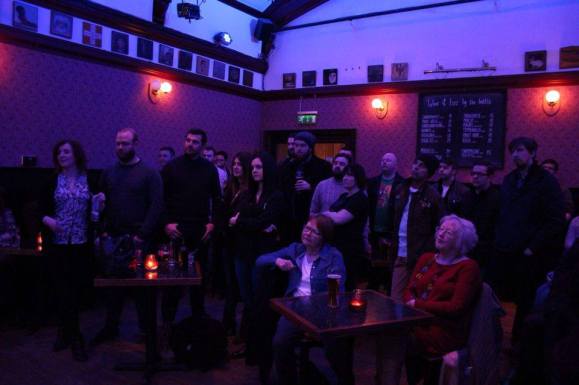
———————————————-
An Interview with Stephen Watt
The Mumble : What are the origins of the collection, did it come out as a whole or is it a later assembling of constituent parts
Stephen : The book derived from the concept of addressing a number of social issues which often affect the west of Scotland, but not exclusively. I decided that it would be a collection with minimal humour due to the often-distressing subjects which deserved reverence and sincerity. The poems were inspired by photographs, films, paintings, books, and current affairs, occasionally producing Ekphrastic poems which breathe new meaning and stories into the bones of their original art forms. There were only a small number of poems that I would consider to be personal, but at the launch I opted to read those ones as audiences are quick to garner honesty and whether or not the poet has a genuine attachment to the subject they are talking about.
The Mumble : What got you into Ekphrastic poetry & how has it affected your poetry
Stephen : I wouldn’t say it has affected my poetry. I’m writing a lot of gothic stuff just now which was inspired by [Mary] Shelly’s ‘Frankenstein’, but I recognised that due to a number of issues I was addressing in Optograms being out with my lifestyle that to create that passion and honesty, I had to tap into other art forms (ie Trainspotting / drug addiction, photograph of a Nazi concentration camp / modern day genocide in Rwanda) as a catalyst for producing a poem of sincerity
The Mumble : Your poems are all accompanied by help-line phone numbers – can you tell us more about this
Stephen : A number of exceptional poets are able to provide good advice, strong opinions, or demonstrate moral worth in their writing. I’m not really that type. I like story-telling, then leaving the reader to make their own mind up. The help-lines are, in a skewered way, my way of providing a solution – an alternative choice to the stark poem which I’ve presented – and of course tries to relate to minority groups who may otherwise feel detached from the rest of society.
The Mumble : And finally, Stephen, which of the poems from Optograms give you the most satisfaction both as a poet & as a reader
Stephen : I would probably opt for ‘Umbrella Knighthood’, a personal poem about my gran who I lost six years ago. She was in a care home living with dementia and a truly special lady in my life. That said, I was fascinated by the Strangeways prison riot in 1990 and I feel that the poem ‘Strangeways’ consummates the anarchic side of me which is compressed most of the time. I genuinely sympathised with Paul Taylor’s case when the prison was housing three prisoners to a cell at times and not catering for basic sanitary needs for others, and it was fascinating reading about the public’s perception of these men, these criminals, and what their human rights were.
 Mumble Words