Uncategorized
An Interview with David Moffat
THE MUMBLE : Hello David, so where are you from & how did you end up in Glasgow
DAVID : I was born in Glasgow and brought up in a tenement in the Gallowgate near the Orient Cinema. It was a lively house (no one talked about ‘flats’ in the east end) with people coming and going all the time. I wasn’t aware of much formal poetry, Daffodils and Village Smithies apart, but from an early age I was exposed to the lyrics of Lorenz Hart, Cole Porter, Ira Gershwin etc, through Saturday night sing-songs in our kitchen. Of course I didn’t know then who had written the words I heard sung by, Jimmy Sinatra, Archie Crosby and Hughie King Cole, only that they were clever and memorable.
***
THE MUMBLE : So how did you become a poet
DAVID : In the late 1960s at Glasgow School of Art, I had a Liberal Studies tutor called Stephen Mulrine who had written a poem I really liked called The Coming of the Wee Malkies. He encouraged me to submit some poems for the Art School magazine called Folio. I did and they were printed. Liz (or Elizabeth as she was then) Lochhead who was a couple of years above me, was one of the main contributors this publication.
Fast forward forty years and I’m a retired Art Teacher remembering the bits and pieces of writing I’d enjoyed doing between the teaching, drawing and painting so I joined a Glasgow University creative writing group tutored by the excellent Donny O’Rourke. We wrote a poem on a given, intriguing prompt every week and then had it group critiqued. I did this for five years and found the experience incredibly stimulating and productive. Thank you Mr O’Rourke.
***
THE MUMBLE : What were your earliest influences & how have they changed over the years
DAVID : I was in fifth year at secondary school when I was introduced to the work of Ted Hughes by my English Teacher. I loved it, especially Hawk Roosting. It opened the metaphor door for me when I was asked reread (how important is it to do that?) and consider the hawk not as a bird but as a symbol of fascism. What a light bulb moment that was. So the first poetry book I actually paid money for, was a Faber paper cover Editions (that’s what was written down the side of the cover) of selected poems by Ted Hughes and Thom Gunn. That introduced me to Mr Gunn and in particular ‘Blackie, the Electric Rembrandt’. A great wee poem whose title, unlike the rest in the collection, was presented in inverted commas. Why? I wanted to know why the poet chose to do that? As I get older I admire most those poets who can successfully straddle spoken word and page poetry. I saw Simon Armitage read at a Stanza event a couple of years ago where he walked onto the big stage to great applause. Ignoring the audience he placed his notes on the rostrum, slowly unscrewed the top of his bottled water, carefully placed it to the side and adjusted his papers. By now the silence was becoming uncomfortable. Then he started his first poem which to the best of my recollection went,‘We would like to apologise for…’ It was a poem about a delayed fight and the different grades of passengers waiting to board, from Platinum class all the way down to, was it Belly Button Fluff? I can’t remember. The point is he had used his silence to make the audience wait… then receive an apology in the form of his poem. So clever.
***
THE MUMBLE : As a spoken word poet, how has the scene in Glasgow been evolving during your participations
DAVID : New blood is always needed. I read every month at Cafe Rio in Glasgow and there is nothing better than a fresh voice, young or old, at the mic delivering original material. It’s important that everyone who does spoken-word encourages new poets to join us.
***
THE MUMBLE : Last year your poem, ‘Listening,’ won the Breathing Space ‘Year of Listening’ competition. Can you tell us about the process
DAVID : Dementia takes many different forms. In my mother’s case, in the early stages, there were lots of malapropisms or words she couldn’t bring to mind but she did want to talk. I realized that although I was hearing an opinion or story for the umpteenth time, she thought she was offering it for the first. That’s the difference I wanted to explore in the poem. I started with some of the actual questions she had asked me which in their own way were quite poetic.
‘Why is your face… thick orange?’ (I had a suntan.)
I found the best way to handle the many (often inconsequential) questions my mother would ask was to do so fully, as if I were speaking to a bright child. My mother might not have understood the answer but she was definitely aware I was engaging with her sincerely. Of course the answers I give in the poem are more considered than I could hope to offer in real time in a nursing home. Poetry allows you to consider what you want to say and how you want to say it. If I were granted a superpower it would be the ability to stop the world while I considered exactly what’s going to come out of my mouth next. In the poem I used an Ask and Answer format with crucially, the first and last questions being exactly the same to emphasise the circularity of the dialogue and represent the boundaries that limited my mother. The poem can be read on the Breathing Space web page.
***
THE MUMBLE : What inspires you to write
DAVID : I can understand and to a limited extent appreciate the beauty in bucolic poems but they don’t get my juices flowing. I don’t care much for the polemic either, I know about bad things. I’m a town mouse who enjoys looking at and listening to people. That and ideas is what does it for me. No way am I saying metaphysical.
THE MUMBLE : Can you tell us about your poem (the spoken/read one)
DAVID : I’ve found there is a bit of a friendly divide between page and spoken word poets. I like both. Massive Generalization Alert- I’ve bought pamphlets containing what was mainly spoken word poems and found they didn’t work on the page for me. Maybe that’s entirely my problem. Anyway when I’m writing for spoken word I try to be conscious of how that poem might be presented on a page. Maybe it’s best to show you what I mean.
Here’s how I read this ‘ironic twist’ poem
.
Old Faithful
Pitiful as an ancient cur’s last yelp,
it fought hard to stir and gasp
a final inhalation
but proved to be past help.
I heard it die,
right there on the vinyl floor,
a fluttering where once a heart had roared.
No more sniffing nostril on the job.
No seeking out a flake of skin,
or tad of sandwich crumb,
that never made my gob.
Throughout a decade plus,
the flexing neck
skirted in my step
and a barrel chest
that owed me nothing
– bar a triage check –
was taped or glued
to pass each fitness test till now.
Replace and not repair I must.
My Dyson cannot suck,
it’s bit the dust.
Ha ha, you thought it was about a dug and it was really about a hoover (sorry I mean vacuum).
Nobody listening thought it was a Shakespearian sonnet but it was (albeit with enjambments). Printed on the page, exactly the same words look like this.
Old Faithful
Pitiful as an ancient cur’s last yelp,
it fought hard to stir and gasp a final
inhalation but proved to be past help.
I heard it die, right there on the vinyl
floor, a fluttering where once a heart had
roared. No more sniffing nostril on the job.
No seeking out a flake of skin, or tad
of sandwich crumb, that never made my gob.
Throughout a decade plus, the flexing neck
skirted in my step and a barrel chest
that owed me nothing – bar a triage check –
was taped or glued to pass each fitness test
till now. Replace and not repair I must.
My Dyson cannot suck, it’s bit the dust.
Fourteen lines of rhyming iambic pentameter with a volta.
***
THE MUMBLE : What is the poetical future for David Moffat
DAVID : A few years ago I wrote an illustrated childhood memoir that no one wanted to publish so I did it as a Kindle book which has sold 3,000 downloads so far. It was a fair bit of work formatting the words and cartoons but well worth it (certainly in financial terms, I get 94p per download).
I have been told that no one wants a Kindle book of poems as everyone prefers their verse in a pamphlet and I think that might be the case. Nevertheless I’m putting together a virtual book of fifty poems along with some thoughts on why anyone would ever write a poem in the first place.
There are a number of reasons for doing going down the Kindle route.
1. It cost nothing but your time to publish the collection.
2. You don’t have to hump books around in the hope someone will buy them.
3. You can tell folk you have a book published and they can go online and have a sniff inside it.
4. It’s inexpensive to buy.
5. You actually make money from your writing – hurrah!
An Interview With Eleanor Livingstone
THE MUMBLE : Hi Eleanor, just under a month to go til this year’s StAnza – are you excited
ELEANOR : I often say that planning a festival is a bit like being a film scriptwriter and the festival is the film premiere. You sit for months at the laptop writing down ideas, bouncing back and forward emails, drafting schedules and rotas: everything is a draft, something sketched out, then on the opening day, poets walk into the Byre Theatre for the launch and for five days they keep on coming from around the world as well as from across the UK, and the audiences as well, and it’s like our film script has been transformed into 3D glorious technicolour – except even better because it’s real and walking amongst us, talking to us, performing for us, so it’s as if they step off the screen and into our festival venues. It is the most magical experience and gives me a tremendous buzz each year. As far as the StAnza team are concerned, I think of that film, Field of Dreams. Our team plan the festival but we rely on around 100 volunteers to help us deliver it. So, each year it’s kind of an act of faith, trusting that if we build it, they will come, and they do! We get volunteers returning each year from all over the UK, as well as new ones joining for the first time, and most of our core local team are volunteers too. StAnza’s success is a tribute to them all.
___
THE MUMBLE : What special moments are we to look forward to this year, the 20th anniversary
ELEANOR : It’s a bit like Christmas morning, and it’s hard to know which parcel to open first because there are so many and they all look so exciting. However, some events stick out because of how they come about. There are some poets we have been trying to get for years, so when it finally works out, then that’s something special, so this year that would include John Agard and Alice Oswald (on the Wednesday and Thursday evenings respectively), and Sibusiso Conelius Simelane from South Africa. At the same time, it’s great to be welcoming back poets who have been great friends to StAnza, like Patience Agbabi. The Poetry Café spoken word events, at 1pm fromThursday to Sunday, are always popular, and I’m really excited about our French-language focus this year, after the success of the German-language focus last year. Plus we have recently unveiled our 20th Anniversary project, Mapping the World in Poetry which when completed will, we hope, feature an audio recording by a poet from each of the more than 50 countries from which poets have appeared at StAnza over the past two decades. And our Collective Reading last year, focused on poems for refugees, was a wonderful event and this year’s Collective Reading will celebrate the porous borders between languages and people, and should be very special. Anyone can come and join in.
___
THE MUMBLE : You were born in Bathgate, but have settled in Fife – what is about the Kingdom that you love so much?
ELEANOR : Fife may have saved my life, so that gives it some claim on me. As a child, I was extremely asthmatic. I spent a lot of time in hospital and on occasion my parents were told I wasn’t going to make it. They were advised to move to the Fife coast to see if the sea air would help, and we did and it did. I love the sea and all Fife’s coastline –the Scottish king James VI called Fife “a beggar’s mantle fringed with gold” – but also the variety of landscape and urban-scape in Fife, from the beaches and rocks along the south coast, sandy reed beds to the north, hills, fields, the arable Howe of Fife, to historic towns like St Andrews and Dunfermline, and old villages like Pittenweem and Falkland. And the perspectives. From so many points along the south coast you can look down on an amazing view across the Forth, but there are some stunning viewpoints further inland as well. Whichever way I drive from my home in Leven to St Andrews has glorious views, I say it has to be the best commute. One of the things we’ll focus on at StAnza this year is how the old Fife trading routes from the 1600s now lead to cities which have their own international poetry festivals, Bremen, Rotterdam, Bergen, Stockholm and Göteborg.
___
___
THE MUMBLE : What first got you into poetry, & who were your earliepast influences?
ELEANOR : When I was a child, and everyone had to be able to perform a party-piece, my parents discovered quickly that I couldn’t sing. In a musical family, that was a challenge but they sent me from age four or thereabouts for elocution lessons. There was quite a famous elocution teacher in Bathgate then. As part of these lessons, I had to learn poems. I can still do I don’t like porridge skinny and brown / waiting for breakfast when I come down. / Whatever happens, however late, / porridge is always sure to wait. And The Sair Finger: You’ve hurt your finger, pair wee man, your pinkie, dearie me …. And I think that got me started on loving words, texts, the sounds of them, how you could roll them in your mouth. I memorised part of Tam o’ Shanter at Primary School, trying and failing to win a prize for doing so, but I can still do the opening. Then in first year at High School, thank you Miss McRuvie, we studied the Border Ballads. The first poem I wrote aged 12 was a very bad pastiche of Helen of Kirkconnel – Curs’d the heart that thought the thought / And curs’d the hand that fired the shot. How could you not be inspired by that! And I can still do all of The Twa Corbies, except for two lines near the end which always elude me. Then Shakespeare, and the War Poets, and Edwin Muir’s The Horses, all thanks to school teachers. My father liked and wrote poetry and sometimes read it to me as well. And then song lyrics were a huge influence. I recently did that Facebook thing going round, 10 albums which made up my teenage soundtrack, and that got me thinking back to the lyrics which made the biggest impact: The Incredible String Band, Cat Stevens, Steeleye Span, Roy Harper, Pete Sinfield, Clifford T. Ward, and so many more.
***
The Tinkers’ Dog
My mother refused to give them money
for drink but buttered half a loaf of bread
instead, while their dog licked at my bare toes.
One wild night years later they set up camp
in the sorry huddle of grass and trees
across the road, their voices reaching me
despite the racket of the night, talking
arguing, even singing off and on.
I lay in bed, only a few thin yards
of wind and rain between us; and the quilt
I pulled over my head against the thought
of the old dog lying on the grass, cold earth
beneath him, rain on his back, worn collar
wet round his neck: our door, locked and bolted.
***
THE MUMBLE : Your first full collection was Even the Sea (Red Squirrel Press, 2010) – can we enjoy a couple of the poems.
ELEANOR : I’m attaching two, In the Mort House and The Tinkers’ Dog. Even the Sea came out in 2010, so obviously these poems are earlier than that. The Tinker’s Dog is biographical and fairly close to facts, so the poem was an examination of my conscience. Mort Houses were where they kept the bodies of the dead before burial to stop them being stolen by graverobbers in times when it was felt that the souls of the dead, and their chance of eventual resurrection, were also stolen with the bodies. It was inspired partly by a visit to a local half-restored Mort House where I learned about the burial practices in past times, and partly by the story of the French revolutionary leader, George Danton. His wife died in childbirth when he was away and he insisted on her body being dug up so he could be sure she was dead.
___
THE MUMBLE : What were the circumstances behind taking up the helm at StAnza
ELEANOR : I was in a Fife Women Writers Group, Kaleidoscope, from about 1998. We went up and took part at the Open Mic at StAnza one year, and then were asked to MC it the following year, and one of the others was invited to join the StAnza Planning Committee. When she had to step down, I was invited in her place, and the following year was asked to take over from Anna Crowe as Artistic Director. I shadowed her for a year before doing so, and then a few years later, we had a similarly careful transition when I took over from Brian Johnstone as Festival Director. It certainly has worked well for StAnza to manage succession in this way, and I can’t imagine how difficult it would have been had it not been a gradual thing. By the time I became Festival Director, I was very familiar with StAnza’s history, aims and objectives, and how things were managed and delivered.
___
THE MUMBLE : How do you feel the festival has grown under your stewardship
ELEANOR : StAnza has always been very much a team effort and so many people have contributed to how the festival has grown and developed, as have the funders and sponsors who have supported us and the various partners we’ve worked with. I have two guiding principles which have shaped how I’ve taken things. Firstly, it has to be enjoyable for everyone involved, the poets taking part, the team and volunteers, our audiences, the staff in the venues we use; and secondly it can’t just be about the poetry I like, it has to appeal across the board, and it has to be different poets each year. So we feature mainstream and experimental, page and stage, past and present. I think we’ve become more diverse as the years have gone on, so spoken word plays a bigger part nowadays, and we’re developed to use digital media in a way which wasn’t possible ten years ago. We’ve also become increasingly international in our planning and engagement. I’ve been very fortunate in being invited to festivals overseas both as a poet and as a festival director. The first time was in 2006 when I went to Poetry International in Rotterdam. I came back inspired and also determined to allow our StAnza audiences the stimulation and excitement of encountering poets and poetry and ideas from around the world.
___
THE MUMBLE : What does the future hold for StAnza, & will you be a part of that
ELEANOR : I’ve been working for StAnza now for 12 years. I hope I’ll be involved for a long time yet, but at the same time, I think it’s important that we continue our successful pattern of a gradual transition to ensure that StAnza thrives, and new ideas and new energies have to be welcome. So I hope that in a few years I’ll start to transfer some of my responsibilities to my successor as part of a planned transition. When that is completed, I’ll be cheering StAnza on, helping out as required, and there to enjoy the festival each March, but I’ll also hope by that time to have more time for my own writing which has taken a back seat since 2010.
___
In the Mort House
On calm nights when the sky
slips down to drape the land in black,
behind the Mort House shutters
in an outer room the widower
keeps watch; and heat from two fires
cannot stop his shivering. Beyond
the lath-and-plaster white partition
those grim sisters, time and sweet
decay work on relentlessly
to beat the body snatchers
at their game.
His ears alone can hear
the resurrection men steal out
from earth’s dark folds,
boots scraping sparks,
spades finding stone,
then earth, then flesh
wrapped bone.
An Interview With Dr. Jim Fergusson

THE MUMBLE : When did you realise you were a poet, what was the catalyst?
************
a right mess
hoosis a
right mess
canny find
thi hoovir
anywherr
sumjunkies
mibby been
n blagged it
a right mess
wioot ma hoovir
**********
THE MUMBLE : Who were your poetic inspirations then, & who inspires you today?
Dr JIM :Not long after I’d bought the typewriter I started going to Tom Leonard’s writing group in Paisley. It was an amazing group, with strong characters and robust debate. Tom is an excellent teacher and a great poet, his ideas on language, class and power were really liberating for me. Before meeting Tom it seemed like I had been writing in the dark. I hadn’t figured out for myself the essential connectedness of language and politics and the mechanics of how the connections operated. I was groping towards those ideas but Tom’s work switched on a light in my mind that opened myriad creative paths for me. It felt like all the disparate parts of myself had come together, it was a wonderful process. I could see how I could be a literary artist. I’d already been reading a lot of Beckett, cummings, Wordsworth, Percy B. Shelley, Burns, Plath, Stevie Smith, Thomas Stearns Eliot, Ted Hughes, Wilfred Owen, some of the beats, Dylan Thomas, Erica Jong, J. P. Donleavy and Jack London. The folk I met at Paisley Writers Group still inspire me, Graham Fulton, Bobby Christie, Margaret Fulton Cook and Brian Whittingham. Folk from Glasgow I met around the same period were Karen Thomson, Freddie Anderson, James Kelman, Rab Fulton and John McGarrigle. In Edinburgh there was Sandie Craigie, Duncan McLean, Viv Gee and Rodney Relax. Graham Brodie and nick-e melville came along a little later. Other writers I liked were Tom Pickard, Gerrie Fellows, Tom Raworth, Eveline Pye, Brendan Cleary and W. S. Graham. Graham’s collected poems sits on my desk most of time, he covered a great breadth of work in his lifetime. Right now my favourite poem of his is ‘Implements in their Places’ which is a magnificent piece of writing. Mayakovsky, Erich Fried, Pablo Neruda and Brecht were influences too.
THE MUMBLE : What is the main driving force behind your writing?
Dr JIM :I don’t really know. I accept that I want to write and it makes me feel good when I do it. I don’t think I have much of an agenda other than some vague idea of empathy, a sense of being human and humane and wanting to share that with others. Fear of death, maybe? Fear of loneliness, maybe? A desire to understand everything better? But probably the simple hedonism of feeling good when I do it is the main thing for me.
Dr JIM :Glasgow University gave me that title for my thesis on Robert Tannahill. That was the only route to fund the research I had to do to write the book. Tannahill was a great poet and songwriter, more folk should read him and hear his songs. I took the doctorate gladly.
THE MUMBLE : How does being an accepted member of the establishment fit in with your punkish roots?Dr JIM :I’m not a member of any establishment. Don’t be absurd [smiles].
clocks tick – nature is silent
when she waited for her wages
yet they failed to come
and she smiled down on her children
sleeping safe and warm
- were they monetised yet?
- converted strictly to cash
- were they dropped off in the pawn?
- possessions of an ugly kind of love
did the Gods see her coming
did her work take her soul
and did she give of her off-spring
to take home Faustian gold?
no, no, no, it wasn’t like that
she was never, never, in control
all she had was stale bannocks
and some mouse-sized cheese
- were they hungry yet?
- were the crops doomed to fail?
- feeding innocent mouths on thimbles of brine
- clocks tick and yet nature doesn’t tell the time
as a hundred massive airships filled the skies
hoped against hope, hope would tumble down
not some black-snow sorrow yet unseen
but quiet nutritious love that might sustain
- when will we see home again
- her children wake and wonder
- when will we see home again?
- her children wait and question everyday
when grown, they bury her in sand and clay
but don’t see home again
no, no, no, it is how it is,
just don’t see home again
a mirage in their minds arises very near
yet remains so very very far away
the guards won’t let them pass, the fences reach so high
it’s here they’ll stay and here they’re sure to die
clocks tick yet nature does not tell the time
clocks tick yet nature does not tell the time.
*****
THE MUMBLE : What are your thoughts on the Scottish Poetry Scene?
Dr JIM :I like a lot of what is happening now. Though I worry about the use of a standard Grime/Rap rhythm, which can get a bit tedious to me at times. There are lots of good live performers with a good breadth of language use. I’d like to see more poems written in Arabic coming out of Scotland. On the page I liked Jackie Kay’s pamphlet ‘The Empathetic Store’ published by Mariscat Press recently.
THE MUMBLE : Who in your eyes are the poets we should be keeping an eye on in 2017?
Dr JIM :Anything by Sandra Alland, Kate Tough, Calum Rodger, Rachel McCrum, Robert Kerr, Craig Birrell.
THE MUMBLE : What does Jim Ferguson like to do when he’s not dallying with the muses?
from ‘for Eva’ – 19. often the rich complain
often the rich complain
that the poor are living too long
the poor just use up resources
that could better be used by the rich
those unproductive ones who live too long
are draining the rich of a source of their profits
yet i don’t see the rich all queuing to die
before their natural time – in reality quite the reverse
i wept for my wee dying mother
who didn’t have time
to do all the things that she wanted
all of her life she was poor
all of her life she worked in a job
where the air poisoned her body
i did not hear the rich complain
about such working conditions –
though they were busy aboard their yachts
catching sun-tans and sending out orders –
it is always all right for the poor to die this way
but the rich never say, please let me die this way too
Rodney Relax

THE MUMBLE : Hi Rodney, so you are one of the stalwarts of the Edinburgh poetry scene – are you from the city
RODNEY : I was born in the university town of St.Andrews. Also famous for the old course, of which many opens have been staged on its hallowed turf. I was actually raised for most of my childhood in the Fife town of Dunfermline. When I eventually settled in Edinburgh which would be around 1992, Rebel Inc would already be taking off and the whole poetry scene was really thriving with writers like Paul Reekie, Sandie Craigie and Barry Graham.
EXISTENTIAL NIHILISM
they had to
accept the unbelievable
beyond terror outside
of the massacre
inside of it
in existential nihilism
crept killers stalked
victims in churches
up on the hills and
finally the marshes
***
RODNEY : All the writers I’ve just mentioned and Milan Kundera’s books shift the gears for me one way or the other. Current writers operating in Scotland would be Nick E Melville, J.L Williams, Jim Ferguson to name only a few. These poets truly stand out for me at the moment. I like writing to be brave and push the boundaries; all three have the talent and intelligence to do just that.
THE MUMBLE : When it comes to performance poetry, you seem keen adding musical soundscapes, why is this?
RODNEY : I used to be in punk band called Alternative back in the 70’s & 80’s, so composing music for the poems was just a natural progression for me. Also working with Nick E Melville in Shellsuit Massacre showed us both the potential for putting soundscapes to performance poetry. It doesn’t always work mind, I’ve heard some pretty diabolical so-called musical interpretations of poetry; believe me! I remember reading a quote a while back about Dylan Thomas poems being put to music, it didn’t work out as he had his own inner noing on. Just love that.
***
HYMNS OF FAITH
we note that on
sunday’s televised debate on
religion that the majority
of the participants were
of certain faiths
so in order to
insert some semblance
of balance to the
proceedings a few aetheists
and agnostics were allowed
into the circle none
were especially helpful except
the woman who proposed
cumulative process in
opposition to irreducible complexity
at no point
was there a
general consensus that
when we die
this is the end
instead they offered
up that if
you believe in
(a)god then
you could expect
to walk into
the gates of
heavan
as they arrived
at the station
one of the
woman asked
where are we?
she was shot
when her children
were found
there was no great
rapture that would
take away their
suffering or the
genocidical actions that
took place here
is there
anybody
there?
the answer is
debatable usually rhetorical
with sinister motivations
towards eliminationism:they
thought that they
were going into
red cross ambulances
instead they were
being taken away
from their families
to death in
numbers that would
haunt the world
so it was
in our hymns
of faith that
we heard the
sirens when the
destruction was complete
***
BLACK WILLOW
lovers under the
black willow sweetly
unknowingly of the
war in europe
***
COLOUR OF HARVEST
to their wives
and their daughters
men placed guns
in the fields
of corn and
rape the yellow
colour of harvest
***
RODNEY : Poetical future for Rodney Relax? Just keep writing, keep performing. There’s the small matter of Second Space poetry events, like to do one in Glasgow this year and keep adding more poets on to our YouTube channel. There’s also our FB page which could certainly do with more contributions i.e., poems, videos, audios & adding to our picture gallery. I‘m also recording a spoken word LP this year with various musicians – cut a few tracks all ready – lots of work still to be done though, it’ll be an interesting journey for sure.
Cat Hepburn

Click Yourself Happy and Thin
Then there’s obsessive and obscene celebrity culture
Paparazzis hanging round people like hungry vultures
Waiting to get the money shot of them getting out a taxi cab
Camera right under the skirt, hoping they’re not wearing pants
Mindless gossip and fabricated and exaggerated rumours
Growing in young minds like deadly tumours
Spending time on their appearance becomes a need
The illusion of personal choice is beginning to recede…
Look how this multi-millionairess
Has managed to lose all her baby weight and squeeze her ass into a tight dress
Shame on all you normal women without personal trainers and home gyms
Your life would be fine- if only you were thin
Adverts on every single page encouraging you to
Spend, Spend, Spend!
Spend money that you don’t have: take out a loan, increase your overdraft, get a credit card
Get into debt to get that great handbag- it’s a must have!
***
Fun Mistakes
Gurning lips meet filter tips
Your laugh’s making my stomach flip
Your mate just offered me a trip
I shake my head and take a sip
Through fag smoke haze
I meet your gaze
Lock eyes wi’ you then look away
I stop myself before I say
It’s going to be one of those days
Full of reckless fun mistakes
***
 To The Lassies
To the lassies!
Look up to people who are famous for being famous, lips injected with filler, silicone breasts and pert bouncing asses
You better pluck and shave and dye, and starve yourself as much as you can
In your endless search to find a man
Otherwise I’d be surprised if Prince Charming gave you a second glance
It’s better to romanticise than to criticise, while you wait to be saved
And remember that if you ever get raped
If you happened to be drunk and wearing a short skirt then it’s you who’ll get the blame
And if you dare express a like for sex, then you must expect
To be belittled and shamed and cat called and trolled
Called a slut, a slag, a tramp, a whore
Something
You are not my boyfriend
Calling you my boyfriend would mean it’s something, and if it’s something
then when it ends … I’m left with nothing
So it’s better to say ‘it’s nothing’
Than to admit it’s anything
Anything! Call me anything… but your girlfriend
Let’s fill in the gap between complete strangers and soulmates with…something…
Something like…. seeing- yes seeing
I’m seeing you
But if seeing is believing, does that mean that I believe in you?
I don’t believe we have a future, it’s just a bit of fun
The type of fun that makes me want to hold your hand when I’m drunk,
tell you a secret, go to you when I’m upset,
Chat to my pals about you, check my phone for your texts
Wait! This is turning into….Something
But it’s not anything, I’m still single on Facebook and you’ve not met my parents
We are keeping this casual, because I would rather do anything
Anything but admit that I’m falling.
Richard Susskind & Daniel Susskind
Edinburgh International Book Festival
Studio Theatre
29th August 2016
—-
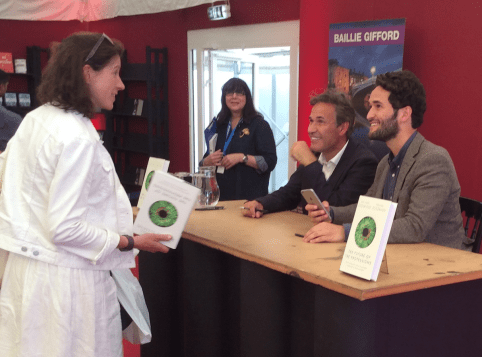
There is a problem with events like this at the Edinburgh Book Festival – it’s impossible to do justice to a book in the space of an hour, or rather, in forty minutes with twenty minutes of audience questions afterwards, particularly when the bulk of us who asked questions hadn’t read the book (yet) and wanted to challenge or probe points that the Susskinds had made during their interview. Lee Randall, the freelance journalist who chaired the event, told me afterwards that she had been out of her comfort zone, but – hey! – she managed the problem pretty damn well. The problem is, of course, conversely an advantage; precisely because it is impossible to do justice to a book in the time given, there is an incentive for the audience to buy it, and that’s what it’s all about…
Richard and Daniel Susskind are academics, father and son, and they are, frankly, experts. Both are advisors to professional companies, governments, to the great, the powerful, and the vested interest. So it is, in a way, rather ironic that the subject of their book, The Future of Professions, deals with the way that technology is already replacing ‘the expert’, and will very soon obliterate experts as a class in all fields including theirs. Reliable information will be sought – no, is already being sought, and sought increasingly – from databases and online resources. As systems become increasingly capable, as algorithms become faster and more adept at identifying patterns within information, they will not simply parallel the work of the professional but will overtake that work and thereafter dominate in all fields. In support of this, the Susskinds point out such facts as there are more visits to WebMD in the USA than walk-ins to general practitioners. Perhaps that’s not a particularly surprising point, given that health care in the US is damned expensive and it’s cheaper for someone at the bottom of the socio-economic ladder to pop to an internet café for an hour than it is to consult a doctor. However, that’s only one of a number of areas in which technology is accelerating.
Developing from this argument is the idea that the ‘job’ – in particular the ‘job’ of the ‘expert’ – will disappear. This does not mean that we will see beggars on the street with a sign saying “DPhil with family to support”, but merely that jobs will be replaced by ‘bundles of tasks’. Funny, that’s what I thought a job was, in essence, and my betting is that when they’re looking for people to do these bundles of tasks, they’ll give the work some kind of job title, but I digress. Many of these tasks, the ones that can’t be fulfilled by other systems and other machines themselves, will involve servicing the systems and the information that goes into them, it must be supposed. Throughout the event I found it difficult to stop my mind wandering back to a 1960s routine by American comedian Bob Newhart, in which he describes a recurring dream about a machine whose bundle of tasks includes firing other machines: “Sit down ma-chine your work has not been go-ing to well late-ly and we are go-ing to have to let you go. This is a rec-ord-ed ann-ounce-ment…”
No, no, no, that’s not it at all! But you can see why I couldn’t shake the idea.
The audience raised all kinds of other issues. Who will be the gatekeepers of the information? What of empathy? What of judgment? Richard Susskind said that the question of judgment was the wrong question (oh dear!), and the proper one to ask was ‘can computers handle uncertainty?’. I have difficulty with the doctrine of ‘the wrong question’, but in this case I see what he means; there is a necessity to think about what we really want to know when we ask a question. Ideally I am supposed to be at events like this to observe and to report and to review, but sometimes I just can’t resist sticking my hand up and asking a question. Mine related to critical review of the information available via computer systems: both Susskinds are academics, they will have had their work peer-reviewed, and once it is published it is open to challenge from others in the same field. I had not heard the concept of ‘critical review’ carried forward into their vision of how the future is turning out, so where in this vision does the testing of the accuracy of the information come in, given that an algorithm will pull in so much information from so many sources? They replied that firstly the process of ‘peer review’ is in the hands of people who ‘have a stake in the game’ (agreed!), that challenge and debate within the community/ies of online users will outstrip the professional peers, and that ‘communities of experience’ will develop which will be both more powerful and more transparent.
Someone asked whether there was a future for politicians, given that even their expertise has been challenged in referenda etc. Earlier that day I had been to a photocall with Gordon Brown, the former PM, and afterwards observed him walking to the Baillie Gifford, with a small knot of suited men, to give his speech. The rarified bubble in which the technocrat-managerial caste exists was almost tangible! Even though the UK’s latest referendum was conducted with an apparent nullification of the ‘expert’, with no critical voice heeded that questioned (rather than denounced) the information being given, there seemed no barrier to that field of expertise being dismantled either.
But “It’s not a free-for-all” said Daniel Susskind, and Richard pointed to three possible gatekeeping models for the systems-dissemination of reliable information. Firstly that it is taken in by the private sector, and based on the profit motive. Secondly that it is taken over by non-profit organisations as varied as charities and national governments. Thirdly that it is held in common in some kind of freely-accessible cloud – think of the database that is to come after Wikipedia, whose shoes Wikipedia is not fit to fasten, if that doesn’t sound too messianic! That last metaphor’s mine, by the way.
At the end of the day, so many questions were left hanging. I can hardly resist the temptation to email the Susskinds and ask them. It might be a good idea to see whether they’re answered in the book. Again I remind myself that I am not here to review a book I haven’t read, however, but the event itself. Let me make a comparison, then. With poet and author Louis de Bernières, I was scribbling and tweeting fit to bust; with the Susskinds I was just scribbling, because I simply had no time to tweet! The event was packed with thought-provoking information. Both father and son are articulate, so adept at putting their ideas into words; if anything father Richard seemed to do more of the talking, but that isn’t to say Daniel was left in the shade. And a quick look back shows that I have written more about this event than about any previous at this year’s Festival. That says something.
Reviewed by Paul Thompson
Lemn Sissay: Poetry with a Sharp Edge
Leila Al Shami / Robin Yassin-Kassab
Edinburgh Book Festival
August 18th
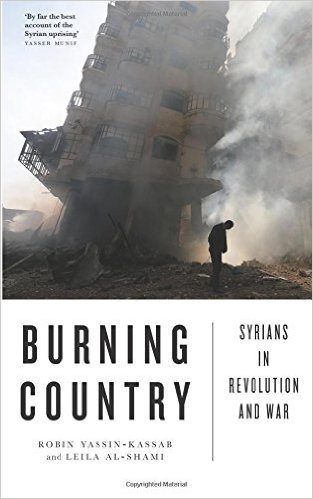
Scottish chair Brian Meecham was clear and commanding in his delivery, just like the two authors of ‘Burning Country’, Leila Al Shami, the co-founder of a network that connects grassroots organisations across the Middle East, and Robin Yassin-Kassab, a media commentator on Syria. Both Syrian-British, they were here to discuss their book, ‘Burning Country: Syrians in Revolution and War’; written to publicise the work being done on the ground by civilian organisations in Syria since the start of the civil war in 2011.
Leila had worked in the domain of human rights in Syria even before the the war began, particularly with women. Robin took his turn first to summarise their work, and was incensed that the Western media reports were so highly inaccurate about the very complex and particular situation that has developed in Syria. He’s weary of the commentary that emphasises geo-politics, speculation about US-driven regime change and the continuation of old rival factions. Where their work fills the void is in two main ways: firstly, in understanding the many factors contributing to civil war and subsequent displacement of millions, and secondly, focusing on the incredible work that regular Syrian people are doing in staggeringly difficult situations. For example, much of the mainstream media suggest that it’s a battle between secular and Jihadi forces, but the fact that many Jihadists are fighting on the side of the old regime itself contradicts this entirely. They have tried hard to add in critical details of context to these discussions in order to make any analysis of the Syrian situation itself much more accurate, as outsiders attempt to make ill-informed commentary based on their knowledge of other countries like Palestine or Iraq.
They discussed why the revolution occurred in the first place. The repression that ensued after the first failed ‘Damascus Spring’ an entire decade earlier, which simply asked for small reforms and an end to torture, created a lingering atmosphere of disappointment. Bashar al-Assad, after he unexpectedly took over the presidency from his late father, continued with crony capitalism and neo-liberalism, creating even more poverty in the country.The unwarranted violence the regime used to respond to the protests created an even more urgent call for reform and morphed into a revolution for social justice and freedom, including, importantly, a call for national unity. Support came from a huge variety of backgrounds, classes and factions, particularly amongst the working class.
Self-organised coordinating committees sprung up in secret, and worked in communities all over Syria, organising protests and linking with one another. Extreme repression resulted again, with torture, rape and disappearances. So extreme in fact, that many soldiers defected in disgust. This situation spiralled into war; convenient for Assad who wouldn’t have been able to justify killing peaceful activists. Al-Quaeda also wanted war; who became relevant again because of their needed military prowess. The regime and foreign states have contributed to sectarianism which was always part and parcel of the regime’s classic divide and rule policy. They outlined the major events leading to war; such as when the regime released the Jihadists who had been fighting in Iraq, imprisoned and then released as needed. Assad organising a massacre of Sunnis by the Alahouns who are a minority Shia sect. At this stage, the West, frightened of the alternative, decided to stick with Assad. Isis was being defeated, but Al Nusra, a home grown version of the Al Queda group, became stronger. Assad and his forces still have been by far the biggest killer of people.
Leila talked about the popular struggle for justice on the ground. The movement for democracy progressed to being a rejection of all forms of authoritarianism. In Idlib province, people protested daily for 160 days to get al Nusra out. It’s an Al Quaeda affiliate in Syria and people don’t want it. Civilians are self-organising in communities for self-rule, and it’s estimated that Assad was only in control of 20% of the country at one point. People were forced to take control at a local level, just to keep basic services like food, sanitation, health and education functioning. Protests were not enough, so people had to find a way to organise themselves using horizontal, autonomous organisational structures to provide food and medical services, many of which run by women. Local councils sprung up in the hundreds, and she estimates that there are now around 800. These administrative structures, many of which have been highly influenced by radical thinkers like anarchist theorists, Sufi clerics and an Italian interfaith priest, have the majority of their leaders democratically elected.
It felt like the discussion between passionate and knowledgeable speakers and a highly engaged audience could have easily gone on for hours, if given the opportunity. The questions were excellent and the answers were immediate and thorough. One of the questions was about the role of journalists, and whether they had given up on this war even though it has massive repercussions for the rest of the world; triggering the biggest refugee crisis since the second world war, and its own domino effect on Brexit and Putin’s military actions. Well-known commentators were named and shamed for being embedded or irrelevant, and even the political analyses of Noam Chomsky, the sacred cow of the left, were slaughtered for its old-fashioned binaries.
Laughter rippled across the tent as the last question was posed to Yassin-Kassab with just a couple of minutes remaining; what’s it going to take to stop the fighting? He sat back and smiled; the first and only smile of the session, given the subject matter. He wasn’t at all optimistic that the end was in sight any time soon. However, he suggested that pressure from outside would help; namely pressure from Western powers on Russia to withdraw its support of the government, and to investigate why the Americans vetoed support of arming the Free Syrian Army.
The audience was obviously a well-educated and politically aware crowd, with great concern and interest in the Syrian civil war and its effects within and without the country. People were keen to know how best we can continue to inform ourselves with accurate information, and what we as outsiders can do to help the situation. The authors indicated a list of news sources in their book, and suggested following blogs such as Syrian Untold and Syria Direct. The consensus was one of huge gratitude to the authors, as most of the vast amount of detailed information they gave us was new, and in a strange way, refreshing in its emphasis on people power and a radical departure from the standard media fare on Syria today.
Reviewed by Lisa Williams
Louis de Bernières
Edinburgh International Book Festival
Baillie Gifford Theatre
25th August 2016
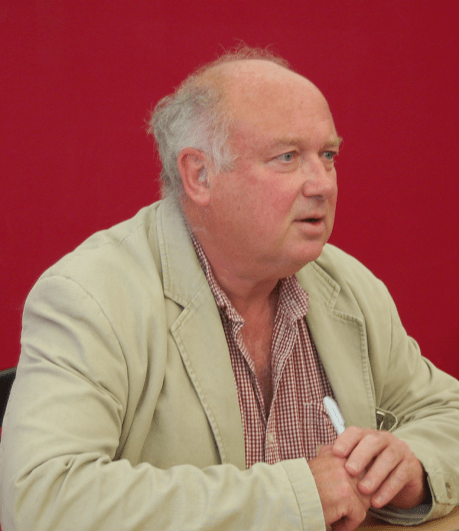
As I sat in the Baillie Gifford Theatre for this event, I filled more pages of my notebook and tweeted more tweets than during any of the events I have attended so far – and we’re almost at the end of the festival. The reason for this is simple. Louis de Bernières seems to produce more quotable quotes per minute than anyone else, and I’m talking about conversationally, never mind when reading his poems.
Poetry is de Bernières’s favourite and chosen medium. During the afternoon passing reference was made to the fact that in 1993 he was known as a promising young novelist, and again passing mention was made of a novel set on a Greek island in World War 2, but the prime purpose of his visit was to talk about Of Love and Desire, his new collection of poetry. Of Love and Desire is his second collection of poetry, and contains poems about, well, love and desire that he has written from the age of seventeen to the present. Viv Groskop, chairing the event, asked if the book was ‘a biography of [his] loves’; “Yes,” admitted de Bernières, “with lies and transformations,” and went on to say that generally when a poet celebrates a large number of loves it begins to sound like boasting.
We didn’t get to hear much of his poetry, it has to be said, as the majority of the time was spent in conversation. What we did hear perhaps couldn’t be called great poetry, but it was fluid, full of imagery, and tended, ‘like Middle-Eastern poetry’, to jump from subject to subject within the space of a line. De Bernières is an incredibly prolific writer of poetry, inspiration coming to him in bed, or whilst driving his car (in which case he has to memorise it), in an almost constant stream which he can’t imagine drying up. “It would be horrendous,” he said, “knowing I was on my deathbed and another poem was coming,” but he could see that happening! “I don’t have self-discipline, I have obsession,” he went on, recalling his younger days when his writing was fired by cigarettes and coffee. “Now that I’m fuelled on red wine I’ve started to slow down a bit [..] I have a demon that drives me on – I’m very grateful to it.”
His editor had told him that there was too much about wine in the first draft of Of Love and Desire, but de Bernières subscribes to the Middle-Eastern tradition of using intoxication by wine as a metaphor for both profane and divine love – again that marked M-E influence.
He treated us to a reading of his newest poem, composed the night before as he strolled along Princes Street and happened to see a street-beggar. This ‘Dreamer on Princes Street’ had ‘slipped through the bars of life.’
“Poetry ought to be speech made musical,” he said. When asked for his poetical influences he admitted to being “terribly influenced by anything I read”, citing Sappho, and Constantine Cavafy. He used to love Pablo Neruda – as do so many young people – but he is no longer young and said “I stopped believing what he was saying.” In pursuit of this musicality, he loves assonance and iambic meter – “T S Eliot has written some wonderful iambic lines, even though we think of him as a modernist poet.”
His greatest achievement? In his opinion, his novel Birds Without Wings, which is actually used in modern Turkey to teach Ottoman history. On a visit to that country he was surprised to see large pictures of himself on advertisements. His guilty pleasures? His collection of guitars. That prompted a member of the audience to ask if he would sing one of the many songs he has written, but that he declined to do unaccompanied. What is the greatest love in the world between two people? Between parent and child. “I have never been loved by anyone as much as I have by my daughter.” Having children is like having research material to hand all the time. His driving demon? He speaks of seeming to hear voices, and wonders if his talent is a constructive form of paranoid schizophrenia.
From all this you’ll realise how fruitful and how easy on the ear the event was. I think it was more relaxed than any event I’ve been to during this long-fortnight. Good listening, good value, enough said.
Reviewed by Paul Thompson
Prue Leith – The Prodigal daughter
Edinburgh Bookfest
Charlotte Square
22/8/16

Previous Michelin starred restaurateur , Prue Leith is publisher of a large volume of cookbooks, some published under her own Leith School of Food and Wine. Here to promote her second book in a pre-mapped trilogy which is her seventh novel to date. The Prodigal Daughter, will be out on the 15th September. It’s a story about, ‘an eighteen year old girl, Angelica, at a cookery school in Paris in the sixties who falls in love with her unsuitable Italian cousin, and her rocky journey from naive enthusiast to top caterer and telly chef.’
Leith has invested in and become an old friend of, ‘cobbler’s wax, the glue that sticks you to your chair ’ after a short course in novel writing. It certainly seems to be paying off : she has aspirations to become a film writer in her seventies, this trilogy has been optioned for a TV series by Stephen Fry’s company Sprout in partnership with Parallel Films. They are combining forces in the hope of making a big fat multi-series. Let’s hope it all happens for the focused, driven and funny lady who has had such an interesting career path that it doesn’t sound too ridiculous to go from chef to cookbook author to novelist and now possible film writer. Go Prue go!
Keen to ditch the chicklet/romantic fiction and be more aligned with her male counterparts whom she tells us are described as giving , ‘deep psychological insights into dysfunctional relationships.’ Leith cites Birdsong (Sebastian Faulks) and Anna Karenina (Leo Tolstoy) as the best love stories and reveals Birdsong as having the best sex scene ever. I’m guessing that her love scenes won’t disappoint her readers then! Being treated to an excerpt from the book we realise sharpish that Angelica is in Paris to learn but won’t be bullied by her forceful teacher, a sentiment close to Prue’s own teaching experience, ‘people who are frightened can’t absorb. You really have to be nice to them if you want them to learn.’
Always one for moderation when it comes to cooking and not for spelt biscuits she also discussed her belief in the saturation of cuisine books and food inspired television series. Slightly schizophrenic looks define her in her television career with her looking more , ‘homepride and voice of reason’ in Great British Menu on BBC2 and , ‘a bit freaky’ looking in My Kitchen Rules Channel 4. Did you know that publishers have algorithm analysis that let them know good names for heroines and what colour of eyes are the most popular ? Well, now you do. Apparently Celtic names are on trend as is Iceland for location. Hair should be red not mousy. A fascinating insight into the world of Prue which should be a good read from what the audience heard today.
Reviewer : Clare Crines
 Mumble Words