Uncategorized
George the Poet
MITCHELL LIBRARY
Aye Write Festival,
18 April 2015

Spending a Saturday evening, cooped up in a library listening to poetry has never held much weight for this reviewer over the years, but Aye Write! Festival 2015 were unearthing the hottest property in spoken word this evening at the Mitchell Library in Glasgow in the form of George Mpanga aka George The Poet. The 24yr old Londoner has been making quite a stir over the last couple of years, featuring on BBC Radio 1, Sky Sports F1 Grand Prix in Monaco, and being shortlisted for the Critics’ Choice category at the 2015 Brit Awards. An ability to adapt rap into a strong, poetic form has enabled the young lyricist to carry his social and political messages farther than even he could ever have envisaged, and for the second time in the past couple of months, George was ready to win over Glasgow.
From among the hubbub of silver-haired scholars, studious apprentices, and salmon-shirted Aye Write staff directing festival things to their appropriate halls inside Glasgow’s stunning Michell Library, Jean Cameron welcomed George to the stage – headset attached, projector backdrop, comfortable seats for Q+A purposes, and lectern on stage awaiting like a business conference. Although sceptical at this formal layout, the evening settled quickly into the young bard’s calm and likeable approach, reeling off the thought process behind new book ‘Search Party’ (launched February 2015) with anecdotes before each poem.
It is the ability to slip comfortably between academic language and London slang which is George’s most established quality, spouting advice between each articulate, assertive line. It is only the occasional stutter and brief pauses to regroup his thoughts which allow the audience to blink free from being indoctrinated by the poet’s tirade concerning ‘the universality of humanity’. This is not to say that this is an unwanted brainwashing, however peculiar that may seem. It is a positive spiel concerning social groups and opportunities available within communities which the skilled lyricist is administering during “Believer”, rising out of the social groups in which we are all parcelled into. The attentive crowd do not applaud until our speaker chooses to say thank you, and it is perhaps a small intimation that the air feels too heavy and that the guest needs to feel that he has everyone on his side.
In “Scapegoat”, the insightful prognosis that a strong social group offers latitude from life’s difficult times is not a revealing proclamation, but it is the poet’s undertones to fight which veer his work from thoughtful oracle into motivational speaker. As he states himself, George loves a validated argument and his curiosity in problem-solving and seeking solutions within corporate circles occasionally jars between being on the cusp of enlightened, radical thought-processes and the enterprising mission statements one finds in the reception areas of big business. Indeed, tonight’s orator cleverly uses the incantation of human growth and technological advances to surprising effect in one poem:
“There are seven billion people in the world
and not one has the same fingerprint as you”.
If George was selling a product, then it would be self discovery and how to progress oneself. The lesson of learning from one’s failures is addressed in the questions and answer session after a half hour set, wherein his advice to younger poets is not to ever consider themselves ‘lesser’ at the beginning of their journey, but to embrace that transition of human experience. Using commentators and an assortment of heroes such as Muhammed Ali, Malcolm X, and Maya Angelou as an example of anyone who can articulate an ethos, George’s observation that one newspaper referring to him as a ‘rapper’ may border on racism is food for thought, and addresses exactly where ‘the poet’ moniker begins. The slow and deliberate responses, articulating his experiences, lends tonight’s performer as being both considerate and respectful, always seeking ways to add value to his words.
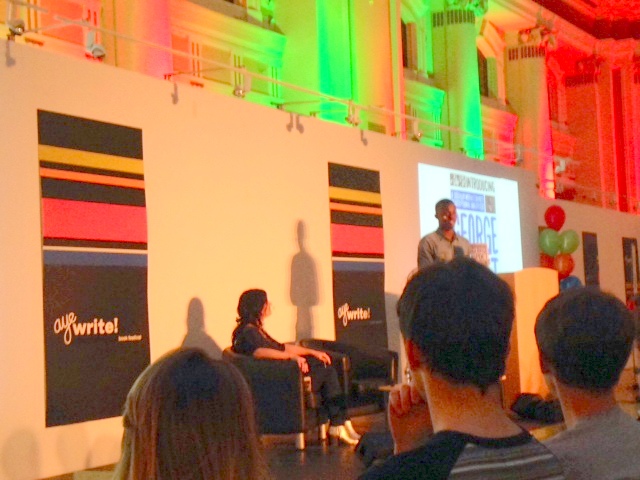
Satire frequently breathes inside of George’s messages, and from experiences ranging from reading in UK prisons to Buckingham Palace, a broad spectrum has now listened to his positive rhetoric and unabashed plugs for his new book – or ‘manifesto’, as he calls it. Tonight was a fascinating experience which left the crowd with a lot on their minds with the upcoming elections only weeks away. If the young poet’s proclamation that we are all in boxes used to manipulate political standing, it will be interesting to listen to what he has to say once the ballots have been crossed and the results are in. Don’t be surprised if, one day, you find yourself voting for George Mpanga’s Search Party.
Reviewer : Stephen Watt
Poetry Café : featuring Erin Pornoff
Studio Theatre, The Byre Theatre, St Andrews.
7th March 2015

As this is going to be my last review at StAnza this year I would like, first of all, to thank the organisers for making me welcome, for putting up with my being underfoot, and for letting me have a replacement ticket when I lost one. It was great to meet the poets – nice to bump into John Dennison again today and, after eavesdropping on an interview, have a few minutes’ chat with him and learn that, yes, our reviews are read by their subjects – and I made my daughter jealous by tweeting that I had been in the same room as Brynden ‘Blackfish’ Tully. Well, that actually means I happened to be in the bar with actor Clive Russell. Anyway…
My last poetry, pie, and Peroni session was a treat. Erin Fornoff, born in North Carolina and now based in Ireland, gave us a shorter and gentler presentation that the preceding ‘Poetry Cafés’, so much so that we were all unsure whether to clap at the end of each poem. To clap is very much a ‘Poetry Café’ thing; not to clap is very much a formal ‘reading’ thing.
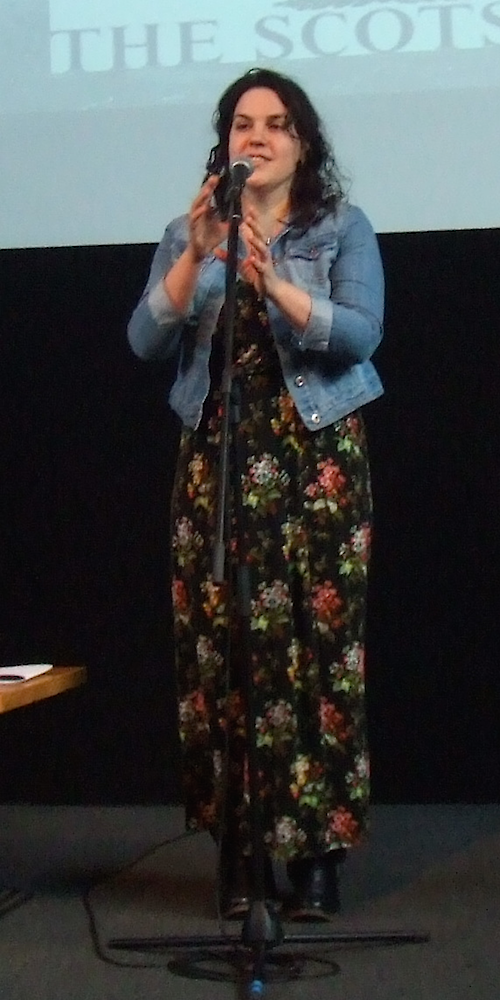
Erin has learned to memorize the poetry she presents live, ever since she was due on stage to give a reading, grabbed her notes, and, when she stepped up to the microphone, found that she had picked up someone’s schedules for gym sessions. She gave us a programme of twelve poems in all, not all of which were memorized, it must be said, but all of which were engaging and delightful. They ranged from a tribute to the way people in New Orleans had been through Hurricane Katrina and come back to resume their lives, to the reaction of a Texan removed to Appalachia and seeing snow for the first time. Introducing one about living across the Atlantic, in a strange country, in a cottage miles from anywhere overlooking the Irish Sea, she mentioned that it turned out to be lonely – “Who knew?” I particularly liked the poem ‘My Father is a Skydiver’, in which she described her father’s growing old as ‘becoming less tall’; also ‘Moonshine’, in which she played with the meaning of the word ‘proof’.
Best of all, though, was ‘Opposite of a Thank You’. How to explain it? It was an esprit d’escalier piece, directed at a former mentor, someone who had encouraged her work at college, only to eventually suggest a liaison because he had ‘contacts in the literary world’. I’m glad to say this is available on YouTube, so just go there and search for her name and the title, and enjoy!
Nothing more to say, except perhaps we could have done with a couple more poems from her – as I said, the session seemed to be over in a trice. Identical to a thank you Erin, and identical to a thank you StAnza.
Review by Paul Thompson
Meet the Artist: BodySearches/Poetry Machine featuring Michiel Koelink and Jon Ståle Ritland
Conference Room, The Byre Theatre, St Andrews.
7th March 2015
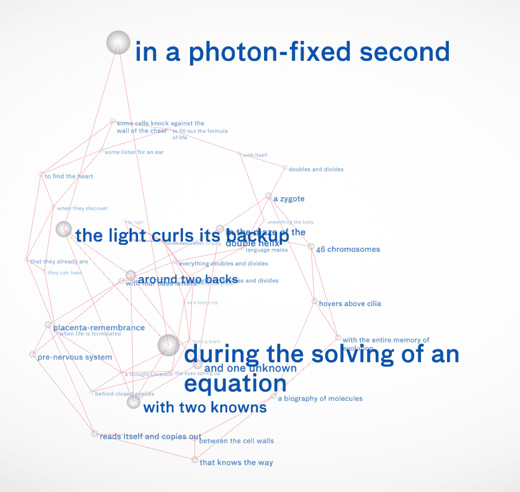
The Conference Room is not the most attractive venue at the Byre, being bare, airless, and humming, but it does have the advantage of technology. It is easy to set up a laptop there with a feed to a screen. If StAnza-goers had been observant, they would have noticed occasionally on the wall of the theatre Atrium, a series of projected phrases zooming in and out of prominence, and maybe wondered what they were. This session was designed to give an explanation, or at least go some way towards it.
Michiel Koelink is Dutch, and Jon Ståle Ritland is Norwegian, but writes poetry in English. They met at StAnza two years ago, had a meeting of minds, and decided to collaborate. The raw materials were Jon’s poetry, in particular works from his book Body Searches, and Michiel’s dexterity with computers. He gave us a quick display of how his software plays with Jon’s words, fixing each phrase to a dot, and the dots attached to each other by lines. There is a central point of ‘gravity’ on the screen to which everything is attracted, but working against that the dots push away from each other while the lines tend to pull back. No, I don’t understand why it doesn’t all end in equilibrium, but it doesn’t. It moves, and phrases emerge into the foreground in an apparently random fashion. The sequences generated do not seem to repeat themselves; Michiel explained it by the analogy of throwing a glass of wine into the sea, and then bringing the glass back twenty-four hours later – it is mathematically possible to scoop up something that is one hundred percent wine, but it is very, very unlikely.
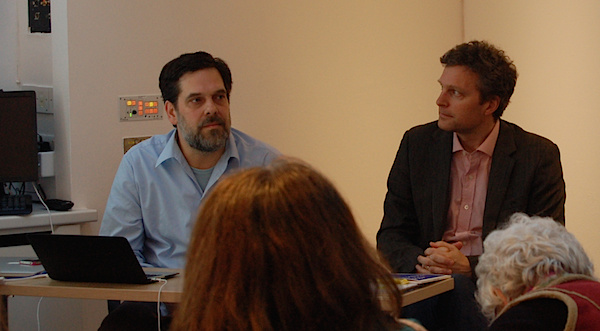
Then Jon gave us a reading of some of his poems. Here the session came unstuck a little, because he has a very quiet delivery, so we struggled to hear well. Perhaps next time there should be a little light amplification provided – it only needed a touch. After that it was Michiel’s turn again to take us through some of the ideas he had been working on prior to their collaboration, which inspired and fed into it.

We had the opportunity to comment and ask questions, which was quite fruitful and prompted a handful of people to speak up. I commented that the effect reminded me of how a touch-screen tablet responds to swooshes and pinches of its operator’s fingers, and wouldn’t it be wonderful if that could be incorporated in the project. Michiel nodded and said that the idea had indeed occurred to them but it was way, way over their available budget.
I’m not going to award stars for this event, because it wasn’t that kind of event – but yes, I enjoyed it, and it sent me away musing on how conventionally we read poetry.
Review by Paul Thompson
Saba Douglas-Hamilton: A Life With Elephants

Poetry Café : Owen O’Neill.
Studio Theatre, The Byre Theatre, St Andrews.
6th March 2015
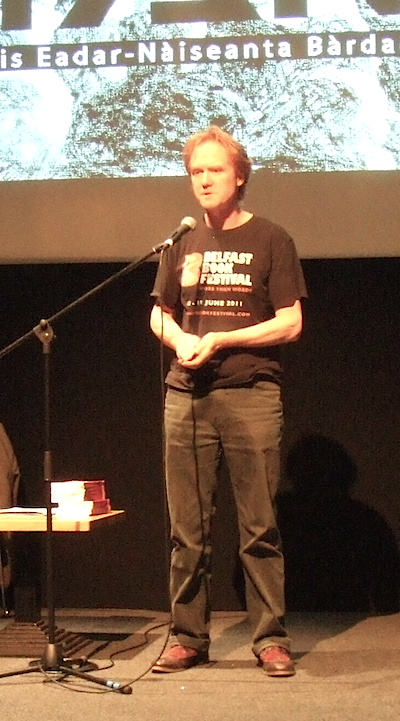
I have a funny story about when I had a stammer. It really is a very funny story. But then there’s this Irish bloke called Owen O’Neill who has a really, really, really funny story about when he had a stammer, and he wrote a letter about the IRA and sent it to a newspaper, and the newspaper only went and printed it, and the IRA sent someone round to the cottage where he was staying to convince him of the error of his ways. And this someone had a stammer…
This is the Poetry Café, and that means you get a pie and a bottle of beer thrown in with your ticket. The wise StAnza-goer bolts his or her pie quickly, and then nurses the beer-bottle between his or her feet, like a penguin guarding an egg. This is necessary. It’s particularly necessary for a session with Owen O’Neill, because you would drop it laughing, or break a tooth if you happened to be taking a swig at the time. Owen, you see, is one hell of a raconteur – and I don’t mind betting he’d hate being called that. But he is a stand-up comedian as well as a poet, and what he actually did for his café-spot was take us on a tour of the people he has met, from his childhood in County Tyrone right up until he recently named his grand-daughter. If you go to see him anywhere, be prepared for his tale of being struck by lightning, or to hear about Miss O’Brien the headmistress at his school and her attitude to his imaginative picture of Christ escaping crucifixion, or to hear about when he, aged nine, decided to confess to ‘a sin of impurity’ because it sounded good, or to hear about Mary Cassidy and why she was called ‘The Virgin Mary’ and why she thought he had the power of healing. Oh yeah, and the stammer, you have to be prepared for that one.
The eight or so poems he managed to fit in around all this story-telling, described many of the same encounters and events; or if not them, they explored the possibility that Lazarus was not dead but having a long lie-in, or who was the odd child at the edge of the school photo, or what is so brilliant about navvies. By comparison with the stories, the poems were serious, or had a seriousness about them. Where they told the same story, they did so on a slightly different plane. Poems and tales, the one sparked off the other. I can’t think of a better way of getting indigestion from bolting a pie. Five stars, right off. Thank you, StAnza.

Review by Paul Thompson
Border Crossings : Hazel Frew and Martin Glaz Serup
Supper Room. Town Hall, St Andrews.
6th March 2015
I have a piece of advice for the people running StAnza, a very simple piece of advice, and it is this: When you have given a poet twenty-five minutes to fill, make sure there is a pocket-watch duct-taped to the podium, so that he or she can gauge how much time is left of the session. What happened this afternoon with Hazel Frew is that having finished a run of poems, and got to minute twenty-five, she then picked up a book, looked across at the chap in charge, and asked “How long have I got?” He, being a polite chap and not wanting her to end her session abruptly, said “About another five minutes.” She ended up with a total of thirty-five minutes, having read us two dozen poems. Now, I have nothing against hearing twenty-four poems by Hazel Frew, because she is after all a good poet, but once again a ‘Border Crossings’ session was badly balanced when it didn’t need to be.

Hazel was brought up in Broughty Ferry but now lives in Glasgow. She expresses a preference for poetry that is ‘direct, but in an indirect way’. When her mother died of cancer, the shock was so great that it took a long time for her to get over writer’s block. It was only broken when the local authority in Glasgow decided to demolish a public garden and fell some trees that had been standing for well over a hundred years. She was then able to write about her mother’s illness, from diagnosis to death, and she presented us with fifteen poems about this. They were serious to the point of being sombre, and they were very, very emotional. Her part of the event was then lightened a little by readings from her book Seahorses, and from a couple of pamphlets, but as I said, it over-ran.
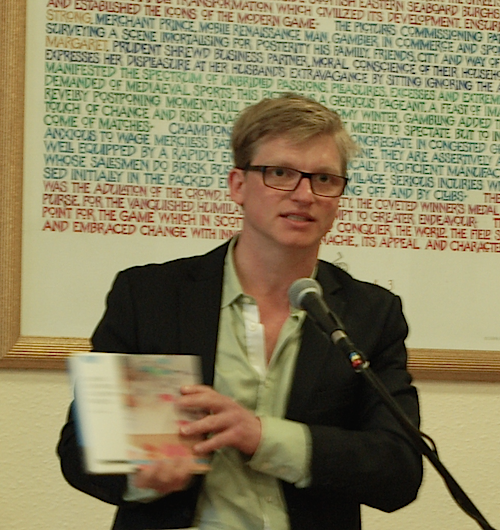
Martin Glaz Serup is from Denmark, and writes in both Danish and English – I instantly thought back to the previous day’s ‘Poetry Café’ in which Agnes Török, who is from the other side of the Øresund Bridge, had a few pointed remarks about bilingualism. He read to us in both languages, mainly, he said, so we would hear how they sounded in Danish. His poems were much longer than Hazel’s; with the Danish versions and extracts, he was only able to give us half-a-dozen. These were full of questions, rhetorical questions mostly, or so we were (possibly) led to believe – weren’t we? The first one included hand-gestures, in lieu of a PowerPoint presentation, to indicate each question mark or Yes/No option. Here’s a question:
Do you have to be happy in order to write a poem about happiness
or should you, precisely, not be happy
should you be made happy by reading it
Please note the complete lack of question marks! I like that. Martin’s poems travel from point A to point Z, not necessarily in alphabetical steps, but they get there. And don’t be surprised when a famous name or two are dropped.
Reviewed by Paul Thompson
StAnza International Poetry Festival ‘Border Crossings’ : Kim Moore and John Dennison.
Supper Room. Town Hall, St Andrews.
5th March 2015
I have to say I am not sure where ‘Border Crossings’ stops and ‘An Archipelago of Poetry’ starts. John Dennison is from New Zealand which certainly counts as an island. Kim Moore is from Barrow in Furness, but unless she’s actually from Walney Island… oh wait, why can we never remember that the bulk of the UK is, in fact, an island? Certainly both Kim and John have crossed borders to get here anyway, and Kim has zigged and zagged across the UK by train to do so.
The venue has a very ‘civic’ feel to it, and straight away the audience knows it is not at a slam (where many of them were twenty minutes earlier) but at a reading. Not that there isn’t wit to be heard, but is embedded in poetry that demands and repays attention.

Kim Moore is the daughter of a scaffolder, and has been a teacher of the trumpet for eleven years. She describes ‘her’ people thus:
I come from people who swear without realising they’re swearing.
I come from scaffolders and plasterers and shoemakers and carers,
the type of carers paid pence per minute to visit an old lady’s house.
Some of my people have been inside a prison. Sometimes I tilt
towards them and see myself reflected back…
She prefers to record her poetry in a hardback book rather than ‘scrappy papers’, because that way it is ‘more real’. Some of her work deals with harsh facts, such as domestic violence, in metaphor. Other poems, such as ‘A psalm for the Scaffolders’ are celebratory. Others still are blackly funny, such as the curse of a trumpet teacher in return for the various atrocities committed by her pupils, in which she changed the gender of the perpetrators to protect their identities. Or so she says!
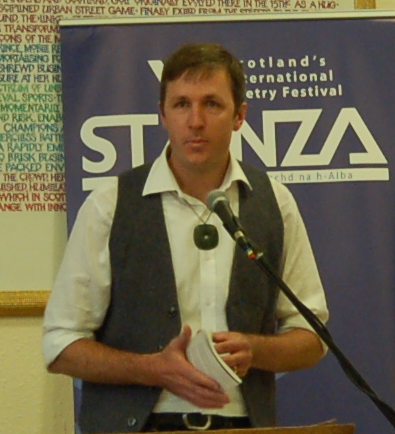
John Dennison’s poetry needs more careful listening still. His poems are shorter, nothing much longer than a sonnet, and when he reads them we are aware of the way he wants his words stressed. There is a careful pace to them, and an apparent deliberation in their construction. His background as a chaplain comes to the fore in, for example, a piece he describes as a ‘Jonah poem’ set in the hold of a ferry, or a poem about climate change based on the story of Balaam’s ass from Numbers 22, or one that points out how like a Madonna and child the common ampersand is – that’s ‘&’ to you and me. His poetry is remarkable.
I would like to give this event five stars. I can’t, I have to take a little bit of the shine off the fifth star, and here’s why. The balance between the two poets wasn’t quite right, and all it would have taken to restore it was one extra poem being given to Kim Moore. Maybe because John Dennison’s poems were short and there were more of them, it felt as though he had more time, as he shuffled to and fro in his book for the next one to read. I admit I didn’t check my watch, I just went away with that impression. As regards the actual quality of the material, and its delivery by both poets, I couldn’t fault it.
Reviewed by Paul Thompson
StAnza International Poetry Festival ‘Poetry Café’ : Agnes Török and Toby Campion.
Studio Theatre, The Byre Theatre, St Andrews.
5th March 2015

Looking around at StAnza you would be forgiven for assuming that there was a way poetry buffs ought to look – the men, for example, with silver beards and skipper caps. Slam poets, by contrast, are young and dress in black. They are situated in a black room with black drapes, black floor, and black armchairs; and we, middle-aged and balancing a Peroni and a macaroni pie, clap, punch the air, and go “Whoop!” whenever they say anything risqué, just to show we’re down with the kids.
That takes care of us. What about the poets? Agnes Török is Swedish, resident in the UK, and bilingual. She arrived in the UK just as the coalition government was getting into its stride, and she declares that as a young, unemployed, gay, European immigrant she is their worst nightmare. Her manifesto is that poets write poetry ‘to deal with stuff’ both personal and political. She has no time for ‘art for art’s sake’, a lot of time for people in hospital (both carers and cared-for), and can compose a whole poem about the questions that people ask her about her sexuality. The latter, when it is so phrased that every instance of the word ‘gay’ is given as ‘straight’, is an incredibly witty way of showing how daft the questions she had to field were. I liked her instantly: I liked her style, I liked her voice (which seemed mid-Atlantic rather than either Swedish or British), I liked her delivery, I liked her words. I especially liked her rising to Toby Campion’s challenge to write a bad poem about three items of foodstuffs – it wasn’t bad at all.
Neither was Toby’s in reply, written to an ex, getting an “ooh!” from the audience for saying that ex was like white wine – ‘a little tart’. He’s a StAnza debutant but no stranger to a slam. Like Agnes, he composes poems that are positive and relevant, he ‘deals with stuff’ with a wit as sharp as a bat’leth, and a compellingly rhythmic delivery. I found that his poems tended to stick in the mind, whether they were about ‘the false victory of change’ when something is renamed to be more acceptable, problems with the government expressed as marital difficulties, or the inherent drama of train announcements apologizing for delays.
Well picked, StAnza – five stars – I hope you have Agnes and Toby back again before too long. Readers, keep your eyes on your local ‘What’s On?’ and if you spot that either of these poets has a gig coming up, go and see them. I’ll be there for a fresh batch of lunchtime poets tomorrow, and this time I’m going to have a steak pie…
Review by Paul Thompson
100 Poems 100 Poets
Project Cafe
Glasgow
Feb 22nd
I Have just attended the most incredible afternoon of poetry. The event entitled 100 poets was a fundraiser for the Scottish Poetry Library organised by Glasgow poet laureate Jim Carruth. To manage 100 to get poets to read in the space of five hours would be no small feat. It would however mean that each poet would be able to read only one poem. Now I am sure there are some people who would be wondering if attending an event where you would be restricted to such a short set would be worth attending. I however had no qualms in accepting my invitation to perform and I did so without reservation. Well I have performed at slams so the idea of one poem and off is by no means new to me.
As the event took place on Sunday I regret to say I wasn’t in attendance for the full five hours as I have church to attend in the morning and this is very important to me. Bearing this in mind I had said to Jim not to put me on too early and I would be down as soon as possible after morning service. To make sure I kept my word I asked my depute minister Alex Stewart to remind me to leave church as soon as possible after the service and not let me wander in to the main hall for the three c’s also known as coffee, cake and chat. Being a good guy Alex was only too happy to oblige and I left the kirk on the corner much earlier than usual and headed to the Project Cafe which was the venue for this poetic feast.
As this was a new venue to me I had a wee bit of trouble finding it but when I finally arrived the place was packed to the rafters and on what would have been my dad’s 88th birthday had he been still been here it was perhaps coincidence or possibly fate that the first poet I saw on my arrival was Stephen Watt who was reading his award winning poem suitably entitled my father. Needless to say this was one of those lump in the throat moments and I just about managed to hold myself together.
Brian Whittingham was next up to the stage and he also read a poem on the topic of parental love and how we seek parental approval even though they are no longer around to provide it. This is a very moving poem and I really enjoy listening to it. I believe I could hear it 100 times get something different from it every time I hear it. As I managed to find a seat I realised I was in good company as I was seated at the same table as Elizabeth Rimmer, Eveline Pye, Rita Bradd, and Colin Will with Etta Dunn and A C Clarke at the table opposite me. With Etta who is the Chairperson of the Federation Of Writers Scotland in such close geographical proximity I thought I had better behave myself or at very least to try to.
Speaking of Colin Will, his poem The Pict was one of the highlights of the day. This complex and thought provoking poem challenged us to think differently about Scotland, stereotypes and the idea of nation and maybe open our ears just a bit more to listen to point of view of others. Another poem which spoke to my heart was Shaun Moore’s take on the Clutha helicopter tragedy and the fact whilst Glasgow mourned some people seemed indecent in their quest for publicity. I wonder who that could be? If it’s ringing any bells they are probably alarm bells and warning you against cynical opportunists. Talking of opportunists Kathryn Metcalfe’s poem on Iraq and summed up perfectly what she and I think of David Cameron. Believe me when I say Kathryn has a habit of hitting the target with her political poetry and yet again my wee chosen sister was bang on the money.
There were also excellent readings from the brilliant Magi Gibson, Rosie Mapplebeck, Peter Russell whose Ewan MacColl inspired poem was one of the best of the day, Donny O’Rourke whose choice of Scots Pine though short was actually lethal, Bernard McLaverty, whose choice of topic seemed to be the boy least likely to succeed but did and made things happen. Stewart Sanderson who is yet another new and exciting voice to the spoken word scene and Stephanie Green who will be appearing at Stanza next month.
Eventually it was my turn and my poem of choice was The Lemon Dress. This poem was written about growing up in the 70’s with a secret and it seems to be a favourite of other poets particularly though not exclusively female poets and it got good reviews from Rita Bradd, Finola Scott, Rosie Mapplebeck, who is a very strong supporter of trans equality and Suzanne Finn whose poem on confession and guilt really struck a chord with me.
In the final hour we had barnstorming performances from our national makar Liz Lochhead, Geoff Cooper, whose poem on Chilean poet Pablo Neruda spoke clearly to my left wing heart. Alan McGlas whose poem The Editor reveals an editor’s secret thoughts which he dare not write when he is sending out rejection letters to those he has refused to publish. Robin Cairns whose poem The Haggis Replies is one of the best and funniest Burns themed poems I have actually heard and Sheila Templeton whose love poem for Glasgow was I thought a fitting way to hand over to Jim Carruth for the final poem of the day.
At the end of a brilliant afternoon Jim gave his vote of thanks to those who needed thanking and raised a fantastic amount of money to assist the Scottish Poetry Library in their renovation work and as I made my way back to Baillieston I reflected that whilst I couldn’t claim to be one in a million. I was proud that I was one in a hundred.
Reviewer : Gayle Smith
Rally & Broad : The Apology Shop
GLASGOW STEREO:
25 January 2015
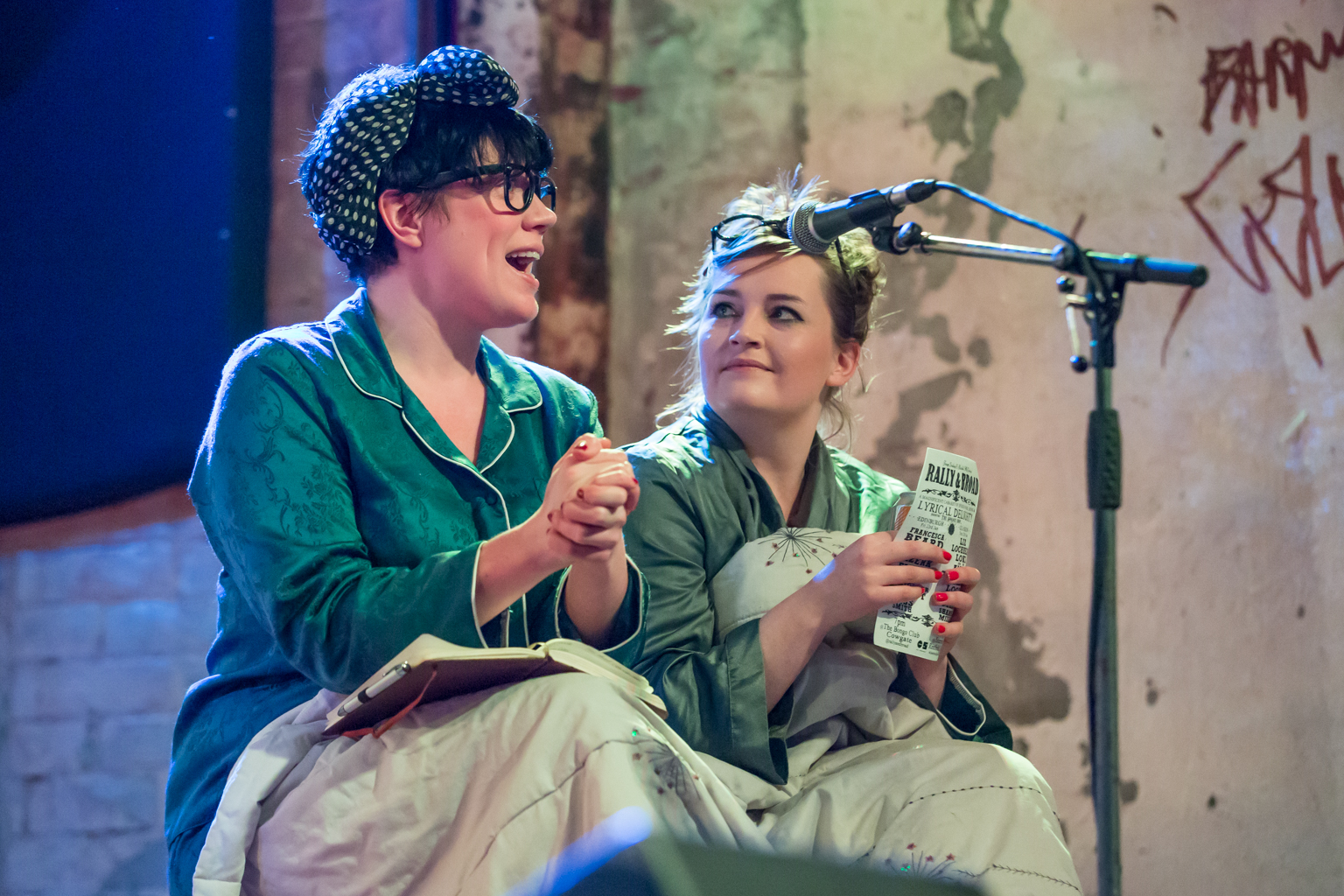
Robert Burns, Rabbie Burns, Robbie Burns, the Bard. There were so many choices for what name should be iced on to Scotland’s national poet’s birthday cake, that it was fitting that Edinburgh’s Rally & Broad team rolled into Glasgow with “The Apology Shop”. Rachel McCrum and Jenny Lindsay’s firebrand show melds spoken word, performance poetry, and music with impactive lyrical content, all stationed within the hospitable basement of Stereo Cafe. The decision to move the R&B shows from Wednesday evenings at the Tron Theatre to Sunday afternoons in Stereo has proven to be an astute one as droves of the rain-sodden public piled beneath the cobbles on Renfield Lane. With such extensive choice around the city, the R&B event appears to be making itself quite at home with a public blithely familiarising themselves more with cabarets than Songs of Praise. ust as Burns alluded that we are all equal prey in his poem “To A Louse”, the spoils on offer at this afternoon’s line-up were genuinely remarkable:
Texture
Liz Lochhead
Kevin Gilday
Carly Brown
Shambles Miller
Shambles Miller is one of those musicians where the music is almost incidental to the story-telling. A well-rounded performer, Shambles’ easy going manner allows laughs to filter between each couplet, each string pluck, and it becomes simple to see why a spot supporting the similarly-endearing Beans On Toast towards the end of 2014 was acquired. Dipping in to the sterling repertoire available as digital albums on his website, Shambles played a set of three songs, consisting of the EP single, “Confessions” – a beautiful ode to an ex lover which doesn’t so much tug as much as it does haul the listener in to the smaller, finer details of relationships. The killer line ‘So long and thanks for all the sex’ is executed in a strangely-comforting manner, which is a clear precedent of Shambles’ instantly likeable character. That uncanny knack of knowing when to pause for laughs (and they were always coming…) is clear throughout the bewitching second song, “Rapture” – a paean to the end of the world, before Shambles rounded off his short but effective set with one further number; a wonderful, commentating musician to begin proceedings.
As the waist-coated and bearded musician stepped offstage, it was then the turn of Texan-talent Carly Brown. A stunning set, garnished in unorthodox, theatrical, and comedic ingenuity graced each poem that Carly chose to perform. The wonderful “50 Shades” was a critical review of the character Anastasia Steele from the book of the same name (albeit, ‘of grey’ tones), analysing our so-called heroine’s self-perception. Carly’s next piece insisted that she was ‘not a poet’; a wonderful tongue-in-cheek look at the ingredients which supposedly mould what a poet should adhere to; the ‘black polo neck top’, ‘the black racoon eyes’, etc. It became clear how Carly became the Scottish Slam Champion in 2013, demonstrating an astute attention to detail and a bright approach to subject matter. Final poem “Texas, I Can’t Bring You To Parties Anymore” was a volatile, but erudite, response to the methods and disciplines adopted by her home state – racism, the death penalty, and the deeply-ingrained lifestyle of Texans were all subject to Carly’s clinical revulsion. This is a poet whose smile is as wide as her talent, and one that promises a fantastic future ahead of her.
Next on the stage was Glasgow’s irreplaceable Kevin P. Gilday, vexing facetious and indignant verse from his second full-length show, The Man Who Loved Beer. As one of the hardest-working poets on the scene, Kevin’s devotion to performance poetry have provided indelible memories during 2014 of performing to thousands at George Square during the referendum and the privilege of sharing his thoughts upon the spoken word stage at Glastonbury; rallies and broad-range, if you will. Gilday’s confession to being enormously hungover was apparent as he clung to the microphone, face whitened by the spotlight, head tilted backwards. However, this worked beautifully in the young poet’s favour as he frothed lines that painted pictures of alcohol dependency (“I’m a can-carrying man /a pint-swallowing bam”…) and an ugly Glasgow with all its prejudices and shortcomings. An expertly-delivered poem entitled “Found In The Mud” listed off Kevin’s first experience of the patter that circulates round Glastonbury festival, with the line ‘Some mud went in my hummus’ delighting the capacity-crowd, roaring with approval. It is Kevin’s grasp of culture, patter, and the patterns of behaviour that Glaswegians depict that makes his poetry such an accessible and enjoyable experience. This continues in the final segment of his set; the exhausted escapade of “Middle Class Love”, the dispirited-but-still-horny “Hangover Poem #3 – Hangover Sex’, and the cringe-worthy treasure that is “There’s A Workie In My House”.
Liz Lochhead was the ideal way to finish the spoken word proceedings. As Scotland’s makar, Lochhead’s poetry has influenced writers the length and breadth of the country for decades, and continues to inspire young (and old) minds alike with her sharp wit and often beguiling story-telling. Today, seeing as it was Burns Day, Lochhead opted to recite Burns’ celebrated poem “To A Mouse”. This preceded her sublime response “From A Mouse”, where the bold vermin retorts to Rabbie’s scolding words. A self adulating slant considers poetry, life, and a bluster that Lochhead expertly delivers in her usual witty style; “Get Rentokil, get real”. Prior to rushing off to a Cumbernauld theatre for a Burns Night, Lochhead (in resplendent tartan jacket) promised to deliver some “mucky” poems for her audience, and the last two were certainly delivered with aplomb; “Song For A Dirty Diva” was a delightfully comical look at a sex life at standstill, while the final effort contemplated the Seniors Association of Greater Edmonton (SAGE) – a quick-witted reflection of sex in the sixties compared with the modern day, and the subject ‘happy to be a member of permissive society’. Often allowing the audience to finish her lines, Lochhead was a fantastic performer to the end, fully befitting of her maker title.
Hip-hop MC and wordsmith Loki was due to round off ‘The Apology Shop’, but was replaced at the final minute by the piquant flavours of Black Lantern’s formidable Texture (Bram E Gieben). As one of the BL founders, Texture has become part of the thriving hip-hop scene which has emerged out of Scotland over the last couple of years. This ability to drop intelligent, relevant and sincere words over electronic landscapes works beautifully on the incredible “Burn”, with Texture’s atmospheric, hypnotic swirl shuddering the walls inside of Stereo. An equally haunting but exhilarating “Incvbate” weighs in with commentary about society’s pressures, and clever lines such as ‘…uninspired by church spires’ are spit out with such venom that it is difficult to argue that Texture isn’t the real deal, and speaks from the heart.
In light of those stories which have failed to reach mainstream media, Texture’s snarling indignation permeates during the third number, echoing ‘nothing is sacred’, until the frustration of attitudes in the early eighties during “Echo Boomers” allows sections of the audience to revel in an incredible hook that overlays a time when ‘Thatcher’s sarcastic pound snatchers’ were gaining momentum. Texture’s anti-corporate stance and gifted vocabulary doesn’t always make it easy listening, but then it never was supposed to be – as the final number, as Texture says is “a love song to the Scottish hip-hop scene”, testifies; nods are awarded to Loki and Hector Bizerk, with Texture’s affection quite visible – ‘…we’re part of a mongrel family’. This was an astonishing look at what spoken word can become in future, if aided by confidence, electronics, and a direction.
Don’t say we didn’t warn you.
Reviewer : Stephen Watt
 Mumble Words